height VAUXHALL MERIVA 2015 Owner's Manual
[x] Cancel search | Manufacturer: VAUXHALL, Model Year: 2015, Model line: MERIVA, Model: VAUXHALL MERIVA 2015Pages: 245, PDF Size: 7.76 MB
Page 9 of 245
In brief7
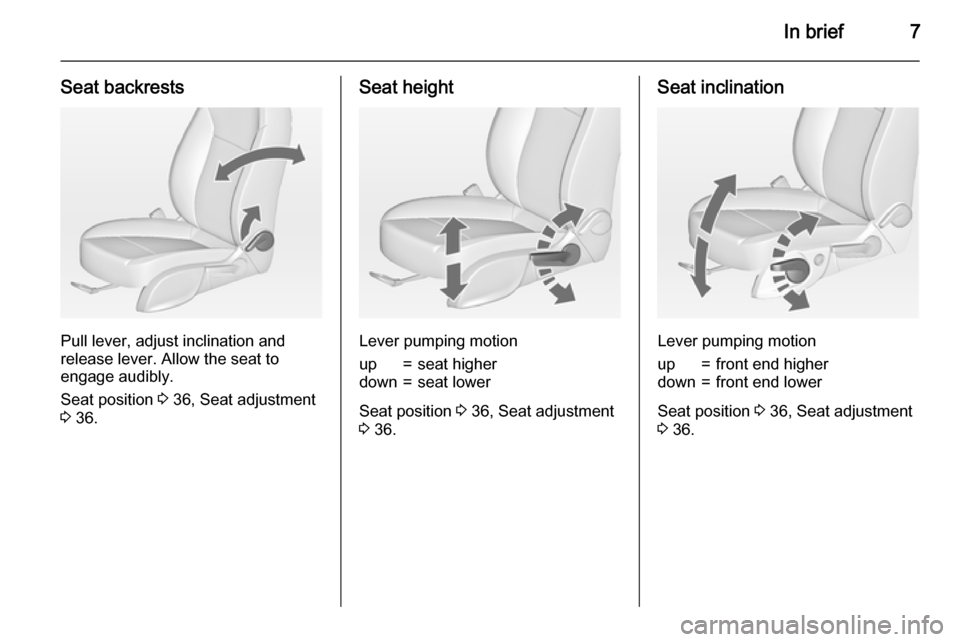
Seat backrests
Pull lever, adjust inclination and
release lever. Allow the seat to
engage audibly.
Seat position 3 36, Seat adjustment
3 36.
Seat height
Lever pumping motion
up=seat higherdown=seat lower
Seat position 3 36, Seat adjustment
3 36.
Seat inclination
Lever pumping motion
up=front end higherdown=front end lower
Seat position 3 36, Seat adjustment
3 36.
Page 10 of 245
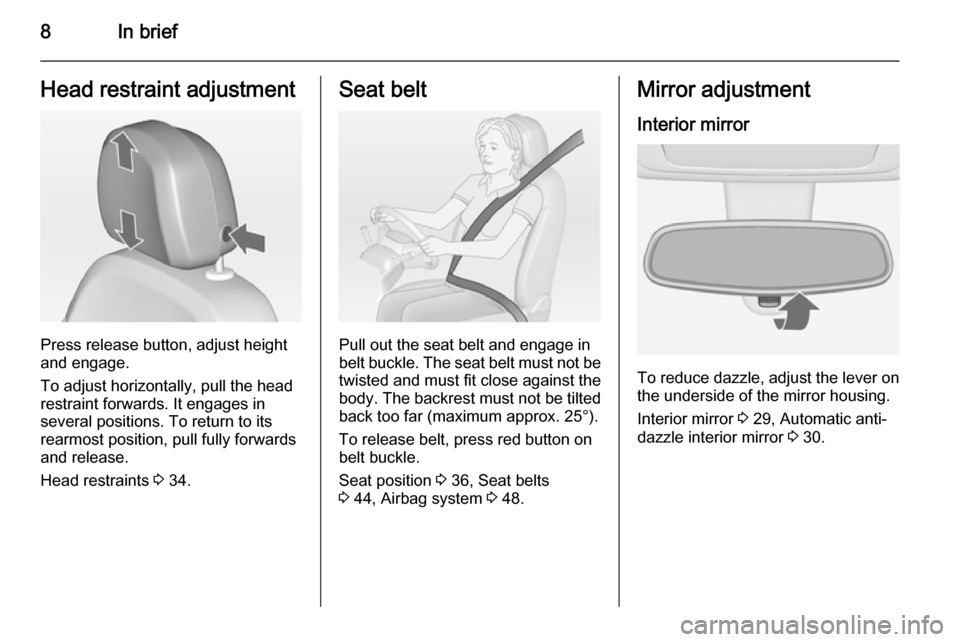
8In briefHead restraint adjustment
Press release button, adjust height
and engage.
To adjust horizontally, pull the head
restraint forwards. It engages in
several positions. To return to its rearmost position, pull fully forwards
and release.
Head restraints 3 34.
Seat belt
Pull out the seat belt and engage in
belt buckle. The seat belt must not be twisted and must fit close against the
body. The backrest must not be tilted
back too far (maximum approx. 25°).
To release belt, press red button on
belt buckle.
Seat position 3 36, Seat belts
3 44, Airbag system 3 48.
Mirror adjustment
Interior mirror
To reduce dazzle, adjust the lever onthe underside of the mirror housing.
Interior mirror 3 29, Automatic anti-
dazzle interior mirror 3 30.
Page 36 of 245
34Seats, restraintsSeats, restraintsHead restraints............................ 34
Front seats ................................... 36
Rear seats ................................... 41
Seat belts ..................................... 44
Airbag system .............................. 48
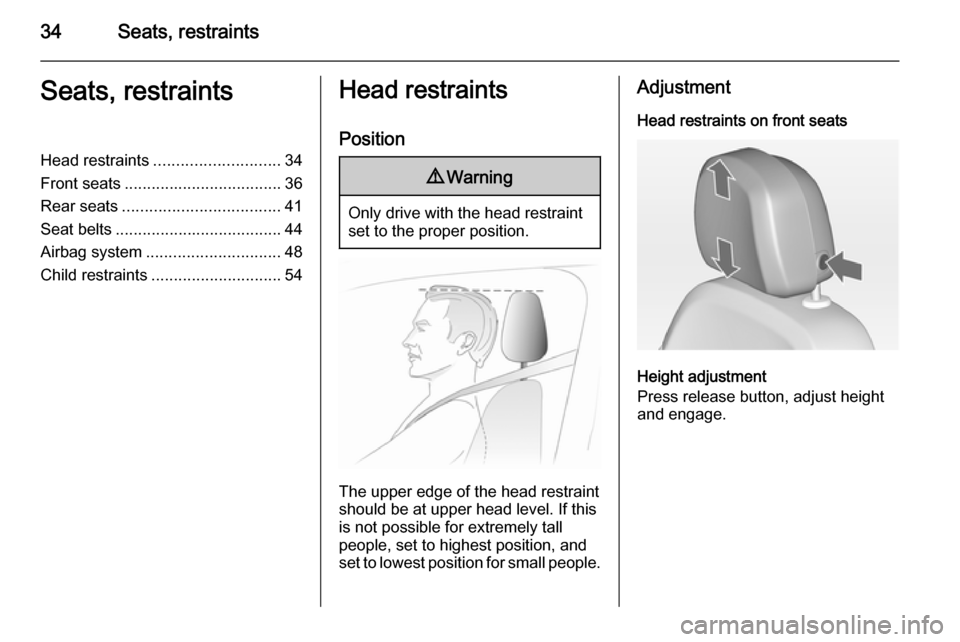
Child restraints ............................. 54Head restraints
Position9 Warning
Only drive with the head restraint
set to the proper position.
The upper edge of the head restraint
should be at upper head level. If this
is not possible for extremely tall
people, set to highest position, and
set to lowest position for small people.
Adjustment
Head restraints on front seats
Height adjustment
Press release button, adjust height
and engage.
Page 37 of 245
Seats, restraints35
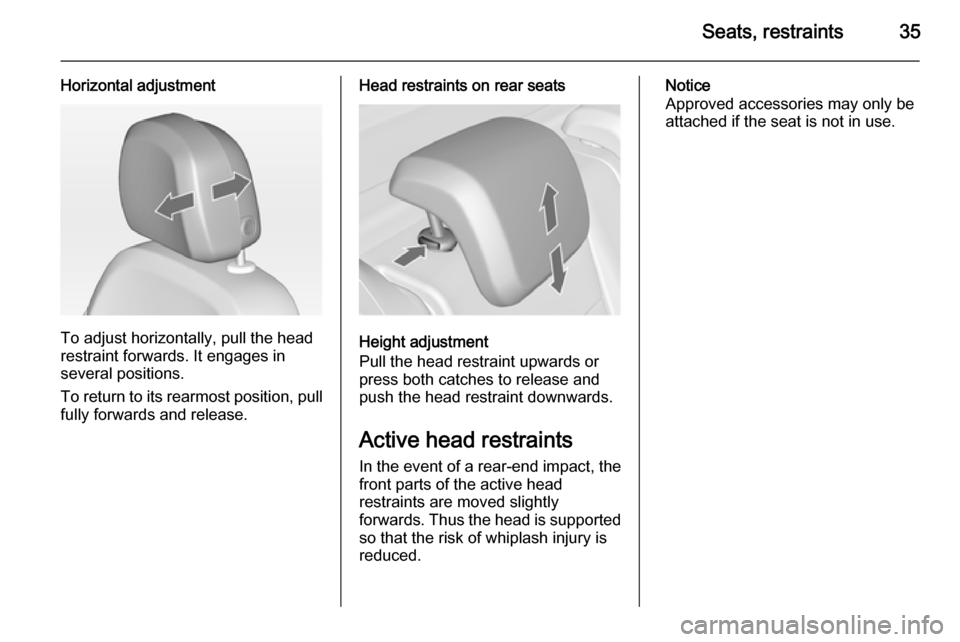
Horizontal adjustment
To adjust horizontally, pull the head
restraint forwards. It engages in
several positions.
To return to its rearmost position, pull fully forwards and release.
Head restraints on rear seats
Height adjustment
Pull the head restraint upwards or
press both catches to release and push the head restraint downwards.
Active head restraints In the event of a rear-end impact, the front parts of the active head
restraints are moved slightly
forwards. Thus the head is supported
so that the risk of whiplash injury is
reduced.
Notice
Approved accessories may only be attached if the seat is not in use.
Page 38 of 245
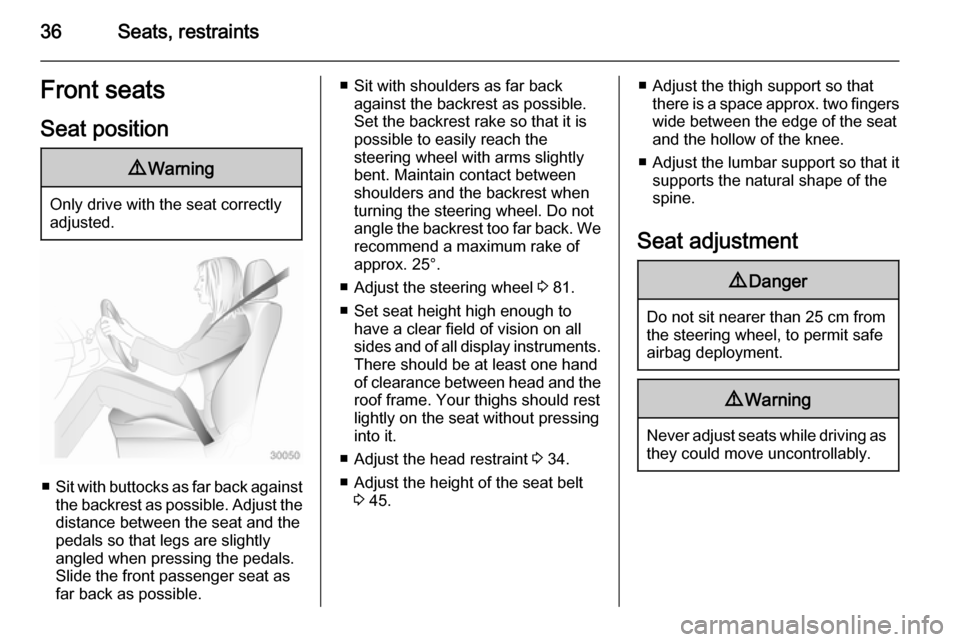
36Seats, restraintsFront seatsSeat position9 Warning
Only drive with the seat correctly
adjusted.
■ Sit with buttocks as far back against
the backrest as possible. Adjust the distance between the seat and the
pedals so that legs are slightly
angled when pressing the pedals.
Slide the front passenger seat as
far back as possible.
■ Sit with shoulders as far back against the backrest as possible.
Set the backrest rake so that it is possible to easily reach the
steering wheel with arms slightly bent. Maintain contact between
shoulders and the backrest when
turning the steering wheel. Do not
angle the backrest too far back. We recommend a maximum rake of
approx. 25°.
■ Adjust the steering wheel 3 81.
■ Set seat height high enough to have a clear field of vision on allsides and of all display instruments.
There should be at least one hand
of clearance between head and the
roof frame. Your thighs should rest
lightly on the seat without pressing
into it.
■ Adjust the head restraint 3 34.
■ Adjust the height of the seat belt 3 45.■ Adjust the thigh support so that
there is a space approx. two fingers
wide between the edge of the seat
and the hollow of the knee.
■ Adjust the lumbar support so that it
supports the natural shape of the
spine.
Seat adjustment9 Danger
Do not sit nearer than 25 cm from
the steering wheel, to permit safe
airbag deployment.
9 Warning
Never adjust seats while driving as
they could move uncontrollably.
Page 39 of 245
Seats, restraints37
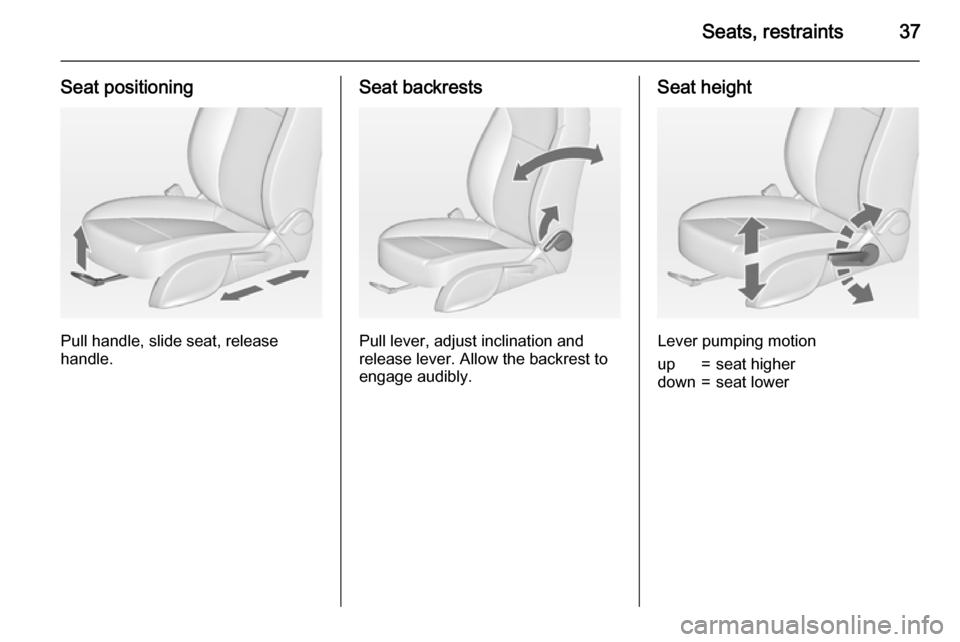
Seat positioning
Pull handle, slide seat, release
handle.
Seat backrests
Pull lever, adjust inclination and
release lever. Allow the backrest to
engage audibly.
Seat height
Lever pumping motion
up=seat higherdown=seat lower
Page 48 of 245

46Seats, restraints
Height adjustment
1. Pull belt out slightly.
2. Press button.
3. Adjust height and engage.
Adjust the height so that the belt lies across the shoulder. It must not lie
across the throat or upper arm.
Do not adjust while driving.
Removing seat belt
To release belt, press red button on
belt buckle.
Seat belts on the rear seats
The centre rear seat is equipped with a particular three-point seat belt.
Pull latch plates out of belt retainer in roof.
Page 59 of 245

Seats, restraints57Child restraint installation locationsPermissible options for fitting a child restraint system
Weight and age class
On front passenger seat
On rear outboard seatsOn rear centre seat
activated airbagdeactivated airbagGroup 0: up to 10 kg
or approx. 10 monthsXU 1U 2U3Group 0+: up to 13 kg
or approx. 2 yearsXU 1U2U3Group I: 9 to 18 kg
or approx. 8 months to 4 yearsXU 1U2U 3Group II: 15 to 25 kg
or approx. 3 to 7 yearsXXU 2U3Group III: 22 to 36 kg
or approx. 6 to 12 yearsXXU 2U31=If the child restraint system is being secured using a three-point seat belt, move seat height adjustment to uppermost
position and ensure that vehicle seat belt runs forwards from the upper anchorage point. Adjust seat backrest inclination as far as necessary to a vertical position to ensure that the belt is tight on the buckle side.2=Only if outboard seats are in position 1 or 2, 3 41.3=Only if outboard seats are flush with the centre seat (position 2, 3 41).U=Universal suitability in conjunction with three-point seat belt.X=No child restraint system permitted in this weight and age class.
Page 194 of 245

192Vehicle careWheels and tyres
Tyre condition, wheel condition
Drive over edges slowly and at right
angles if possible. Driving over sharp
edges can cause tyre and wheel
damage. Do not trap tyres on the kerb when parking.
Regularly check the wheels for
damage. Seek the assistance of a
workshop in the event of damage or
unusual wear.
Winter tyres Winter tyres improve driving safety at
temperatures below 7 °C and should
therefore be fitted on all wheels.
In accordance with country-specific
regulations, affix the speed sticker in
the driver's field of view.Tyre designations
E.g. 195/65 R 15 91 H195=Tyre width, mm65=Cross-section ratio (tyre height
to tyre width), %R=Belt type: RadialRF=Type: RunFlat15=Wheel diameter, inches91=Load index e.g. 91 is
equivalent to 615 kgH=Speed code letter
Speed code letter:
Q=up to 100 mphS=up to 112 mphT=up to 118 mphH=up to 130 mphV=up to 150 mphW=up to 168 mph
Tyre pressure
Check the pressure of cold tyres at least every 14 days and before any
long journey. Do not forget the spare
wheel. This also applies to vehicles
with tyre pressure monitoring system.
Unscrew the valve cap.
Tyre pressure 3 232 and refer to the
label on the front passenger door.
The tyre pressure data refers to cold
tyres. It applies to summer and winter tyres.
Always inflate the spare tyre to the
pressure specified for full load.
The ECO tyre pressure serves to
achieve the smallest amount of fuel
consumption possible.
Incorrect tyre pressures will impair
safety, vehicle handling, comfort and fuel economy and will increase tyre
wear.
Page 207 of 245

Vehicle care205
Fold out the wheel wrench and
install ensuring that it locates
securely and loosen each wheel
bolt by half a turn.
The wheels might be protected by
locking wheel bolts. To loosen
these specific bolts first attach the
key adapter onto the head of the
bolt before installing the wheel
wrench. The key adapter is
located in the glovebox.3. Ensure the jack is positioned correctly with the vehicle jacking
points.
4. Variant 1:
Set the jack to the necessary
height. Position it directly below
the jacking point in a manner that
prevents it from slipping.
Attach jack handle and with the
jack correctly aligned rotate handle until wheel is clear of theground.
Variant 2: