ignition VAUXHALL MERIVA 2016 Repair Manual
[x] Cancel search | Manufacturer: VAUXHALL, Model Year: 2016, Model line: MERIVA, Model: VAUXHALL MERIVA 2016Pages: 251, PDF Size: 8.02 MB
Page 192 of 251
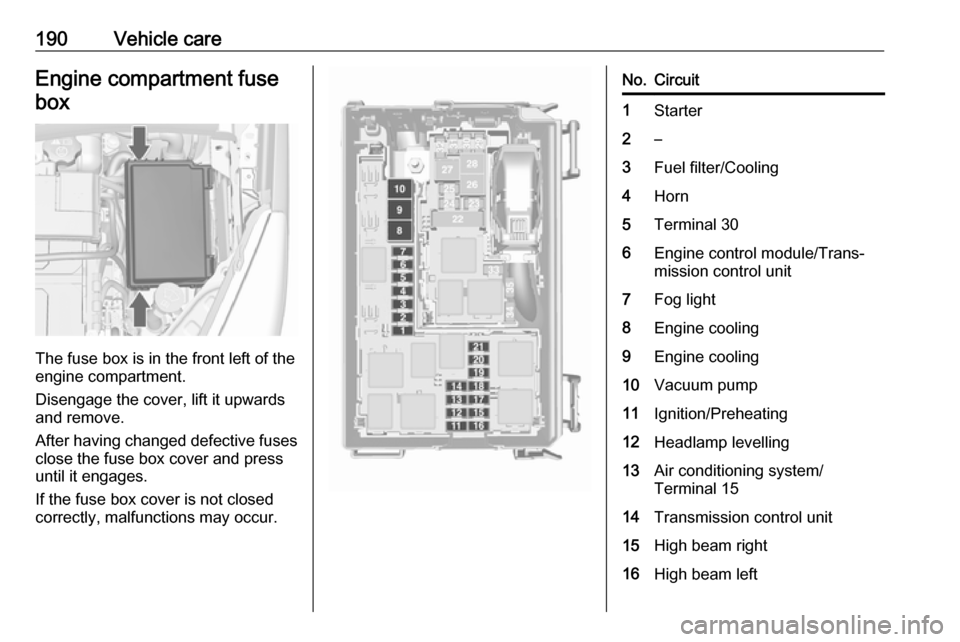
190Vehicle careEngine compartment fuse
box
The fuse box is in the front left of the
engine compartment.
Disengage the cover, lift it upwards
and remove.
After having changed defective fuses
close the fuse box cover and press
until it engages.
If the fuse box cover is not closed
correctly, malfunctions may occur.
No.Circuit1Starter2–3Fuel filter/Cooling4Horn5Terminal 306Engine control module/Trans‐
mission control unit7Fog light8Engine cooling9Engine cooling10Vacuum pump11Ignition/Preheating12Headlamp levelling13Air conditioning system/
Terminal 1514Transmission control unit15High beam right16High beam left
Page 194 of 251
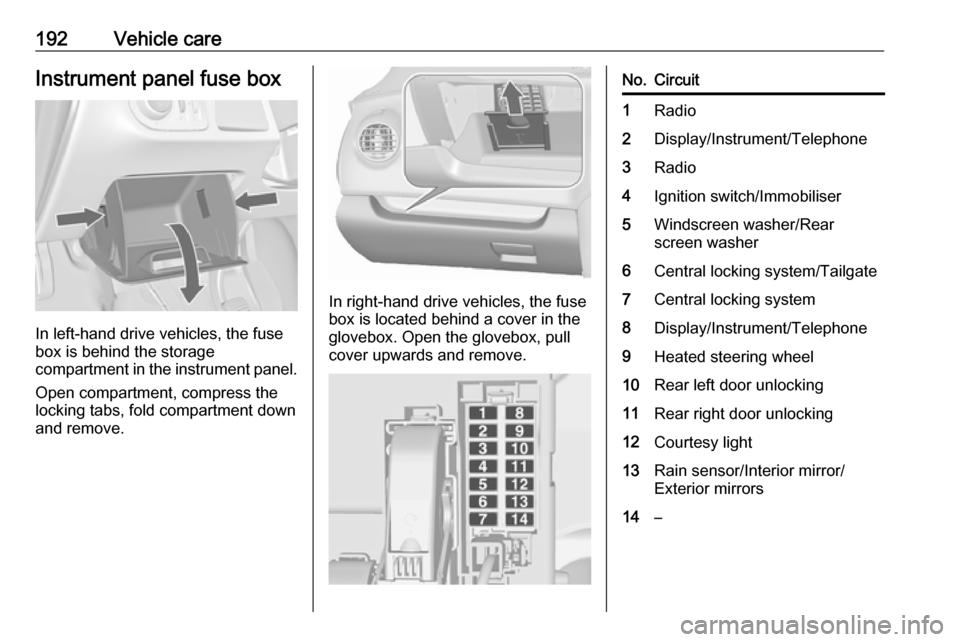
192Vehicle careInstrument panel fuse box
In left-hand drive vehicles, the fuse
box is behind the storage
compartment in the instrument panel.
Open compartment, compress the
locking tabs, fold compartment down and remove.
In right-hand drive vehicles, the fuse
box is located behind a cover in the
glovebox. Open the glovebox, pull
cover upwards and remove.
No.Circuit1Radio2Display/Instrument/Telephone3Radio4Ignition switch/Immobiliser5Windscreen washer/Rear
screen washer6Central locking system/Tailgate7Central locking system8Display/Instrument/Telephone9Heated steering wheel10Rear left door unlocking11Rear right door unlocking12Courtesy light13Rain sensor/Interior mirror/
Exterior mirrors14–
Page 198 of 251
196Vehicle careTyre pressureCheck the pressure of cold tyres at
least every 14 days and before any
long journey. Do not forget the spare
wheel. This also applies to vehicles
with tyre pressure monitoring system.
Unscrew the valve cap.
Tyre pressure 3 234.
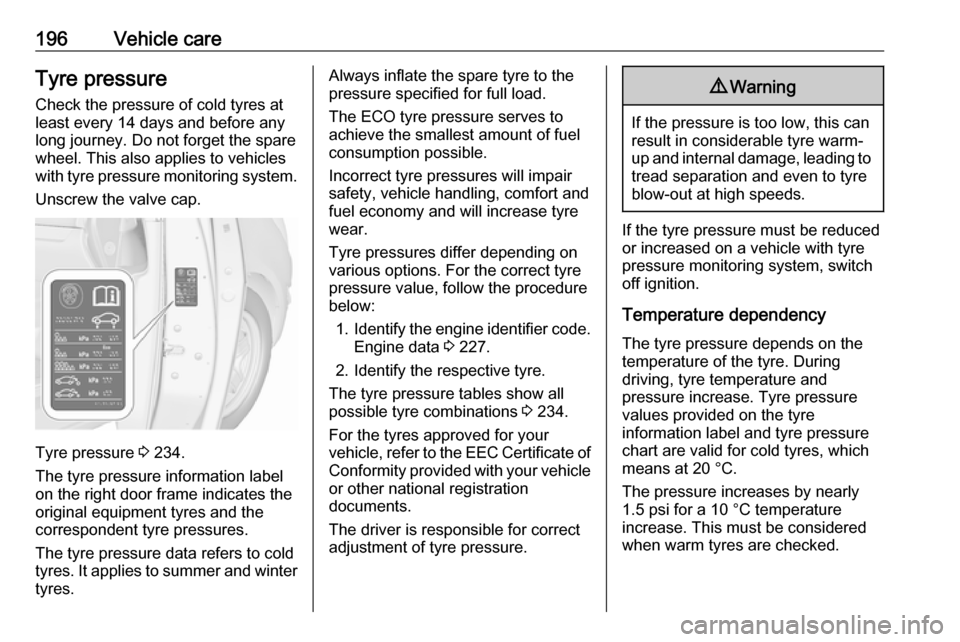
The tyre pressure information label
on the right door frame indicates the original equipment tyres and the
correspondent tyre pressures.
The tyre pressure data refers to cold
tyres. It applies to summer and winter tyres.
Always inflate the spare tyre to the
pressure specified for full load.
The ECO tyre pressure serves to
achieve the smallest amount of fuel
consumption possible.
Incorrect tyre pressures will impair
safety, vehicle handling, comfort and
fuel economy and will increase tyre
wear.
Tyre pressures differ depending on
various options. For the correct tyre
pressure value, follow the procedure
below:
1. Identify the engine identifier code.
Engine data 3 227.
2. Identify the respective tyre.
The tyre pressure tables show all
possible tyre combinations 3 234.
For the tyres approved for your
vehicle, refer to the EEC Certificate of Conformity provided with your vehicle
or other national registration
documents.
The driver is responsible for correct adjustment of tyre pressure.9 Warning
If the pressure is too low, this can
result in considerable tyre warm-
up and internal damage, leading to tread separation and even to tyre
blow-out at high speeds.
If the tyre pressure must be reduced
or increased on a vehicle with tyre
pressure monitoring system, switch
off ignition.
Temperature dependencyThe tyre pressure depends on thetemperature of the tyre. During
driving, tyre temperature and
pressure increase. Tyre pressure
values provided on the tyre
information label and tyre pressure
chart are valid for cold tyres, which
means at 20 °C.
The pressure increases by nearly
1.5 psi for a 10 °C temperature
increase. This must be considered
when warm tyres are checked.
Page 200 of 251

198Vehicle care
A detected low tyre pressure
condition is indicated by the control
indicator w 3 97.
If w illuminates, stop as soon as
possible and inflate the tyres as
recommended 3 234.
If w flashes for 60-90 seconds and
then illuminates continuously, there is
a fault in the system. Consult a
workshop.
After inflating, driving may be
required to update the tyre pressure
values in the Driver Information
Centre. During this time w may
illuminate.
If w illuminates at lower temperatures
and extinguishes after some driving,
this could be an indicator for
approaching a low tyre pressure
condition. Check tyre pressure.
Vehicle messages 3 105.
If the tyre pressure shall be reduced
or increased, switch off ignition.
Only mount wheels with pressure
sensors, otherwise the tyre pressure
will not be displayed and w
illuminates continuously.
A temporary spare wheel is not
equipped with pressure sensors. The
tyre pressure monitoring system is
not operational for these wheels.
Control indicator w illuminates. For
the further three wheels the system
remains operational.
The use of commercially available
liquid tyre repair kits can impair the
function of the system. Factory-
approved repair kits can be used.
Operating electronic devices or being close to facilities using similar wave
frequencies could disrupt the tyre
pressure monitoring system.Each time the tyres are replaced tyre
pressure monitoring system sensors
must be dismounted and serviced. For the screwed sensor: replace
valve core and sealing ring. For
clipped sensor: replace complete
valve stem.
Vehicle loading status
Adjust tyre pressure to load condition
according to tyre information label or tyre pressure chart 3 234, and select
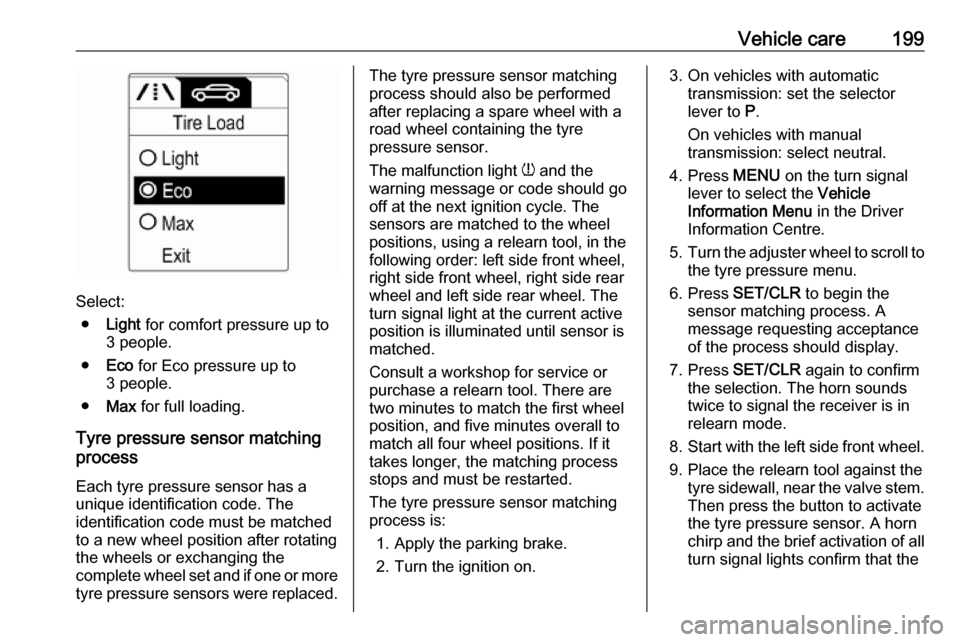
the relevant setting in the menu Tyre
Load in the Driver Information Centre,
Vehicle Information Menu 3 100 . This
setting is the reference for the tyre
pressure warnings.
The Tyre Load menu only appears if
the vehicle is in a standstill and the
parking brake is applied. On vehicles
with automatic transmission the
selector lever has to be in P.
Page 201 of 251
Vehicle care199
Select:● Light for comfort pressure up to
3 people.
● Eco for Eco pressure up to
3 people.
● Max for full loading.
Tyre pressure sensor matching
process
Each tyre pressure sensor has a
unique identification code. The
identification code must be matched
to a new wheel position after rotating the wheels or exchanging the
complete wheel set and if one or more tyre pressure sensors were replaced.
The tyre pressure sensor matching
process should also be performed
after replacing a spare wheel with a
road wheel containing the tyre
pressure sensor.
The malfunction light w and the
warning message or code should go
off at the next ignition cycle. The
sensors are matched to the wheel
positions, using a relearn tool, in the following order: left side front wheel,
right side front wheel, right side rear
wheel and left side rear wheel. The
turn signal light at the current active
position is illuminated until sensor is
matched.
Consult a workshop for service or
purchase a relearn tool. There are
two minutes to match the first wheel
position, and five minutes overall to
match all four wheel positions. If it
takes longer, the matching process stops and must be restarted.
The tyre pressure sensor matching
process is:
1. Apply the parking brake.
2. Turn the ignition on.3. On vehicles with automatic transmission: set the selector
lever to P.
On vehicles with manual
transmission: select neutral.
4. Press MENU on the turn signal
lever to select the Vehicle
Information Menu in the Driver
Information Centre.
5. Turn the adjuster wheel to scroll to
the tyre pressure menu.
6. Press SET/CLR to begin the
sensor matching process. A
message requesting acceptance
of the process should display.
7. Press SET/CLR again to confirm
the selection. The horn sounds
twice to signal the receiver is in
relearn mode.
8. Start with the left side front wheel.
9. Place the relearn tool against the tyre sidewall, near the valve stem.Then press the button to activate
the tyre pressure sensor. A horn
chirp and the brief activation of all turn signal lights confirm that the
Page 202 of 251
200Vehicle caresensor identification code has
been matched to this wheel
position.
10. Proceed to the right side front wheel, and repeat the procedure
in Step 9.
11. Proceed to the right side rear wheel, and repeat the procedure
in Step 9.
12. Proceed to the left side rear wheel, and repeat the procedure
in Step 9. The horn sounds twice
to ind
icate the sensor identification
code has been matched to the left side rear wheel, and the tyre
pressure sensor matching
process is no longer active.
13. Turn off the ignition.
14. Set all four tyres to the recommended air pressure level
as indicated on the tyre pressure
information label.
15. Ensure the tyre loading status is set according selected pressure
3 100.Tread depth
Check tread depth at regular
intervals.
Tyres should be replaced for safety
reasons at a tread depth of 2-3 mm
(4 mm for winter tyres).
For safety reasons it is recommended
that the tread depth of the tyres on
one axle should not vary by more than 2 mm.
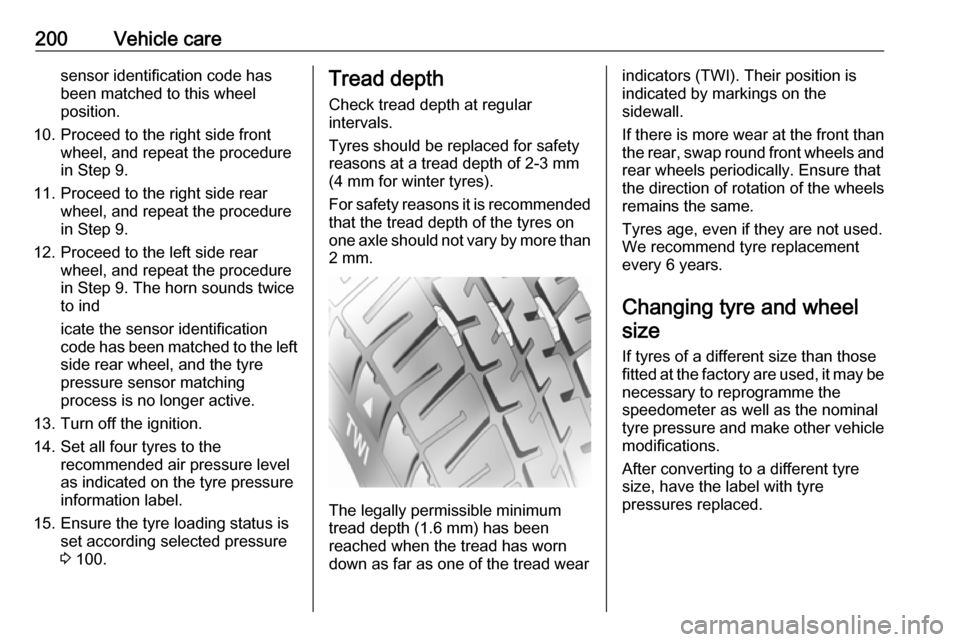
The legally permissible minimum
tread depth (1.6 mm) has been
reached when the tread has worn
down as far as one of the tread wear
indicators (TWI). Their position is
indicated by markings on the
sidewall.
If there is more wear at the front than
the rear, swap round front wheels and rear wheels periodically. Ensure that
the direction of rotation of the wheels
remains the same.
Tyres age, even if they are not used.
We recommend tyre replacement
every 6 years.
Changing tyre and wheel
size
If tyres of a different size than those
fitted at the factory are used, it may be necessary to reprogramme the
speedometer as well as the nominal
tyre pressure and make other vehicle modifications.
After converting to a different tyre
size, have the label with tyre
pressures replaced.
Page 205 of 251
Vehicle care203
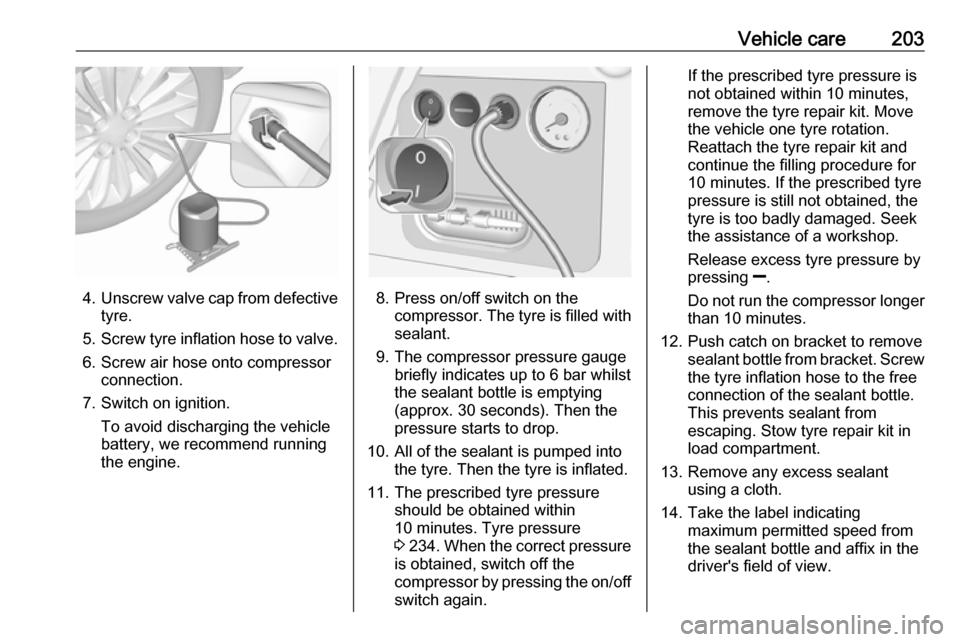
4.Unscrew valve cap from defective
tyre.
5. Screw tyre inflation hose to valve.
6. Screw air hose onto compressor connection.
7. Switch on ignition. To avoid discharging the vehicle
battery, we recommend running
the engine.8. Press on/off switch on the compressor. The tyre is filled withsealant.
9. The compressor pressure gauge briefly indicates up to 6 bar whilst
the sealant bottle is emptying
(approx. 30 seconds). Then the
pressure starts to drop.
10. All of the sealant is pumped into the tyre. Then the tyre is inflated.
11. The prescribed tyre pressure should be obtained within
10 minutes. Tyre pressure
3 234 . When the correct pressure
is obtained, switch off the
compressor by pressing the on/off switch again.
If the prescribed tyre pressure is
not obtained within 10 minutes,
remove the tyre repair kit. Move
the vehicle one tyre rotation.
Reattach the tyre repair kit and
continue the filling procedure for 10 minutes. If the prescribed tyre
pressure is still not obtained, the
tyre is too badly damaged. Seek
the assistance of a workshop.
Release excess tyre pressure by
pressing ].
Do not run the compressor longer
than 10 minutes.
12. Push catch on bracket to remove sealant bottle from bracket. Screwthe tyre inflation hose to the free
connection of the sealant bottle.
This prevents sealant from
escaping. Stow tyre repair kit in
load compartment.
13. Remove any excess sealant using a cloth.
14. Take the label indicating maximum permitted speed from
the sealant bottle and affix in the
driver's field of view.
Page 216 of 251
214Vehicle care
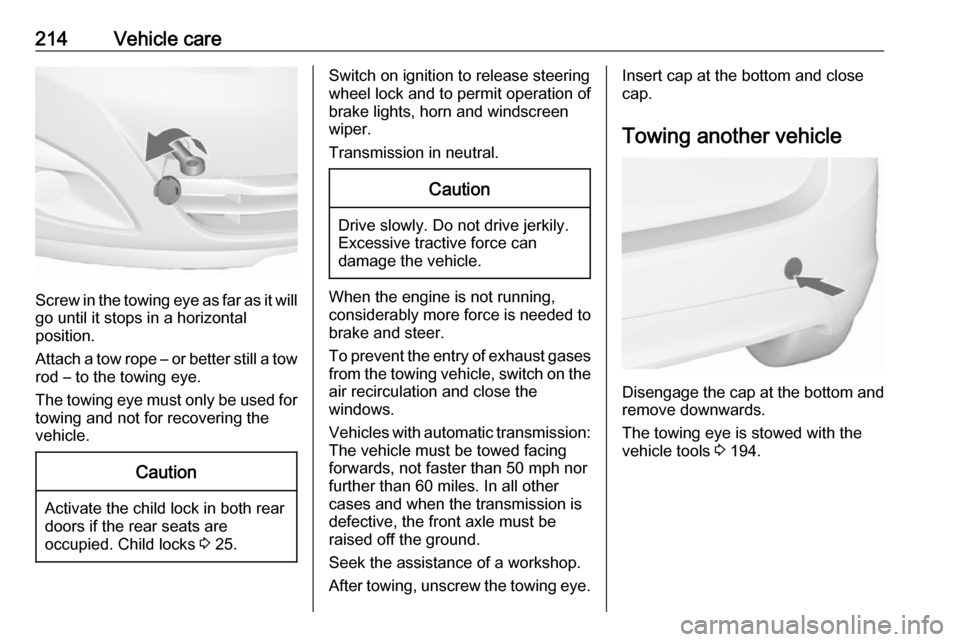
Screw in the towing eye as far as it will
go until it stops in a horizontal
position.
Attach a tow rope – or better still a tow
rod – to the towing eye.
The towing eye must only be used for towing and not for recovering the
vehicle.
Caution
Activate the child lock in both rear
doors if the rear seats are
occupied. Child locks 3 25.
Switch on ignition to release steering
wheel lock and to permit operation of
brake lights, horn and windscreen
wiper.
Transmission in neutral.Caution
Drive slowly. Do not drive jerkily.
Excessive tractive force can
damage the vehicle.
When the engine is not running,
considerably more force is needed to
brake and steer.
To prevent the entry of exhaust gases from the towing vehicle, switch on the
air recirculation and close the
windows.
Vehicles with automatic transmission: The vehicle must be towed facing
forwards, not faster than 50 mph nor further than 60 miles. In all other
cases and when the transmission is
defective, the front axle must be
raised off the ground.
Seek the assistance of a workshop. After towing, unscrew the towing eye.
Insert cap at the bottom and close
cap.
Towing another vehicle
Disengage the cap at the bottom and
remove downwards.
The towing eye is stowed with the
vehicle tools 3 194.
Page 244 of 251

242Customer informationWhen using the vehicle, situations
may occur in which these technical
data related to other information
(accident report, damages on the
vehicle, witness statements etc.) may be associated with a specific person -
possibly, with the assistance of an
expert.
Additional functions contractually
agreed upon with the client (e.g.
vehicle location in emergency cases)
allow the transmission of particular vehicle data from the vehicle.
Radio Frequency
Identification (RFID)
RFID technology is used in some
vehicles for functions such as tyre
deflation detection and ignition
system security. It is also used in
connection with conveniences such
as radio remote controls for door
locking/unlocking and starting, and in-
vehicle transmitters for garage door
openers. RFID technology in
Vauxhall vehicles does not use or
record personal information or link
with any other Vauxhall system
containing personal information.
Page 248 of 251

246Fuse box..................................... 190
Fuses ......................................... 188
G Gauges ......................................... 88
General information ...................165
Glovebox ..................................... 60
Graphic-Info-Display, Colour- Info-Display ............................ 103
H Halogen headlights ....................179
Hand brake ......................... 149, 150
Hazard warning flashers ............123
Headlight flash ........................... 121
Headlight range adjustment ......121
Headlights .......................... 119, 121
Headlights when driving abroad 121
Head restraint adjustment .............8
Head restraints ............................ 34
Heated mirrors ............................. 29
Heated rear window ..................... 32
Heated steering wheel .................81
Heating ........................................ 40
Heating and ventilation system . 128
High beam ........................... 99, 121
Hill start assist ........................... 151
Horn ....................................... 13, 82I
Identification plate .....................223
Ignition switch positions .............139
Immobiliser ............................ 28, 98
Indicators ...................................... 88
Information displays.................... 100
Instrument cluster ........................88
Instrument panel fuse box .........192
Instrument panel illumination .....188
Instrument panel illumination control .................................... 125
Instrument panel overview ........... 10
Interior care ............................... 217
Interior lighting ............................ 125
Interior lights ...................... 125, 188
Interior mirrors .............................. 30
Interruption of power supply ......147
Introduction .................................... 3
ISOFIX child restraint systems ....59
J
Jump starting ............................. 212
K Keys ............................................. 19
Keys, locks ................................... 19
Keys, memorised settings ............21
L Lashing eyes ............................... 75
Light covers, misted.................... 124Lighting features .........................126
Light switch ................................ 119
Load compartment ................26, 72
Load compartment cover .............73
Load compartment fuse box ......193
Loading information .....................78
Low fuel ....................................... 98
M Malfunction indicator light ............95
Manual anti-dazzle ......................30
Manual mode ............................. 147
Manual transmission .................. 148
Manual windows ..........................31
Memorised settings ......................21
Mirror adjustment ........................... 8
Misted light covers .....................124
Moonroof ..................................... 33
N New vehicle running-in ..............139
Number plate light .....................187
O
Object detection systems ...........155
Octane rating .............................. 227
Odometer ..................................... 88
Oil ............................................... 173
Oil, engine .......................... 220, 224
Oil pressure .................................. 98
OnStar® system .........................115