fuel consumption VAUXHALL MERIVA 2016 Owner's Manual
[x] Cancel search | Manufacturer: VAUXHALL, Model Year: 2016, Model line: MERIVA, Model: VAUXHALL MERIVA 2016Pages: 251, PDF Size: 8.02 MB
Page 111 of 251
Instruments and controls109
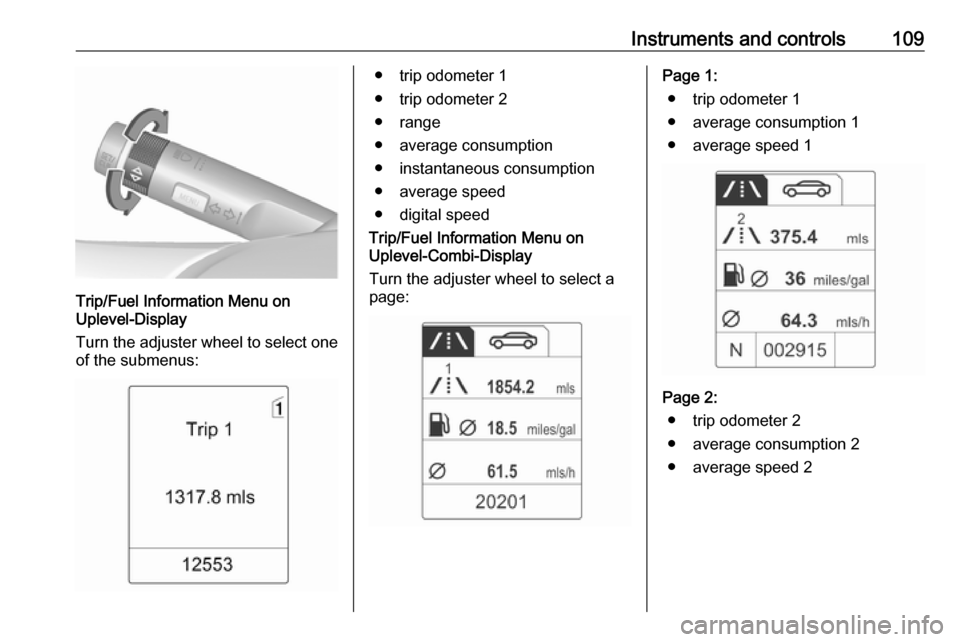
Trip/Fuel Information Menu on
Uplevel-Display
Turn the adjuster wheel to select one of the submenus:
● trip odometer 1
● trip odometer 2
● range
● average consumption
● instantaneous consumption
● average speed
● digital speed
Trip/Fuel Information Menu on
Uplevel-Combi-Display
Turn the adjuster wheel to select a
page:Page 1:
● trip odometer 1
● average consumption 1
● average speed 1
Page 2: ● trip odometer 2
● average consumption 2
● average speed 2
Page 112 of 251
110Instruments and controls
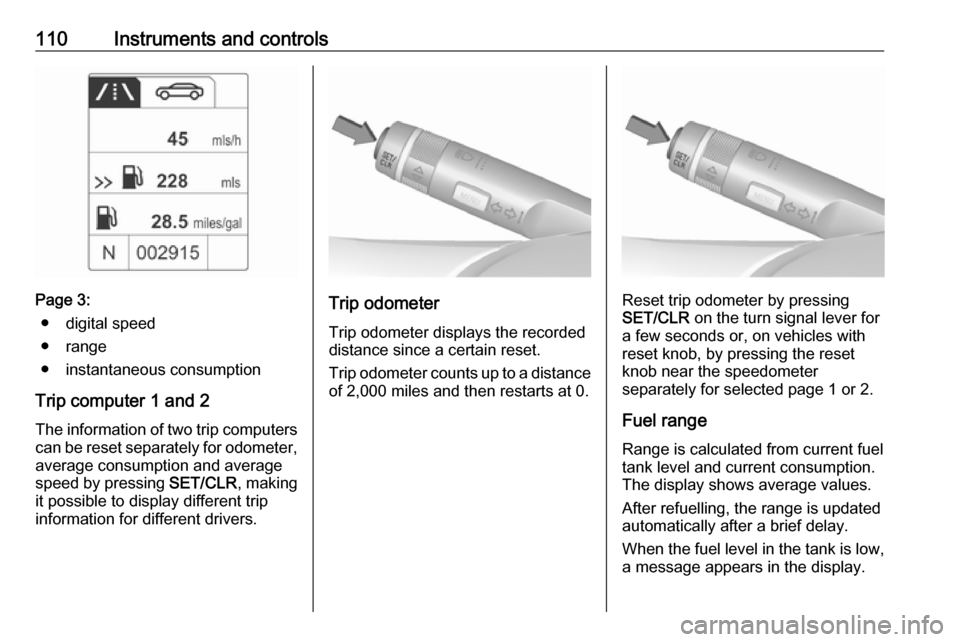
Page 3:● digital speed
● range
● instantaneous consumption
Trip computer 1 and 2
The information of two trip computers can be reset separately for odometer, average consumption and average
speed by pressing SET/CLR, making
it possible to display different trip
information for different drivers.Trip odometer
Trip odometer displays the recorded
distance since a certain reset.
Trip odometer counts up to a distance of 2,000 miles and then restarts at 0.Reset trip odometer by pressing
SET/CLR on the turn signal lever for
a few seconds or, on vehicles with
reset knob, by pressing the reset knob near the speedometer
separately for selected page 1 or 2.
Fuel range Range is calculated from current fuel
tank level and current consumption.
The display shows average values.
After refuelling, the range is updated
automatically after a brief delay.
When the fuel level in the tank is low,
a message appears in the display.
Page 113 of 251

Instruments and controls111When the tank has to be refuelled
immediately, a warning message is
displayed.
Additionally the control indicator i in
the fuel gauge illuminates or flashes
3 98.
Fuel range LPG version
Display of approximate fuel range
available with the remaining fuel in
each respective fuel tank of gasoline
and LPG fuel, along with a total range of both fuel types together. Switch
between the mode by pressing
SET/CLR .
Average consumption
Display of average consumption. The measurement can be reset at any
time and starts with a default value.
To reset, press SET/CLR for a few
seconds separately for selected page
1 or 2.
On vehicles with LPG engines:
Average consumption is indicated for
the currently selected mode; LPG or
Gasoline.Instantaneous consumption
Displays the instantaneous
consumption.
On vehicles with LPG engines:
Instantaneous consumption is
indicated for the currently selected mode; LPG or Gasoline.
Average speed Display of average speed. The
measurement can be reset at any
time.
To reset, press SET/CLR for a few
seconds separately for selected page
1 or 2.
Digital speed
Digital display of the instantaneous
speed.Vehicle personalisation
The vehicle's behaviour can be
personalised by changing the settings in the Info-Display.
Some of the personal settings for
different drivers can be memorised
individually for each vehicle key.
Memorised settings 3 21.
Depending on vehicle equipment and
country-specific regulations some of
the functions described below might
not be available.
Some functions are only displayed or
active when the engine is running.
Personal settings in the
Graphic-Info-Display
CD 300/CD 400/CD 400plus
Page 140 of 251

138Driving and operatingDriving and
operatingDriving hints ............................... 138
Control of the vehicle ...............138
Steering ................................... 139
Starting and operating ...............139
New vehicle running-in ............139
Ignition switch positions ...........139
Retained power off ..................139
Starting the engine ..................140
Overrun cut-off ........................ 141
Stop-start system ....................141
Parking .................................... 143
Engine exhaust .......................... 144
Diesel particle filter ..................144
Catalytic converter ...................145
Automatic transmission ..............145
Transmission display ...............145
Selector lever .......................... 146
Manual mode ........................... 147
Electronic driving programmes 147
Fault ........................................ 147
Interruption of power supply ....147
Manual transmission ..................148Brakes........................................ 149
Antilock brake system .............149
Parking brake .......................... 150
Brake assist ............................. 151
Hill start assist ......................... 151
Ride control systems .................152
Traction Control system ..........152
Electronic Stability Control ......152
Driver assistance systems .........153
Cruise control .......................... 153
Parking assist .......................... 155
Rear view camera ...................157
Fuel ............................................ 159
Fuel for petrol engines .............159
Fuel for diesel engines ............159
Fuel for liquid gas operation ....159
Refuelling ................................ 161
Fuel consumption - CO 2-
Emissions .............................. 164
Trailer hitch ................................ 165
General information .................165
Driving characteristics and towing tips .............................. 166
Trailer towing ........................... 166
Towing equipment ...................167Driving hints
Control of the vehicle
Never coast with engine not
running (except during Autostop)
Many systems will not function in this
situation (e.g. brake servo unit, power steering). Driving in this manner is a
danger to yourself and others. All
systems function during an Autostop,
but there will be a controlled reduction
in power steering assist and vehicle
speed is reduced.
Stop-start system 3 141.
Idle boost
If charging of the vehicle battery is
required due to vehicle battery
condition, the power output of the
generator must be increased. This will be achieved by an idle boost whichmay be audible.
On vehicles with Uplevel-Display or
Uplevel-Combi-Display, a message
appears in the Driver Information
Centre.
Page 141 of 251
Driving and operating139PedalsTo ensure the pedal travel is
uninhibited, there must be no mats in
the area of the pedals.
Use only floor mats, which fit properly
and are fixed by the retainers on the
driver side.
Steering
If power steering assist is lost
because the engine stops or due to a system malfunction, the vehicle can
be steered but may require a higher
or lower steering effort.
Control indicator c 3 96.Caution
Vehicles equipped with hydraulic
power steering:
If the steering wheel is turned until it reaches the end of its travel, and
is held in that position for more
than 15 seconds, damage may
occur to the power steering
system and there may be loss of
power steering assist.
Starting and operating
New vehicle running-in
Do not brake unnecessarily hard for
the first few journeys.
During the first drive, smoke may
occur because of wax and oil
evaporating off the exhaust system.
Park the vehicle in the open for a
while after the first drive and avoid
inhaling the fumes.
During the running-in period fuel and engine oil consumption may be
higher and the cleaning process of the diesel particle filter may take
place more often. Autostop may be
inhibited to allow for charging the
vehicle battery.
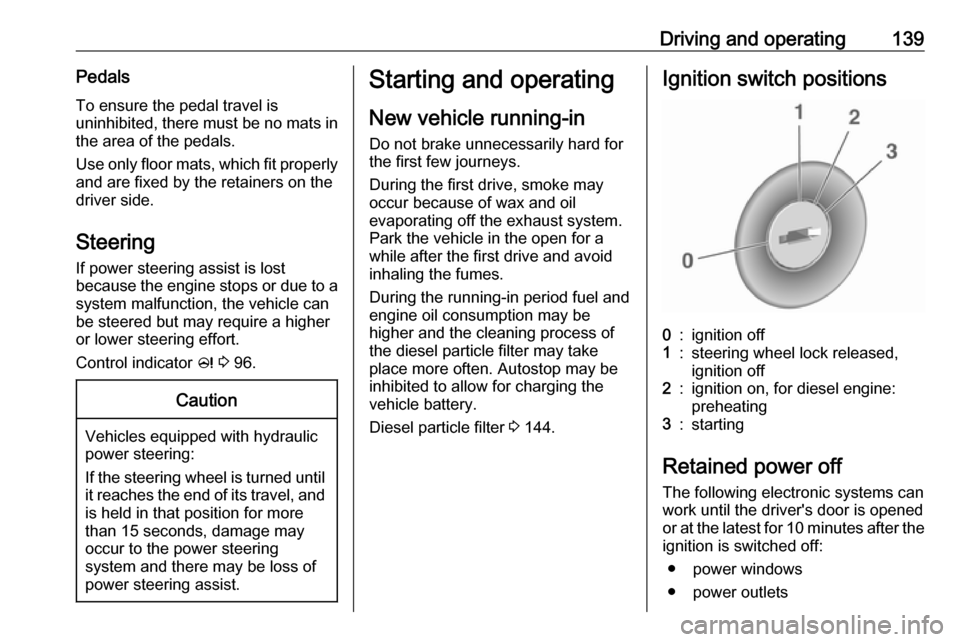
Diesel particle filter 3 144.Ignition switch positions0:ignition off1:steering wheel lock released,
ignition off2:ignition on, for diesel engine:
preheating3:starting
Retained power off
The following electronic systems can
work until the driver's door is opened
or at the latest for 10 minutes after the
ignition is switched off:
● power windows
● power outlets
Page 146 of 251
144Driving and operatingEngine exhaust9Danger
Engine exhaust gases contain
poisonous carbon monoxide,
which is colourless and odourless and could be fatal if inhaled.
If exhaust gases enter the interior
of the vehicle, open the windows.
Have the cause of the fault
rectified by a workshop.
Avoid driving with an open load
compartment, otherwise exhaust
gases could enter the vehicle.
Diesel particle filter
The diesel particle filter system filters
harmful soot particles out of the
exhaust gases. The system includes
a self-cleaning function that runs
automatically during driving without
any notification. The filter is cleaned
by periodically burning off the soot
particles at high temperature. This
process takes place automatically
under set driving conditions and may
take up to 25 minutes. Typically it
needs between 7 and 12 minutes.
Autostop is not available and fuel
consumption may be higher during
this period. The emission of smells
and smoke during this process is
normal.
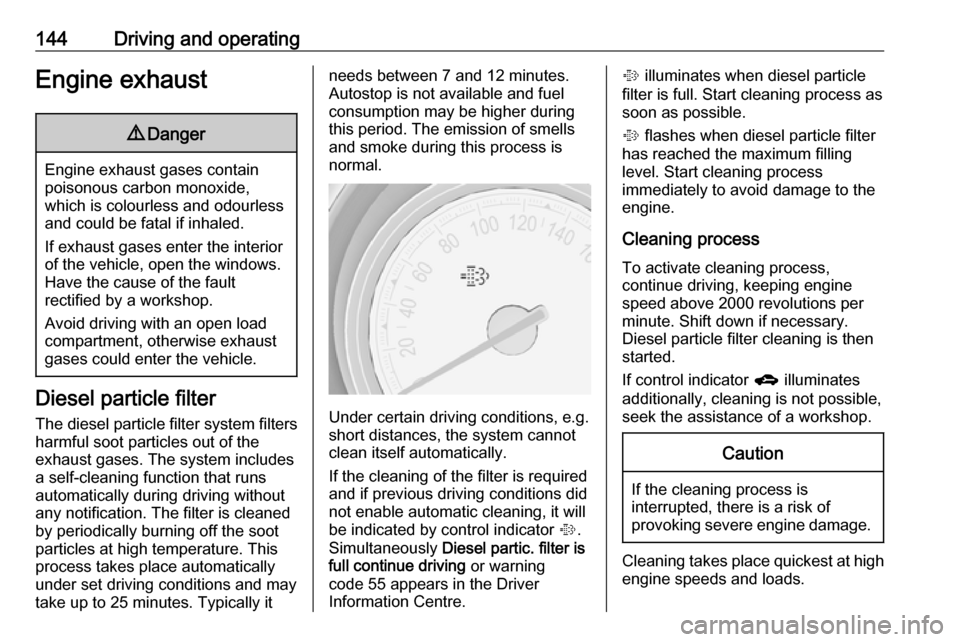
Under certain driving conditions, e.g.
short distances, the system cannot
clean itself automatically.
If the cleaning of the filter is required
and if previous driving conditions did
not enable automatic cleaning, it will
be indicated by control indicator %.
Simultaneously Diesel partic. filter is
full continue driving or warning
code 55 appears in the Driver
Information Centre.
% illuminates when diesel particle
filter is full. Start cleaning process as
soon as possible.
% flashes when diesel particle filter
has reached the maximum filling
level. Start cleaning process
immediately to avoid damage to the
engine.
Cleaning process To activate cleaning process,
continue driving, keeping engine
speed above 2000 revolutions per
minute. Shift down if necessary.
Diesel particle filter cleaning is then
started.
If control indicator g illuminates
additionally, cleaning is not possible,
seek the assistance of a workshop.Caution
If the cleaning process is
interrupted, there is a risk of
provoking severe engine damage.
Cleaning takes place quickest at high
engine speeds and loads.
Page 166 of 251
164Driving and operatingThe multivalve on the liquid gas tank
automatically limits the fill quantity. If
a larger quantity is added, we
recommend not exposing the vehicle to the sun until the excess amount
has been used up.
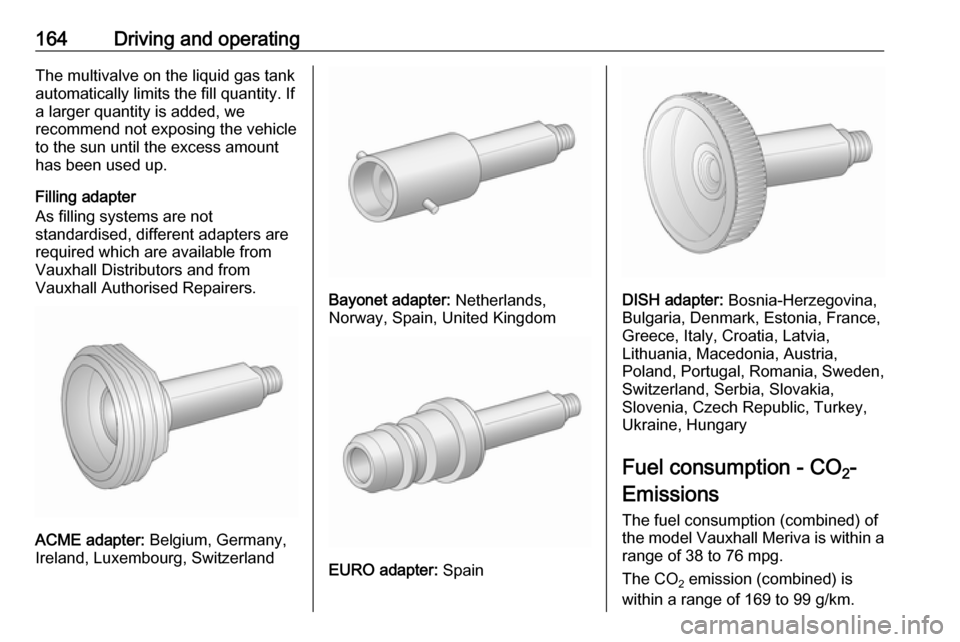
Filling adapter
As filling systems are not
standardised, different adapters are
required which are available from
Vauxhall Distributors and from
Vauxhall Authorised Repairers.
ACME adapter: Belgium, Germany,
Ireland, Luxembourg, Switzerland
Bayonet adapter: Netherlands,
Norway, Spain, United Kingdom
EURO adapter: Spain
DISH adapter: Bosnia-Herzegovina,
Bulgaria, Denmark, Estonia, France,
Greece, Italy, Croatia, Latvia,
Lithuania, Macedonia, Austria,
Poland, Portugal, Romania, Sweden,
Switzerland, Serbia, Slovakia,
Slovenia, Czech Republic, Turkey,
Ukraine, Hungary
Fuel consumption - CO 2-
Emissions
The fuel consumption (combined) of
the model Vauxhall Meriva is within a range of 38 to 76 mpg.
The CO 2 emission (combined) is
within a range of 169 to 99 g/km.
Page 167 of 251

Driving and operating165For the values specific for your
vehicle, refer to the EEC Certificate of
Conformity provided with your vehicle
or other national registration
documents.
General information The official fuel consumption and
specific CO 2 emission figures quoted
relate to the EU base model with
standard equipment.
Fuel consumption data and CO 2
emission data are determined
according to regulation R (EC) No.
715/2007 (in the version respectively
applicable), taking into consideration
the vehicle weight in running order, as
specified by the regulation.
The figures are provided only for the
purpose of comparison between
different vehicle variants and must not be taken as a guarantee for the
actual fuel consumption of a
particular vehicle. Additional
equipment may result in slightly
higher results than the stated
consumption and CO 2 figures.Furthermore, fuel consumption is
dependent on personal driving styleas well as road and traffic conditions.Trailer hitch
General information
Only use towing equipment that has
been approved for your vehicle.
Entrust retrofitting of towing
equipment to a workshop. It may be
necessary to make changes that
affect the cooling system, heat
shields or other equipment.
The bulb outage detection function for trailer brake light cannot detect a
partial bulb outage, e.g. in case of four
times five watt bulbs, the function only detects lamp outage when only a
single five Watt lamp remains or none remain.
Fitting of towing equipment could
cover the opening of the towing eye. If this is the case use the coupling ball
bar for towing. Always keep the
coupling ball bar in the vehicle when
not in use.
Page 198 of 251
196Vehicle careTyre pressureCheck the pressure of cold tyres at
least every 14 days and before any
long journey. Do not forget the spare
wheel. This also applies to vehicles
with tyre pressure monitoring system.
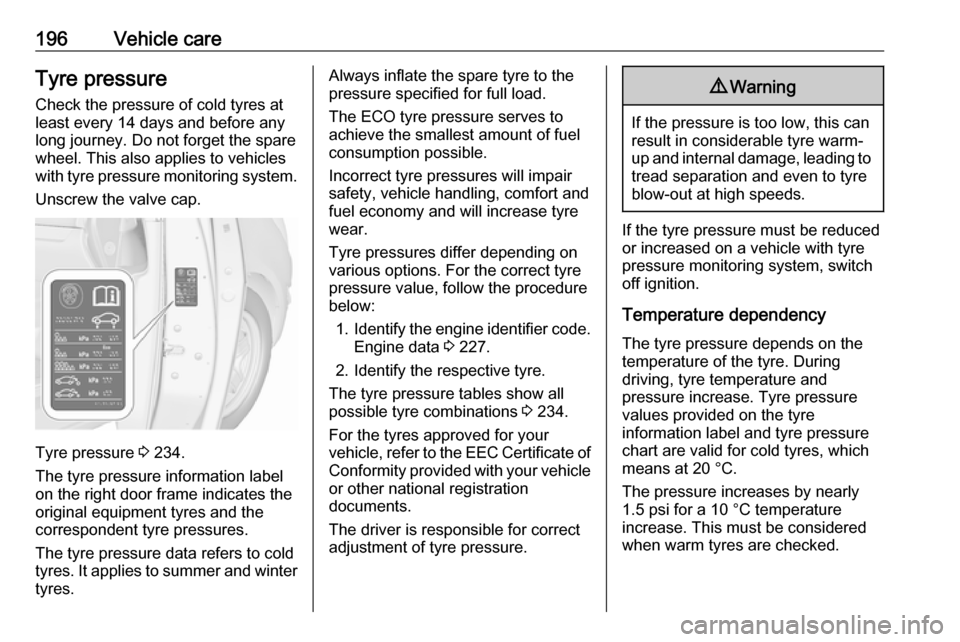
Unscrew the valve cap.
Tyre pressure 3 234.
The tyre pressure information label
on the right door frame indicates the original equipment tyres and the
correspondent tyre pressures.
The tyre pressure data refers to cold
tyres. It applies to summer and winter tyres.
Always inflate the spare tyre to the
pressure specified for full load.
The ECO tyre pressure serves to
achieve the smallest amount of fuel
consumption possible.
Incorrect tyre pressures will impair
safety, vehicle handling, comfort and
fuel economy and will increase tyre
wear.
Tyre pressures differ depending on
various options. For the correct tyre
pressure value, follow the procedure
below:
1. Identify the engine identifier code.
Engine data 3 227.
2. Identify the respective tyre.
The tyre pressure tables show all
possible tyre combinations 3 234.
For the tyres approved for your
vehicle, refer to the EEC Certificate of Conformity provided with your vehicle
or other national registration
documents.
The driver is responsible for correct adjustment of tyre pressure.9 Warning
If the pressure is too low, this can
result in considerable tyre warm-
up and internal damage, leading to tread separation and even to tyre
blow-out at high speeds.
If the tyre pressure must be reduced
or increased on a vehicle with tyre
pressure monitoring system, switch
off ignition.
Temperature dependencyThe tyre pressure depends on thetemperature of the tyre. During
driving, tyre temperature and
pressure increase. Tyre pressure
values provided on the tyre
information label and tyre pressure
chart are valid for cold tyres, which
means at 20 °C.
The pressure increases by nearly
1.5 psi for a 10 °C temperature
increase. This must be considered
when warm tyres are checked.
Page 247 of 251

245Climate control ............................. 15
Climate control, service ..............136
Climate control systems .............128
Clock............................................. 85
Code ........................................... 105
Collision damage repair ..............239
Control indicators.......................... 91
Control of the vehicle .................138
Controls ........................................ 81
Controls in steering wheel ............81
Convex shape .............................. 29
Coolant ....................................... 174
Coolant and antifreeze ...............220
Coolant temperature gauge ..........89
Coupling ball bar ........................167
Cruise control ...................... 99, 153
Cupholders .................................. 60
Curtain airbag system .................. 52
Curve lighting.............................. 122
D
Danger, Warnings and Cautions ...4
Dashboard .................................... 10
Daytime running light ..................120
Daytime running lights ...............122
Declaration of conformity ............237
Diesel fuel system bleeding .......178
Diesel particle filter ...............97, 144
Door open .................................... 99
Doors ............................................ 26Driver assistance systems..........153
Driver Information Centre ...........100
Driving characteristics and towing tips .............................. 166
Driving hints ................................ 138
E Electric adjustment ......................29
Electrical system......................... 188
Electric parking brake ...........96, 150
Electric parking brake fault ...........96
Electronic climate control system 131
Electronic driving programmes ..147
Electronic Stability Control.......... 152
Electronic Stability Control and Traction Control system ...........97
Electronic Stability Control off ...... 97
End-of-life vehicle recovery .......171
Engine compartment fuse box ...190
Engine coolant ........................... 174
Engine coolant temperature gauge ....................................... 89
Engine data ............................... 227
Engine exhaust .......................... 144
Engine identification ...................223
Engine oil ................... 173, 220, 224
Engine oil pressure ......................98
Entry lighting .............................. 126
Event data recorders ..................241
Exhaust gases ............................ 144Exit lighting ................................ 126
Exterior care .............................. 215
Exterior light ................................. 98
Exterior lighting ....................12, 119
Exterior mirrors ............................. 29
F
Fault ........................................... 147
First aid ......................................... 77
First aid kit ................................... 77
Fixed air vents ........................... 136
Flex-Fix system ............................ 63
Fog light ....................................... 99
Fog lights .................... 123, 124, 183
Folding mirrors ............................. 29
Folding tray .................................. 77
Front airbag system .....................51
Front fog lights ........................... 123
Front seats.................................... 36
Front storage ............................... 62
Front turn signal light ..................179
Front turn signal lights ...............183
Fuel............................................. 159
Fuel consumption - CO 2-
Emissions ............................... 164
Fuel for diesel engines ..............159
Fuel for liquid gas operation .......159
Fuel for petrol engines ...............159
Fuel gauge ................................... 89
Fuel selector ................................ 89