warning VAUXHALL MOKKA 2014 Manual PDF
[x] Cancel search | Manufacturer: VAUXHALL, Model Year: 2014, Model line: MOKKA, Model: VAUXHALL MOKKA 2014Pages: 217, PDF Size: 5.9 MB
Page 178 of 217
176Vehicle care
confirms that the sensoridentification code has been
matched to this tyre and wheel
position.
9. Proceed to the passenger side front tyre, and repeat the
procedure in Step 8.
10. Proceed to the passenger side rear tyre, and repeat the
procedure in Step 8.
11. Proceed to the driver side rear tyre, and repeat the procedure inStep 8. The horn sounds twice to
indicate the sensor identification
code has been matched to the
driver side rear tyre, and the
TPMS sensor matching process
is no longer active.
12. Turn off the ignition.
13. Set all four tyres to the recommended air pressure level
as indicated on the tyre pressure
label.
Tread depth Check tread depth at regular
intervals.Tyres should be replaced for safety
reasons at a tread depth of 2-3 mm
(4 mm for winter tyres).
For safety reasons it is recommended
that the tread depth of the tyres on
one axle should not vary by more than
2 mm.
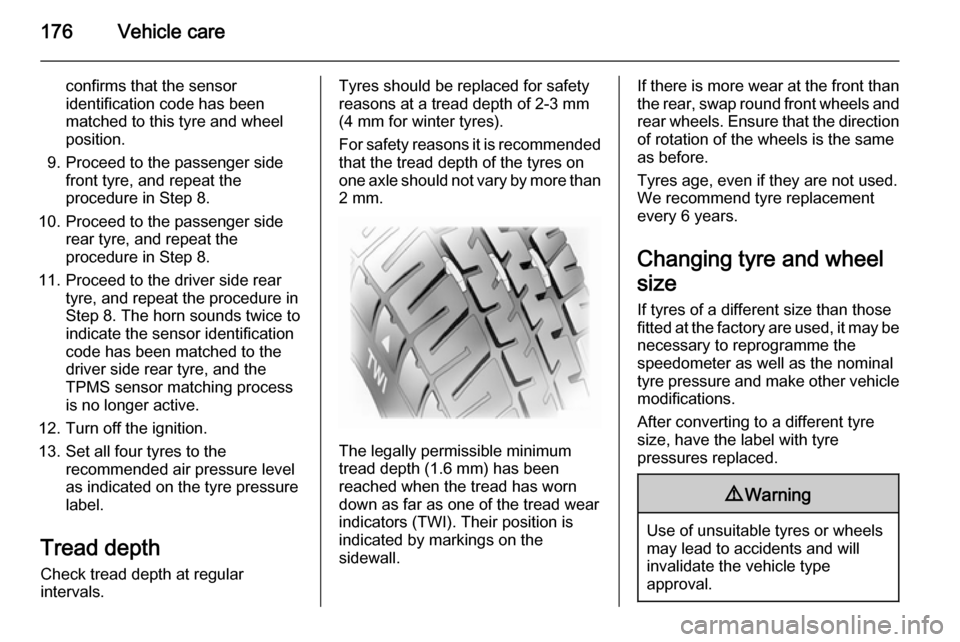
The legally permissible minimum
tread depth (1.6 mm) has been
reached when the tread has worn
down as far as one of the tread wear
indicators (TWI). Their position is
indicated by markings on the
sidewall.
If there is more wear at the front than
the rear, swap round front wheels and rear wheels. Ensure that the direction
of rotation of the wheels is the same
as before.
Tyres age, even if they are not used.
We recommend tyre replacement
every 6 years.
Changing tyre and wheel
size
If tyres of a different size than those
fitted at the factory are used, it may be necessary to reprogramme the
speedometer as well as the nominal tyre pressure and make other vehicle modifications.
After converting to a different tyre
size, have the label with tyre
pressures replaced.9 Warning
Use of unsuitable tyres or wheels
may lead to accidents and will
invalidate the vehicle type
approval.
Page 179 of 217

Vehicle care177Wheel coversWheel covers and tyres that are
factory-approved for the respective
vehicle and comply with all of the
relevant wheel and tyre combination
requirements must be used.
If the wheel covers and tyres used are
not factory-approved, the tyres must
not have a rim protection ridge.
Wheel covers must not impair brake
cooling.9 Warning
Use of unsuitable tyres or wheel
covers could lead to sudden
pressure loss and thereby
accidents.
Vehicles with alloy wheels: When
mounting steel wheels with alloy
wheel nuts, e.g. when changing to
winter tyres, the wheel covers cannot
be attached to the steel wheels.
Tyre chains
Use tyre chains only on front wheels.
9 Warning
Damage may lead to tyre blowout.
Tyre chains are permitted on tyres of
size 195/70 R16.
Always use fine mesh chains suitable
for sport utility vehicles that add no
more than 12 mm to the tyre tread and the inboard sides (including chain
lock).
On tyres of size 215/55 R18, special
snow chains are only permitted when
they are designed with a rotating
chain belt on the tyre tread, no chain
links on the wheel inboard sides and
the chains add no more than 12 mm
to the tyre tread. For further
information of right snow chain usage
for this tyre size, contact a specialized vehicle parts dealer or snow chain
manufacturer.
Tyre chains are not permitted on tyres of size 205/70 R16, 215/65 R16 and
215/60 R17.
The use of tyre chains is not permitted on the temporary spare wheel.
Tyre repair kit Minor damage to the tyre tread can be
repaired with the tyre repair kit.
Do not remove foreign bodies from
the tyres.
Tyre damage exceeding 4 mm or that
is at tyre's sidewall cannot be repaired with the tyre repair kit.
Page 180 of 217
178Vehicle care9Warning
Do not drive faster than 50 mph.
Do not use for a lengthy period.
Steering and handling may be
affected.
If you have a flat tyre:
Apply the parking brake and engage
first gear, reverse gear or P.
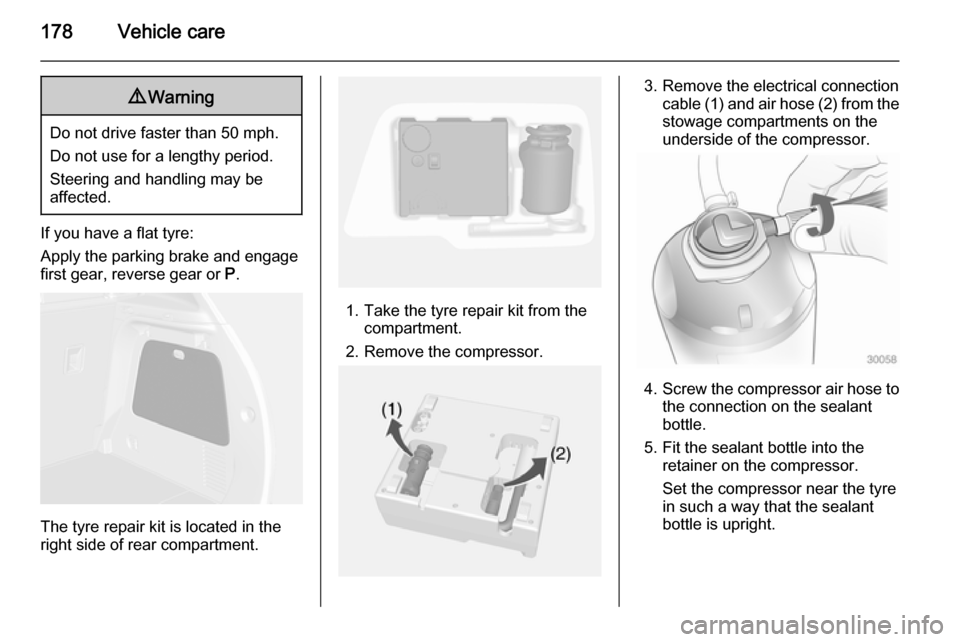
The tyre repair kit is located in the
right side of rear compartment.
1. Take the tyre repair kit from the compartment.
2. Remove the compressor.
3. Remove the electrical connection cable (1) and air hose (2) from the
stowage compartments on the
underside of the compressor.
4. Screw the compressor air hose to
the connection on the sealant
bottle.
5. Fit the sealant bottle into the retainer on the compressor.
Set the compressor near the tyre
in such a way that the sealant
bottle is upright.
Page 183 of 217

Vehicle care181
Make the following preparations and
observe the following information:
■ Park the vehicle on a level, firm and
non-skid surface. The front wheels
must be in the straight-ahead
position.
■ Apply the parking brake and engage first gear, reverse gear or
P .
■ Remove the spare wheel 3 183.
■ Never change more than one wheel
at once.
■ Use the jack only to change wheels
in case of puncture, not for
seasonal winter or summer tyre
change.
■ If the ground on which the vehicle is standing is soft, a solid board
(max. 1 cm thick) should be placed
under the jack.
■ No people or animals may be in the
vehicle when it is jacked-up.
■ Never crawl under a jacked-up vehicle.■ Do not start the vehicle when it is
raised on the jack.
■ Clean wheel nuts and thread with a
clean cloth before mounting the
wheel.9 Warning
Do not grease wheel bolt, wheel
nut and wheel nut cone.
1. Disengage wheel nut caps with a
screwdriver and remove. Pull off
the wheel cover.
2. Fold out the wheel wrench and install ensuring that it locates
securely and loosen each wheel
nut by half a turn.
3. Ensure the jack is correctly positioned under the relevant
vehicle jacking point.
Depending on the equipment, first
remove the covers from the
jacking points.
4. Set the jack to the necessary height. Position it directly below
the jacking point in a manner that
prevents it from slipping.
Page 187 of 217
Vehicle care185Jump starting
Do not start with a quick charger.
A vehicle with a discharged battery
can be started using jump leads and the battery of another vehicle.9 Warning
Be extremely careful when starting
with jump leads. Any deviation
from the following instructions can
lead to injuries or damage caused
by battery explosion or damage to the electrical systems of both
vehicles.
9 Warning
Avoid contact of the battery with
eyes, skin, fabrics and painted
surfaces. The fluid contains
sulphuric acid which can cause
injuries and damage in the event
of direct contact.
■ Never expose the battery to naked flames or sparks.
■ A discharged battery can alreadyfreeze at a temperature of 0 °C.
Defrost the frozen battery before
connecting jump leads.
■ Wear eye protection and protective
clothing when handling a battery.
■ Use a booster battery with the same voltage (12 Volts). Its
capacity (Ah) must not be much less than that of the discharged
battery.
■ Use jump leads with insulated terminals and a cross section of at
least 16 mm 2
(25 mm 2
for diesel
engines).
■ Do not disconnect the discharged battery from the vehicle.
■ Switch off all unnecessary electrical
consumers.
■ Do not lean over the battery during jump starting.
■ Do not allow the terminals of one lead to touch those of the other
lead.
■ The vehicles must not come into contact with each other during the
jump starting process.■ Apply the parking brake, transmission in neutral, automatictransmission in P.
■ Open the positive terminal protection caps of both batteries.
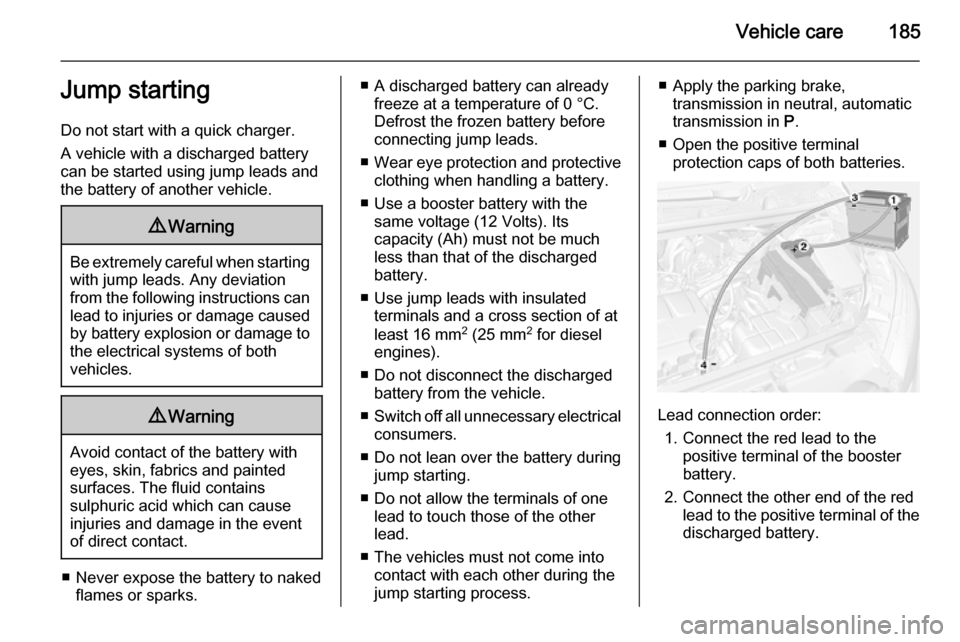
Lead connection order:
1. Connect the red lead to the positive terminal of the booster
battery.
2. Connect the other end of the red lead to the positive terminal of the
discharged battery.
Page 190 of 217

188Vehicle careTowing another vehicle
Disengage the cap by using a
screwdriver and remove.
The towing eye is stowed with the
vehicle tools 3 171.
Screw in the towing eye as far as it will
go until it stops in a horizontal
position.
The lashing eye at the rear
underneath the vehicle must never be used as a towing eye.
Attach a tow rope – or even better a
tow bar – to the towing eye.
The towing eye must only be used for
towing and not for recovering a
vehicle.
Switch on the hazard warning
flashers on both vehicles.
Caution
Drive slowly. Do not drive jerkily.
Excessive tractive force can
damage the vehicle.
After towing, unscrew the towing eye.
Insert cap at the bottom and engage
cap.
Page 195 of 217

Service and maintenance193
Make sure that the Service and
Warranty Booklet is completed
correctly as continuous proof of
service is essential if any warranty or goodwill claims are to be met, and is
also a benefit when selling the
vehicle.
Service interval with remaining
engine oil life duration The service interval is based on
several parameters depending on
usage.
The service display lets you know
when to change the engine oil.
Service display 3 80.Recommended fluids,
lubricants and parts
Recommended fluids and
lubricants
Only use products that meet the
recommended specifications.
Damage resulting from the use of
products not in line with these
specifiations will not be covered by
the warranty.9 Warning
Operating materials are
hazardous and could be
poisonous. Handle with care. Pay
attention to information given on
the containers.
Engine oil
Engine oil is identified by its quality
and its viscosity. Quality is more
important than viscosity when
selecting which engine oil to use. The oil quality ensures e.g. engine
cleanliness, wear protection and oil
aging control, whereas viscosity
grade gives information on the oil's
thickness over a temperature range.
Dexos is the newest engine oil quality
that provides optimum protection for
gasoline and diesel engines. If it is unavailable, engine oils of other listed qualities have to be used.
Recommendations for gasoline
engines are also valid for
Compressed Natural Gas (CNG),
Liquified Petroleum Gas (LPG) and
Ethanol (E85) fuelled engines.
Select the appropriate engine oil
based on its quality and on the
minimum ambient temperature
3 197.
Topping up engine oil
Engine oils of different manufacturers
and brands can be mixed as long as
they comply with the required engine
oil quality and viscosity.
Use of engine oil with only
ACEA A1/B1 or only A5/B5 quality is
prohibited, since it can cause long-
term engine damage under certain
operating conditions.
Page 213 of 217

211
Convex shape .............................. 27
Coolant and antifreeze ...............193
Cruise control ...................... 88, 135
Cupholders .................................. 55
Curtain airbag system .................. 45
D Danger, Warnings and Cautions ...4
Daytime running lights ...............106
Declaration of conformity ............207
Delayed locking ............................ 23
Descent control system .......85, 134
Diesel fuel system bleeding .......159
Diesel particle filter ...............86, 125
Door open .................................... 88
Doors ............................................ 24
Driver assistance systems ..........135
Driver Information Centre .............88
Driving characteristics and towing tips .............................. 150
Driving hints ................................ 120
E Electric adjustment ......................27
Electrical system......................... 166
Electronic climate control system 116
Electronic driving programmes ..128
Electronic Stability Control.......... 133
Electronic Stability Control and Traction Control system ............86Electronic Stability Control off....... 86
End-of-life vehicle recovery .......153
Engine compartment fuse box ...167
Engine coolant ........................... 155
Engine coolant temperature gauge ....................................... 80
Engine data ............................... 200
Engine exhaust .......................... 125
Engine identification ...................196
Engine oil ................... 154, 193, 197
Engine oil pressure ......................87
Entry lighting .............................. 112
Event data recorders ..................207
Exit lighting ................................ 112
Exterior care .............................. 189
Exterior light ................................. 87
Exterior lighting ....................12, 104
Exterior mirrors ............................. 27
F Fault ........................................... 129
First aid kit ................................... 69
Fixed air vents ........................... 119
Flex-Fix system ............................ 57
Fog light ....................................... 88
Fog lights ................................... 163
Folding mirrors ............................. 27
Forward collision alert................. 138
Front airbag system .....................44
Front fog lights ........................... 109Front seats.................................... 34
Front turn signal lights ...............163
Fuel............................................. 148
Fuel consumption - CO 2-
Emissions ............................... 150
Fuel for diesel engines ..............148
Fuel for petrol engines ...............148
Fuel gauge ................................... 80
Fuses ......................................... 166
G Gauges ......................................... 79
General information ...................150
Glovebox ..................................... 55
Glove box lighting .......................111
Graphic-Info-Display, Colour- Info-Display .............................. 91
H
Halogen headlights ....................160
Hand brake ......................... 131, 132
Hazard warning flashers ............109
Headlight flash ........................... 105
Headlight range adjustment ......105
Headlights when driving abroad 105
Head restraint adjustment .............8
Head restraints ............................ 33
Heated mirrors ............................. 28
Heated rear window ..................... 30
Heated steering wheel .................73
Page 214 of 217

212
Heating ........................................ 37
Heating and ventilation system . 114
High beam ........................... 87, 105
Hill start assist ........................... 132
Horn ....................................... 13, 73
I
Identification plate .....................195
Ignition switch positions .............121
Immobiliser ............................ 26, 87
Indicators ...................................... 79
Information displays...................... 88
Initial drive information.................... 6 Instrument panel fuse box .........168
Instrument panel illumination control .................................... 110
Instrument panel overview ........... 10
Instrument panel storage ..............54
Interior care ............................... 191
Interior lighting ............................ 110
Interior lights ...................... 111, 166
Interior mirrors .............................. 28
Interruption of power supply ......129
Introduction .................................... 3
ISOFIX child restraint systems ....52
J
Jump starting ............................. 185K
Key, memorised settings ..............21
Keys ............................................. 19
Keys, locks ................................... 19
L
Lane departure warning .......85, 146
Lashing eyes ............................... 69
Lighting features .........................112
Light switch ................................ 104
Load compartment ................24, 66
Load compartment cover .............68
Load compartment fuse box ......170
Loading information .....................70
Low fuel ....................................... 87
M Malfunction indicator light ............84
Manual anti-dazzle ......................28
Manual mode ............................. 128
Manual transmission .................. 130
Manual windows ..........................29
Memorised settings ......................21
Mirror adjustment ........................... 8
Misted light covers .....................110
N
New vehicle running-in ..............121
Number plate light .....................165O
Object detection systems ...........140
Odometer ..................................... 79
Oil, engine .......................... 193, 197
Outside temperature ....................76
Overrun cut-off ........................... 122
P Parking ................................ 17, 124
Parking assist ............................ 140
Parking brake ............................ 132
Particulate filter ........................... 125
Performance .............................. 201
Performing work ........................153
Pollen filter ................................. 119
Power outlets ............................... 78
Power steering.............................. 85
Power windows ............................ 29
Preheating ................................... 86
Puncture ..................................... 180
R Radio Frequency Identification (RFID) ..................................... 208
Radio remote control ...................20
Reading lights ............................ 111
Rear carrier system ......................57
Rear floor storage cover ..............68
Rear fog light ....................... 88, 110
Rear view camera ...................... 141
Page 216 of 217

214
Vehicle personalisation ...............98
Vehicle security ............................ 25
Vehicle specific data ......................3
Vehicle storage ........................... 152
Vehicle tools ............................... 171
Vehicle unlocking ........................... 6 Vehicle weight ........................... 202
Ventilation ................................... 114
W
Warning chimes ........................... 95
Warning lights ............................... 79
Warning triangle .......................... 69
Washer and wiper systems .........14
Washer fluid ............................... 156
Wheel changing .........................180
Wheel covers ............................. 177
Wheels and tyres .......................172
Windows ....................................... 29
Windscreen................................... 29
Windscreen wiper/washer ...........73
Winter tyres ............................... 172
Wiper blade replacement ..........159
X
Xenon headlights .......................162