roof VAUXHALL MOVANO_B 2014 Owner's Manual
[x] Cancel search | Manufacturer: VAUXHALL, Model Year: 2014, Model line: MOVANO_B, Model: VAUXHALL MOVANO_B 2014Pages: 201, PDF Size: 4.74 MB
Page 20 of 201

18Keys, doors and windowsKeys, doors and
windowsKeys, locks ................................... 18
Doors ........................................... 24
Vehicle security ............................ 27
Exterior mirrors ............................ 30
Interior mirrors ............................. 31
Windows ...................................... 32
Roof ............................................. 34Keys, locks
Keys Replacement keys
The key number is specified in the
Car Pass or on a detachable tag.
The key number must be quoted
when ordering replacement keys as it
is a component of the immobiliser
system.
Locks 3 164.
Car Pass The Car Pass contains security
related vehicle data and should
therefore be kept in a safe place.
When the vehicle is taken to a
workshop, this vehicle data is needed
in order to perform certain operations.Radio remote control
Used to operate:
■ Central locking system
■ Anti-theft locking system
■ Anti-theft alarm system
Depending on model, the vehicle may use a 2-button or 3-button remote
control.
The remote control has a range of
approx. 5 metres. It can be affected
by external influences. The hazard
warning flashers confirm operation.
Page 36 of 201
34Keys, doors and windows
Heating works with the engine
running and is switched off
automatically after a short time.
Climate control system 3 94.
Electronic climate control system 3 96.
Sun visors The sun visors can be folded down orswivelled to the side to prevent
dazzling.
If the sun visors have integral mirrors, the mirror covers should be closed
when driving.
Sun visors also feature a holder for
parking tickets etc.Roof
Glass panel
Emergency exit
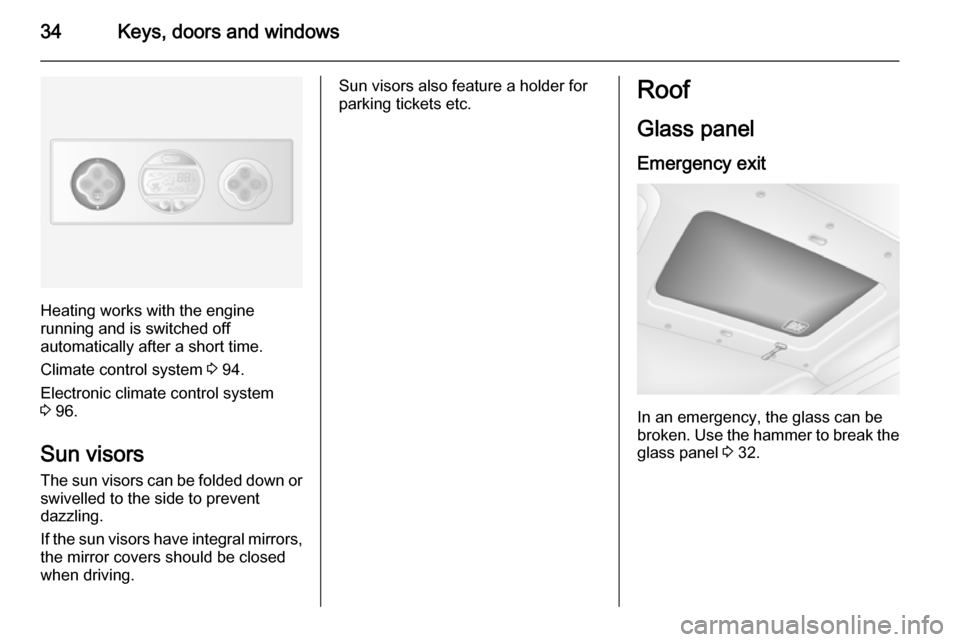
In an emergency, the glass can be
broken. Use the hammer to break the
glass panel 3 32.
Page 38 of 201
36Seats, restraints
Removal
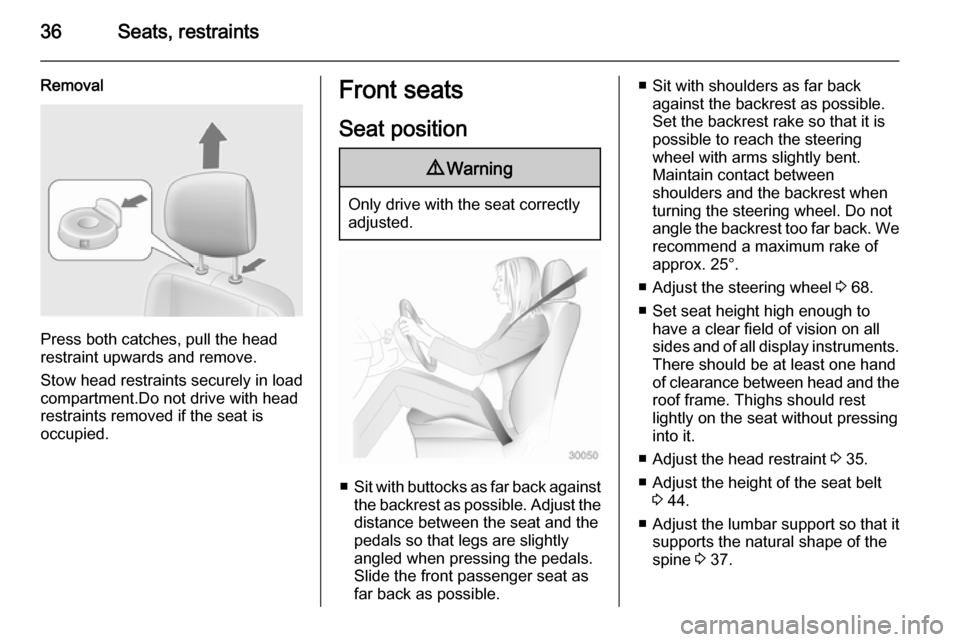
Press both catches, pull the head
restraint upwards and remove.
Stow head restraints securely in load
compartment.Do not drive with head
restraints removed if the seat is
occupied.
Front seats
Seat position9 Warning
Only drive with the seat correctly
adjusted.
■ Sit with buttocks as far back against
the backrest as possible. Adjust the distance between the seat and the
pedals so that legs are slightly
angled when pressing the pedals.
Slide the front passenger seat as
far back as possible.
■ Sit with shoulders as far back against the backrest as possible.
Set the backrest rake so that it is possible to reach the steering
wheel with arms slightly bent.
Maintain contact between
shoulders and the backrest when
turning the steering wheel. Do not
angle the backrest too far back. We recommend a maximum rake of
approx. 25°.
■ Adjust the steering wheel 3 68.
■ Set seat height high enough to have a clear field of vision on allsides and of all display instruments.
There should be at least one hand
of clearance between head and the
roof frame. Thighs should rest
lightly on the seat without pressing
into it.
■ Adjust the head restraint 3 35.
■ Adjust the height of the seat belt 3 44.
■ Adjust the lumbar support so that it
supports the natural shape of the
spine 3 37.
Page 62 of 201
60StorageStorageStorage compartments................60
Load compartment .......................63
Roof rack system .........................66
Loading information .....................66Storage compartments9Warning
Do not store heavy or sharp
objects in the storage
compartments. Otherwise, the
storage compartment lid could
open and vehicle occupants could be injured by objects being thrown
around in the event of hard
braking, a sudden change in
direction or an accident.
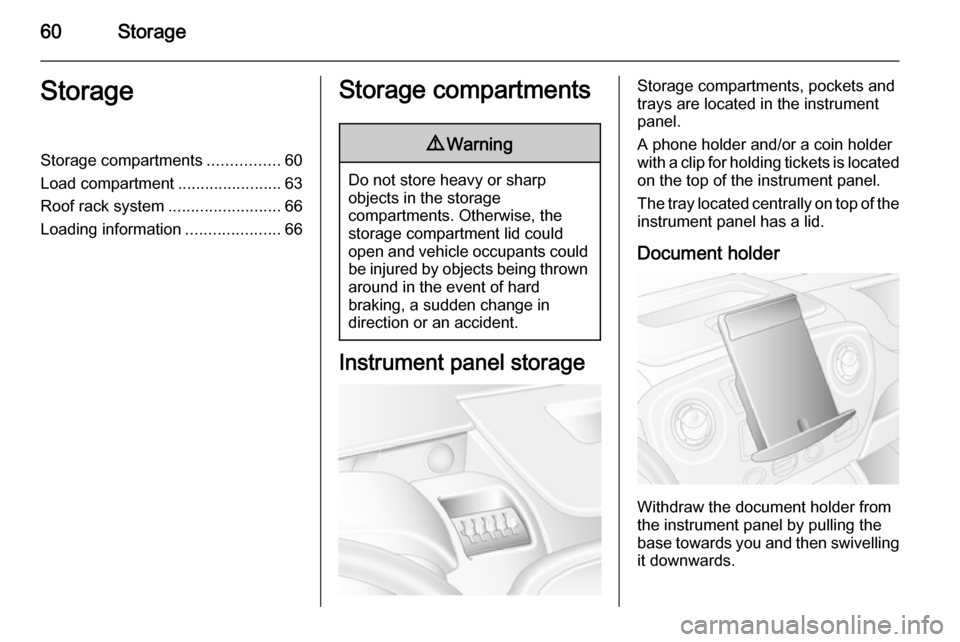
Instrument panel storage
Storage compartments, pockets and
trays are located in the instrument
panel.
A phone holder and/or a coin holder
with a clip for holding tickets is located on the top of the instrument panel.
The tray located centrally on top of the instrument panel has a lid.
Document holder
Withdraw the document holder from
the instrument panel by pulling the
base towards you and then swivelling it downwards.
Page 65 of 201
Storage63Load compartment
Lashing eyes
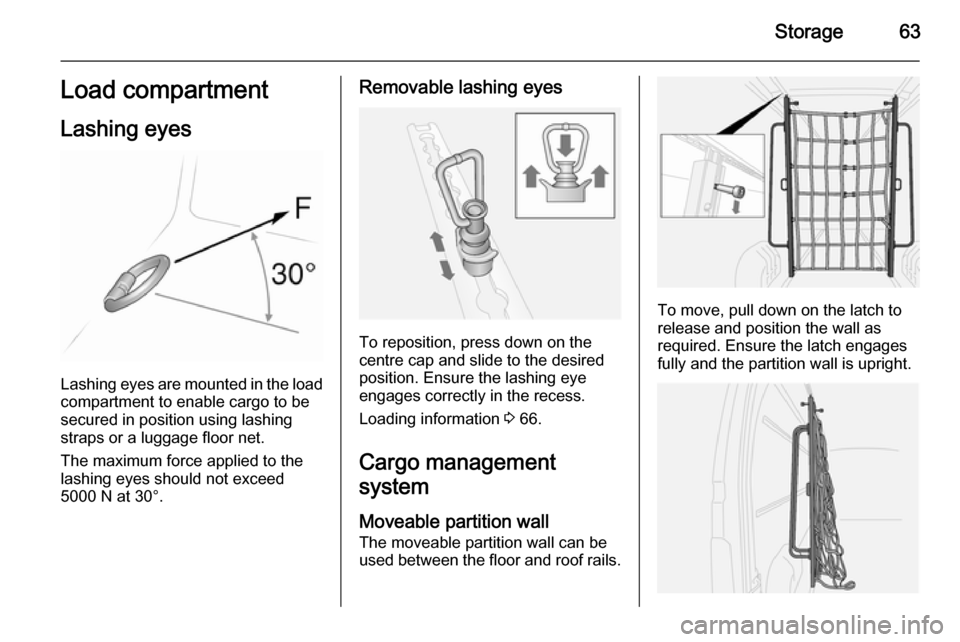
Lashing eyes are mounted in the load
compartment to enable cargo to be secured in position using lashing
straps or a luggage floor net.
The maximum force applied to the
lashing eyes should not exceed
5000 N at 30°.
Removable lashing eyes
To reposition, press down on the
centre cap and slide to the desired position. Ensure the lashing eye
engages correctly in the recess.
Loading information 3 66.
Cargo management
system
Moveable partition wall
The moveable partition wall can be
used between the floor and roof rails.
To move, pull down on the latch to release and position the wall as
required. Ensure the latch engages
fully and the partition wall is upright.
Page 67 of 201
Storage65Safety net
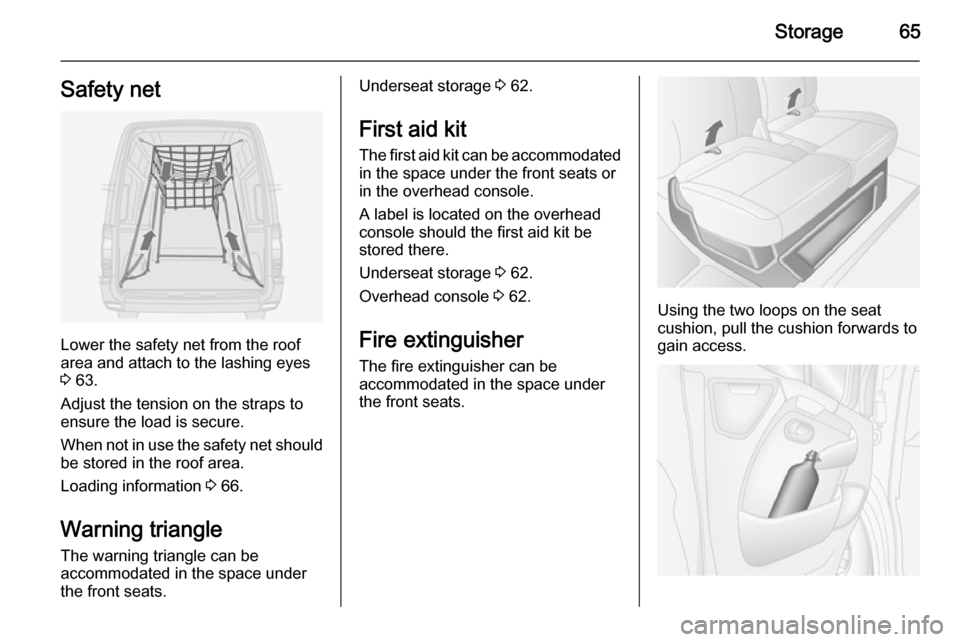
Lower the safety net from the roof
area and attach to the lashing eyes
3 63.
Adjust the tension on the straps to
ensure the load is secure.
When not in use the safety net should be stored in the roof area.
Loading information 3 66.
Warning triangle
The warning triangle can be
accommodated in the space under
the front seats.
Underseat storage 3 62.
First aid kit The first aid kit can be accommodated
in the space under the front seats or
in the overhead console.
A label is located on the overhead
console should the first aid kit be
stored there.
Underseat storage 3 62.
Overhead console 3 62.
Fire extinguisher The fire extinguisher can be
accommodated in the space under
the front seats.
Using the two loops on the seat
cushion, pull the cushion forwards to
gain access.
Page 68 of 201

66Storage
An additional extinguisher may be
located in the front door panel.
As a visible indication of this, a label
is located on the overhead console.Roof rack system
Roof rack For safety reasons and to avoid
damage to the roof, the vehicle
approved roof rack system is
recommended.
Follow the installation instructions and remove the roof rack when not in use.Loading information
■ Heavy objects in the load compartment should be evenly
distributed and placed as far
forward as possible. If objects can
be stacked, the heavier objects
should be placed at the bottom.
■ Secure objects with lashing straps attached to lashing eyes 3 63.
■ Secure loose objects in load compartment to prevent them from
sliding.
■ The load must not obstruct the operation of the pedals, parking
brake and gear selector lever, or
hinder the freedom of movement of
the driver. Do not place any
unsecured objects in the interior.
■ Do not drive with an open load compartment. In addition, the
number plate is only
distinguishable and illuminated correctly if the doors are closed.
Page 69 of 201

Storage679Warning
Always make sure that the load in
the vehicle is securely stowed.
Otherwise objects can be thrown
around inside the vehicle and
cause personal injury or damage
to the load or car.
■ The payload is the difference between the permitted gross
vehicle weight (see identification
plate 3 171) and the EC kerb
weight.
To calculate the EC kerb weight,
enter the data for your vehicle in the
Weights table at the front of this
manual.
The EC kerb weight includes
weights for the driver (68 kg),
luggage (7 kg) and all fluids (tank
90% full).
Optional equipment and
accessories increase the kerb
weight.
■ Driving with a roof load increases the sensitivity of the vehicle to
cross-winds and has a detrimental
effect on vehicle handling due to
the vehicle's higher centre of
gravity. Distribute the load evenly
and secure it properly with retaining
straps. Adjust the tyre pressure and vehicle speed according to the load
conditions. Check and retighten the straps frequently.
Do not drive faster than 75 mph.
■ The permissible roof load (which includes the weight of the roof rack)
is 200 kg for standard roof variants.
The roof load is the combined
weight of the roof rack and the load.
Page 166 of 201
164Vehicle careAppearance care
Exterior care Locks
The locks are lubricated at the factory using a high quality lock cylinder
grease. Use de-icing agent only when absolutely necessary, as this has adegreasing effect and impairs lockfunction. After using a de-icing agent,
have the locks regreased by a
workshop.
Washing The paintwork of your vehicle is
exposed to environmental influences.
Wash and wax your vehicle regularly.
When using automatic vehicle
washes, select a programme that
includes waxing.
Bird droppings, dead insects, resin,
pollen and the like should be cleaned
off immediately, as they contain
aggressive constituents which can
cause paint damage.If using a vehicle wash, comply with
the vehicle wash manufacturer's
instructions. The windscreen wipers
must be switched off. Remove
antenna and external accessories
such as roof racks etc..
If you wash your vehicle by hand, make sure that the insides of the
wheel housings are also thoroughly
rinsed out.
Clean edges and folds on opened
doors and the bonnet as well as the
areas they cover.Caution
Always use a cleaning agent with
a pH value of 4 to 9.
Do not use cleaning agents on hot surfaces.
Have the door hinges of all doors
greased by a workshop.
Do not clean the engine compartment with a steam-jet or high-pressure jet
cleaner.
Thoroughly rinse and leather-off the vehicle. Rinse leather frequently. Use
separate leathers for painted and
glass surfaces: remnants of wax on
the windows will impair vision.
Exterior lights
Headlight and other light covers are
made of plastic. Do not use any
abrasive or caustic agents, do not use an ice scraper, and do not clean them
dry.
Polishing and waxing Wax the vehicle regularly (at the
latest when water no longer beads).
Otherwise, the paintwork will dry out.
Polishing is necessary only if the paint
has become dull or if solid deposits
have become attached to it.
Paintwork polish with silicone forms a
protective film, making waxing
unnecessary.
Plastic body parts must not be treated with wax or polishing agents.
Page 169 of 201

Service and maintenance167Service and
maintenanceGeneral information ...................167
Recommended fluids, lubricants and parts .................................... 168General information
Service information In order to ensure economical and
safe vehicle operation and to
maintain the value of your vehicle, it
is of vital importance that all
maintenance work is carried out at the proper intervals as specified.
The detailed, up-to-date service
schedule for the vehicle is available at
the workshop.
Service display 3 75.
Engine identification 3 171.
Service intervals - except Bus Maintenance of your vehicle is
required every 25,000 miles or after
2 years, whichever occurs first,
unless otherwise indicated by the
service display.
Service intervals - Bus only
Maintenance of your vehicle is
required every 20,000 miles or after
2 years, whichever occurs first,
unless otherwise indicated by the
service display.Confirmations
Confirmation of service is recorded in the Service and Warranty Booklet.The date and mileage is completed
with the stamp and signature of the
servicing workshop.
Make sure that the Service and
Warranty Booklet is completed
correctly as continuous proof of
service is essential if any warranty or
goodwill claims are to be met, and is
also a benefit when selling the
vehicle.
Service display
The service interval is based on
several parameters depending on
usage.
The service display, located in the
Driver Information Centre, indicates
when the next service is due. Seek
the assistance of a workshop.
Service display 3 75.
Engine oil lever monitor 3 74.