battery VAUXHALL MOVANO_B 2015 Owner's Guide
[x] Cancel search | Manufacturer: VAUXHALL, Model Year: 2015, Model line: MOVANO_B, Model: VAUXHALL MOVANO_B 2015Pages: 209, PDF Size: 4.92 MB
Page 164 of 209
162Vehicle care
3. Remove the power supply leadand air hose from the stowage
compartments on the underside
of the compressor.
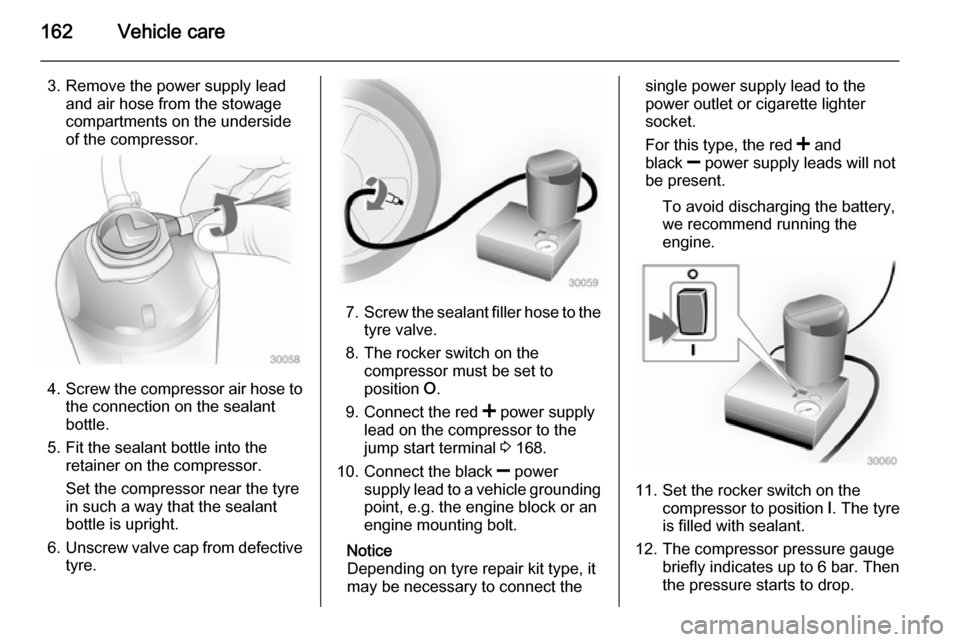
4. Screw the compressor air hose to
the connection on the sealant
bottle.
5. Fit the sealant bottle into the retainer on the compressor.
Set the compressor near the tyre
in such a way that the sealant
bottle is upright.
6. Unscrew valve cap from defective
tyre.
7. Screw the sealant filler hose to the
tyre valve.
8. The rocker switch on the compressor must be set to
position O.
9. Connect the red < power supply
lead on the compressor to the
jump start terminal 3 168.
10. Connect the black ] power
supply lead to a vehicle grounding
point, e.g. the engine block or an
engine mounting bolt.
Notice
Depending on tyre repair kit type, it
may be necessary to connect the
single power supply lead to the
power outlet or cigarette lighter
socket.
For this type, the red < and
black ] power supply leads will not
be present.
To avoid discharging the battery,
we recommend running the
engine.
11. Set the rocker switch on the compressor to position I. The tyre
is filled with sealant.
12. The compressor pressure gauge briefly indicates up to 6 bar. Then
the pressure starts to drop.
Page 170 of 209
168Vehicle care
If your vehicle gets a flat tyre on therear while towing another vehicle,
mount the temporary spare wheel in the front and the full tyre in the rear.
Tyre chains 3 161.
Summer and winter tyres
If you use winter tyres, the spare
wheel may still be fitted with a
summer tyre.
If you use the spare wheel when it is
fitted with a summer tyre the vehicle's
driveability may be affected,
especially on slippery road surfaces.
Directional tyres Fit directional tyres such that they rollin the direction of travel. The rolling
direction is indicated by a symbol
(e.g. an arrow) on the sidewall.
The following applies to tyres fitted
opposing the rolling direction:
■ Driveability may be affected. Have the defective tyre renewed or
repaired as soon as possible.
■ Do not drive faster than 50 mph.
■ Drive particularly carefully on wet and snow-covered road surfaces.Jump starting
Do not start with a quick charger.
A vehicle with a discharged battery
can be started using jump leads and
the battery of another vehicle.9 Warning
Be extremely careful when starting
with jump leads. Any deviation
from the following instructions can
lead to injuries or damage caused
by battery explosion or damage to the electrical systems of both
vehicles.
9 Warning
Avoid contact with eyes, skin,
fabrics, and painted surfaces. The fluid contains sulphuric acid which can cause injuries and damage in
the event of direct contact.
Caution
The air suspension system must
be switched off prior to jump
starting.
9 Warning
Avoid contact of the battery with
eyes, skin, fabrics and painted
surfaces. The fluid contains
sulphuric acid which can cause
injuries and damage in the event
of direct contact.
■ Never expose the vehicle battery to
naked flames or sparks.
■ A discharged vehicle battery can already freeze at a temperature of
0 °C. Defrost the frozen vehicle
battery before connecting jump
leads.
■ Wear eye protection and protective
clothing when handling a vehicle
battery.
Page 171 of 209
Vehicle care169
■ Use a booster battery with thesame voltage (12 volts). Its capacity
(Ah) must not be much less than
that of the discharged vehicle
battery.
■ Use jump leads with insulated terminals and a cross section of at
least 25 mm 2
.
■ Do not disconnect the discharged battery from the vehicle.
■ Switch off all unnecessary electrical
consumers.
■ Switch off the air suspension system.
■ Do not lean over the vehicle battery
during jump starting.
■ Do not allow the terminals of one lead to touch those of the otherlead.
■ The vehicles must not come into contact with each other during the
jump starting process.
■ Apply the parking brake, transmission in neutral.Jump start terminal
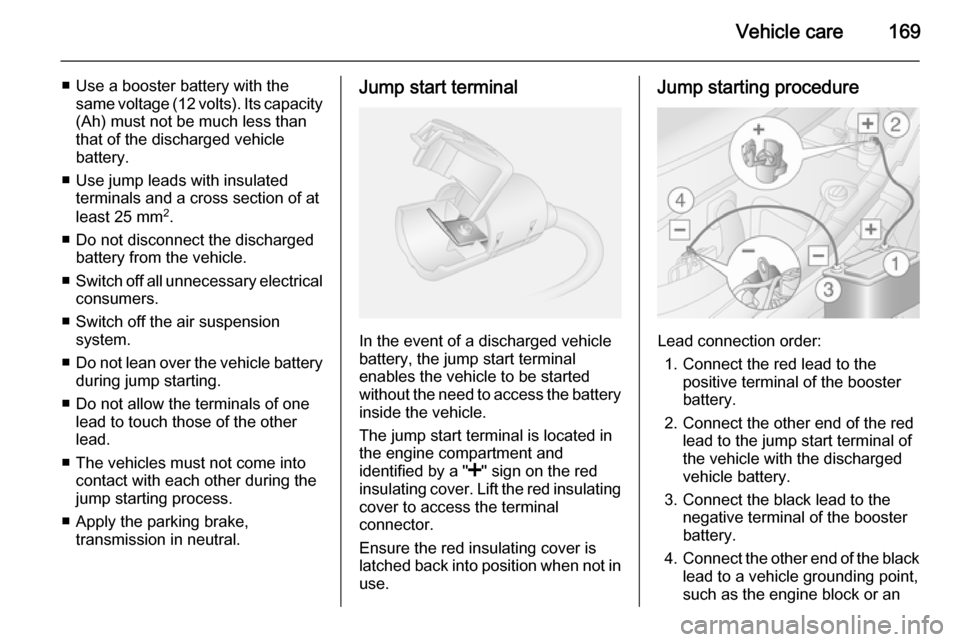
In the event of a discharged vehicle
battery, the jump start terminal
enables the vehicle to be started
without the need to access the battery inside the vehicle.
The jump start terminal is located in
the engine compartment and
identified by a " <" sign on the red
insulating cover. Lift the red insulating
cover to access the terminal
connector.
Ensure the red insulating cover is
latched back into position when not in
use.
Jump starting procedure
Lead connection order:
1. Connect the red lead to the positive terminal of the booster
battery.
2. Connect the other end of the red lead to the jump start terminal of
the vehicle with the discharged
vehicle battery.
3. Connect the black lead to the negative terminal of the booster
battery.
4. Connect the other end of the black
lead to a vehicle grounding point,
such as the engine block or an
Page 172 of 209
170Vehicle care
engine mounting bolt. Connect asfar away from the discharged
vehicle battery as possible,
however at least 60 cm.
Route the leads so that they cannot
catch on rotating parts in the engine
compartment.
To start the engine: 1. Start the engine of the vehicle providing the jump start.
2. After 5 minutes, start the other engine. Start attempts should be
made for no longer than
15 seconds at an interval of
1 minute.
3. Allow both engines to idle for approx. 3 minutes with the leads
connected.
4. Switch on electrical consumers (e.g. headlights, heated rear
window) of the vehicle receiving
the jump start.
5. Reverse above sequence exactly when removing leads.Towing
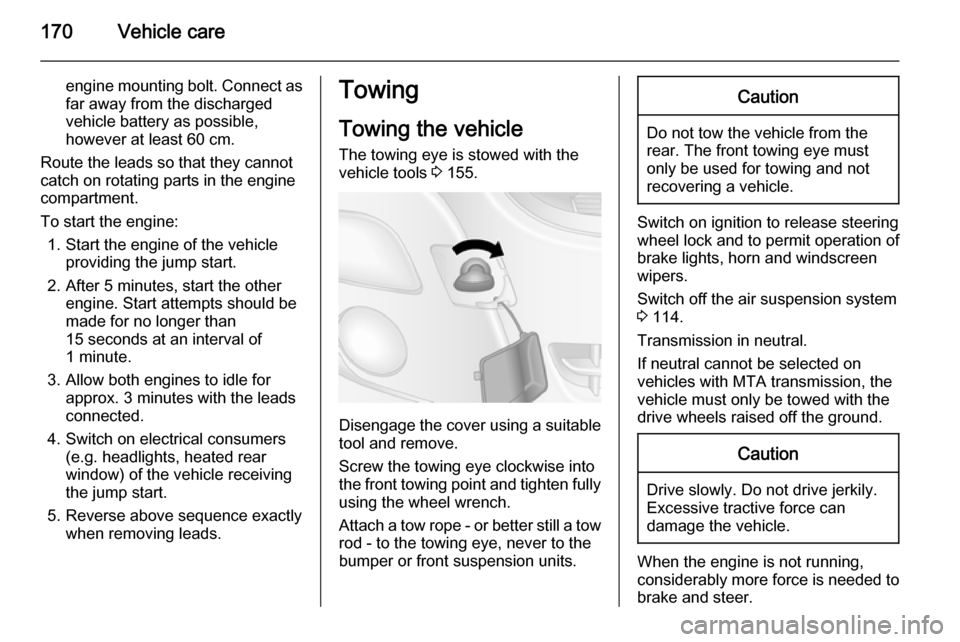
Towing the vehicle The towing eye is stowed with the
vehicle tools 3 155.
Disengage the cover using a suitable
tool and remove.
Screw the towing eye clockwise into
the front towing point and tighten fully using the wheel wrench.
Attach a tow rope - or better still a tow
rod - to the towing eye, never to the
bumper or front suspension units.
Caution
Do not tow the vehicle from the
rear. The front towing eye must
only be used for towing and not
recovering a vehicle.
Switch on ignition to release steering
wheel lock and to permit operation of
brake lights, horn and windscreen
wipers.
Switch off the air suspension system
3 114.
Transmission in neutral.
If neutral cannot be selected on
vehicles with MTA transmission, the vehicle must only be towed with the
drive wheels raised off the ground.
Caution
Drive slowly. Do not drive jerkily.
Excessive tractive force can
damage the vehicle.
When the engine is not running,
considerably more force is needed to
brake and steer.
Page 204 of 209

202IndexAAccessories and vehicle modifications .......................... 135
Adaptive forward lighting .....91, 147
Adjustable air vents ...................106
Airbag and belt tensioners ...........79
Airbag deactivation ................51, 79
Airbag label................................... 46 Airbag system .............................. 46
Air conditioning regular operation ................................ 107
Air conditioning system ................ 97
Air intake .................................... 107
Air suspension ........................... 114
Air vents...................................... 106
Antifreeze ................................... 138
Antilock brake system ................ 121
Antilock brake system (ABS) .......81
Anti-theft alarm system ................27
Anti-theft locking system .............. 27
Appearance care ........................171
Armrest ........................................ 41
Ashtrays ....................................... 73 Automatic light control .................89
Automatic locking ........................23
Auxiliary heater ........................... 102B
Battery, jump starting.................. 168
Belts.............................................. 44 Bonnet ....................................... 137
Brake assist ............................... 122
Brake fluid .......................... 141, 176
Brake pad wear ............................ 81
Brakes ............................... 121, 141
Brake system ............................... 80
Breakdown.................................. 170
Bulb replacement ....................... 144
C
Capacities .................................. 197
Cargo management system ........64
Car Pass ...................................... 18
Catalytic converter .....................116
Central locking system ................19
Centre high-mounted brake light 150
Changing tyre and wheel size ...160
Charging system .......................... 80
Child locks ................................... 23
Child restraint installation locations ................................... 54
Child restraints.............................. 52
Child restraint systems ................52
Cigarette lighter ........................... 73
Cleaning the vehicle ...................171
Climate control ............................. 14
Page 208 of 209

206
Traction Control system ............. 123
Trailer coupling ........................... 132
Trailer stability assist .................134
Trailer towing ............................. 133
Transmission ............................... 15
Transmission display ...........76, 117
Tread depth ............................... 160
Trip computer .............................. 86
Triple-Info-Display .......................85
Trip odometer .............................. 74
Turn and lane-change signals .....91
Turn signal ................................... 79
Tyre chains ................................ 161
Tyre changing ............................. 164
Tyre designations ......................156
Tyre pressure ............................ 156
Tyre pressure monitoring system ............................... 82, 157
Tyre pressures ........................... 198
Tyre repair kit ............................. 161
Tyres .......................................... 156
Tyres and wheel size, changing. 160
U
Ultrasonic parking assist............. 128
Underseat storage .......................63
Upholstery .................................. 173
Upshift .......................................... 81
Using this manual ..........................3V
Vehicle battery ........................... 141
Vehicle checks............................ 136
Vehicle data ................................ 181
Vehicle data recording and privacy ..................................... 200
Vehicle dimensions .................... 189
Vehicle Identification Number ....178
Vehicle jack ................................ 155
Vehicle messages .......................85
Vehicle security ............................ 27
Vehicle specific data ......................3
Vehicle storage ........................... 135
Vehicle tools ............................... 155
Vehicle unlocking ........................... 6
Vehicle weight ........................... 184
Ventilation ..................................... 96
W
Warning chimes ........................... 86
Warning lights ............................... 74
Warning triangle .......................... 66
Washer and wiper systems .........14
Washer fluid ............................... 140
Washing the vehicle ...................171
Wheel changing .........................164
Wheel covers ............................. 160
Wheels and tyres .......................156
Wide view mirror ........................... 31Windows....................................... 32
Windscreen wiper/washer ...........70
Winter tyres ............................... 156
Wiper blade replacement ..........143