torque VAUXHALL MOVANO_B 2018 Owner's Manual
[x] Cancel search | Manufacturer: VAUXHALL, Model Year: 2018, Model line: MOVANO_B, Model: VAUXHALL MOVANO_B 2018Pages: 261, PDF Size: 6.3 MB
Page 134 of 261

132Driving and operatingDriving hints
Driving economically
ECO mode
ECO mode is a function that
optimises fuel consumption. It affects engine power and torque,
acceleration, gear shift indication,
heating, air conditioning and electrical consumers.
ActivationPress ECO. Control indicator
illuminates when activated and a corresponding message appears in
the Driver Information Centre 3 101.
During driving, it is possible to
temporarily disable ECO mode, e.g.
to increase engine performance, by
depressing the accelerator pedal
firmly.
ECO mode is reactivated when
pressure is reduced on the
accelerator pedal.
Deactivation
Press ECO again. Control indicator
extinguishes.
Control of the vehicle
Never coast with engine not
running (except during Autostop)
Many systems will not function in this
situation (e.g. brake servo unit, power
steering). Driving in this manner is a
danger to yourself and others. All
systems function during an Autostop,
but there may be a controlled
reduction in power steering assist and
vehicle speed is reduced.Stop-start system 3 135.
Pedals To ensure the pedal travel is
uninhibited, there must be no mats in
the area of the pedals.
Use only floor mats which fit properly and are fixed by the retainers on the
driver's side.
Driving downhill
Engage a gear when driving downhill
to ensure that sufficient brake
pressure is available.
Steering If power steering assist is lost
because the engine stops or due to a system malfunction, the vehicle can
be steered but may require increased
effort.
Page 136 of 261
134Driving and operatingSteering wheel lock
Remove key from ignition switch and
turn steering wheel until it engages.9 Danger
Never remove the key from
ignition switch during driving as
this will cause steering wheel lock.
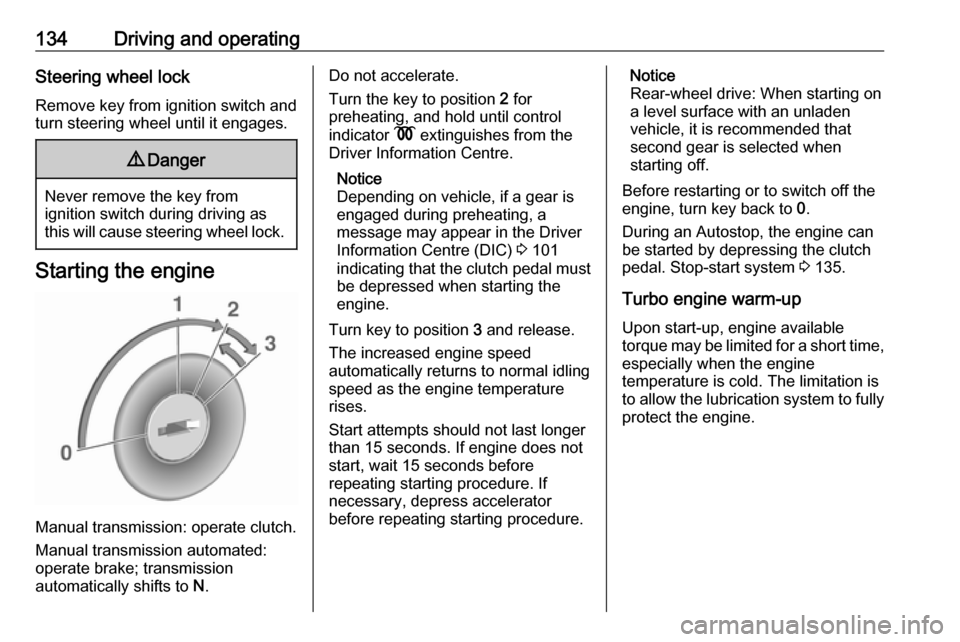
Starting the engine
Manual transmission: operate clutch.
Manual transmission automated:
operate brake; transmission
automatically shifts to N.
Do not accelerate.
Turn the key to position 2 for
preheating, and hold until control
indicator N extinguishes from the
Driver Information Centre.
Notice
Depending on vehicle, if a gear is
engaged during preheating, a
message may appear in the Driver
Information Centre (DIC) 3 101
indicating that the clutch pedal must be depressed when starting the
engine.
Turn key to position 3 and release.
The increased engine speed
automatically returns to normal idling
speed as the engine temperature
rises.
Start attempts should not last longer
than 15 seconds. If engine does not
start, wait 15 seconds before
repeating starting procedure. If
necessary, depress accelerator
before repeating starting procedure.Notice
Rear-wheel drive: When starting on
a level surface with an unladen
vehicle, it is recommended that
second gear is selected when
starting off.
Before restarting or to switch off the
engine, turn key back to 0.
During an Autostop, the engine can
be started by depressing the clutch
pedal. Stop-start system 3 135.
Turbo engine warm-up
Upon start-up, engine available
torque may be limited for a short time, especially when the engine
temperature is cold. The limitation is
to allow the lubrication system to fully
protect the engine.
Page 160 of 261

158Driving and operatingEngine Drag Torque Control
The engine drag torque control
system is an integral feature of
ESP® Plus
. When downshifting under
slippery road conditions, the engine speed and torque increases to help
prevent locking of the drive wheels
during sudden deceleration.
Fault
If the system detects a fault, control indicator b 3 98 illuminates together
with A 3 96 in the instrument cluster
and a corresponding message
appears in the Driver Information
Centre 3 101.
The Electronic Stability Program
(ESP® Plus
) is not operational. Have
the cause of the fault remedied by a workshop.
Vehicle messages 3 102.
Limited-slip rear axle
Rear-wheel drive vehicles may be
equipped with an automatic locking
rear differential which automatically
controls the torque transmitted toeach rear wheel, enhancing traction
in the event of soft ground, mud or
snow-covered road surfaces.9 Warning
Do not let this special safety
feature tempt you into taking risks
when driving.
Adapt speed to the road
conditions.
When vehicle speed reaches
20 mph, or once the rear wheels
return to surfaces with normal grip,
e.g. paved roads, the system
automatically deactivates,
sometimes accompanied by a noise
(with no consequence to vehicle
behaviour).
The system can also be deactivated
manually once normal grip conditions have resumed by briefly releasing the
accelerator.
Driver assistance
systems9 Warning
Driver assistance systems are
developed to support the driver
and not to replace the driver's
attention.
The driver accepts full
responsibility when driving the
vehicle.
When using driver assistance
systems, always take care
regarding the current traffic
situation.
Cruise control
The cruise control can store and
maintain speeds of 20 mph and
above. Deviations from the stored
speeds may occur when driving uphill or downhill. The stored speed will
flash in the Driver Information Centre
3 101.
Page 211 of 261

Vehicle care209Raise the vehicle (max. 3 cm) bypressing the wheel wrench until
the wheel is clear of the ground.
4. Unscrew wheel bolts/nuts completely and wipe clean with a
cloth.
Put wheel bolts/nuts somewhere
where the threads will not be
soiled.
5. Change the wheel.
6. Screw in the wheel bolts/nuts.
7. Lower vehicle.
8. Install the wheel wrench (depending on vehicle, attach
wheel wrench to adapters)
ensuring that it locates securely
and tighten each wheel bolt/nut in a crosswise sequence. Tighteningtorque is: 172 Nm (Front-wheel
drive), 235 Nm (Rear-wheel drive with twin rear wheels), 264 Nm
(Rear-wheel drive with single rear
wheels).
9. Refit wheel cover. Rear-wheel drive, with twin rear
wheels: Install the tyre valve
extender to the inner rear wheel
before refitting the wheel cover.Notice
If applicable, fit anti-theft bolts
nearest the tyre valve (otherwise it
may not be possible to refit the wheel
cover).
10. Stow the replaced wheel 3 209
and the vehicle tools 3 198.
11. Have the new wheel balanced on the vehicle. Check the tyre
pressure of the installed tyre
3 244 and also the wheel bolt/nut
torque as soon as possible.
Have the defective tyre renewed or
repaired.
Spare wheel Some vehicles are equipped with atyre repair kit instead of a spare wheel 3 204.
If mounting a spare wheel which is
different from the other wheels, this
wheel might be classified as a
temporary spare wheel and the
corresponding speed limits apply,
even though no label indicates this.
Seek the assistance of a workshop to
check the applicable speed limit.Caution
The use of a spare wheel that is smaller than the other wheels or in combination with winter tyres
could affect driveability. Have the defective tyre replaced as soon as
possible.
The spare wheel is held under the
vehicle frame using a winch and
secured by tightening a cable using
the wheel wrench and adapters
(depending on vehicle).
It may be necessary to jack the
vehicle up to gain access to the spare
wheel on a fully loaded vehicle with a flat rear tyre.
Page 227 of 261

Technical data225Engine data
Sales designation
2.3 CDTI 1252.3 CDTI 110,
2.3 CDTI 110
ecoFLEX2.3 CDTI
BITURBO 1352.3 CDTI 1502.3 BITURBO 163Engine identifier codeM9T (MH) 1)
, (MD) 2)
,
(MJ) 2)M9T (MR) 2)M9T (MN)2)M9T (MF)2)M9T (MP) 3)
, (MU) 4)Number of cylinders44444Piston displacement
[cm 3
]22982298229822982298Engine power [kW]9281100110120at rpm35003500350035003500Torque [Nm]310285340/350 5)3503603)
/380 4)at rpm1250-20001250-20001500-250015001500-2750Fuel typeDieselDieselDieselDieselDiesel1)
Euro 4.
2) Euro 5.
3) Euro 5.
4) Euro VI with AdBlue.
5) Front-wheel drive/Rear-wheel drive.
Page 228 of 261

226Technical dataSales designation2.3 CDTI 1102.3 CDTI 1302.3 BITURBO 1302.3 BITURBO 1452.3 BITURBO 170Engine identifier codeM9T (MW)6)M9T (MY)6)M9T (M1)7)M9T (MS) 6)
, (MT) 7)M9T (ML) 6)Number of cylinders44444Piston displacement [cm 3
]22982298229822982298Engine power [kW] (PS)819696107125at rpm35003500350035003500Torque [Nm]290320330360380at rpm1250150015001500-27501500-2750Fuel typeDieselDieselDieselDieselDiesel6) Euro 6 with AdBlue.
7) Euro VI with AdBlue.
AdBlue 3
142.
Page 255 of 261

253Charging system .......................... 96
Child locks ................................... 26
Child restraint installation locations ................................... 64
Child restraints.............................. 61
Child restraint systems ................61
Cigarette lighter ........................... 88
Cleaning the vehicle ...................216
Climate control ............................. 15
Climate control systems .............115
Clock ............................................ 86
Coat hooks ................................... 72
Collision damage repair ..............250
Control indicators.......................... 92
Control of the vehicle .................132
Controls ........................................ 83
Convex shape .............................. 34
Coolant ....................................... 178
Coolant and antifreeze ...............220
Coolant heater ............................ 122
Cornering light ....................110, 187
Coupling ball bar ........................171
Cruise control ....................100, 158
Cupholders .................................. 72
D Danger, Warnings and Cautions ...4
Dashboard .................................... 10
Daytime running lights ...............109
Declaration of conformity ............246DEF............................................ 142
Demisting and defrosting ..............15
Diesel exhaust fluid ....................142
Diesel fuel ................................... 167
Diesel fuel filter .......................... 182
Diesel fuel system bleeding .......183
Diesel particle filter ....................141
Door locks..................................... 21
Door open .................................. 100
Doors ............................................ 27
DPF (diesel particle filter) ...........141
Drink holders ................................ 72
Driver assistance systems ..........158
Driver Information Centre ...........101
Driving characteristics and towing tips .............................. 170
Driving economically................... 132
Driving hints ................................ 132
E ECO mode .................................. 132
ecoScoring.................................. 103
Electric adjustment ......................35
Electrical accessories ...................86
Electrical system......................... 193
Electronic climate control system 117
Electronic driving programmes ..151
Electronic Stability Program 98,
156, 171
Electronic Stability Program off ...98Emergency exit .......................38, 40
End-of-life vehicle recovery .......175
Engine compartment fuse box ...194
Engine coolant ........................... 178
Engine coolant temperature ........98
Engine coolant temperature gauge ....................................... 90
Engine data ............................... 225
Engine Drag Torque Control ......156
Engine exhaust .......................... 141
Engine identification ...................223
Engine oil ...........176, 220, 224, 243
Engine oil additives ....................220
Engine oil level monitor ................91
Engine oil pressure ......................99
Engine oil viscosity grades .........220
Enhanced Traction function....... ................................ 155, 156, 158
Event data recorders ..................250
Exhaust gases ............................ 141
Exit lighting ................................ 114
Exterior care .............................. 216
Exterior light ............................... 100
Exterior lighting ....................12, 107
Exterior mirrors ............................. 34
F
Fault ........................................... 152
Fire extinguisher ........................... 79
First aid ......................................... 79