tow VAUXHALL MOVANO_B 2019 Owner's Guide
[x] Cancel search | Manufacturer: VAUXHALL, Model Year: 2019, Model line: MOVANO_B, Model: VAUXHALL MOVANO_B 2019Pages: 249, PDF Size: 6.37 MB
Page 213 of 249
Vehicle care211
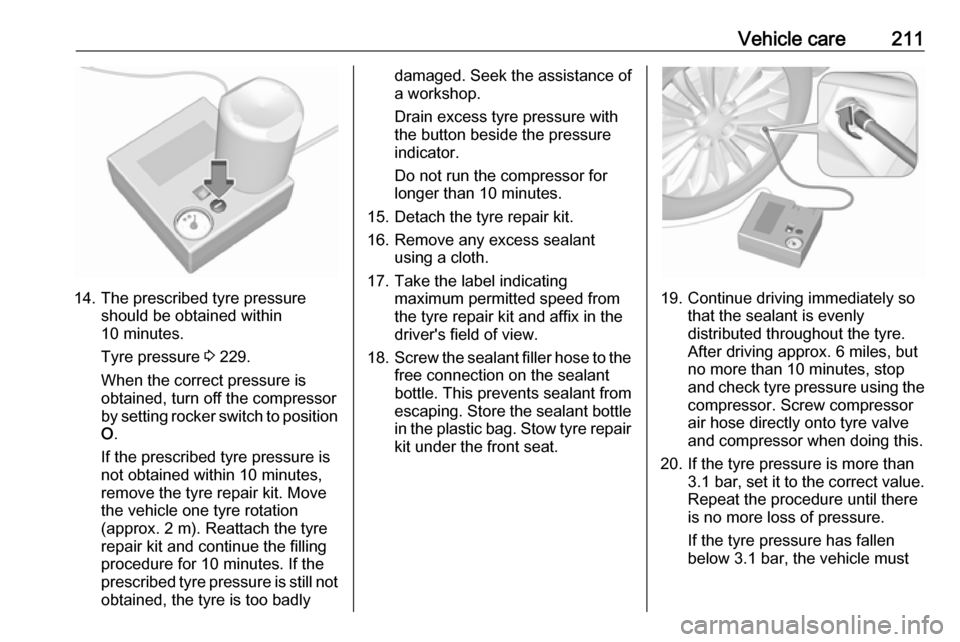
14. The prescribed tyre pressureshould be obtained within
10 minutes.
Tyre pressure 3 229.
When the correct pressure is
obtained, turn off the compressor
by setting rocker switch to position O .
If the prescribed tyre pressure is
not obtained within 10 minutes,
remove the tyre repair kit. Move
the vehicle one tyre rotation
(approx. 2 m). Reattach the tyre
repair kit and continue the filling
procedure for 10 minutes. If the
prescribed tyre pressure is still not
obtained, the tyre is too badly
damaged. Seek the assistance of
a workshop.
Drain excess tyre pressure with
the button beside the pressure
indicator.
Do not run the compressor for
longer than 10 minutes.
15. Detach the tyre repair kit.
16. Remove any excess sealant using a cloth.
17. Take the label indicating maximum permitted speed from
the tyre repair kit and affix in the
driver's field of view.
18. Screw the sealant filler hose to the
free connection on the sealant
bottle. This prevents sealant from
escaping. Store the sealant bottle
in the plastic bag. Stow tyre repair kit under the front seat.
19. Continue driving immediately so that the sealant is evenly
distributed throughout the tyre.
After driving approx. 6 miles, but
no more than 10 minutes, stop
and check tyre pressure using the
compressor. Screw compressor
air hose directly onto tyre valve
and compressor when doing this.
20. If the tyre pressure is more than 3.1 bar , set it to the correct value.
Repeat the procedure until there
is no more loss of pressure.
If the tyre pressure has fallen
below 3.1 bar, the vehicle must
Page 214 of 249

212Vehicle carenot be driven. Seek the
assistance of a workshop.
21. Stow tyre repair kit under the front
seat.
Notice
The driving characteristics of the repaired tyre are severely affected,
therefore have this tyre replaced.
If unusual noise is heard or the
compressor becomes hot, turn
compressor off for at least
30 minutes.
The built-in safety valve opens at a
pressure of 7 bar (102 psi).
Note the expiry date of the kit. After
this date its sealing capability is no
longer guaranteed. Pay attention to
storage information on sealant
bottle.
Replace the used sealant bottle. Dispose of the bottle as prescribed
by applicable laws.
The compressor and sealant can be
used from approx. -30 °C.Wheel changing
Make the following preparations and
observe the following information:
● Park the vehicle on a level, firm and non-slippery surface. The
front wheels must be in the
straight-ahead position.
● Apply the parking brake and engage first gear or reverse gear
(manual transmission) or N
(manual transmission
automated).
● Switch off the air suspension system 3 142.
● Remove the spare wheel 3 214.
● Never change more than one wheel at a time.
● Use the jack only to change wheels in case of puncture, not
for seasonal winter or summer
tyre change.
● The jack is maintenance-free.
● If the ground on which the vehicle
is standing is soft, a solid board
(max. 1 cm thick) should be
placed under the jack.● No people or animals may be in the vehicle when it is jacked-up.
● Never crawl under a jacked-up vehicle.
● Do not start the engine when the vehicle is raised on the jack.
● Clean wheel bolts / nuts and their
threads before mounting the wheel.9 Warning
Do not grease wheel bolt, wheel
nut and wheel nut cone.
1. Remove the wheel cover using the hook supplied.
Vehicle tools 3 203.
Depending on vehicle, first
remove the bolt / nut covers by
hand then remove the wheel
cover, or press wheel cover at the points indicated by the arrows and
turn to release.
Rear-wheel drive, with twin rear
wheels: Remove the tyre valve
extender from the inner rear
wheel.
Page 216 of 249

214Vehicle careRaise the vehicle by pressing the
wheel wrench until the wheel is
clear of the ground.
4. Unscrew wheel bolts / nuts completely and wipe clean with a
cloth.
Put wheel bolts / nuts somewhere
where the threads will not be
soiled.
5. Change the wheel.
6. Screw in the wheel bolts / nuts.
7. Lower vehicle.
8. Install the wheel wrench (depending on vehicle, attach
wheel wrench to adapters)
ensuring that it is securely located and tighten each wheel bolt / nut
in a crosswise sequence.
Tightening torque is: 172 Nm
(Front-wheel drive), 235 Nm
(Rear-wheel drive with twin rear
wheels), 264 Nm (Rear-wheel
drive with single rear wheels).
9. Refit wheel cover. Rear-wheel drive, with twin rear
wheels: Install the tyre valve
extender to the inner rear wheel
before refitting the wheel cover.Notice
If applicable, fit anti-theft bolts
nearest the tyre valve (otherwise it
may not be possible to refit the wheel
cover).
10. Stow the replaced wheel 3 214
and the vehicle tools 3 203.
11. Have the new wheel balanced on the vehicle. Check the tyre
pressure of the installed tyre
3 229 and also the wheel bolt /
nut torque as soon as possible.
Have the defective tyre renewed or
repaired.
Spare wheel
The spare wheel can be classified as
a temporary spare wheel depending
on the size compared to the other
mounted wheels and country
regulations. In this case a permissible maximum speed applies, even
though no label at the spare wheel
indicates this.Caution
The use of a spare wheel that is smaller than the other wheels or in combination with winter tyres
could affect driveability. Have the defective tyre replaced as soon as
possible.
The spare wheel is held under the
vehicle frame using a winch and
secured by tightening a cable using
the wheel wrench and adapters
(depending on vehicle).
It may be necessary to jack the
vehicle up to gain access to the spare
wheel on a fully loaded vehicle with a flat rear tyre.
Page 221 of 249
Vehicle care219far away from the discharged
vehicle battery as possible,
however at least 60 cm.
Route the leads so that they cannot
catch on rotating parts in the engine
compartment.
To start the engine: 1. Start the engine of the vehicle providing the jump start.
2. After 5 minutes, start the other engine. Start attempts should be
made for no longer than
15 seconds at an interval of
1 minute.
3. Allow both engines to idle for approx. 3 minutes with the leads
connected.
4. Switch on electrical consumers (e.g. headlights, heated rear
window) of the vehicle receiving
the jump start.
5. Reverse above sequence exactly when removing leads.Towing
Towing the vehicle The towing eye and wheel wrench are
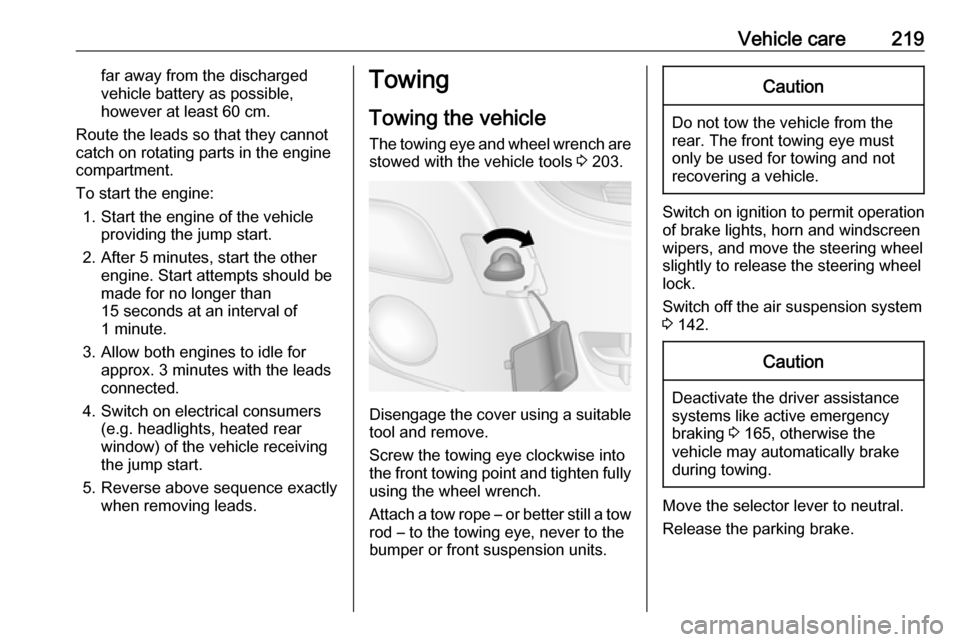
stowed with the vehicle tools 3 203.
Disengage the cover using a suitable
tool and remove.
Screw the towing eye clockwise into
the front towing point and tighten fully using the wheel wrench.
Attach a tow rope – or better still a tow
rod – to the towing eye, never to the
bumper or front suspension units.
Caution
Do not tow the vehicle from the
rear. The front towing eye must
only be used for towing and not
recovering a vehicle.
Switch on ignition to permit operation
of brake lights, horn and windscreen
wipers, and move the steering wheel
slightly to release the steering wheel
lock.
Switch off the air suspension system 3 142.
Caution
Deactivate the driver assistance
systems like active emergency
braking 3 165, otherwise the
vehicle may automatically brake during towing.
Move the selector lever to neutral.
Release the parking brake.
Page 222 of 249
220Vehicle careCaution
Vehicles with manual
transmission automated: If neutral cannot be selected, the vehiclemust only be towed with the drive
wheels raised off the ground.
The vehicle should always be
towed with the ignition switched
off.
Manual transmission automated
3 152.
Caution
Drive slowly. Do not drive jerkily.
Excessive tractive force can
damage the vehicle.
When the engine is not running,
considerably more force is needed to
brake and steer.
To prevent the entry of exhaust fumes
from the towing vehicle, switch on the air recirculation system 3 119 and
close the windows.
Seek the assistance of a workshop.
After towing, unscrew the towing eye
and refit the cover.
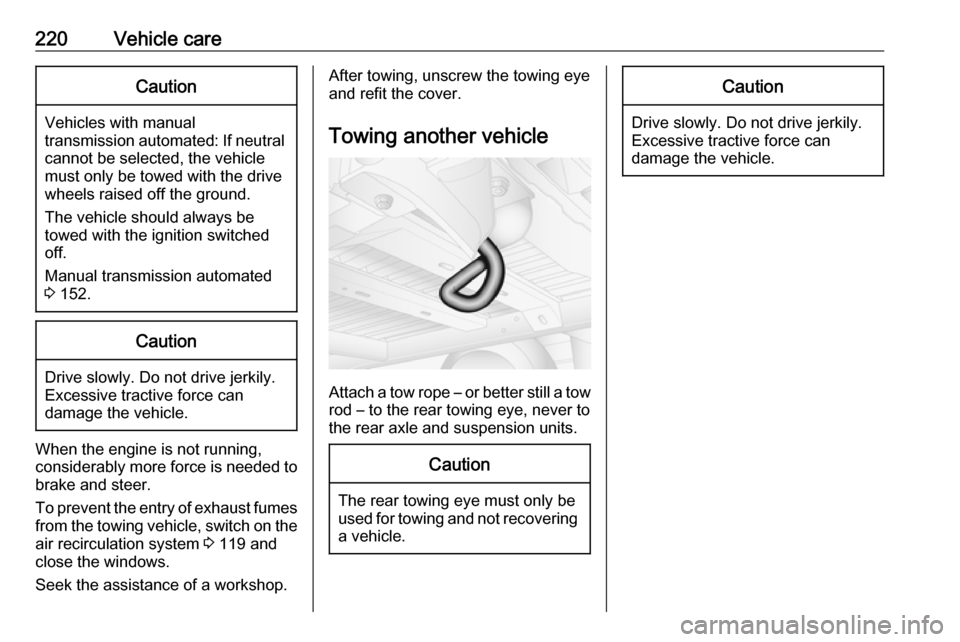
Towing another vehicle
Attach a tow rope – or better still a tow
rod – to the rear towing eye, never to
the rear axle and suspension units.
Caution
The rear towing eye must only be
used for towing and not recovering a vehicle.
Caution
Drive slowly. Do not drive jerkily.
Excessive tractive force can
damage the vehicle.
Page 224 of 249

222Vehicle careUnpainted plastic body parts must notbe treated with wax or polishing
agents.
Matt filmed body parts or decor tapes must not be polished, to avoid
gleaming. Do not use hot wax
programmes in automatic car washes if the vehicle is equipped with theseparts.
Matt painted decor parts, e.g. mirror
housing cover, must not be polished.
Otherwise these parts would become
agleam or the colour would be
dissolved.
Windows and windscreen wiper
blades
Switch off wipers before handling in their areas.
Use a soft lint-free cloth or chamois
leather together with window cleaner
and insect remover.
When cleaning the rear window from
inside, always wipe in parallel to the
heating element to prevent damage.For mechanical removal of ice, use a
sharp-edged ice scraper. Press the
scraper firmly against the glass so
that no dirt can get under it and
scratch the glass.
Remove dirt residues from smearing
wiper blades by using a soft cloth and window cleaner. Also make sure to
remove any residues such as wax,
insect residues and similar from the
window.
Wheels and tyres Do not use high-pressure jet
cleaners.
Clean rims with a pH-neutral wheel
cleaner.
Rims are painted and can be treated
with the same agents as the body.
Paintwork damageRectify minor paintwork damage with
a touch-up pen before rust forms.
Have more extensive damage or rust
areas repaired by a workshop.Underbody
Some areas of the vehicle underbody
have a PVC undercoating while other
critical areas have a durable
protective wax coating.
After the underbody is washed, check
the underbody and have it waxed if
necessary.
Bitumen / rubber materials could
damage the PVC coating. Have
underbody work carried out by a
workshop.
Before and after winter, wash the
underbody and have the protective
wax coating checked.
Towing equipment Do not clean the coupling ball bar with
a steam-jet or high-pressure jet
cleaner.
Page 234 of 249

232Customer informationOhmstrasse 4, 85716
Unterschleissheim, Germany
Operation frequency: 125 kHz
Maximum output:
42 dBμA/m @ 10 m
Infotainment system IntelliLink Touch
Continental Automotive GmbH
1 Rue de Clairefontaine, 78120
Rambouillet, France
Operation frequency: N/A
Maximum output: N/A
NAVI 50 IntelliLink / NAVI 80
IntelliLink
LG Electronics
LG Electronics European Shared
Service Center B.V., Krijgsman 1,
1186 DM Amstelveen, The
Netherlands
Operation frequency: 2.4 GHz
Maximum output: 100 mW EIRP
Infotainment system R16 / R16 BT
USB / CD18 BT USB
Visteon Electronics04 Rue Nelson Mandela, Zone
Industrielle Borj Cedria, 2055 Bir El
Bey, Tunisia
Operation frequency:
2400 – 2483,5 MHz
Maximum output: 100 mW EIRP
Infotainment system R15 BT / CD16
BT / CD16 BT DAB+
HUMAX Poland Sp.z.o.o.
Ul. Przemyslowa 4, 97-400
Belchatow, Poland
Operation frequency:
2402 – 2480 MHz
Maximum output: 4dBm EIRP
Navigation module
TomTom Int’l BV
De Ruijterkade 154, 1011 AC
Amsterdam, The Netherlands
Operation frequency:
2400 - 2483.5 MHz
Maximum output: 100 mW EIRP
Parking heater remote control
receiver
Eberspaecher Climate Control
Systems GmbH & Co. KGEberspaecherstrasse 24, 73730
Esslingen, Germany
Operation frequency: N/A
Maximum output: N/A
Parking heater remote control
transmitter
Eberspaecher Climate Control
Systems GmbH & Co. KG
Eberspaecherstrasse 24, 73730
Esslingen, Germany
Operation frequency: 434,6 MHz
Maximum output: 10dBm
Telematics control unit
Continental Automotive
1 Rue de Clairefontaine, 78120
Rambouillet, France
Operation frequency:
2400 – 2483,5 MHz
Maximum output: 100 mW EIRP
Rear view camera display
Ficosa International
Gran Via de Carles III, 98, 08028
Barcelona, Spain
Page 243 of 249

241Child locks ................................... 30
Child restraint installation locations ................................... 68
Child restraints.............................. 65
Child restraint systems ................65
Cigarette lighter ........................... 91
Cleaning the vehicle ...................221
Climate control ............................. 16
Climate control systems .............118
Clock ............................................ 89
Coat hooks ................................... 75
Control indicators.......................... 95
Control of the vehicle .................135
Controls ........................................ 86
Convex shape .............................. 39
Coolant ....................................... 183
Coolant and antifreeze ...............225
Coolant heater ............................ 125
Cornering light ....................113, 189
Cornering lights .......................... 113
Coupling ball bar ........................176
Cruise control ....................103, 161
Cupholders .................................. 75
D
Danger, Warnings and Cautions ...4
Dashboard .................................... 11
Daytime running lights ...............113
Declaration of conformity ............231
DEF ............................................ 145Demisting and defrosting..............16
Diesel exhaust fluid ....................145
Diesel fuel ................................... 172
Diesel fuel filter .......................... 187
Diesel fuel system bleeding .......188
Diesel particle filter ....................144
Door locks..................................... 23
Door open .................................. 104
Doors ............................................ 30
DPF (diesel particle filter) ...........144
Drain fuel filter ........................... 103
Drink holders ................................ 75
Driver assistance systems ..........161
Driver Information Centre ...........104
Driving characteristics and towing tips .............................. 175
Driving economically................... 135
Driving hints ................................ 135
E
ECO mode .................................. 135
ecoScoring.................................. 107
Electric adjustment ......................39
Electrical accessories ...................89
Electrical system......................... 198
Electronic climate control system 120
Electronic driving programmes ..154
Electronic key system ...................22
Electronic Stability Control 101, 159, 176Electronic Stability Control off..... 101
Emergency exit .......................42, 44
End-of-life vehicle recovery .......180
Engine compartment fuse box ...199
Engine coolant ........................... 183
Engine coolant temperature ......101
Engine coolant temperature gauge ....................................... 93
Engine drag torque control .........159
Engine exhaust .......................... 144
Engine identification ...................228
Engine oil ................... 181, 225, 229
Engine oil additives ....................225
Engine oil level monitor ................94
Engine oil pressure ....................102
Engine oil viscosity grades .........225
Enhanced Traction function....... ................................ 158, 159, 161
Event data recorders ..................235
Exhaust gases ............................ 144
Exit lighting ................................ 117
Exterior care .............................. 221
Exterior light ............................... 103
Exterior lighting ....................13, 110
Exterior mirrors ............................. 39
F
Fault ........................................... 155
Fire extinguisher ........................... 82
First aid ......................................... 82
Page 246 of 249

244Reversing lights .........................114
Ride control systems ..........158, 161
Ride height ................................. 142
Roof .............................................. 44
Glass panel ............................... 44
Roof load ...................................... 83
Roof rack ..................................... 83
S Safety belts ................................... 55
Safety net .................................... 81
Seat adjustment ....................... 7, 47
Seat belt ........................................ 8
Seat belt reminder .......................98
Seat belts ..................................... 55 Seat heating ................................. 52
Seat position ................................ 46
Selective catalytic reduction .......145
Selector lever ............................. 153
Service ............................... 132, 224
Service display ......................94, 99
Service information ....................224
Service vehicle soon .................... 99
Side airbag system ......................63
Sidelights .................................... 110
Side turn lights ........................... 195
Side windows................................ 42
Sliding door .................................. 30
Sliding side door ........................... 30
Spare wheel ............................... 214Speed limiter ................91, 104, 163
Speedometer ............................... 91
Starting and operating ................136
Starting off ................................... 17
Starting the engine .......17, 137, 153
Steering ...................................... 135
Steering column controls ..............86
Steering wheel adjustment ....10, 86
Steering wheel controls ...............86
Stop engine ................................ 100
Stop-start system.......... 17, 103, 138
Storage ......................................... 74
Storage compartments .................74
Storage net ............................. 75, 76
Sun visors .................................... 44
Suspension height ......................142
Suspension seat ........................... 47
Swivelling shelf ............................. 75
Symbols ......................................... 4
T Tachograph ........................ 104, 109
Tachometer ................................. 92
Tail lights ................................... 193
Three-point seat belt .................... 56
Tools .......................................... 203
Top-Tether .................................... 65
Touchscreen ............................... 105
Tow bar....................................... 175
Towing ........................................ 175Towing another vehicle .............220
Towing a trailer ........................... 175
Towing equipment .....................176
Towing eye ................................. 219
Towing the vehicle .....................219
Traction Control system ............. 158
Trailer coupling ........................... 175
Trailer stability assist .................176
Trailer towing ............................. 175
Transmission ............................... 17
Transmission display ...........95, 152
Tread depth ............................... 207
Trip computer ............................ 107
Trip odometer .............................. 92
Turbo engine warm-up ...............137
Turn lights ............................ 98, 113
Tyre chains ................................ 208
Tyre changing ............................. 212
Tyre designations ......................204
Tyre pressure ............................ 204
Tyre pressure monitoring system ............................. 102, 205
Tyre pressures ........................... 230
Tyre repair kit ............................. 209
Tyres .......................................... 204
Tyres and wheel size, changing. 208
U
Ultrasonic parking assist............. 167
Underseat storage .......................76