ignition VAUXHALL MOVANO_B 2019 Repair Manual
[x] Cancel search | Manufacturer: VAUXHALL, Model Year: 2019, Model line: MOVANO_B, Model: VAUXHALL MOVANO_B 2019Pages: 249, PDF Size: 6.37 MB
Page 191 of 249

Vehicle care189Lift wiper arm, press retaining clip
towards wiper arm and detach wiper
blade.
Attach the wiper blade slightly angled
to the wiper arm and push until it
engages.
Lower wiper arm carefully.Bulb replacement
Ensure the ignition is switched off
completely (the vehicle must not be in
an Autostop 3 138) and turn off the
relevant switch or close the doors.
Only hold a new bulb at the base. Do not touch the bulb glass with bare
hands.
Use only the same bulb type for
replacement.
Bulb check
After a bulb replacement, switch on
the ignition, operate and check the
lights.
Performing work 3 180.Headlights
Headlights have separate systems for
high beam 1 and low beam 2.
Page 200 of 249
198Vehicle careInstrument panel
illumination
Have bulbs replaced by a workshop.Electrical system
Fuses
Data on the replacement fuse must
match the data on the defective fuse.
There are two fuse boxes in the
vehicle:
● on the left-hand side of the instrument panel, behind the trim
panel
● in the engine compartment located below the coolant
expansion tankCombi
An additional fuse box is located
behind a trim panel on the right-hand side of the load compartment, beside the rear door.Bus
An additional fuse box is located on
the lower right-hand side of the load
compartment, below the step trim
panel.
Before replacing a fuse, turn off the
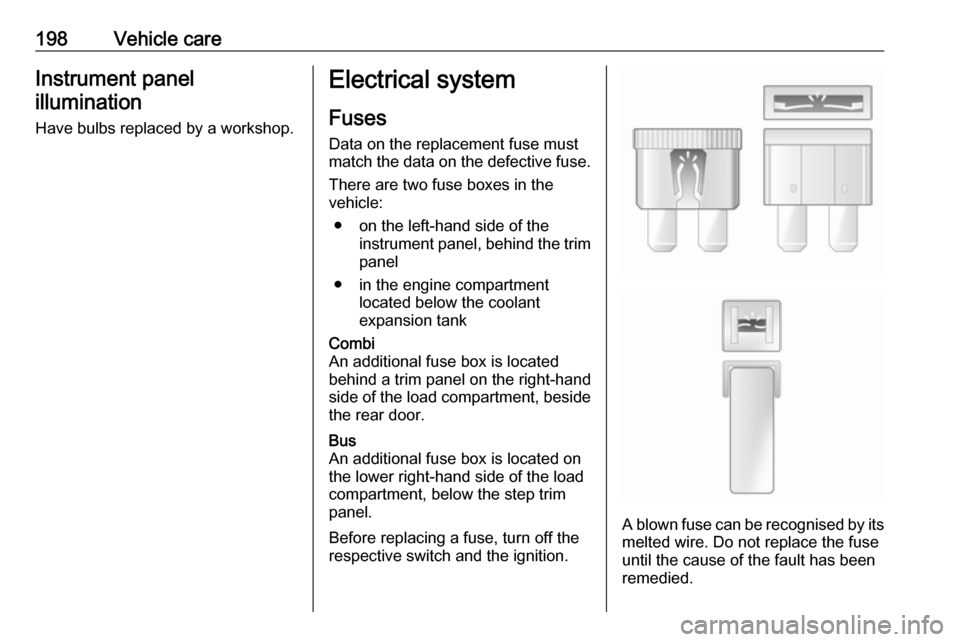
respective switch and the ignition.A blown fuse can be recognised by its
melted wire. Do not replace the fuse
until the cause of the fault has been
remedied.
Page 208 of 249
206Vehicle careCaution
Tyre pressure monitoring system
warns only about low tyre pressure condition and does not replace
regular tyre maintenance by the
driver.
All wheels must be equipped with pressure sensors and the tyres must
have the prescribed pressure.
Notice
In countries where the tyre pressure
monitoring system is legally
required, the use of wheels without
pressure sensors will invalidate the
vehicle operating permit.
The tyre pressure monitoring system
sensors monitor the air pressure in
the tyres and transmit tyre pressure
readings to a receiver located in the
vehicle.
Tyre pressure chart 3 229.
Low tyre pressure condition
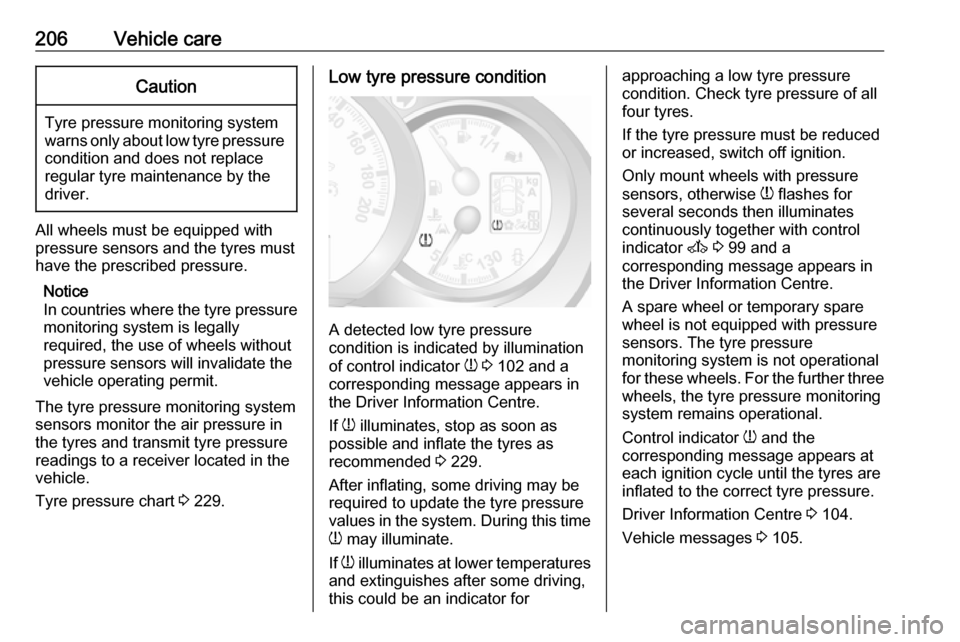
A detected low tyre pressure
condition is indicated by illumination
of control indicator w 3 102 and a
corresponding message appears in
the Driver Information Centre.
If w illuminates, stop as soon as
possible and inflate the tyres as
recommended 3 229.
After inflating, some driving may be
required to update the tyre pressure
values in the system. During this time
w may illuminate.
If w illuminates at lower temperatures
and extinguishes after some driving,
this could be an indicator for
approaching a low tyre pressure
condition. Check tyre pressure of all
four tyres.
If the tyre pressure must be reduced
or increased, switch off ignition.
Only mount wheels with pressure
sensors, otherwise w flashes for
several seconds then illuminates
continuously together with control
indicator A 3 99 and a
corresponding message appears in
the Driver Information Centre.
A spare wheel or temporary spare
wheel is not equipped with pressure
sensors. The tyre pressure
monitoring system is not operational
for these wheels. For the further three wheels, the tyre pressure monitoring
system remains operational.
Control indicator w and the
corresponding message appears at
each ignition cycle until the tyres are
inflated to the correct tyre pressure.
Driver Information Centre 3 104.
Vehicle messages 3 105.
Page 221 of 249
Vehicle care219far away from the discharged
vehicle battery as possible,
however at least 60 cm.
Route the leads so that they cannot
catch on rotating parts in the engine
compartment.
To start the engine: 1. Start the engine of the vehicle providing the jump start.
2. After 5 minutes, start the other engine. Start attempts should be
made for no longer than
15 seconds at an interval of
1 minute.
3. Allow both engines to idle for approx. 3 minutes with the leads
connected.
4. Switch on electrical consumers (e.g. headlights, heated rear
window) of the vehicle receiving
the jump start.
5. Reverse above sequence exactly when removing leads.Towing
Towing the vehicle The towing eye and wheel wrench are
stowed with the vehicle tools 3 203.
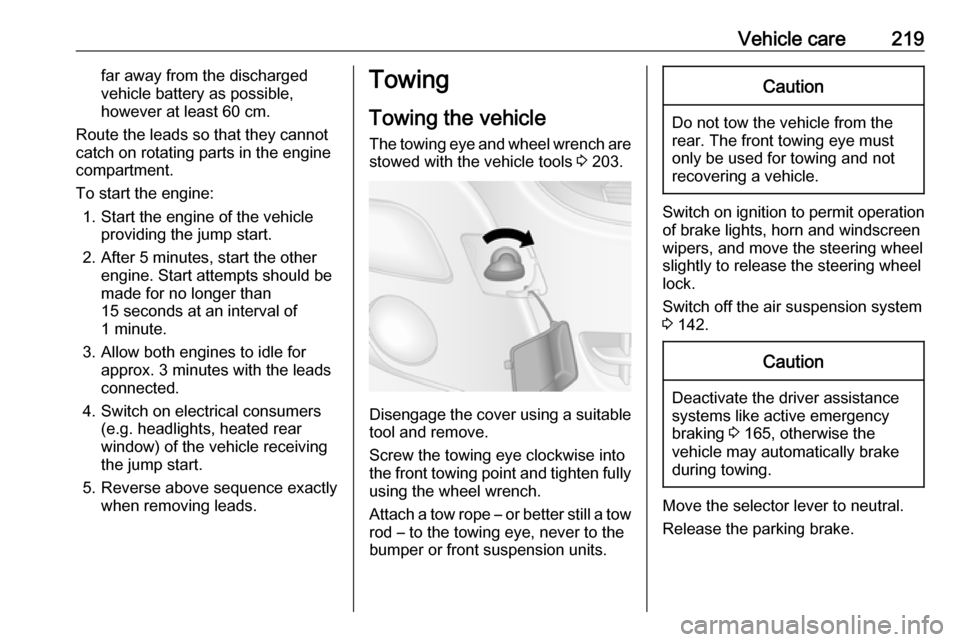
Disengage the cover using a suitable
tool and remove.
Screw the towing eye clockwise into
the front towing point and tighten fully using the wheel wrench.
Attach a tow rope – or better still a tow
rod – to the towing eye, never to the
bumper or front suspension units.
Caution
Do not tow the vehicle from the
rear. The front towing eye must
only be used for towing and not
recovering a vehicle.
Switch on ignition to permit operation
of brake lights, horn and windscreen
wipers, and move the steering wheel
slightly to release the steering wheel
lock.
Switch off the air suspension system 3 142.
Caution
Deactivate the driver assistance
systems like active emergency
braking 3 165, otherwise the
vehicle may automatically brake during towing.
Move the selector lever to neutral.
Release the parking brake.
Page 222 of 249
220Vehicle careCaution
Vehicles with manual
transmission automated: If neutral cannot be selected, the vehiclemust only be towed with the drive
wheels raised off the ground.
The vehicle should always be
towed with the ignition switched
off.
Manual transmission automated
3 152.
Caution
Drive slowly. Do not drive jerkily.
Excessive tractive force can
damage the vehicle.
When the engine is not running,
considerably more force is needed to
brake and steer.
To prevent the entry of exhaust fumes
from the towing vehicle, switch on the air recirculation system 3 119 and
close the windows.
Seek the assistance of a workshop.
After towing, unscrew the towing eye
and refit the cover.
Towing another vehicle
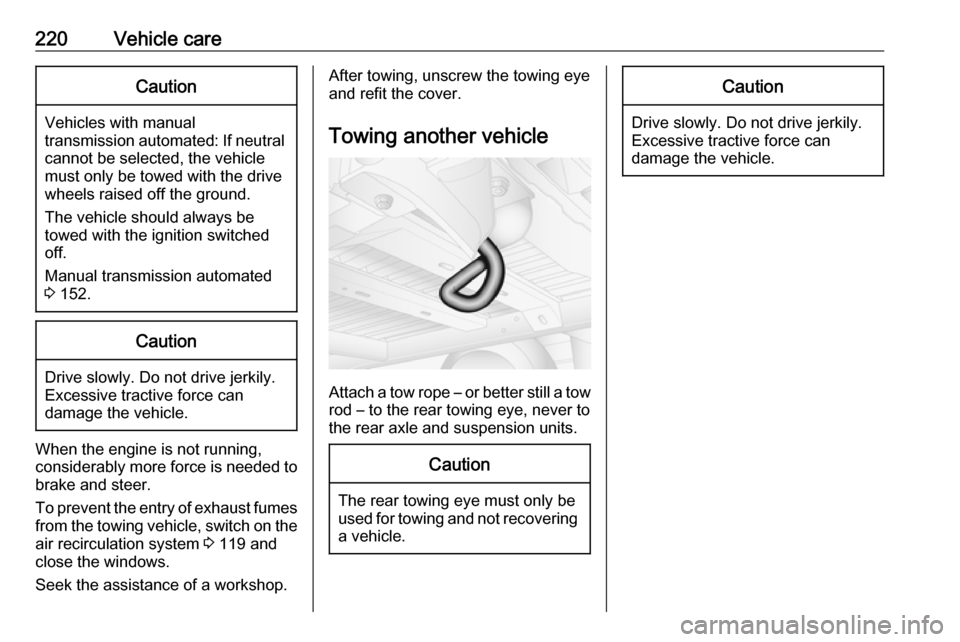
Attach a tow rope – or better still a tow
rod – to the rear towing eye, never to
the rear axle and suspension units.
Caution
The rear towing eye must only be
used for towing and not recovering a vehicle.
Caution
Drive slowly. Do not drive jerkily.
Excessive tractive force can
damage the vehicle.
Page 244 of 249

242First aid kit ................................... 82
Fixed air vents ........................... 132
Fog lights .................................... 114
Folding mirrors ............................. 39
Folding seat .................................. 75
Front airbag system .....................62
Front courtesy light .....................115
Front fog lights ...103, 110, 114, 192
Front reading light....................... 116
Front seats.................................... 46
Front storage ................................ 75
Front turn lights .......................... 192
Fuel economy rating (ecoScoring) ............................ 107
Fuel for diesel engines ..............172
Fuel gauge ................................... 93
Fuel tank ..................................... 229
Fuse box ..................... 199, 200, 201
Fuses ......................................... 198
G Gauges ......................................... 91
Gear shifting ............................... 100
General information ...................175
Glass panel .................................. 44
Glovebox ..................................... 75
Glovebox cooler ......................... 132
Grab handles ................................ 77
Ground clearance .......................142H
Hand brake - see Parking brake. 157
Hazard warning flashers ............113
Headlight flash ........................... 112
Headlight range adjustment ......112
Headlights .................. 110, 111, 189
Headlights when driving abroad 113
Head restraint adjustment .............8
Head restraints ............................ 45
Heated exterior mirrors .................16
Heated mirrors ............................. 40
Heated rear window ...............16, 43
Heating ........................................ 52
Heating and ventilation system . 118
High beam ......................... 103, 111
High beam assist ................103, 111
Hill start assist ........................... 158
Horn ....................................... 15, 86
Hub cap hook ............................. 203
I
Identification plate .....................228
Idle speed control .......................138
Ignition switch positions .............136
Immobiliser .................................. 38
Indicators ...................................... 91
Info Display ................................. 105
Information displays.................... 104
Infotainment system ...................105
Initial drive information.................... 6Instrument cluster ........................91
Instrument panel fuse box .........200
Instrument panel illumination .....198
Instrument panel overview ........... 11
Instrument panel storage ..............74
Interior care ............................... 223
Interior lighting ............................ 115
Interior lights ...................... 115, 197
Interior mirrors .............................. 40
Interruption of power supply ......156
Introduction .................................... 3
ISOFIX .......................................... 65
J Jack ............................................ 203
Journey record............................ 107
Jump starting ............................. 217
K
Keys ............................................. 20
Keys, locks ................................... 20
L
Lane departure warning .....101, 171
Lashing eyes ............................... 77
Lashing straps .............................. 77
Laying up the vehicle ..................185
Light covers, misted.................... 114
Lighting ....................................... 110
Lighting features .........................117
Light switch ................................ 110