brake sensor VAUXHALL MOVANO_B 2019 Owner's Manual
[x] Cancel search | Manufacturer: VAUXHALL, Model Year: 2019, Model line: MOVANO_B, Model: VAUXHALL MOVANO_B 2019Pages: 249, PDF Size: 6.37 MB
Page 104 of 249
102Instruments and controlsIlluminates together with control
indicator A to indicate a system
failure or as a warning that engine
starting may not be possible after a
certain distance. Seek the assistance
of a workshop immediately.
A corresponding message may
appear in the Driver Information
Centre 3 104.
AdBlue 3 145.
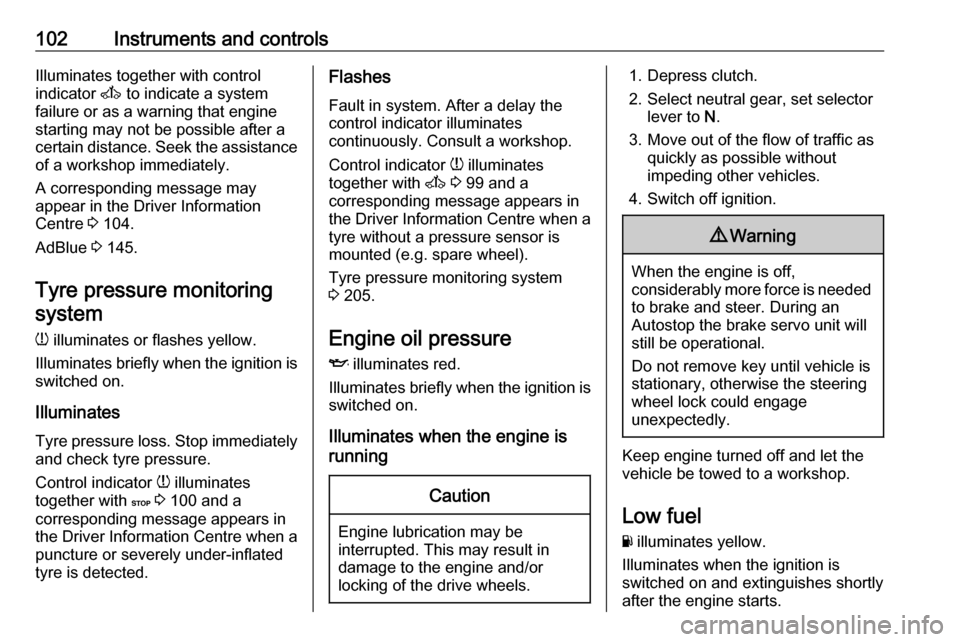
Tyre pressure monitoring
system
w illuminates or flashes yellow.
Illuminates briefly when the ignition is
switched on.
Illuminates
Tyre pressure loss. Stop immediately
and check tyre pressure.
Control indicator w illuminates
together with C 3 100 and a
corresponding message appears in
the Driver Information Centre when a puncture or severely under-inflatedtyre is detected.Flashes
Fault in system. After a delay the
control indicator illuminates
continuously. Consult a workshop.
Control indicator w illuminates
together with A 3 99 and a
corresponding message appears in the Driver Information Centre when a tyre without a pressure sensor is
mounted (e.g. spare wheel).
Tyre pressure monitoring system
3 205.
Engine oil pressure
I illuminates red.
Illuminates briefly when the ignition is switched on.
Illuminates when the engine is
runningCaution
Engine lubrication may be
interrupted. This may result in
damage to the engine and/or
locking of the drive wheels.
1. Depress clutch.
2. Select neutral gear, set selector lever to N.
3. Move out of the flow of traffic as quickly as possible without
impeding other vehicles.
4. Switch off ignition.9 Warning
When the engine is off,
considerably more force is needed
to brake and steer. During an
Autostop the brake servo unit will still be operational.
Do not remove key until vehicle is stationary, otherwise the steeringwheel lock could engage
unexpectedly.
Keep engine turned off and let the
vehicle be towed to a workshop.
Low fuel Y illuminates yellow.
Illuminates when the ignition is
switched on and extinguishes shortly
after the engine starts.
Page 140 of 249

138Driving and operatingIdle speed control
To increase the idle speed press the
switch. After a few seconds the
function will be activated.
The function will be deactivated
when:
● The clutch pedal is depressed.
● The accelerator pedal is depressed.
● The manual transmission automated is not in N (neutral).
● Vehicle speed is above 0 mph. ● Control indicator j, W or C
illuminate in the instrument
cluster.
To increase or decrease the fast idle
speed rate, consult a workshop.
Notice
When the fast idle function is
activated, the stop-start system is
automatically deactivated.
Stop-start system 3 138.
Overrun cut-off
The fuel supply is automatically cut off
during overrun, i.e. when the vehicle
is driven with a gear engaged but accelerator pedal is released.
Depending on driving conditions, the
overrun cut-off may be deactivated.
Stop-start system The stop-start system helps to save
fuel and to reduce the exhaust
emissions. When conditions allow, it
switches off the engine as soon as the
vehicle is at a low speed or at a
standstill, e.g. at a traffic light or in a
traffic jam.It restarts the engine automatically as
soon as the clutch pedal is depressed (manual transmission) or the brake
pedal is released (manual
transmission automated).
A vehicle battery sensor ensures that
an Autostop is only performed if the vehicle battery is sufficiently charged
for a restart.
Activation
The stop-start system is available as
soon as the engine is started, the
vehicle starts-off and the conditions
as stated below in this section are
fulfilled.
If the below conditions are not
fulfilled, an Autostop is prohibited and
control indicator \ illuminates in the
instrument cluster 3 103.
Page 167 of 249

Driving and operating165Switching off the system
Press U.
Yellow control indicator U
extinguishes in the instrument cluster.
Maximum speed limiterIn accordance with local or national
regulations, the vehicle may be
equipped with a fixed maximum
speed limiter that cannot be disabled.
If equipped, a warning label indicating the fixed maximum speed limit (55 to
80 mph) is located on the instrument
panel.
Deviations from the maximum speed
limit may occur briefly when driving
downhill, for physical reasons.
A warning chime may sound for
10 seconds if the vehicle briefly
exceeds the set limit.
Vehicles also equipped with speed
limiter: the maximum speed cannot
be exceeded by depressing the
accelerator pedal firmly beyond the
point of resistance.Active emergency braking
Active emergency braking can help to reduce the damage and injury from
crashes with vehicles directly ahead,
when a collision can no longer be
avoided either by manual braking or
by steering. The feature uses various
inputs (e.g. camera sensor, radar
sensor, brake pressure, vehicle
speed) to calculate the probability of a frontal collision.9 Warning
This system is not intended to
replace the driver responsibility for driving the vehicle and looking
ahead. Its function is limited to
supplemental use only to reduce
the vehicle speed before a
collision.
The system only detects vehicles
driving in the same direction of
traffic.
After a sudden lane change, the
system needs a certain time to
detect the next preceding vehicle.
The driver must always be ready
to take action and apply the brakes and steer to avoid collisions.
Operation conditions
The system is operational at a vehicle
speed between 10 mph and 62 mph.
Activation
The system is automatically active
when the ignition is switched on.
Functionality
When driving in the speed range
mentioned above and a risk of
collision with the vehicle ahead is
imminent, l will flash and a warning
chime sounds.
The indicator light l and the chimes
stop when the system detects that a
collision is not imminent anymore.
Just before the imminent collision, the system brakes automatically to
reduce the impact speed of the
collision or prohibit a crash.
Page 169 of 249
Driving and operating167●detecting a vehicle when weather
limits visibility, such as in fog,
rain, or snow
● driving during nighttime
● sensor in the windscreen or radar
unit behind the front bumper
blocked by snow, ice, slush, mud, dirt, etc.
● windscreen damaged or affected
by foreign objects, e.g. stickers
Complete attention is always required
while driving, and you should be
ready to take action and apply the
brakes and / or steer the vehicle to
avoid crashes.
Fault
In case the system requires a service,
a message is displayed in the Driver
Information Centre.
Additionally, warning lights l and
j illuminate at the same time.
When the system detects that its
function is not available, warning light l or j illuminates and stays on.
Additionally, a message in the Driver
Information Centre appears. The
system may be temporarily disrupted(for example: radar or camera
obscured by dirt, mud, snow etc.). In
this case, park the vehicle and switch
off the engine. Clean the windscreen
area around the camera and the
detection zone of the radar in the front bumper. When the warning lights and
messages still appear after starting
the vehicle again, seek the
assistance of a workshop.
Parking assist9 Warning
It is the driver who bears full
responsibility for the parking
manoeuvre.
Always check the surrounding
area while reversing and using the rear parking assist system.
The parking assist measures the
distance between the vehicle and
obstacles behind the vehicle. It
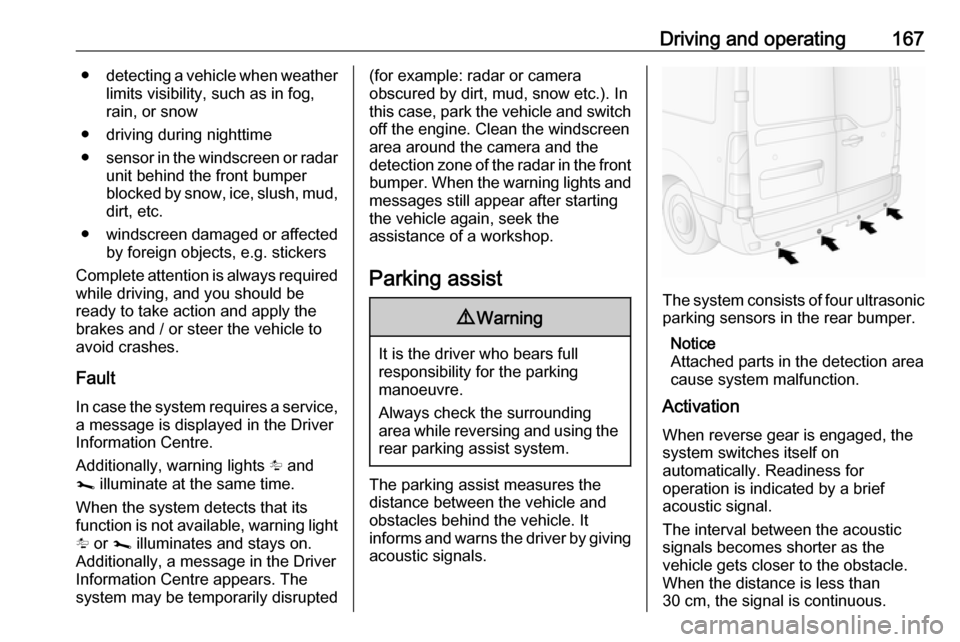
informs and warns the driver by giving acoustic signals.
The system consists of four ultrasonic parking sensors in the rear bumper.
Notice
Attached parts in the detection area
cause system malfunction.
Activation
When reverse gear is engaged, the
system switches itself on
automatically. Readiness for
operation is indicated by a brief
acoustic signal.
The interval between the acoustic
signals becomes shorter as the
vehicle gets closer to the obstacle.
When the distance is less than
30 cm, the signal is continuous.
Page 238 of 249

236Customer informationOperating data in the vehicleControl units process data for
operation of the vehicle.
This data includes, e.g.: ● vehicle status information (e.g. speed, movement delay, lateral
acceleration, wheel rotation rate, "seat belts fastened" display)
● ambient conditions (e.g. temperature, rain sensor,
distance sensor)
As a rule such data is transient, not
stored for longer than an operational
cycle, and only processed on board the vehicle itself. Control units often
include data storage (including the
vehicle key). This is used to allow
information to be documented
temporarily or permanently on vehicle
condition, component stress,
maintenance requirements and
technical events and errors.Depending on technical equipment
level, the data stored is as follows:
● system component operating states (e.g. fill level, tyre
pressure, battery status)
● faults and defects in important system components (e.g. lights,
brakes)
● system reactions in special driving situations (e.g. triggering
of an airbag, actuation of the
stability control systems)
● information on events damaging the vehicle
● for electric vehicles the amount of
charge in the high-voltage
battery, estimated range
In special cases (e.g. if the vehicle
has detected a malfunction), it may be
necessary to save data that would
otherwise just be volatile.
When you use services (e.g. repairs,
maintenance), the operating data
saved can be read together with the
vehicle identification number and
used when necessary. Staff working
for the service network ( e.g. garages,
manufacturers) or third parties (e.g.breakdown services) can read the
data from the vehicle. The same
applies to warranty work and quality
assurance measures.
Data is generally read via the OBD
(On-Board Diagnostics) port
prescribed by law in the vehicle. The operating data which is read out,
documents the technical condition of
the vehicle or individual components
and assists with fault diagnosis,
compliance with warranty obligations
and quality improvement. This data,
in particular information on
component stress, technical events,
operator errors and other faults, is
transmitted to the manufacturer
where appropriate, together with the
vehicle identification number. The
manufacturer is also subject to
product liability. The manufacturer
potentially also uses operating data
from vehicles for product recalls. This
data can also be used to check
customer warranty and guarantee
claims.
Fault memories in the vehicle can be
reset by a service company when
carrying out servicing or repairs or at
your request.
Page 245 of 249

243Limited-slip rear axle..................161
Load compartment .................24, 77
Load compartment fuse box ......201
Load compartment grille ...............81
Load compartment lighting .........115
Loading information .....................83
Low beam ................................... 103
Low fuel ..................................... 102
Luggage floor net .........................77
M
Malfunction indicator light ............99
Manual adjustment ......................39
Manual anti-dazzle ......................40
Manual door locks ........................24
Manual mode ............................. 154
Manual transmission............. 17, 152 Manual transmission automated ......................... 17, 152
Manual windows ..........................41
Messages ................................... 105
Mirror adjustment ........................... 9
Mirrors .................................... 39, 40
Misted light covers .....................114
N New vehicle running-in ..............136
Number plate light .....................196O
Object detection systems ...........167
Odometer ..................................... 92
Oil ............................................... 181
Oil, engine .......................... 225, 229
Oil level ......................................... 94
Oil pressure ................................ 102
Outside temperature ....................88
Overcab storage ..........................77
Overhead console .......................76
Overrun cut-off ........................... 138
P Parking ................................ 19, 141
Parking assist ............................ 167
Parking brake ............................ 157
Parking distance control .............167
Parking ticket holder .....................44
Particulate filter ........................... 144
Pedals......................................... 135
Performing work ........................180
Power door locks ..........................28
Power outlets ............................... 89
Power side step ............................ 30
Power sliding door ........................30
Power steering fluid ....................183
Power take-off ............................ 176
Power windows ............................ 41
Preheating ......................... 101, 137
Puncture ............................. 209, 212R
Radio Frequency Identification (RFID) ..................................... 238
Radio remote control ...................21
Rain sensor .................................. 87
REACH ....................................... 235
Reading lights ............................ 116
Rear air conditioning system .....124
Rear bench seat storage ..............76
Rear courtesy light...................... 115
Rear doors ................................... 34
Rear fog light .....................103, 193
Rear fog lights ....................110, 114
Rear heating system .................. 122
Rear reading light .......................116
Rear reversing lens ......................42
Rear seats ................................... 52
Bus ............................................ 52
Installing .................................... 52
Rear seat access ......................52
Removing .................................. 52
Rear storage ................................. 77
Rear view camera ...................... 169
Rear windows .............................. 42
Recommended fluids and lubricants ........................ 225, 229
Refuelling ................................... 173
Registered trademarks ...............235
Remote control ............................. 21
Retractable parking brake ..........157