brakes VAUXHALL VIVA 2016.5 Owner's Manual
[x] Cancel search | Manufacturer: VAUXHALL, Model Year: 2016.5, Model line: VIVA, Model: VAUXHALL VIVA 2016.5Pages: 197, PDF Size: 5.27 MB
Page 18 of 197
![VAUXHALL VIVA 2016.5 Owners Manual 16In briefManual transmission automatedR:reverse, engage only when
vehicle is stationaryN:neutralD:automatic modeM:manual mode<:upshift in manual mode]:downshift in manual mode
Manual transmission aut](/img/38/19571/w960_19571-17.png "VAUXHALL VIVA 2016.5 Owners Manual 16In briefManual transmission automatedR:reverse, engage only when
vehicle is stationaryN:neutralD:automatic modeM:manual mode<:upshift in manual mode]:downshift in manual mode
Manual transmission aut")
16In briefManual transmission automatedR:reverse, engage only when
vehicle is stationaryN:neutralD:automatic modeM:manual mode<:upshift in manual mode]:downshift in manual mode
Manual transmission automated
3 111.
Starting off
Check before starting off ● Tyre pressure and condition 3 150, 3 182.
● Engine oil level and fluid levels 3 134.
● All windows, mirrors, exterior lighting and number plates are
free from dirt, snow and ice and
are operational.
● Proper position of mirrors, seats, and seat belts 3 26, 3 32,
3 36.
● Brake function at low speed, particularly if the brakes are wet.Starting the engine
● Turn key to position 1.
● Move the steering wheel slightly to release the steering wheel
lock.
● Manual transmission: operate clutch and brake pedal.
Manual transmission automated:
operate brake pedal.
Automatic transmission: operate
brake pedal and move selector
lever to P or N.
● Do not operate accelerator pedal.
● Turn key to position 3 and
release.
Page 82 of 197

80Instruments and controlsVehicle messages in Driver
Information Centre
The vehicle messages are displayed
as code numbers.
No.Vehicle message3Engine coolant level low4Air conditioning off11Brakes worn12Vehicle overloaded13Compressor overheatedNo.Vehicle message15Centre high-mounted brake
light failure16Brake light failure17Headlight levelling malfunction18Left low beam failure19Rear fog light failure20Right low beam failure21Left sidelight failure22Right sidelight failure23Reversing light failure24Number plate light failure25Left front turn signal failure26Left rear turn signal failure27Right front turn signal failure28Right rear turn signal failure35Replace battery in radio remote
control36ESC InitialisingNo.Vehicle message49Lane departure warning unavailable52Change timing belt56Tyre pressure imbalance on
front axle57Tyre pressure imbalance on
rear axle59Open, then close driver window60Open, then close front
passenger window61Open, then close left rear
window62Open, then close right rear
window65Theft attempted66Service anti-theft alarm system67Service steering wheel lock68Service power steering75Service air conditioning
Page 105 of 197

Driving and operating103Driving and
operatingDriving hints ............................... 103
Control of the vehicle ...............103
Steering ................................... 104
Starting and operating ...............104
New vehicle running-in ............104
Ignition switch positions ...........104
Retained power off ..................105
Starting the engine ..................105
Overrun cut-off ........................ 106
Stop-start system ....................106
Parking .................................... 109
Engine exhaust .......................... 110
Catalytic converter ...................110
Manual transmission ..................110
Manual transmission automa‐
ted .............................................. 111
Transmission display ...............111
Starting the engine ..................111
Selector lever .......................... 112
Manual mode ........................... 113
Electronic driving programmes 113
Fault ........................................ 113Brakes........................................ 114
Antilock brake system .............114
Parking brake .......................... 115
Brake assist ............................. 115
Hill start assist ......................... 115
Ride control systems .................116
Traction Control system ..........116
Electronic Stability Control ......117
City mode ................................ 118
Driver assistance systems .........119
Cruise control .......................... 119
Speed limiter ........................... 121
Parking assist .......................... 122
Lane departure warning ..........123
Fuel ............................................ 124
Fuel for petrol engines .............124
Fuel for liquid gas operation ....125
Refuelling ................................ 127
Fuel consumption - CO 2-
Emissions ............................... 130Driving hints
Control of the vehicle
Never coast with engine not
running
Many systems will not function in this situation (e.g. brake servo unit, power
steering). Driving in this manner is a
danger to yourself and others.
All systems function during an
Autostop.
Stop-start system 3 106.
Idle boost
If charging of the vehicle battery is
required due to battery condition, the
power output of the generator must be increased. This will be achieved by an idle boost which may be audible.
A message appears in the Driver
Information Centre.
Pedals
To ensure the pedal travel is
uninhibited, there must be no mats in
the area of the pedals.
Page 116 of 197

114Driving and operatingIn the event of a fault, control indicatorg illuminates. Additionally, a
warning message is displayed in the
Driver Information Centre. Vehicle
messages 3 79.
Continued driving is restricted or not
possible, depending on the fault.
Have the cause of the fault remedied
by a workshop.Brakes
The brake system comprises two
independent brake circuits.
If a brake circuit fails, the vehicle can
still be braked using the other brake
circuit. However, braking effect is
achieved only when the brake pedal
is depressed firmly. Considerably
more force is needed for this. The braking distance is extended. Seek
the assistance of a workshop before
continuing the journey.
When the engine is not running, the
support of the brake servo unit
disappears once the brake pedal has been depressed once or twice.
Braking effect is not reduced, but
braking requires significantly greater
force. It is especially important to bear this in mind when being towed.
Control indicator R 3 69.
Antilock brake system
Antilock brake system (ABS)
prevents the wheels from locking.ABS starts to regulate brake pressure as soon as a wheel shows a tendency to lock. The vehicle remains
steerable, even during hard braking.
ABS control is made apparent
through a pulse in the brake pedal
and the noise of the regulation
process.
For optimum braking, keep the brake
pedal fully depressed throughout the
braking process, despite the fact that
the pedal is pulsating. Do not reduce
the pressure on the pedal.
After starting-off the system performs
a self-test which may be audible.
Control indicator u 3 70.
Adaptive brake light
During full braking, all three brake
lights flash for the duration of ABS
control.
Page 117 of 197
Driving and operating115Fault9Warning
If there is a fault in the ABS, the
wheels may be liable to lock due
to braking that is heavier than
normal. The advantages of ABS are no longer available. During
hard braking, the vehicle can no longer be steered and may
swerve.
Have the cause of the fault remedied
by a workshop.
Parking brake
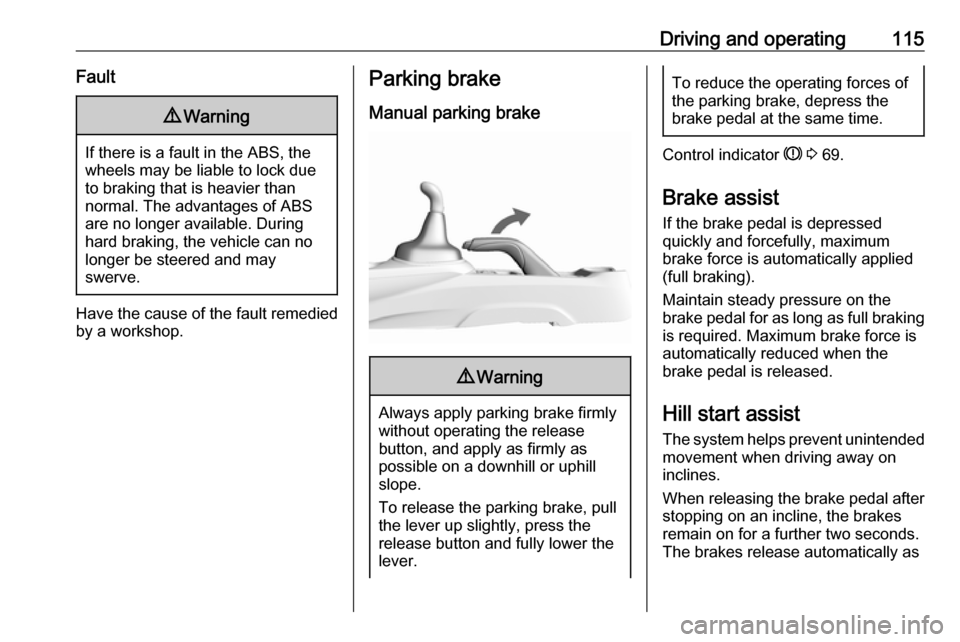
Manual parking brake9 Warning
Always apply parking brake firmly
without operating the release
button, and apply as firmly as
possible on a downhill or uphill
slope.
To release the parking brake, pull
the lever up slightly, press the
release button and fully lower the
lever.
To reduce the operating forces of
the parking brake, depress the
brake pedal at the same time.
Control indicator R 3 69.
Brake assist
If the brake pedal is depressed
quickly and forcefully, maximum
brake force is automatically applied
(full braking).
Maintain steady pressure on the
brake pedal for as long as full braking is required. Maximum brake force is
automatically reduced when the
brake pedal is released.
Hill start assist
The system helps prevent unintended movement when driving away on
inclines.
When releasing the brake pedal after
stopping on an incline, the brakes
remain on for a further two seconds.
The brakes release automatically as
Page 133 of 197

Vehicle care131Vehicle careGeneral Information...................131
Accessories and vehicle modifications .......................... 131
Vehicle storage ........................132
End-of-life vehicle recovery .....132
Vehicle checks ........................... 133
Performing work ......................133
Bonnet ..................................... 133
Engine oil ................................. 134
Engine coolant ......................... 135
Washer fluid ............................ 135
Brakes ..................................... 136
Brake fluid ............................... 136
Vehicle battery ......................... 136
Wiper blade replacement ........138
Bulb replacement .......................138
Halogen headlights ..................139
Fog lights ................................. 140
Front turn signal lights .............141
Tail lights ................................. 141
Side turn signal lights ..............142
Centre high-mounted brake light ......................................... 143
Number plate light ...................143Interior lights ............................ 144
Instrument panel illumination ...144
Electrical system ........................144
Fuses ....................................... 144
Engine compartment fuse box . 146
Instrument panel fuse box .......147
Vehicle tools .............................. 149
Tools ........................................ 149
Wheels and tyres .......................150
Winter tyres ............................. 150
Tyre designations ....................150
Tyre pressure .......................... 150
Tyre pressure monitoring
system .................................... 151
Tread depth ............................. 155
Changing tyre and wheel size . 155 Wheel covers ........................... 155
Tyre chains .............................. 156
Tyre repair kit .......................... 156
Wheel changing .......................159
Spare wheel ............................ 161
Jump starting ............................. 163
Towing ....................................... 165
Towing the vehicle ...................165
Appearance care .......................166
Exterior care ............................ 166
Interior care ............................. 168General Information
Accessories and vehiclemodifications
We recommend the use of genuine
parts and accessories and factory approved parts specific for your
vehicle type. We cannot assess or
guarantee reliability of other products
- even if they have a regulatory or
otherwise granted approval.
Do not make any modifications to the
electrical system, e.g. changes of
electronic control units (chip tuning).Caution
When transporting the vehicle on
a train or on a recovery vehicle, the
mud flaps might be damaged.
Page 138 of 197

136Vehicle careBrakesIn the event of minimum thickness of
the brake lining, a squealing noise
sounds during braking.
Continued driving is possible but
have the brake lining replaced as
soon as possible.
Once new brake linings are installed,
do not brake unnecessarily hard for
the first few journeys.
Brake fluid9 Warning
Brake fluid is poisonous and
corrosive. Avoid contact with eyes, skin, fabrics and painted surfaces.
The brake fluid level must be betweenthe MIN and MAX marks.
If fluid level is below MIN seek the
assistance of a workshop.
Brake and clutch fluid 3 170.
Vehicle battery
The vehicle battery is maintenance-
free provided that the driving profile
allows sufficient charging of the
battery. Short-distance-driving and
frequent engine starts can discharge
the vehicle battery. Avoid the use of
unnecessary electrical consumers.
Batteries do not belong in household
waste. They must be disposed of at
an appropriate recycling collection
point.
Laying up the vehicle for more than
four weeks can lead to vehicle battery
discharge. Disconnect the clamp from
the negative terminal of the vehicle
battery.
Ensure the ignition is switched off
before connecting or disconnecting
the vehicle battery.
The anti-theft alarm siren must be deactivated as follows: Switch theignition on then off, disconnect the
vehicle's battery within 15 seconds.
Battery discharge protection 3 93.
Page 192 of 197

190IndexAAccessories and vehicle modifications .......................... 131
Adjustable air vents ...................100
Airbag and belt tensioners ...........68
Airbag deactivation ................42, 68
Airbag label................................... 37 Airbag system .............................. 37
Air conditioning regular operation ................................ 101
Air conditioning system ................ 95
Air intake .................................... 101
Air vents...................................... 100
Antilock brake system ................ 114
Antilock brake system (ABS) .......70
Anti-theft alarm system ................25
Appearance care ........................166
Ashtrays ....................................... 61
Autostop ..................................... 106
B Battery discharge protection ........93
Battery voltage ............................. 81
Belts.............................................. 35
Bonnet ....................................... 133
Bonnet open ................................. 72
Brake and clutch fluid .................170
Brake and clutch system .............69
Brake assist ............................... 115
Brake fluid .................................. 136Brakes ............................... 114, 136
Breakdown.................................. 165
Bulb replacement ....................... 138
C Capacities .................................. 181
Catalytic converter .....................110
Central locking system ................21
Centre console storage ...............50
Centre high-mounted brake light 143
Changing tyre and wheel size ...155
Charging system .......................... 69
Child locks ................................... 23
Child restraint installation locations ................................... 45
Child restraints.............................. 43
Child restraint systems ................43
Cigarette lighter ........................... 61
City mode ................................... 118
Climate control ............................. 15
Climate control systems ...............94
Clock ............................................ 59
Code ............................................. 79
Collision damage repair ..............185
Control indicators.......................... 65
Control of the vehicle .................103
Controls ........................................ 57
Coolant and antifreeze ...............170
Cornering lights ............................ 89
Cruise control ...................... 72, 119