fuel pressure VAUXHALL VIVA 2017 User Guide
[x] Cancel search | Manufacturer: VAUXHALL, Model Year: 2017, Model line: VIVA, Model: VAUXHALL VIVA 2017Pages: 201, PDF Size: 5.29 MB
Page 157 of 201
Vehicle care155Directional tyresDirectional tyres must be mounted so
that they rotate in the correct
direction. The proper rotation
direction is indicated by a symbol
(e.g. an arrow) on the sidewall.
Tyre pressure
Check the pressure of cold tyres at least every 14 days and before any
long journey.
Do not forget the spare wheel.
This also applies to vehicles with tyre pressure monitoring system.
Unscrew the valve cap.Tyre pressure 3 187.
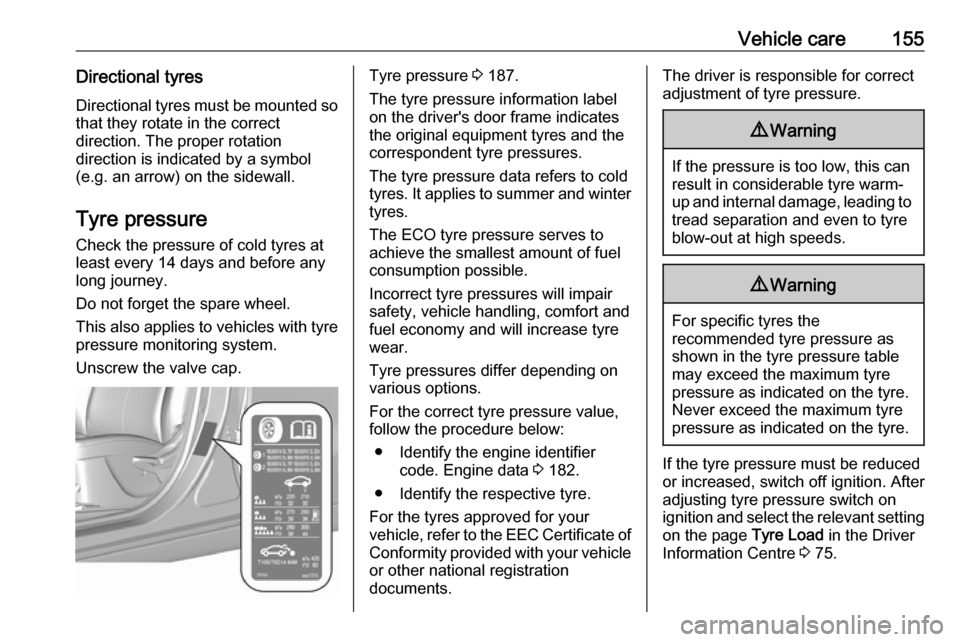
The tyre pressure information label
on the driver's door frame indicates
the original equipment tyres and the
correspondent tyre pressures.
The tyre pressure data refers to cold
tyres. It applies to summer and winter tyres.
The ECO tyre pressure serves to
achieve the smallest amount of fuel
consumption possible.
Incorrect tyre pressures will impair
safety, vehicle handling, comfort and fuel economy and will increase tyre
wear.
Tyre pressures differ depending on
various options.
For the correct tyre pressure value,
follow the procedure below:
● Identify the engine identifier code. Engine data 3 182.
● Identify the respective tyre.
For the tyres approved for your
vehicle, refer to the EEC Certificate of
Conformity provided with your vehicle or other national registration
documents.The driver is responsible for correct adjustment of tyre pressure.9 Warning
If the pressure is too low, this can
result in considerable tyre warm-
up and internal damage, leading to tread separation and even to tyre
blow-out at high speeds.
9 Warning
For specific tyres the
recommended tyre pressure as
shown in the tyre pressure table may exceed the maximum tyre
pressure as indicated on the tyre.
Never exceed the maximum tyre
pressure as indicated on the tyre.
If the tyre pressure must be reduced
or increased, switch off ignition. After
adjusting tyre pressure switch on
ignition and select the relevant setting on the page Tyre Load in the Driver
Information Centre 3 75.
Page 173 of 201
Vehicle care171If using a car wash, comply with the
car wash manufacturer's instructions.
The windscreen wiper and rear
window wiper must be switched off.
Remove antenna and external
accessories such as roof racks etc.
If you wash your vehicle by hand,
make sure that the insides of the
wheel housings are also thoroughly
rinsed out.
Clean edges and folds on opened
doors and the bonnet as well as the
areas they cover.
Clean bright metal mouldings with a
cleaning solution approved for
aluminium to avoid damages.Caution
Always use a cleaning agent with
a pH value of four to nine.
Do not use cleaning agents on hot surfaces.
Have the door hinges of all doors
greased by a workshop.
Do not clean the engine compartment with a steam-jet or high-pressure jet
cleaner.
Thoroughly rinse and leather-off the vehicle. Rinse leather frequently. Use
separate leathers for painted and
glass surfaces: remnants of wax on
the windows will impair vision.
Exterior lights
Headlight and other light covers are
made of plastic. Do not use any
abrasive or caustic agents, do not use
an ice scraper, and do not clean them
dry.
Polishing and waxing
Wax painted parts of the vehicle
regularly (at the latest when water no longer beads). Otherwise, the
paintwork will dry out.
Polishing is necessary only if the paint
has become dull or if solid deposits
have become attached to it.
Paintwork polish with silicone forms a
protective film, making waxing
unnecessary.
Unpainted plastic body parts must not be treated with wax or polishing
agents.Windows and windscreen wiper
blades
Use a soft lint-free cloth or chamois
leather together with window cleaner
and insect remover.
When cleaning the rear window from
inside, always wipe in parallel to the
heating element to prevent damage.
For mechanical removal of ice, use a
sharp-edged ice scraper. Press the
scraper firmly against the glass so
that no dirt can get under it and
scratch the glass.
Clean smearing wiper blades with a
soft cloth and window cleaner.
SunroofNever clean with solvents or abrasive
agents, fuels, aggressive media (e.g.
paint cleaner, acetone-containing
solutions etc.), acidic or highly
alkaline media or abrasive pads. Do
not apply wax or polishing agents to
the sunroof.
Wheels and tyres
Do not use high-pressure jet
cleaners.
Page 197 of 201

195Cupholders .................................. 51
Curtain airbag system .................. 43
D
Danger, Warnings and Cautions ...4
Daytime running lights .................92
Declaration of conformity ............188
Door open .................................... 75
Doors ............................................ 24
Driver assistance systems ..........122
Driver Information Centre .............75
Driving hints ................................ 106
E Electric adjustment ......................27
Electrical system......................... 149
Electronic climate control system 100
Electronic driving programmes ..116
Electronic Stability Control.......... 120
Electronic Stability Control and Traction Control system ............72
Electronic Stability Control off....... 72
End-of-life vehicle recovery .......136
Engine compartment fuse box ...150
Engine coolant ........................... 139
Engine coolant temperature ........73
Engine coolant temperature gauge ....................................... 66
Engine data ............................... 182
Engine exhaust .......................... 113
Engine identification ...................178Engine oil ................... 138, 175, 179
Engine oil pressure ......................73
Event data recorders ..................192
Exit lighting .................................. 95
Exterior care .............................. 170
Exterior light ................................. 74
Exterior lighting ......................12, 91
Exterior mirrors ............................. 27
F Fault ........................................... 116
First aid ......................................... 56
First aid kit ................................... 56
Fixed air vents ........................... 104
Fog light ....................................... 74
Fog lights ................................... 145
Folding mirrors ............................. 27
Front airbag system .....................42
Front doors ................................... 24
Front fog lights ............................. 93
Front seats.................................... 34
Front turn signal lights ...............145
Fuel............................................. 127
Fuel consumption - CO 2-
Emissions ............................... 133
Fuel for liquid gas operation .......128
Fuel for petrol engines ...............127
Fuel gauge ................................... 64 Fuel selector ................................ 65
Fuses ......................................... 149G
Gauges ......................................... 63
Gear shifting ................................. 72
Glovebox ..................................... 51
H
Halogen headlights ....................143
Hand brake ......................... 117, 118
Hazard warning flashers ..............92
Headlight flash ............................. 91
Headlight range adjustment ........92
Headlights..................................... 91
Headlights when driving abroad ..92
Head restraint adjustment .............8
Head restraints ............................ 33
Heated mirrors ............................. 28
Heated rear window ..................... 31
Heated steering wheel .................59
Heating ........................................ 36
Heating and ventilation system ...97
High beam ............................. 74, 91
Hill start assist ........................... 118
Horn ....................................... 13, 60
I
Identification plate .....................178
Ignition switch positions .............107
Immobiliser ............................ 26, 74
Indicators ...................................... 63
Info display ................................... 80
Information displays...................... 75