CITY VAUXHALL VIVA 2019 Owner's Manual
[x] Cancel search | Manufacturer: VAUXHALL, Model Year: 2019, Model line: VIVA, Model: VAUXHALL VIVA 2019Pages: 189, PDF Size: 5.22 MB
Page 13 of 189

In brief111Central locking system ..........20
Power windows .....................28
2 Exterior mirrors .....................26
3 Cruise control .....................115
Speed limiter ...................... 116
Heated steering wheel ..........58
4 Turn lights, headlight
flash, low beam and high
beam ..................................... 90
Exit lighting ........................... 92
Parking lights ........................ 91
5 Side air vents ...................... 100
6 Instruments .......................... 62
7 Driver Information Centre ...... 73
8 Steering wheel controls .......58
9 Windscreen wiper,
windscreen washer
system, rear window
wiper, rear window washer
system ................................... 59
10 Centre air vents .................. 100
11 Hazard warning flashers ......89
12 Info Display ........................... 7813Anti-theft alarm system
status LED ........................... 25
14 Infotainment system
15 Glovebox .............................. 50
16 Climate control system .......... 94
17 AUX input, USB input
18 Selector lever .....................109
19 Seat heating .......................... 35
20 Parking brake ......................111
21 Ignition switch with
steering wheel lock ............103
22 Horn ..................................... 59
Driver airbag ........................ 41
23 Bonnet release lever ..........126
24 Steering wheel adjustment ..58
25 Fuse box ............................ 141
26 Traction Control system .....112
City mode ............................ 113
Stop-start system ................105
Lane departure warning .....119
Electronic Stability Control . 11327 Light switch .......................... 88
Headlight range
adjustment ........................... 89
Front fog light ........................ 90
Rear fog light ........................ 90
Brightness of instrument
panel illumination ..................91
Page 66 of 189
64Instruments and controls
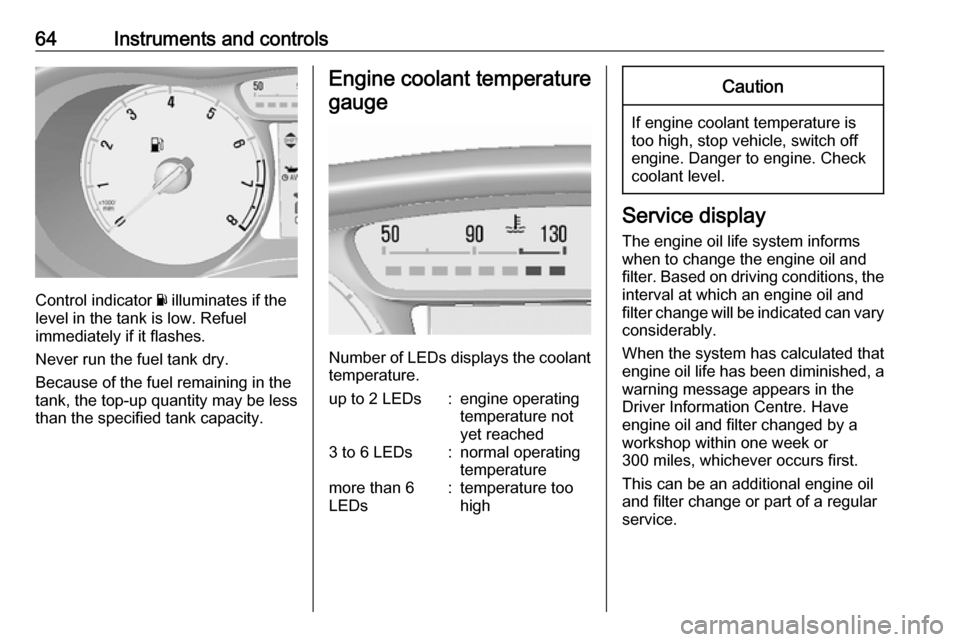
Control indicator Y illuminates if the
level in the tank is low. Refuel
immediately if it flashes.
Never run the fuel tank dry.
Because of the fuel remaining in the
tank, the top-up quantity may be less
than the specified tank capacity.
Engine coolant temperature
gauge
Number of LEDs displays the coolant temperature.
up to 2 LEDs:engine operating
temperature not
yet reached3 to 6 LEDs:normal operating
temperaturemore than 6
LEDs:temperature too
highCaution
If engine coolant temperature is
too high, stop vehicle, switch off
engine. Danger to engine. Check
coolant level.
Service display
The engine oil life system informs
when to change the engine oil and
filter. Based on driving conditions, the interval at which an engine oil and
filter change will be indicated can vary
considerably.
When the system has calculated that
engine oil life has been diminished, a warning message appears in theDriver Information Centre. Have
engine oil and filter changed by a
workshop within one week or
300 miles, whichever occurs first.
This can be an additional engine oil
and filter change or part of a regular
service.
Page 87 of 189

Instruments and controls85SOS button
Press [ to establish a priority
emergency connection to a specially
trained emergency advisor.
Status LED
Green: The system is ready with activated transmission of the vehicle
location.
Green flashing: The system is on a
call.
Red: A problem arose.
Off: The system is ready with
deactivated transmission of the
vehicle location or the system is in
standby mode.
Red / green flashing for a short period
of time: The transmission of the
vehicle location has been
deactivated.
OnStar services
General services
If you need any information e.g.
opening hours, points of interest and
destinations or if you need any
support e.g. in the case of a vehiclebreakdown, a flat tyre and empty fuel
tank, press Z to establish a
connection to an advisor.
Emergency services
In the case of an emergency situation,
press [ and talk to an advisor. The
advisor then contacts emergency or
assistance service providers and
directs them to your vehicle.
In the case of an accident with
activation of airbags or belt
tensioners, an automatic emergency
call is established. The advisor is
immediately connected to your
vehicle to see whether help is
needed.
Wi-Fi hotspot
The Wi-Fi hotspot of the vehicle
provides internet connectivity with a
maximum speed of 4G/LTE.
Notice
The Wi-Fi hotspot functionality is not available for all markets.
Notice
Some mobile devices connect to Wi-
Fi hotspots automatically and use
mobile data capacity in thebackground, even if they are not in
use. This includes automatic
updates, downloads, as well as
programme or app synchronisation
traffic. The data volume purchased
via OnStar might be consumed
rapidly. Turn off automatic
synchronisations in the settings of
your device.
Up to seven devices may be
connected.
To connect a mobile device with the
Wi-Fi hotspot:
1. Press j and then select Wi-Fi
settings on the Info Display. The settings displayed include the Wi- Fi hotspot name (SSID),
password and connection type.
2. Start a Wi-Fi network search on your mobile device.
3. Select your vehicle hotspot (SSID) when listed.
4. When prompted, enter the password on your mobile device.
Page 104 of 189

102Driving and operatingDriving and
operatingDriving hints ............................... 102
Control of the vehicle ...............102
Steering ................................... 103
Starting and operating ...............103
New vehicle running-in ............103
Ignition switch positions ...........103
Retained power off ..................104
Starting the engine ..................105
Overrun cut-off ........................ 105
Stop-start system ....................105
Parking .................................... 107
Engine exhaust .......................... 108
Catalytic converter ...................108
Manual transmission ..................109
Brakes ........................................ 110
Antilock brake system .............110
Parking brake .......................... 111
Brake assist ............................. 111
Hill start assist ......................... 111
Ride control systems .................112
Traction Control system ..........112
Electronic Stability Control ......113
City mode ................................ 113Driver assistance systems .........115
Cruise control .......................... 115
Speed limiter ........................... 116
Parking assist .......................... 117
Lane departure warning ..........119
Fuel ............................................ 120
Fuel for petrol engines .............120
Refuelling ................................ 121Driving hints
Control of the vehicle Never coast with engine not
running
Many systems will not function in this
situation (e.g. brake servo unit, power steering). Driving in this manner is a
danger to yourself and others.
All systems function during an
Autostop.
Stop-start system 3 105.
Idle boost
If charging of the vehicle battery is
required due to battery condition, the
power output of the generator must
be increased. This will be achieved by an idle boost which may be audible.
A message appears in the Driver
Information Centre.
Pedals
To ensure the pedal travel is
uninhibited, there must be no mats in
the area of the pedals.
Page 115 of 189

Driving and operating113Electronic Stability Control
Electronic Stability Control (ESC)
improves driving stability when
necessary, regardless of the type of
road surface or tyre grip.
As soon as the vehicle starts to
swerve (understeer / oversteer),
engine output is reduced and the wheels are braked individually.
ESC operates in combination with the Traction Control system (TC). It
prevents the drive wheels from
spinning.
ESC is operational after each engine
start as soon as the control indicator
b extinguishes.
When ESC operates b flashes.
9 Warning
Do not let this special safety
feature tempt you into taking risks
when driving.
Adapt speed to the road
conditions.
Control indicator b 3 70.
Deactivation
For very high-performance driving
ESC can be deactivated:
Press and hold t for a minimum of
5 seconds. Control indicator t
illuminates.
ESC is reactivated by pressing t
again. If the TC system was
previously disabled, both TC and
ESC are reactivated. k and t
extinguish when TC and ESC are reactivated.
ESC is also reactivated the next time
the ignition is switched on.
Fault
If there is a fault in the system, the
control indicator b illuminates
continuously and a warning code appears in the Driver Information
Centre. The system is not
operational.
Have the cause of the fault remedied
by a workshop.
City mode City mode is a feature which enables
increased steering assistance during
lower speed conditions, e.g. city
traffic or parking. Steering assistance
is increased for greater convenience.
Page 116 of 189
114Driving and operatingActivation
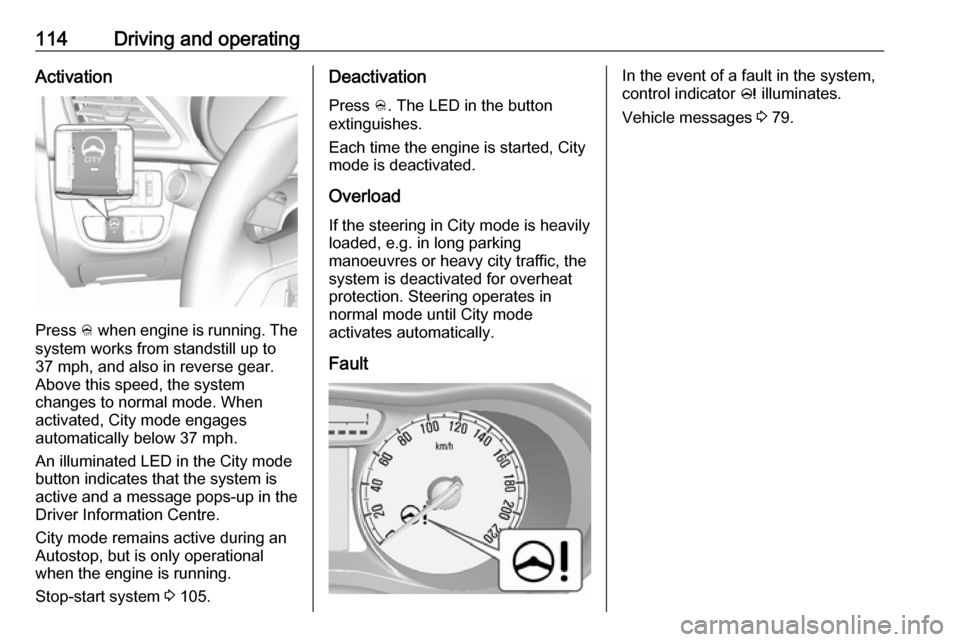
Press B when engine is running. The
system works from standstill up to
37 mph, and also in reverse gear. Above this speed, the system
changes to normal mode. When
activated, City mode engages
automatically below 37 mph.
An illuminated LED in the City mode
button indicates that the system is
active and a message pops-up in the
Driver Information Centre.
City mode remains active during an
Autostop, but is only operational when the engine is running.
Stop-start system 3 105.
Deactivation
Press B. The LED in the button
extinguishes.
Each time the engine is started, City
mode is deactivated.
Overload If the steering in City mode is heavily
loaded, e.g. in long parking
manoeuvres or heavy city traffic, the
system is deactivated for overheat
protection. Steering operates in
normal mode until City mode
activates automatically.
FaultIn the event of a fault in the system,
control indicator c illuminates.
Vehicle messages 3 79.
Page 159 of 189
Vehicle care157Jump starting
Do not start with a quick charger.
A vehicle with a discharged vehicle
battery can be started using jump
leads and the vehicle battery of
another vehicle.9 Warning
Be extremely careful when starting
with jump leads. Any deviation
from the following instructions can
lead to injuries or damage caused
by battery explosion or damage to the electrical systems of both
vehicles.
9 Warning
Avoid contact of the battery with
eyes, skin, fabrics and painted
surfaces. The fluid contains
sulphuric acid which can cause
injuries and damage in the event
of direct contact.
● Never expose the battery to naked flames or sparks.
● A discharged vehicle battery canalready freeze at a temperature
of 0 °C. Defrost the frozen battery
before connecting jump leads.
● Wear eye protection and protective clothing when
handling a battery.
● Use a booster battery with the same voltage (12 V). Its capacity
(Ah) must not be much less than
that of the discharged battery.
● Use jump leads with insulated terminals and a cross section of
at least 16 mm 2
.
● Do not disconnect the discharged
vehicle battery from the vehicle.
● Switch off all unnecessary electrical consumers.
● Do not lean over the battery during jump starting.
● Do not allow the terminals of one
lead to touch those of the other
lead.
● The vehicles must not come into contact with each other during
the jump starting process.● Apply the parking brake, transmission in neutral.
● Open the positive terminal protection caps of both vehicle
batteries.
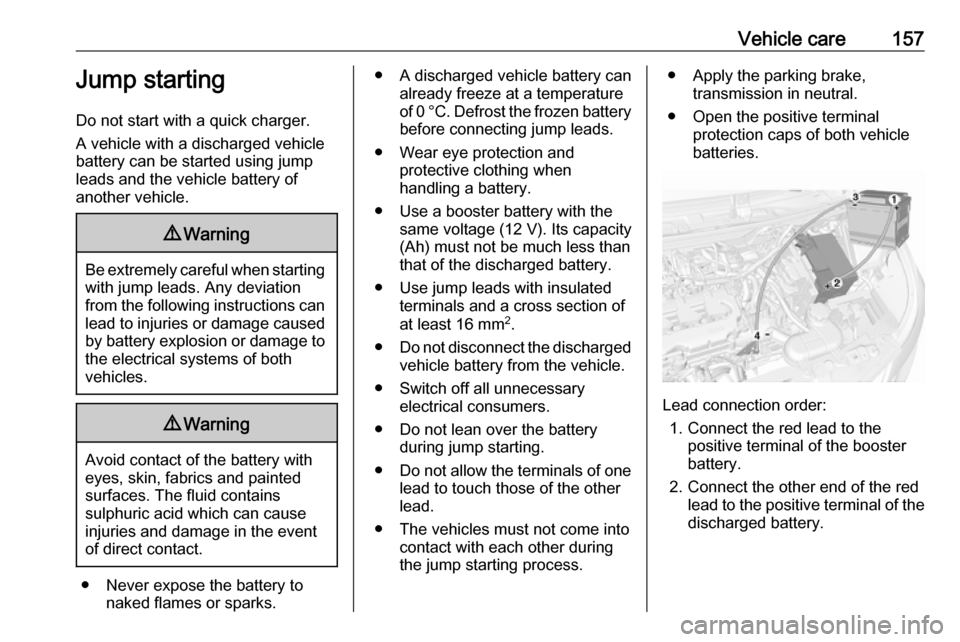
Lead connection order:
1. Connect the red lead to the positive terminal of the booster
battery.
2. Connect the other end of the red lead to the positive terminal of the
discharged battery.
Page 175 of 189

Customer information173Customer
informationCustomer information ................173
Declaration of conformity .........173
REACH .................................... 176
Software acknowledgement ....176
Registered trademarks ............177
Vehicle data recording and pri‐
vacy ........................................... 178
Event data recorders ...............178
Radio Frequency Identification (RFID) ..................................... 181Customer information
Declaration of conformity
Radio transmission systems
This vehicle has systems that
transmit and / or receive radio waves
subject to Directive 2014/53/EU. The
manufacturers of the systems listed
below declare conformity with
Directive 2014/53/EU. The full text of
the EU declaration of conformity for each system is available at the
following internet address:
www.opel.com/conformity.
Importer is
Opel / Vauxhall, Bahnhofsplatz,
65423 Ruesselsheim am Main,
Germany.
Antenna
INFAC ELECS
Saneop-ro 155beon-gi Gwonseon-
gu, Suwon city, Gyeonggi-do, Korea
Operation frequency: N/A
Maximum output: N/AAntenna
Laird
Daimlerring 31, 31135 Hildesheim, Germany
Operation frequency: N/A
Maximum output: N/A
Immobiliser
Robert Bosch GmbH
Robert Bosch Platz 1, 70839
Gerlingen, Germany
Operation frequency: 125 kHz
Maximum output:
5.1 dBµA/m @ 10 m
Infotainment system R 4.0 / Navi 4.0
LG Electronics
Electronics European Shared Service
Center B.V., Krijgsman 1, 1186 DM
Amstelveen, The NetherlandsOperation
frequency (MHz)Maximum output
(dBm)2400.0 - 2483.542400.0 - 2483.5135725.0 - 5850.013
Page 184 of 189

182IndexAAccessories and vehicle modifications .......................... 124
Adjustable air vents ...................100
Airbag and belt tensioners ...........68
Airbag deactivation ................43, 68
Airbag label................................... 38 Airbag system .............................. 38
Air conditioning regular operation ................................ 101
Air conditioning system ................ 95
Air intake .................................... 101
Air vents...................................... 100
Antilock brake system ................ 110
Antilock brake system (ABS) .......70
Anti-theft alarm system ................25
Appearance care ........................159
Ashtrays ....................................... 62
Autostop ..................................... 105
B Battery discharge protection ........93
Battery voltage ............................. 81
Belts.............................................. 36
Bonnet ....................................... 126
Bonnet open ................................. 72
Brake and clutch fluid .................163
Brake and clutch system .............69
Brake assist ............................... 111
Brake fluid .................................. 129Brakes ............................... 110, 129
Breakdown.................................. 158
Bulb replacement ....................... 132
C Catalytic converter .....................108
Central locking system ................20
Centre console storage ...............51
Centre high-mounted brake light 136
Changing tyre and wheel size ...148
Charging system .......................... 69
Child locks ................................... 22
Child restraint installation locations ................................... 47
Child restraints.............................. 44
Child restraint systems ................44
Cigarette lighter ........................... 62
City mode ................................... 113
Climate control ............................. 15
Climate control systems ...............94
Clock ............................................ 60
Code ............................................. 79
Control indicators.......................... 65
Control of the vehicle .................102
Controls ........................................ 58
Coolant and antifreeze ...............163
Cornering lights ............................ 89
Cruise control ...................... 72, 115
Cupholders .................................. 50
Curtain airbag system .................. 43