warning VAUXHALL VIVARO 2014.5 Repair Manual
[x] Cancel search | Manufacturer: VAUXHALL, Model Year: 2014.5, Model line: VIVARO, Model: VAUXHALL VIVARO 2014.5Pages: 189, PDF Size: 4.16 MB
Page 134 of 189
132Vehicle care
■ Fill up the washer fluid reservoir.
■ Check the engine oil level.
■ Check the coolant level.
■ Fit the number plate, if necessary.
End-of-life vehicle
recovery
Information on end-of-life vehicle
recovery centres and the recycling of
end-of-life vehicles is available on our website. Only entrust this work to an
authorised recycling centre.Vehicle checks
Performing work9 Warning
Only perform engine compartment
checks when the ignition is off.
The cooling fan may start
operating even if the ignition is off.
9 Danger
The ignition system generates
extremely high voltages. Do not
touch.
The caps for topping up the engine oil, the coolant, the washer fluid and the
oil dipstick handle are yellow for ease
of identification.
Bonnet
Opening
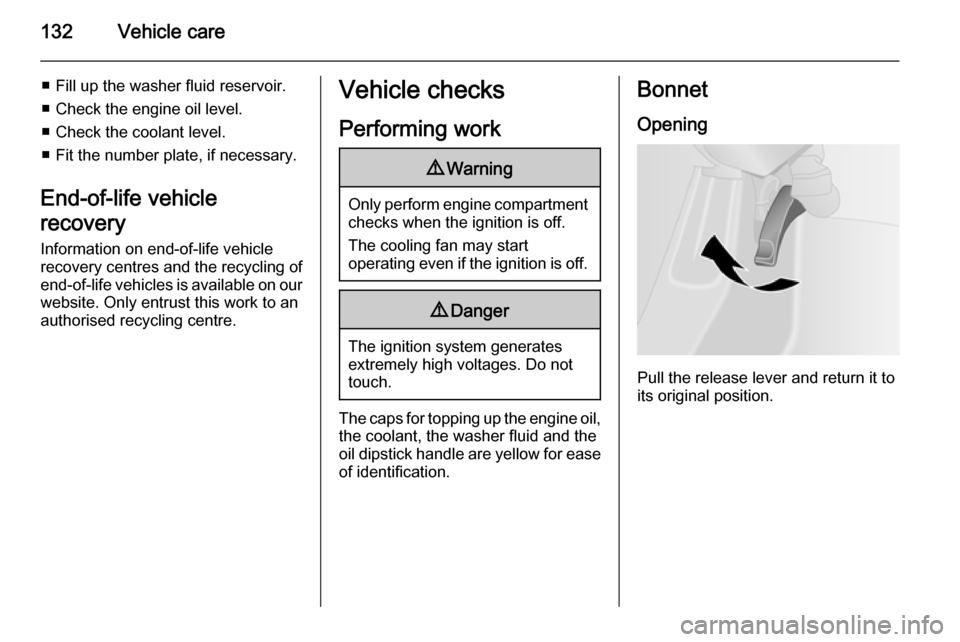
Pull the release lever and return it to
its original position.
Page 137 of 189

Vehicle care135Engine coolantThe coolant provides freeze
protection down to approx. -28 °C.Caution
Only use approved antifreeze.
Coolant level
Caution
Too low a coolant level can cause engine damage.
If the cooling system is cold, the
coolant level should be just above the
MIN mark. Top up if the level is low.9Warning
Allow the engine to cool before
opening the cap. Carefully open
the cap, relieving the pressure
slowly.
Top up with antifreeze. If no
antifreeze is available, use clean tap
water or distilled water. Install the cap
tightly. Have the antifreeze
concentration checked and have the
cause of the coolant loss remedied by a workshop.
If a substantial amount of coolant is
required, it will be necessary to bleed
any trapped air from the cooling
system. Seek the assistance of a
workshop.
If the coolant temperature is too high, control indicator W 3 84 illuminates
red in the instrument cluster, together
with C 3 82. Consult a workshop if
coolant level is sufficient.
Power steering fluidCaution
Extremely small amounts of
contamination can cause steering
system damage and cause it to not work properly. Do not allow
contaminates to contact the fluid
side of the reservoir cap or from
entering the reservoir.
The power steering fluid reservoir is located below the front wheel arch,
behind a trim panel.
The fluid level normally does not need
to be checked. If an unusual noise is
heard during steering or if the power
steering reacts conspicuously, seek
the assistance of a workshop.
Page 138 of 189
136Vehicle care
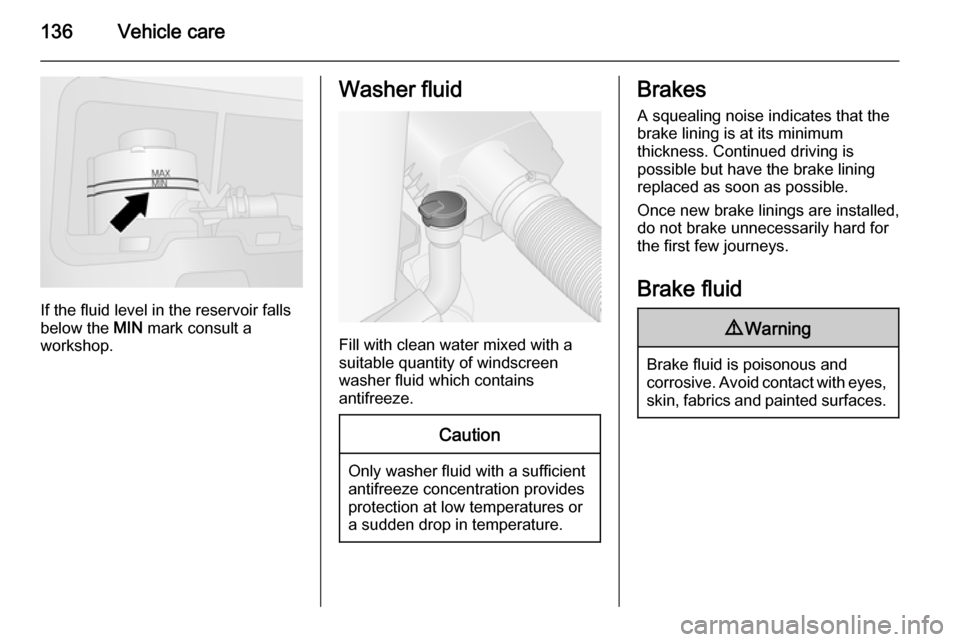
If the fluid level in the reservoir falls
below the MIN mark consult a
workshop.
Washer fluid
Fill with clean water mixed with a
suitable quantity of windscreen
washer fluid which contains
antifreeze.
Caution
Only washer fluid with a sufficient
antifreeze concentration provides
protection at low temperatures or
a sudden drop in temperature.
Brakes
A squealing noise indicates that the
brake lining is at its minimum
thickness. Continued driving is
possible but have the brake lining
replaced as soon as possible.
Once new brake linings are installed,
do not brake unnecessarily hard for
the first few journeys.
Brake fluid9 Warning
Brake fluid is poisonous and
corrosive. Avoid contact with eyes, skin, fabrics and painted surfaces.
Page 139 of 189
Vehicle care137
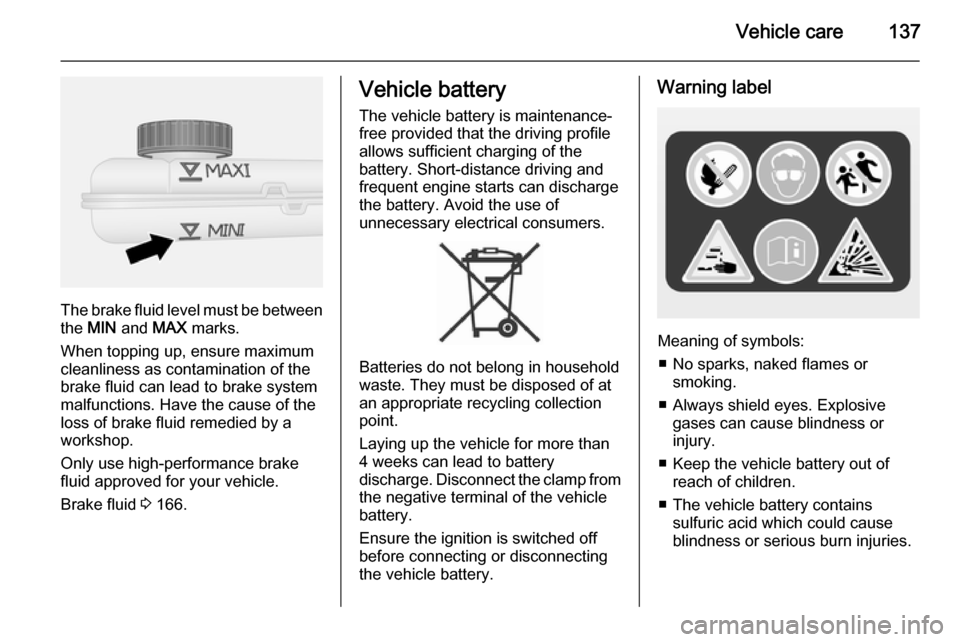
The brake fluid level must be betweenthe MIN and MAX marks.
When topping up, ensure maximum cleanliness as contamination of the
brake fluid can lead to brake system
malfunctions. Have the cause of the
loss of brake fluid remedied by a
workshop.
Only use high-performance brake
fluid approved for your vehicle.
Brake fluid 3 166.
Vehicle battery
The vehicle battery is maintenance-
free provided that the driving profile
allows sufficient charging of the
battery. Short-distance driving and
frequent engine starts can discharge
the battery. Avoid the use of
unnecessary electrical consumers.
Batteries do not belong in household
waste. They must be disposed of at
an appropriate recycling collection
point.
Laying up the vehicle for more than
4 weeks can lead to battery
discharge. Disconnect the clamp from the negative terminal of the vehicle
battery.
Ensure the ignition is switched off
before connecting or disconnecting
the vehicle battery.
Warning label
Meaning of symbols:
■ No sparks, naked flames or smoking.
■ Always shield eyes. Explosive gases can cause blindness or
injury.
■ Keep the vehicle battery out of reach of children.
■ The vehicle battery contains sulfuric acid which could cause
blindness or serious burn injuries.
Page 149 of 189

Vehicle care147
No.Circuit1Vehicle battery (with electronic
key system)2APC battery backup (with elec‐
tronic key system)3Passenger compartment heater4Adaptations5Adaptations6Passenger compartment heater7Additional air conditioning8Additional heating9Electric exterior mirrors, addi‐
tional adaptations10Heated exterior mirrors11Radio, multimedia, electric exte‐
rior mirrors, diagnostic socket12Multimedia, trailer hitch13Fuel injection system, courtesy
lightsNo.Circuit14Fuel injection system, tyre pres‐ sure monitoring system, elec‐
tronic key system15Hazard warning flashers, turn and lane-change signals16Central locking17Left-hand high beam, right-hand
low beam, tail lights, left-hand
daytime running light18Front fog lights, rear fog lights,
number plate lighting19Alarm, horn, automatic light
control, wiper20Instrument cluster21Light switch22Rear window wiper, windscreen
washer pump, horn23APC general battery24Reversing lights25Engine start-stop buttonNo.Circuit26Fuel injection, starter27Airbag, steering column lock28Passenger power window29Power steering30Brake lights31APC battery backup (with elec‐
tronic key system)32Service display33Cigarette lighter, power outlet34Right-hand high beam, left-
hand low beam, headlights,
right-hand daytime running light35Brake lights, ABS, immobiliser36Interior lighting, air conditioning37Starting with electronic key
system38Rear window wiper39Warning chimes
Page 152 of 189
150Vehicle care
Incorrect tyre pressures will impair
safety, vehicle handling, comfort and
fuel economy and will increase tyre
wear.
The tyre pressure tables show all
possible tyre combinations 3 178.
For the tyres approved for your
vehicle, refer to the EEC Certificate of Conformity provided with your vehicle
or other national registration
documents.
The driver is responsible for correct
adjustment of tyre pressure.9 Warning
If the pressure is too low, this can
result in considerable tyre warm-
up and internal damage, leading to tread separation and even to tyre
blow-out at high speeds.
Tyre pressure monitoring
system
The tyre pressure monitoring system
checks the pressure of all four wheels once a minute when vehicle speed
exceeds a certain limit.Caution
Tyre pressure monitoring system
warns only about low tyre pressure
condition and does not replace
regular tyre maintenance by the
driver.
All wheels must be equipped with pressure sensors and the tyres must
have the prescribed pressure.
Notice
In countries where the tyre pressure
monitoring system is legally
required, the use of wheels without
pressure sensors will invalidate the
vehicle type approval.
Tyre pressures in display
The current tyre pressures can be
shown in the Driver Information
Centre 3 86.
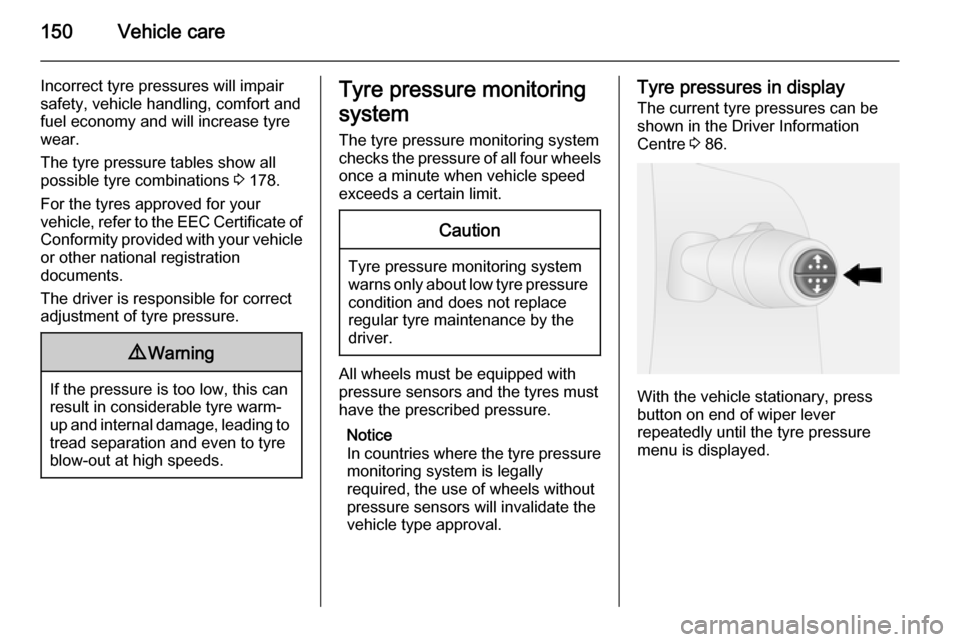
With the vehicle stationary, press
button on end of wiper lever
repeatedly until the tyre pressure
menu is displayed.
Page 154 of 189
152Vehicle care
Relearn function
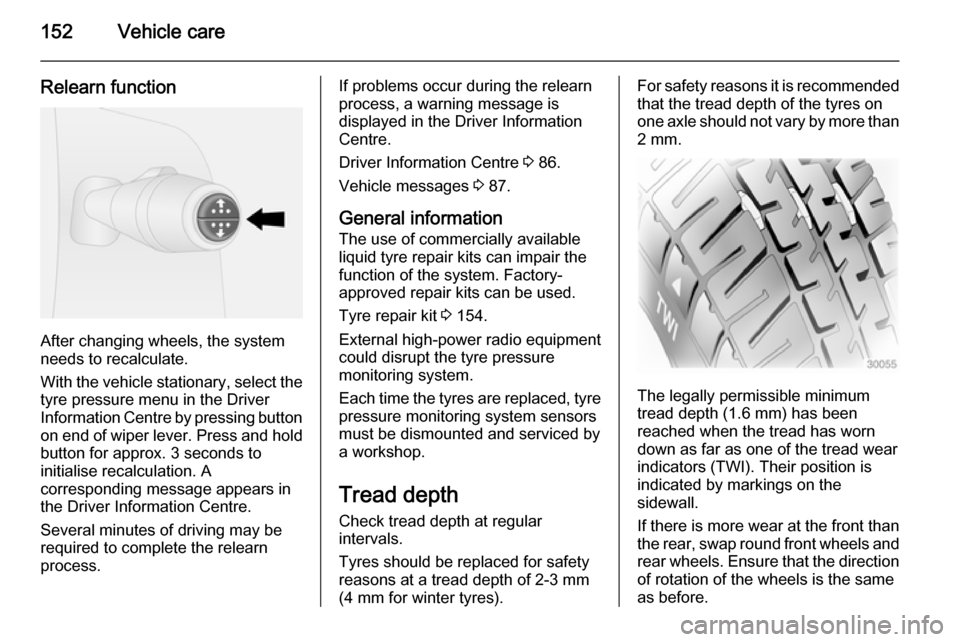
After changing wheels, the system
needs to recalculate.
With the vehicle stationary, select the tyre pressure menu in the Driver
Information Centre by pressing button
on end of wiper lever. Press and hold button for approx. 3 seconds to
initialise recalculation. A
corresponding message appears in
the Driver Information Centre.
Several minutes of driving may be
required to complete the relearn
process.
If problems occur during the relearn
process, a warning message is
displayed in the Driver Information
Centre.
Driver Information Centre 3 86.
Vehicle messages 3 87.
General information The use of commercially available
liquid tyre repair kits can impair the
function of the system. Factory-
approved repair kits can be used.
Tyre repair kit 3 154.
External high-power radio equipment
could disrupt the tyre pressure
monitoring system.
Each time the tyres are replaced, tyre
pressure monitoring system sensors
must be dismounted and serviced by a workshop.
Tread depth
Check tread depth at regular
intervals.
Tyres should be replaced for safety
reasons at a tread depth of 2-3 mm
(4 mm for winter tyres).For safety reasons it is recommended
that the tread depth of the tyres on
one axle should not vary by more than
2 mm.
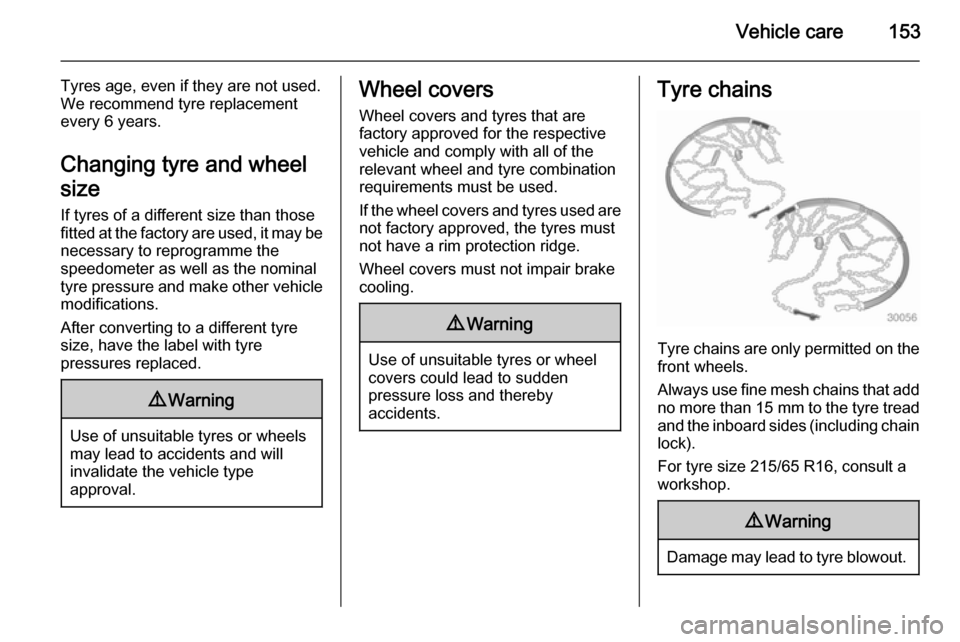
The legally permissible minimum
tread depth (1.6 mm) has been
reached when the tread has worn
down as far as one of the tread wear
indicators (TWI). Their position is
indicated by markings on the
sidewall.
If there is more wear at the front than
the rear, swap round front wheels and
rear wheels. Ensure that the direction
of rotation of the wheels is the same
as before.
Page 155 of 189
Vehicle care153
Tyres age, even if they are not used.
We recommend tyre replacement
every 6 years.
Changing tyre and wheel
size If tyres of a different size than those
fitted at the factory are used, it may be necessary to reprogramme the
speedometer as well as the nominal
tyre pressure and make other vehicle modifications.
After converting to a different tyre
size, have the label with tyre
pressures replaced.9 Warning
Use of unsuitable tyres or wheels
may lead to accidents and will
invalidate the vehicle type
approval.
Wheel covers
Wheel covers and tyres that are
factory approved for the respective
vehicle and comply with all of the
relevant wheel and tyre combination requirements must be used.
If the wheel covers and tyres used are
not factory approved, the tyres must
not have a rim protection ridge.
Wheel covers must not impair brake
cooling.9 Warning
Use of unsuitable tyres or wheel
covers could lead to sudden
pressure loss and thereby
accidents.
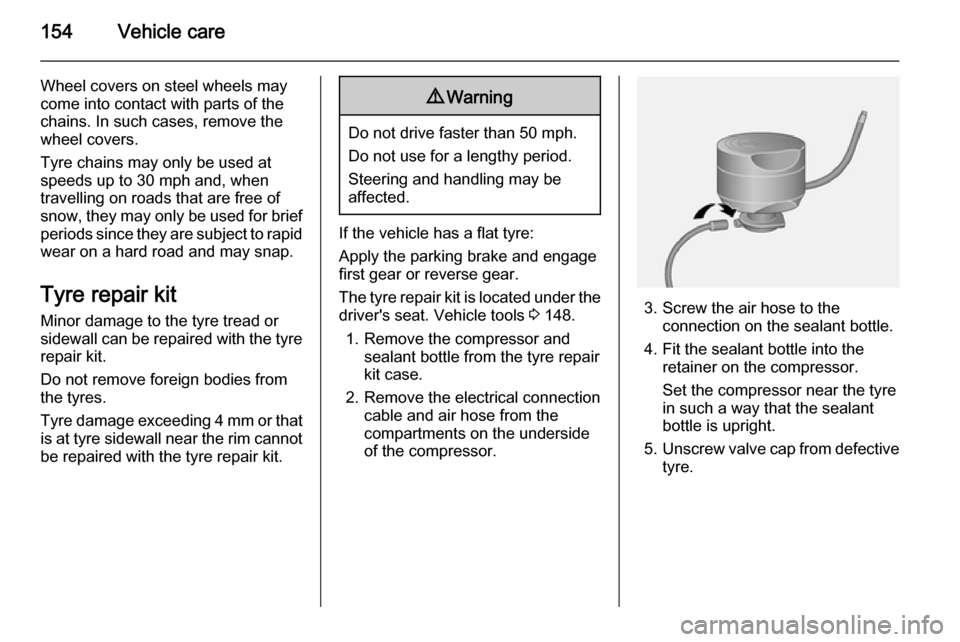
Tyre chains
Tyre chains are only permitted on the
front wheels.
Always use fine mesh chains that add no more than 15 mm to the tyre tread
and the inboard sides (including chain lock).
For tyre size 215/65 R16, consult a
workshop.
9 Warning
Damage may lead to tyre blowout.
Page 156 of 189
154Vehicle care
Wheel covers on steel wheels maycome into contact with parts of the
chains. In such cases, remove the
wheel covers.
Tyre chains may only be used at
speeds up to 30 mph and, when
travelling on roads that are free of
snow, they may only be used for brief
periods since they are subject to rapid wear on a hard road and may snap.
Tyre repair kit
Minor damage to the tyre tread or
sidewall can be repaired with the tyre repair kit.
Do not remove foreign bodies from
the tyres.
Tyre damage exceeding 4 mm or that
is at tyre sidewall near the rim cannot
be repaired with the tyre repair kit.9 Warning
Do not drive faster than 50 mph.
Do not use for a lengthy period.
Steering and handling may be
affected.
If the vehicle has a flat tyre:
Apply the parking brake and engage
first gear or reverse gear.
The tyre repair kit is located under the
driver's seat. Vehicle tools 3 148.
1. Remove the compressor and sealant bottle from the tyre repairkit case.
2. Remove the electrical connection cable and air hose from the
compartments on the underside
of the compressor.
3. Screw the air hose to the connection on the sealant bottle.
4. Fit the sealant bottle into the retainer on the compressor.
Set the compressor near the tyre
in such a way that the sealant
bottle is upright.
5. Unscrew valve cap from defective
tyre.
Page 158 of 189
156Vehicle care
damaged. Seek the assistance of
a workshop.
Drain excess tyre pressure with
the button beside the pressure
indicator.
Do not run the compressor for
longer than 15 minutes.
13. Detach the tyre repair kit.
14. Remove any excess sealant using a cloth.
15. Take the label indicating maximum permitted speed from
the tyre repair kit and affix in the driver's field of view.
16. Store the sealant bottle in the plastic bag. Return tyre repair kitto case and stow under the
driver's seat.
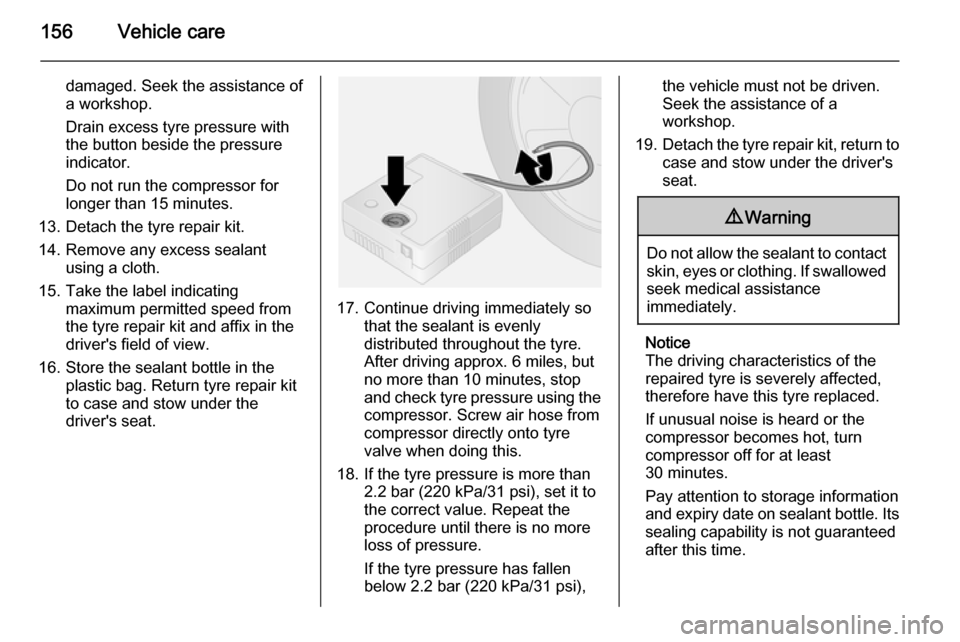
17. Continue driving immediately so that the sealant is evenly
distributed throughout the tyre.
After driving approx. 6 miles, but
no more than 10 minutes, stop
and check tyre pressure using the
compressor. Screw air hose from
compressor directly onto tyre
valve when doing this.
18. If the tyre pressure is more than 2.2 bar (220 kPa/31 psi), set it to
the correct value. Repeat the
procedure until there is no more
loss of pressure.
If the tyre pressure has fallen
below 2.2 bar (220 kPa/31 psi),
the vehicle must not be driven.
Seek the assistance of a
workshop.
19. Detach the tyre repair kit, return to
case and stow under the driver's
seat.9 Warning
Do not allow the sealant to contact
skin, eyes or clothing. If swallowed seek medical assistance
immediately.
Notice
The driving characteristics of the
repaired tyre is severely affected,
therefore have this tyre replaced.
If unusual noise is heard or the
compressor becomes hot, turn
compressor off for at least
30 minutes.
Pay attention to storage information
and expiry date on sealant bottle. Its
sealing capability is not guaranteed
after this time.