radio VAUXHALL VIVARO 2014.5 Owner's Manual
[x] Cancel search | Manufacturer: VAUXHALL, Model Year: 2014.5, Model line: VIVARO, Model: VAUXHALL VIVARO 2014.5Pages: 189, PDF Size: 4.16 MB
Page 8 of 189
6In briefIn briefInitial drive informationVehicle unlockingUnlocking with remote control
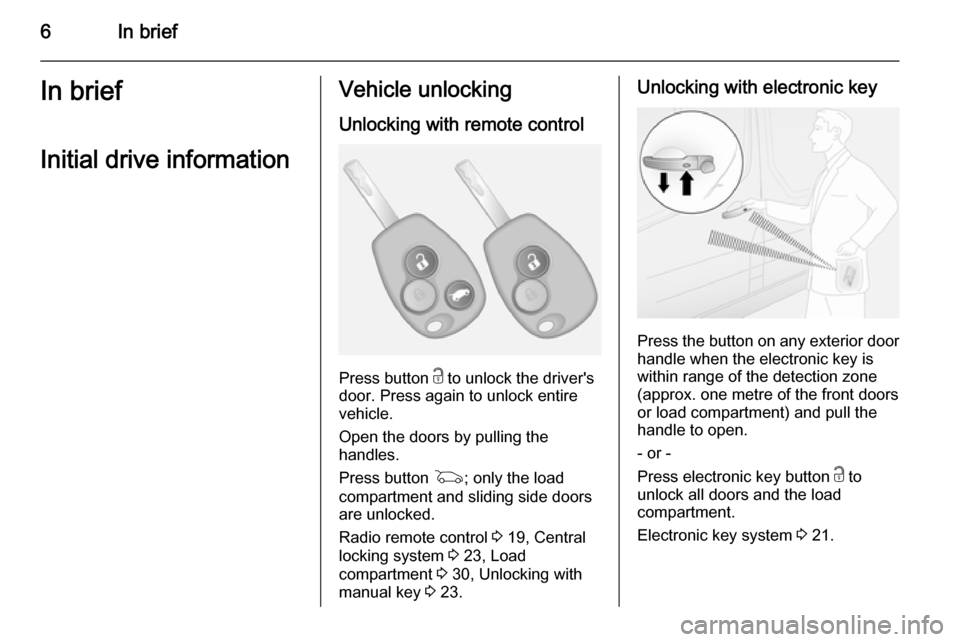
Press button c to unlock the driver's
door. Press again to unlock entire
vehicle.
Open the doors by pulling the
handles.
Press button G; only the load
compartment and sliding side doors
are unlocked.
Radio remote control 3 19, Central
locking system 3 23, Load
compartment 3 30, Unlocking with
manual key 3 23.
Unlocking with electronic key
Press the button on any exterior door
handle when the electronic key is
within range of the detection zone
(approx. one metre of the front doors
or load compartment) and pull the handle to open.
- or -
Press electronic key button c to
unlock all doors and the load
compartment.
Electronic key system 3 21.
Page 21 of 189

Keys, doors and windows19Keys, doors and
windowsKeys, locks ................................... 19
Doors ........................................... 29
Vehicle security ............................ 31
Exterior mirrors ............................ 35
Interior mirrors ............................. 36
Windows ...................................... 37Keys, locks
Keys Replacement keys
The key number is specified on the
key or on a detachable tag.
The key number must be quoted
when ordering replacement keys as it
is a component of the immobiliser
system.
Locks 3 162, Radio remote control
3 19, Electronic key system 3 21,
Central locking 3 23, Starting the
engine 3 111.
Lock cylinders
Designed to free-wheel if they are
forcefully rotated without the correct
key or if the correct key is not fully
inserted. To reset, turn cylinder with
the correct key until its slot is vertical, remove key and then re-insert it. If the
cylinder still free-wheels, turn the key through 180° and repeat operation.Car Pass
The Car Pass contains security
related vehicle data and should
therefore be kept in a safe place.
When the vehicle is taken to a
workshop, this vehicle data is needed
in order to perform certain operations.
Radio remote control
Used to operate: ■ Central locking system 3 23
■ Anti-theft locking system 3 31
Page 22 of 189
20Keys, doors and windows
■ Anti-theft alarm system 3 33
■ Load compartment 3 30
The remote control has a range of
approx. 5 metres. It can be restricted
by external influences. The hazard
warning flashers confirm operation.
Handle with care, protect it from
moisture and high temperatures and
avoid unnecessary operation.
Depending on model, the vehicle may use a 2 button or 3 button remote
control or an electronic key which
includes the functionality of the radio
remote control.
Electronic key system 3 21.
Fault
If the central locking system cannot
be operated with the remote control,
it may be due to the following:
■ Range exceeded
■ Battery voltage too low
■ Frequent, repeated operation of the
remote control while not in range,
which will require reprogramming
by a workshop■ Overload of the central locking system by operating at frequent
intervals, the power supply is
interrupted for a short time
■ Interference from higher-power radio waves from other sources
Manual key operation 3 23.
Remote control battery
replacement
Replace the battery as soon as the
range reduces.
Batteries do not belong in household
waste. They must be disposed of at
an appropriate recycling collection
point.
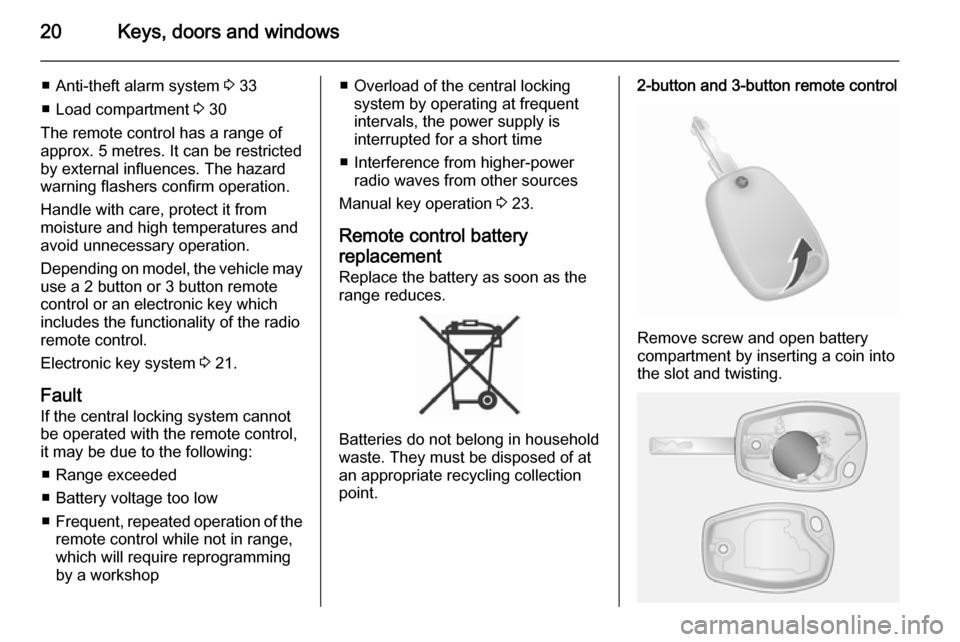
2-button and 3-button remote control
Remove screw and open battery
compartment by inserting a coin into
the slot and twisting.
Page 24 of 189
22Keys, doors and windows
Notice
Always take the electronic key with you when exiting the vehicle.
The electronic key being left in the
card reader is indicated by a warning chime 3 87 and a message in the
Driver Information Centre 3 87
when the driver's door is opened.
Additionally, the electronic key
includes the functionality of the radio
remote control 3 19 and an entry
lighting function 3 95.
Handle with care, protect from
moisture and high temperatures and
avoid unnecessary operation.
Notice
Do not put the electronic key in the
load compartment during driving, as
this is outside of the detection zone
(indicated by a warning chime at low
speed 3 87 and a message in the
Driver Information Centre 3 87).
Handsfree operation is automatically
disabled when the electronic key
buttons have been operated or thecentral locking switch e 3 23 is
pressed. To re-enable handsfree
operation, restart the engine.
Power button 3 110.
Replacing battery in electronic
key Replace the battery as soon as the
system no longer operates properly
or the range is reduced. The need for
battery replacement is indicated by a
message in the Driver Information
Centre 3 87.
Battery replacement, see Radio
remote control 3 19.
Fault
If the central locking system cannot
be operated or the engine cannot be
started, the cause may be one of the
following:
■ Fault in electronic key.
■ Electronic key out of reception range.
■ Battery voltage too low.■ Overload of the central locking system by operating at frequent
intervals, the power supply is
interrupted for a short time.
■ Interference from higher-power radio waves from other sources.
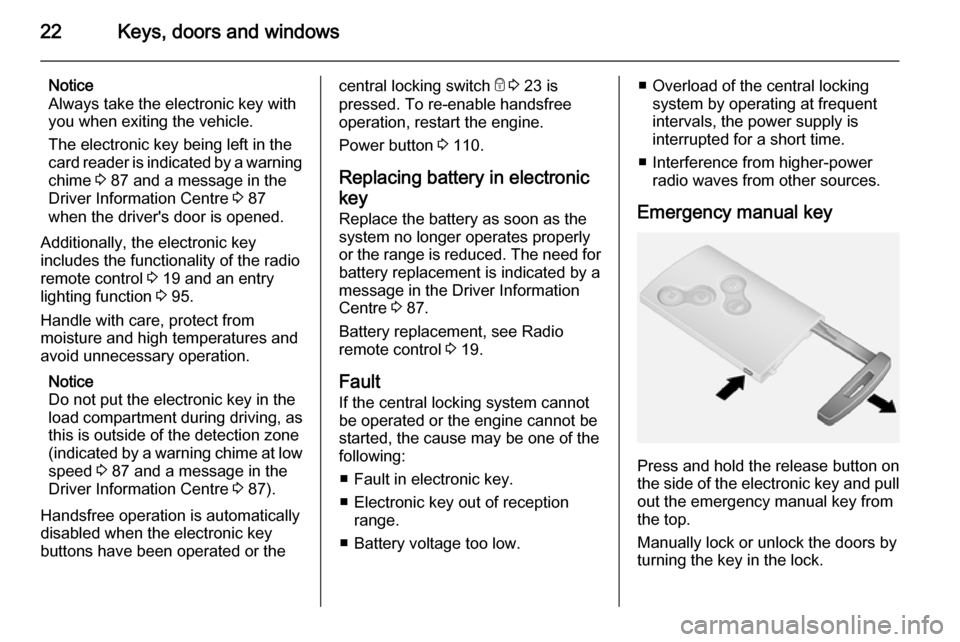
Emergency manual key
Press and hold the release button on
the side of the electronic key and pull out the emergency manual key from
the top.
Manually lock or unlock the doors by turning the key in the lock.
Page 113 of 189
Driving and operating111
These functions stop working when
the driver's door is opened and the
vehicle is locked.
Notice
Always take the electronic key with you when exiting the vehicle.
The electronic key being left in the
card reader is indicated by a warning
chime 3 87 and a message in the
Driver Information Centre 3 87 when
the driver's door is opened.9 Danger
Never leave an electronic key
inside the vehicle when children or animals are left in the vehicle, to
avoid unintended operation of
windows, doors or engine. Risk of
fatal injury.
Fault
If the engine cannot be started, the
cause may be one of the following:
■ Fault in electronic key.
■ Electronic key out of reception range.
■ Battery voltage too low.
■ Overload of the central locking system by operating at frequentintervals, the power supply is
interrupted for a short time.
■ Interference from higher-power radio waves from other sources.
Battery replacement 3 19.
Central locking system 3 23.
Electronic key system 3 21.
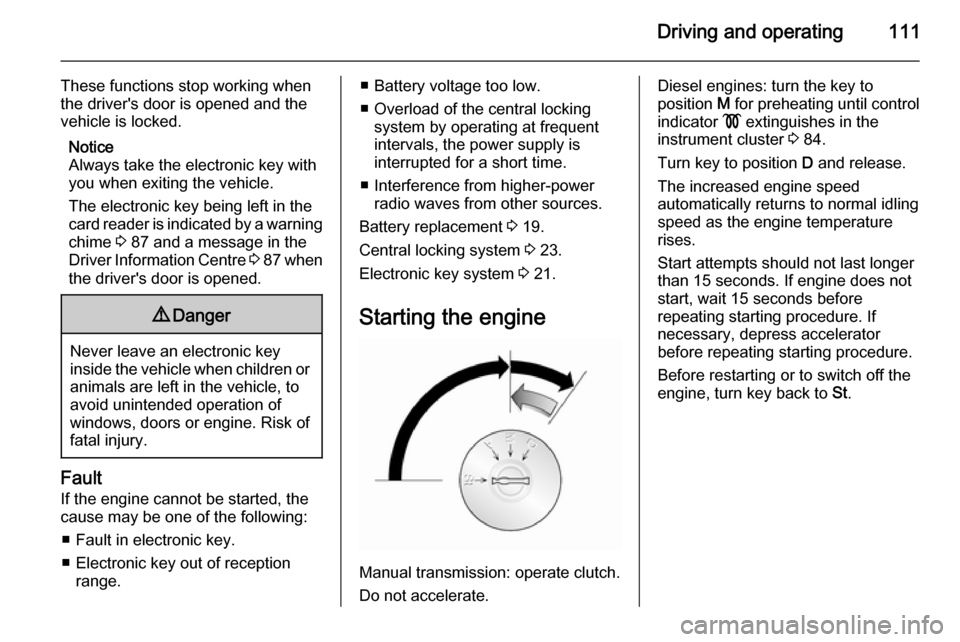
Starting the engine
Manual transmission: operate clutch.
Do not accelerate.
Diesel engines: turn the key to
position M for preheating until control
indicator ! extinguishes in the
instrument cluster 3 84.
Turn key to position D and release.
The increased engine speed
automatically returns to normal idling
speed as the engine temperature
rises.
Start attempts should not last longer
than 15 seconds. If engine does not
start, wait 15 seconds before
repeating starting procedure. If
necessary, depress accelerator
before repeating starting procedure.
Before restarting or to switch off the
engine, turn key back to St.
Page 149 of 189

Vehicle care147
No.Circuit1Vehicle battery (with electronic
key system)2APC battery backup (with elec‐
tronic key system)3Passenger compartment heater4Adaptations5Adaptations6Passenger compartment heater7Additional air conditioning8Additional heating9Electric exterior mirrors, addi‐
tional adaptations10Heated exterior mirrors11Radio, multimedia, electric exte‐
rior mirrors, diagnostic socket12Multimedia, trailer hitch13Fuel injection system, courtesy
lightsNo.Circuit14Fuel injection system, tyre pres‐ sure monitoring system, elec‐
tronic key system15Hazard warning flashers, turn and lane-change signals16Central locking17Left-hand high beam, right-hand
low beam, tail lights, left-hand
daytime running light18Front fog lights, rear fog lights,
number plate lighting19Alarm, horn, automatic light
control, wiper20Instrument cluster21Light switch22Rear window wiper, windscreen
washer pump, horn23APC general battery24Reversing lights25Engine start-stop buttonNo.Circuit26Fuel injection, starter27Airbag, steering column lock28Passenger power window29Power steering30Brake lights31APC battery backup (with elec‐
tronic key system)32Service display33Cigarette lighter, power outlet34Right-hand high beam, left-
hand low beam, headlights,
right-hand daytime running light35Brake lights, ABS, immobiliser36Interior lighting, air conditioning37Starting with electronic key
system38Rear window wiper39Warning chimes
Page 154 of 189
152Vehicle care
Relearn function
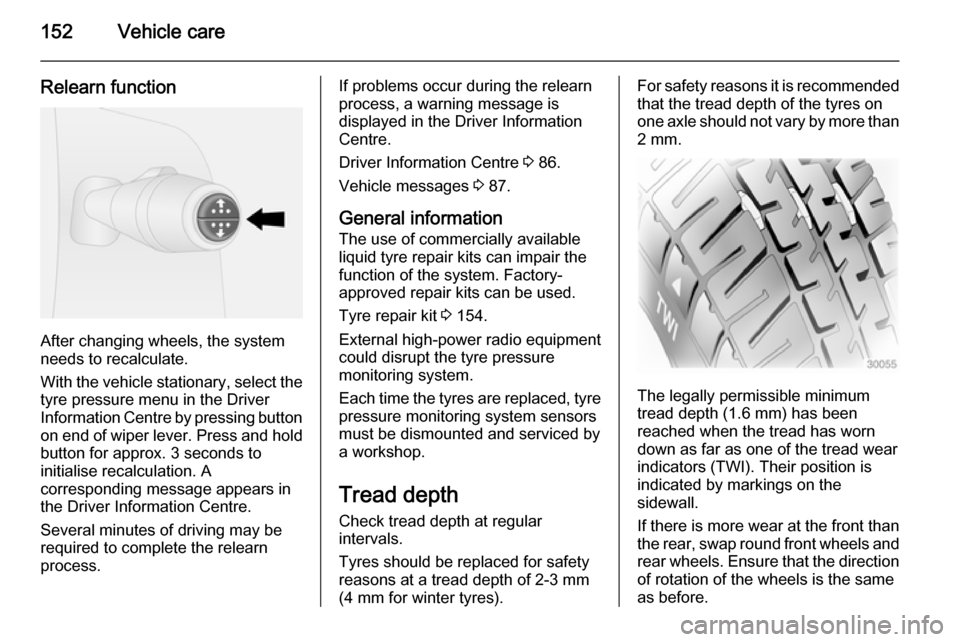
After changing wheels, the system
needs to recalculate.
With the vehicle stationary, select the tyre pressure menu in the Driver
Information Centre by pressing button
on end of wiper lever. Press and hold button for approx. 3 seconds to
initialise recalculation. A
corresponding message appears in
the Driver Information Centre.
Several minutes of driving may be
required to complete the relearn
process.
If problems occur during the relearn
process, a warning message is
displayed in the Driver Information
Centre.
Driver Information Centre 3 86.
Vehicle messages 3 87.
General information The use of commercially available
liquid tyre repair kits can impair the
function of the system. Factory-
approved repair kits can be used.
Tyre repair kit 3 154.
External high-power radio equipment
could disrupt the tyre pressure
monitoring system.
Each time the tyres are replaced, tyre
pressure monitoring system sensors
must be dismounted and serviced by a workshop.
Tread depth
Check tread depth at regular
intervals.
Tyres should be replaced for safety
reasons at a tread depth of 2-3 mm
(4 mm for winter tyres).For safety reasons it is recommended
that the tread depth of the tyres on
one axle should not vary by more than
2 mm.
The legally permissible minimum
tread depth (1.6 mm) has been
reached when the tread has worn
down as far as one of the tread wear
indicators (TWI). Their position is
indicated by markings on the
sidewall.
If there is more wear at the front than
the rear, swap round front wheels and
rear wheels. Ensure that the direction
of rotation of the wheels is the same
as before.
Page 181 of 189

Customer information179Customer informationCustomer information................179
Vehicle data recording and pri‐
vacy ........................................... 179Customer information
Declaration of conformity
This vehicle has systems that
transmit and/or receive radio waves
subject to Directive 1999/5/EC.
These systems are in compliance
with the essential requirements and
other relevant provisions of
Directive 1999/5/EC. Copies of the
original Declarations of Conformity
can be obtained on our website.Vehicle data recording
and privacy
Event data recorders
Data storage modules in the
vehicle
A large number of electronic
components of your vehicle contain
data storage modules temporarily or
permanently storing technical data
about the condition of the vehicle,
events and errors. In general, this
technical information documents the
condition of parts, modules, systems
or the environment:
■ Operating conditions of system components (e.g. filling levels)
■ Status messages of the vehicle and
its single components ( e.g. number
of wheel revolutions / rotational
speed, deceleration, lateral
acceleration)
■ Dysfunctions and defects in important system components
Page 182 of 189

180Customer information
■ Vehicle reactions in particulardriving situations (e.g. inflation of
an airbag, activation of the stability
regulation system)
■ Environmental conditions (e.g. temperature)
These data are exclusively technical
and help identifying and correcting
errors as well as optimizing vehicle
functions.
Motion profiles indicating travelled
routes cannot be created with these
data.
If services are used (e.g. repair
works, service processes, warranty
cases, quality assurance),
employees of the service network
(manufacturer included) are able to
read out this technical information
from the event and error data storage
modules applying special diagnostic
devices. If required, you will receive
further information at these
workshops. After an error has been
corrected, the data are deleted from
the error storage module or they are
constantly overwritten.When using the vehicle, situations
may occur in which these technical
data related to other information
(accident report, damages on the
vehicle, witness statements etc.) may be associated with a specific person -
possibly, with the assistance of an
expert.
Additional functions contractually
agreed upon with the client (e.g.
vehicle location in emergency cases)
allow the transmission of particular vehicle data from the vehicle.Radio Frequency
Identification (RFID) RFID technology is used in somevehicles for functions such as tyre
pressure monitoring and ignition
system security. It is also used in
connection with conveniences such
as radio remote controls for door
locking/unlocking and starting, and in-
vehicle transmitters for garage door
openers. RFID technology in
Vauxhall vehicles does not use or
record personal information or link with any other Vauxhall system
containing personal information.
Page 187 of 189

185
PParking ................................ 18, 115
Parking assist ............................ 124
Parking brake ............................ 118
Particulate filter ........................... 115
Performing work ........................132
Pollen filter ................................. 107
Power button .............................. 110
Power outlets ............................... 75
Power steering fluid ....................135
Power windows ............................ 37
Preheating ................................... 84
Puncture ..................................... 157
R
Radio Frequency Identification (RFID) ..................................... 180
Radio remote control ...................19
Rear air conditioning system .....101
Rear doors ................................... 29
Rear fog light ............................... 85
Rear fog lights ............................. 93
Rear heating system .................. 101
Rear seats .................................... 44
Rear view camera ...................... 125
Rear windows .............................. 38
Rear window wiper/washer .......... 73
Recommended fluids and lubricants ........................ 166, 171Refuelling ................................... 127
Remote control ............................. 19
Reversing light ........................... 142
Reversing lights ........................... 94
Roof load ...................................... 69
Roof rack ..................................... 69
S Safety belts ................................... 47
Safety net .................................... 68
Seat adjustment ....................... 7, 42
Seat belt ........................................ 8
Seat belt reminder .......................81
Seat belts ..................................... 47 Seat heating ................................. 44
Seat position ................................ 41
Service ............................... 107, 165
Service display ............................ 78
Service information ....................165
Service vehicle soon .................... 82
Side airbag system ......................54
Sidelights ...................................... 91
Side turn signal lights ................141
Sliding door .................................. 29
Spare wheel ............................... 158
Spare wheel security tool ...........148
Speed limiter............................... 123
Speedometer ............................... 76
Starting and operating ................109
Starting off ................................... 16Starting the engine ....................111
Steering ...................................... 109
Steering column controls ..............72
Steering wheel adjustment ......9, 71
Steering wheel controls ...............71
Stop engine .................................. 82
Stop-start system........................ 113
Storage ......................................... 64
Storage compartments .................64
Sun visors .................................... 39
Symbols ......................................... 4
T
Tachograph .................................. 90
Tachometer ................................. 77
Tailgate ......................................... 30
Tail lights ................................... 141
Technical data ............................ 172
Three-point seat belt .................... 48
Tools .......................................... 148
Top-tether fastening eyes ............63
Torx key ...................................... 148
Tow bar....................................... 129
Towing ................................ 129, 161
Towing another vehicle .............162
Towing a trailer ........................... 129
Towing eye ......................... 148, 161
Towing the vehicle .....................161
Traction Control system ............. 118
Trailer coupling ........................... 129