ECU VAUXHALL VIVARO 2014 User Guide
[x] Cancel search | Manufacturer: VAUXHALL, Model Year: 2014, Model line: VIVARO, Model: VAUXHALL VIVARO 2014Pages: 173, PDF Size: 4.11 MB
Page 58 of 173
56StorageCupholders
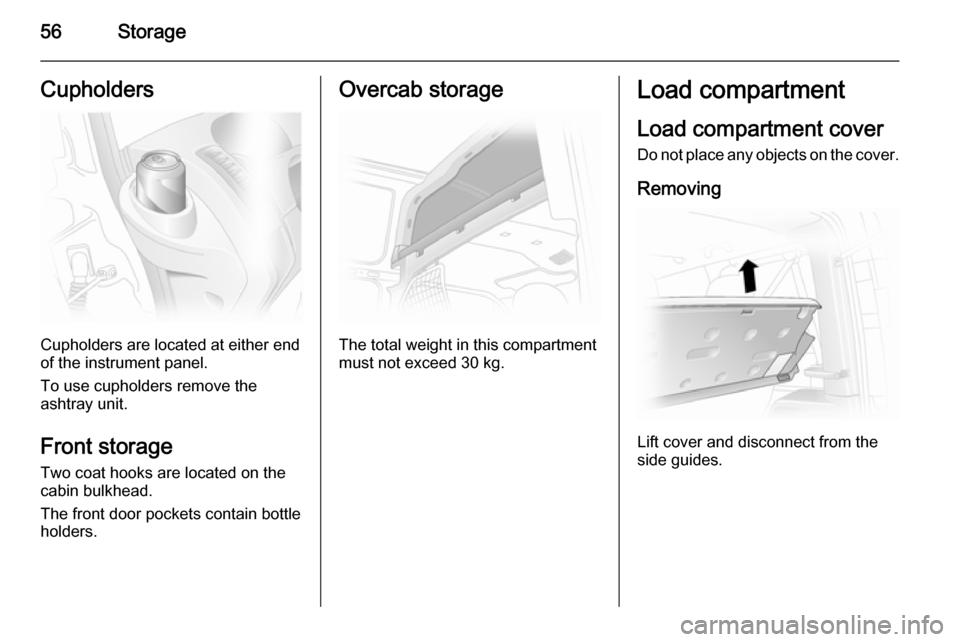
Cupholders are located at either end
of the instrument panel.
To use cupholders remove the
ashtray unit.
Front storage
Two coat hooks are located on the cabin bulkhead.
The front door pockets contain bottle
holders.
Overcab storage
The total weight in this compartment
must not exceed 30 kg.
Load compartment
Load compartment cover Do not place any objects on the cover.
Removing
Lift cover and disconnect from the
side guides.
Page 59 of 173
Storage57Load rails and hooks
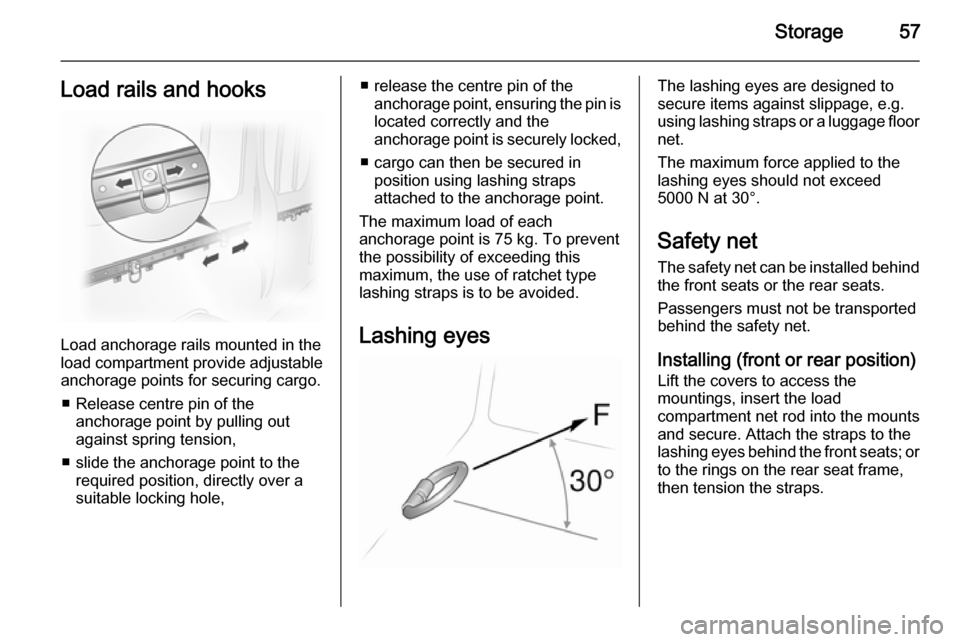
Load anchorage rails mounted in the
load compartment provide adjustable anchorage points for securing cargo.
■ Release centre pin of the anchorage point by pulling out
against spring tension,
■ slide the anchorage point to the required position, directly over a
suitable locking hole,
■ release the centre pin of the anchorage point, ensuring the pin islocated correctly and the
anchorage point is securely locked,
■ cargo can then be secured in position using lashing straps
attached to the anchorage point.
The maximum load of each
anchorage point is 75 kg. To prevent
the possibility of exceeding this
maximum, the use of ratchet type
lashing straps is to be avoided.
Lashing eyesThe lashing eyes are designed to
secure items against slippage, e.g.
using lashing straps or a luggage floor
net.
The maximum force applied to the
lashing eyes should not exceed
5000 N at 30°.
Safety net
The safety net can be installed behind the front seats or the rear seats.
Passengers must not be transported
behind the safety net.
Installing (front or rear position) Lift the covers to access the
mountings, insert the load
compartment net rod into the mounts
and secure. Attach the straps to the
lashing eyes behind the front seats; or
to the rings on the rear seat frame,
then tension the straps.
Page 60 of 173
58Storage
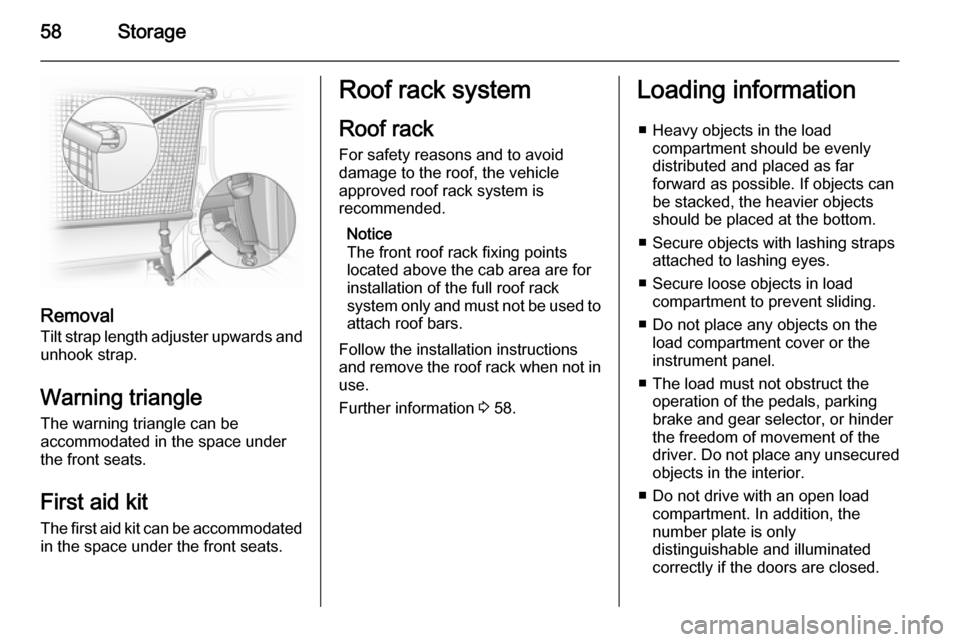
Removal
Tilt strap length adjuster upwards and unhook strap.
Warning triangleThe warning triangle can be
accommodated in the space under
the front seats.
First aid kit
The first aid kit can be accommodated
in the space under the front seats.
Roof rack system
Roof rack For safety reasons and to avoiddamage to the roof, the vehicle
approved roof rack system is
recommended.
Notice
The front roof rack fixing points
located above the cab area are for
installation of the full roof rack
system only and must not be used to attach roof bars.
Follow the installation instructions
and remove the roof rack when not in
use.
Further information 3 58.Loading information
■ Heavy objects in the load compartment should be evenly
distributed and placed as far
forward as possible. If objects can
be stacked, the heavier objects
should be placed at the bottom.
■ Secure objects with lashing straps attached to lashing eyes.
■ Secure loose objects in load compartment to prevent sliding.
■ Do not place any objects on the load compartment cover or theinstrument panel.
■ The load must not obstruct the operation of the pedals, parking
brake and gear selector, or hinder
the freedom of movement of the
driver. Do not place any unsecured objects in the interior.
■ Do not drive with an open load compartment. In addition, the
number plate is only
distinguishable and illuminated
correctly if the doors are closed.
Page 61 of 173

Storage59
■ The payload is the differencebetween the permitted gross
vehicle weight (see identification
plate 3 150) and the EC kerb
weight.
To calculate the EC kerb weight,
enter the data for your vehicle in the
Weights table at the front of this
manual.
The EC kerb weight includes
weights for the driver (68 kg),
luggage (7 kg) and all fluids (tank
90 % full).
Optional equipment and
accessories increase the kerb
weight.
■ Driving with a roof load increases the sensitivity of the vehicle to
cross-winds and has a detrimental
effect on vehicle handling due to
the vehicle's higher centre of
gravity. Distribute the load evenly
and secure it properly with retaining
straps. Adjust the tyre pressure and vehicle speed according to the load
conditions. Check and retighten the straps frequently.
Do not drive faster than 75 mph.The permissible roof load (which
includes the weight of the roof rack)
is 280 kg for standard roof variants
and 210 kg for high roof variants
(excludes Platform cab
conversions). The roof load is the
combined weight of the roof rack
and the load.
The permissible roof load on the
approved full length roof rack
system is 210 kg for standard roof
variants and 140 kg for high roof
variants (excludes Platform cab
conversions). The roof load is the
combined weight of the roof rack
and the load.
Page 90 of 173
88Climate control
The control buttons operate
identically to the timer unit described
previously.
To activate the remote control, press
activation button X and release it
when the menu bar appears in the
display. The signal indicator and
SENd appear briefly in the display,
followed by the temperature.9 Warning
When refuelling, switch off the
remote control unit as well as the
heater!
To switch off, press and hold
activation button X to prevent
inadvertent operation.
The remote control has a maximum
range of 600 metres. The range may
be reduced due to environmental
conditions and as the battery
becomes weaker.
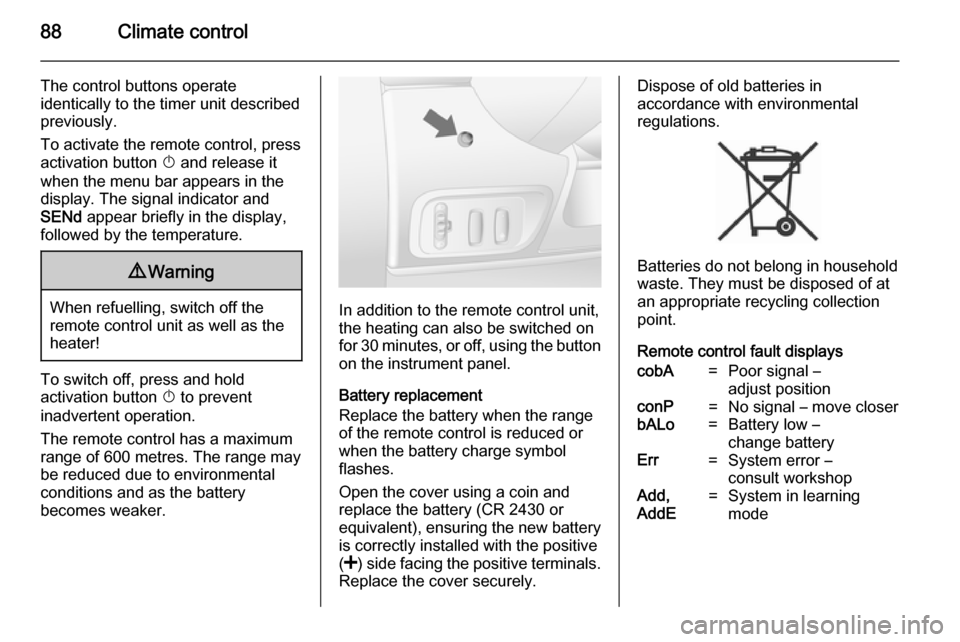
In addition to the remote control unit,
the heating can also be switched on
for 30 minutes, or off, using the button
on the instrument panel.
Battery replacement
Replace the battery when the range
of the remote control is reduced or when the battery charge symbol
flashes.
Open the cover using a coin and
replace the battery (CR 2430 or equivalent), ensuring the new battery
is correctly installed with the positive
( < ) side facing the positive terminals.
Replace the cover securely.
Dispose of old batteries in
accordance with environmental
regulations.
Batteries do not belong in household
waste. They must be disposed of at
an appropriate recycling collection
point.
Remote control fault displays
cobA=Poor signal –
adjust positionconP=No signal – move closerbALo=Battery low –
change batteryErr=System error –
consult workshopAdd,
AddE=System in learning
mode
Page 101 of 173
Driving and operating99
Rocking the vehicle
Rocking the vehicle is only
permissible if the vehicle is stuck in
sand, mud, snow or a hole. Move the
selector lever between R and A/M (or
between + and -) in a repeat pattern,
while applying light pressure to the
accelerator pedal. Do not race the
engine and avoid sudden
acceleration.
Parking
Apply the parking brake. The most
recently engaged gear (see
transmission display) remains
engaged. With N, no gear is engaged.
When the ignition is switched off, the
transmission no longer responds to
movement of the selector lever.
Manual mode
If a higher gear is selected when the
engine speed is too low, or a lower
gear when the speed is too high, the
shift is not executed. This prevents
the engine from running at too low or too high an engine speed.If engine speed is too low, the
transmission automatically shifts to a
lower gear.
If engine speed is too high, the
transmission only switches to a higher gear via kickdown.
Electronic driving
programmes
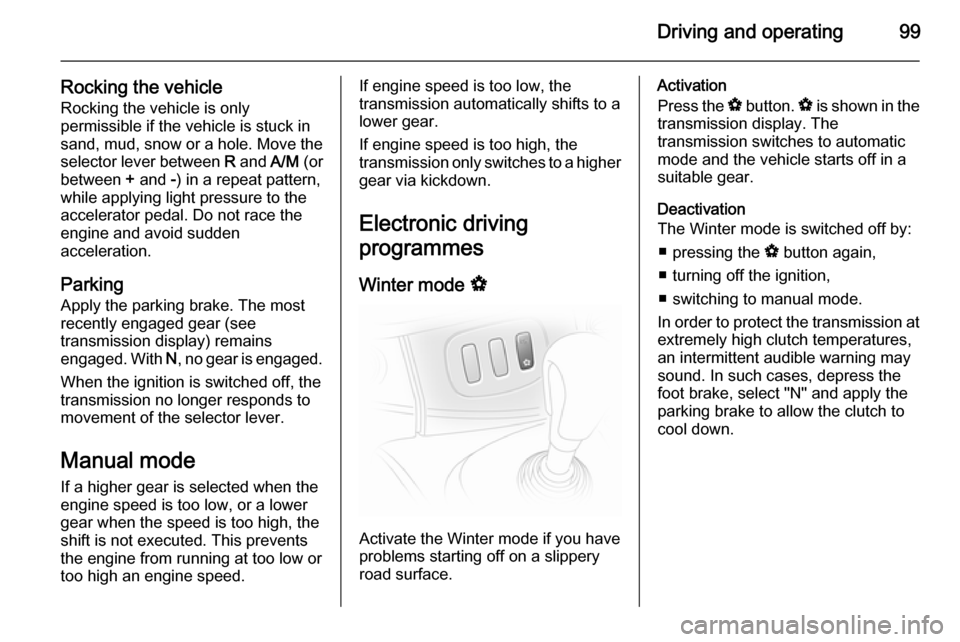
Winter mode V
Activate the Winter mode if you have
problems starting off on a slippery
road surface.
Activation
Press the V button. V is shown in the
transmission display. The
transmission switches to automatic
mode and the vehicle starts off in a
suitable gear.
Deactivation
The Winter mode is switched off by:
■ pressing the V button again,
■ turning off the ignition,
■ switching to manual mode.
In order to protect the transmission at extremely high clutch temperatures,
an intermittent audible warning may
sound. In such cases, depress the
foot brake, select "N" and apply the
parking brake to allow the clutch to
cool down.
Page 119 of 173
Vehicle care117
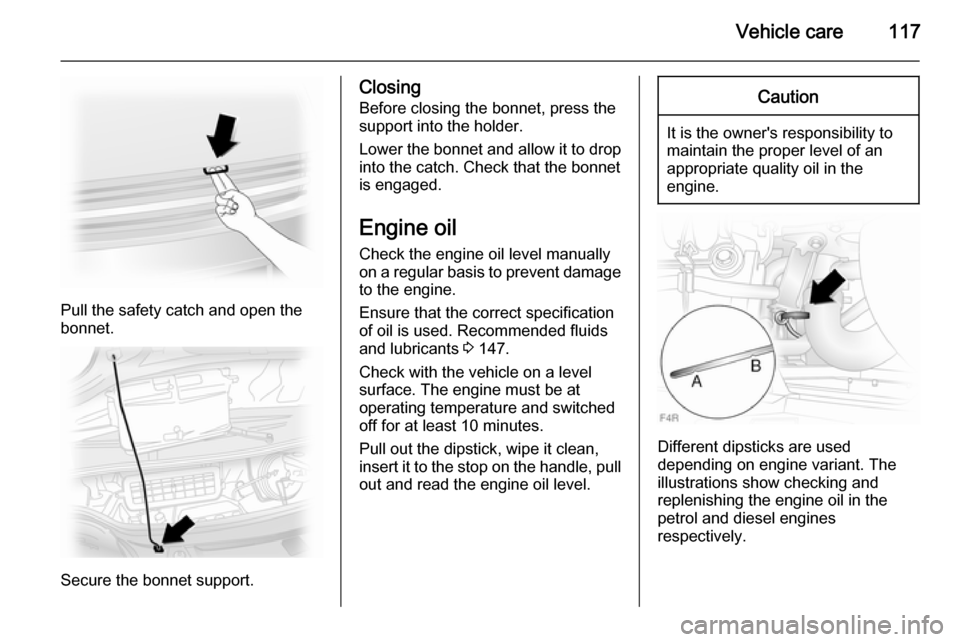
Pull the safety catch and open the
bonnet.
Secure the bonnet support.
Closing
Before closing the bonnet, press the
support into the holder.
Lower the bonnet and allow it to drop into the catch. Check that the bonnet
is engaged.
Engine oil
Check the engine oil level manually
on a regular basis to prevent damage
to the engine.
Ensure that the correct specification
of oil is used. Recommended fluids
and lubricants 3 147.
Check with the vehicle on a level
surface. The engine must be at
operating temperature and switched
off for at least 10 minutes.
Pull out the dipstick, wipe it clean,
insert it to the stop on the handle, pull
out and read the engine oil level.Caution
It is the owner's responsibility to
maintain the proper level of an
appropriate quality oil in the
engine.
Different dipsticks are used
depending on engine variant. The
illustrations show checking and
replenishing the engine oil in the
petrol and diesel engines
respectively.
Page 121 of 173
Vehicle care119
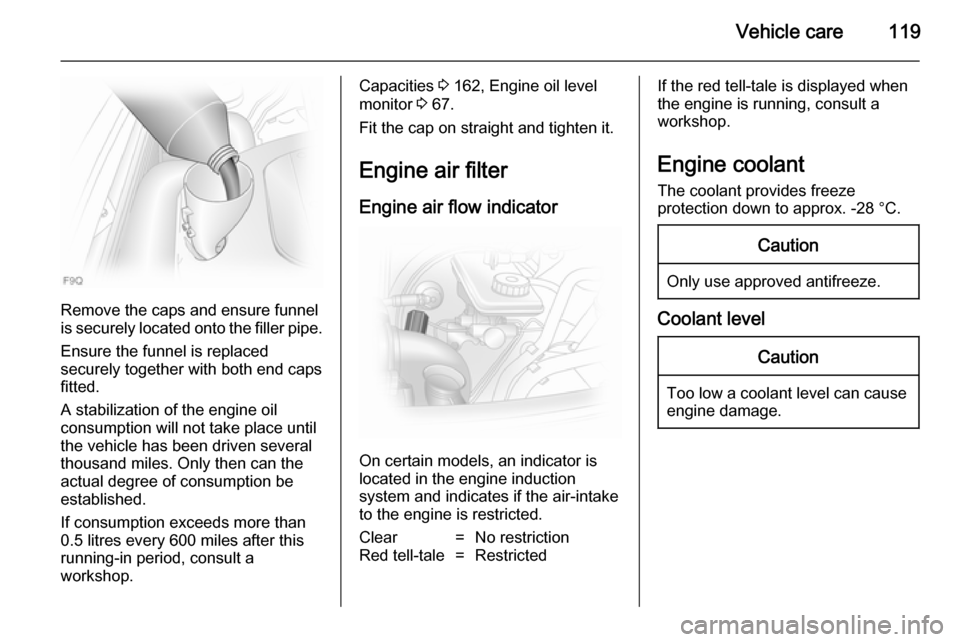
Remove the caps and ensure funnel
is securely located onto the filler pipe.
Ensure the funnel is replaced
securely together with both end caps
fitted.
A stabilization of the engine oil
consumption will not take place until
the vehicle has been driven several
thousand miles. Only then can the
actual degree of consumption be
established.
If consumption exceeds more than 0.5 litres every 600 miles after this
running-in period, consult a
workshop.
Capacities 3 162, Engine oil level
monitor 3 67.
Fit the cap on straight and tighten it.
Engine air filter Engine air flow indicator
On certain models, an indicator is
located in the engine induction
system and indicates if the air-intake
to the engine is restricted.
Clear=No restrictionRed tell-tale=RestrictedIf the red tell-tale is displayed when
the engine is running, consult a
workshop.
Engine coolant
The coolant provides freeze
protection down to approx. -28 °C.Caution
Only use approved antifreeze.
Coolant level
Caution
Too low a coolant level can cause engine damage.
Page 127 of 173
Vehicle care125Front turn signal lights
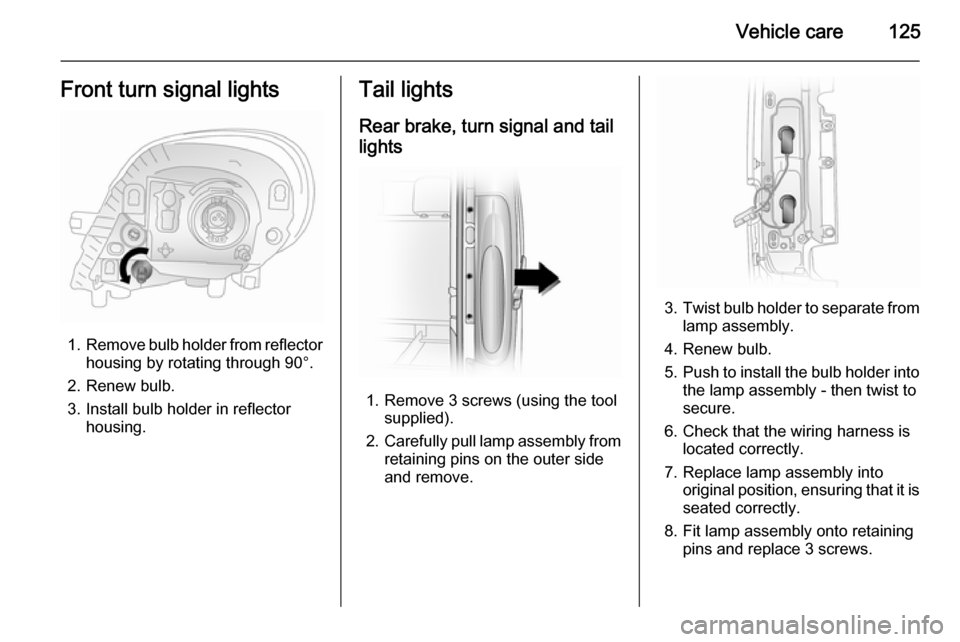
1.Remove bulb holder from reflector
housing by rotating through 90°.
2. Renew bulb.
3. Install bulb holder in reflector housing.
Tail lights
Rear brake, turn signal and tail lights
1. Remove 3 screws (using the tool supplied).
2. Carefully pull lamp assembly from
retaining pins on the outer side
and remove.
3. Twist bulb holder to separate from
lamp assembly.
4. Renew bulb.
5. Push to install the bulb holder into
the lamp assembly - then twist to
secure.
6. Check that the wiring harness is located correctly.
7. Replace lamp assembly into original position, ensuring that it isseated correctly.
8. Fit lamp assembly onto retaining pins and replace 3 screws.
Page 128 of 173
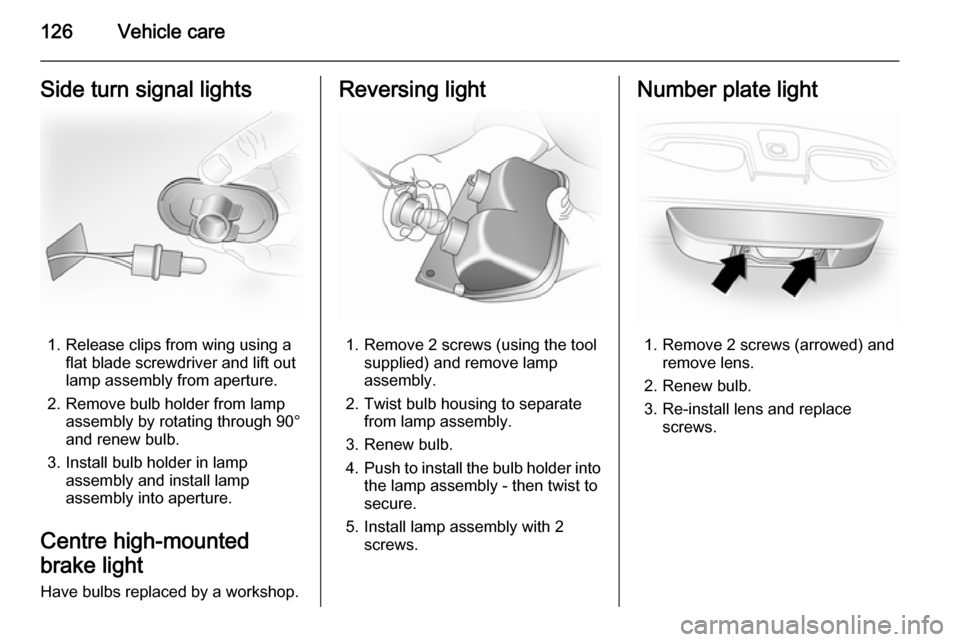
126Vehicle careSide turn signal lights
1. Release clips from wing using aflat blade screwdriver and lift out
lamp assembly from aperture.
2. Remove bulb holder from lamp assembly by rotating through 90°
and renew bulb.
3. Install bulb holder in lamp assembly and install lamp
assembly into aperture.
Centre high-mounted
brake light
Have bulbs replaced by a workshop.
Reversing light
1. Remove 2 screws (using the tool supplied) and remove lamp
assembly.
2. Twist bulb housing to separate from lamp assembly.
3. Renew bulb.
4. Push to install the bulb holder into
the lamp assembly - then twist to
secure.
5. Install lamp assembly with 2 screws.
Number plate light
1. Remove 2 screws (arrowed) and remove lens.
2. Renew bulb.
3. Re-install lens and replace screws.