battery VAUXHALL VIVARO 2014 User Guide
[x] Cancel search | Manufacturer: VAUXHALL, Model Year: 2014, Model line: VIVARO, Model: VAUXHALL VIVARO 2014Pages: 173, PDF Size: 4.11 MB
Page 102 of 173
100Driving and operating
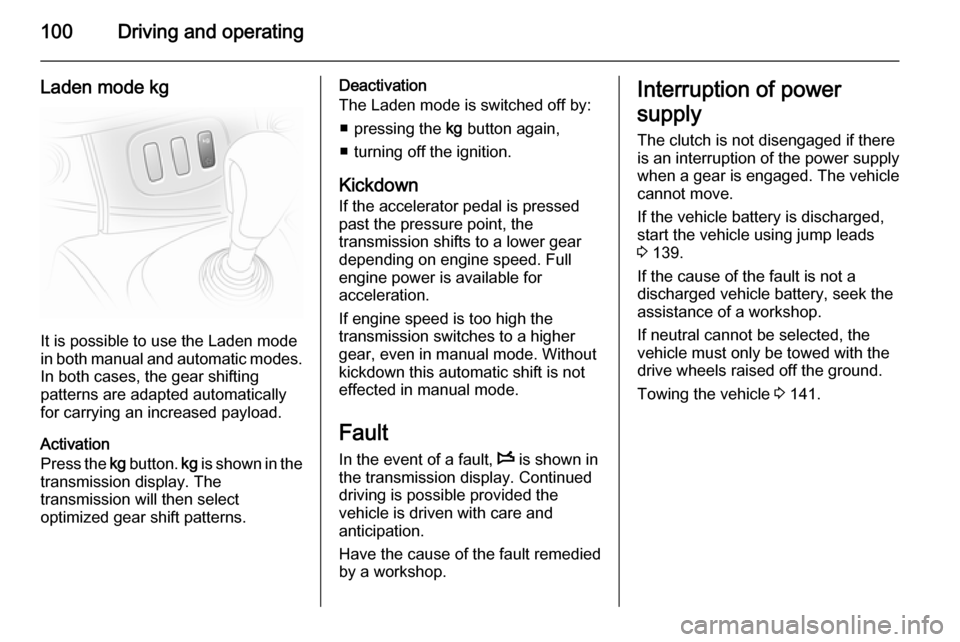
Laden mode kg
It is possible to use the Laden mode
in both manual and automatic modes. In both cases, the gear shifting
patterns are adapted automatically
for carrying an increased payload.
Activation
Press the kg button. kg is shown in the
transmission display. The
transmission will then select
optimized gear shift patterns.
Deactivation
The Laden mode is switched off by:
■ pressing the kg button again,
■ turning off the ignition.
Kickdown If the accelerator pedal is pressed
past the pressure point, the
transmission shifts to a lower gear depending on engine speed. Full
engine power is available for
acceleration.
If engine speed is too high the
transmission switches to a higher
gear, even in manual mode. Without
kickdown this automatic shift is not
effected in manual mode.
Fault
In the event of a fault, W is shown in
the transmission display. Continued driving is possible provided the
vehicle is driven with care and
anticipation.
Have the cause of the fault remedied
by a workshop.Interruption of power
supply
The clutch is not disengaged if there is an interruption of the power supply
when a gear is engaged. The vehicle
cannot move.
If the vehicle battery is discharged,
start the vehicle using jump leads
3 139.
If the cause of the fault is not a
discharged vehicle battery, seek the
assistance of a workshop.
If neutral cannot be selected, the
vehicle must only be towed with the
drive wheels raised off the ground.
Towing the vehicle 3 141.
Page 113 of 173
Driving and operating111
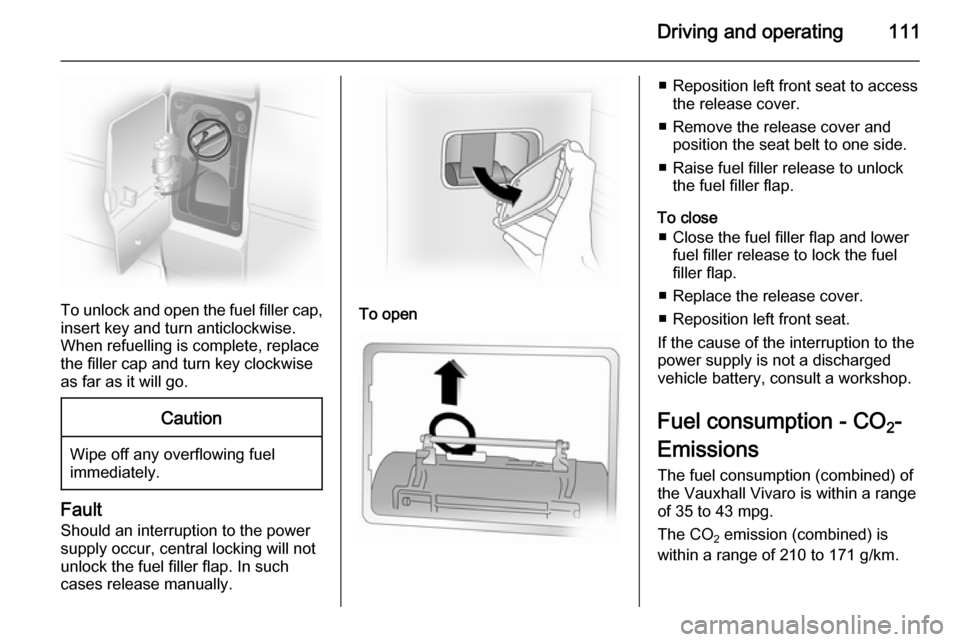
To unlock and open the fuel filler cap,insert key and turn anticlockwise.
When refuelling is complete, replace
the filler cap and turn key clockwise
as far as it will go.
Caution
Wipe off any overflowing fuel
immediately.
Fault
Should an interruption to the power supply occur, central locking will not
unlock the fuel filler flap. In such
cases release manually.
To open
■ Reposition left front seat to access the release cover.
■ Remove the release cover and position the seat belt to one side.
■ Raise fuel filler release to unlock the fuel filler flap.
To close ■ Close the fuel filler flap and lower fuel filler release to lock the fuel
filler flap.
■ Replace the release cover.
■ Reposition left front seat.
If the cause of the interruption to the
power supply is not a discharged
vehicle battery, consult a workshop.
Fuel consumption - CO 2-
Emissions
The fuel consumption (combined) of
the Vauxhall Vivaro is within a range
of 35 to 43 mpg.
The CO 2 emission (combined) is
within a range of 210 to 171 g/km.
Page 117 of 173

Vehicle care115Vehicle careGeneral Information...................115
Vehicle checks ........................... 116
Bulb replacement .......................124
Electrical system ........................128
Vehicle tools .............................. 131
Wheels and tyres .......................131
Towing ....................................... 141
Appearance care .......................143General Information
Accessories and vehicle
modifications
We recommend the use of Genuine Parts and Accessories and factory
approved parts specific for your
vehicle type. We cannot assess or guarantee reliability of other products
- even if they have a regulatory or
otherwise granted approval.
Do not make any modifications to the electrical system, e.g. changes of
electronic control units (chip tuning).
Vehicle storage Storage for a long period of time
If the vehicle is to be stored for several months:
■ Wash and wax the vehicle.
■ Have the wax in the engine compartment and underbody
checked.
■ Clean and preserve rubber seals.
■ Fill up fuel tank completely.■ Change the engine oil.
■ Drain the washer fluid reservoir.
■ Check the coolant antifreeze and corrosion protection.
■ Adjust tyre pressure to the value specified for full load.
■ Park vehicle in a dry, well ventilated
place. Engage first or reverse gear. Prevent the vehicle from rolling.
■ Do not apply the parking brake.
■ Open the bonnet, close all doors and lock the vehicle.
■ Disconnect the clamp from the negative terminal of the vehicle
battery. Beware that all systems are
not functional, e.g. anti-theft alarm
system.
Putting back into operation When the vehicle is to be put back into
operation:
■ Connect the clamp to the negative terminal of the vehicle battery.
Activate the electronics of the
power windows.
■ Check tyre pressure.
Page 123 of 173
Vehicle care121Caution
Only washer fluid with a sufficient
antifreeze concentration provides
protection at low temperatures or
a sudden drop in temperature.
Brakes
A squealing noise indicates that the
brake lining is at its minimum
thickness. Continued driving is
possible but have the brake lining
replaced as soon as possible.
Once new brake linings are installed,
do not brake unnecessarily hard for
the first few journeys.
Brake fluid
9 Warning
Brake fluid is poisonous and
corrosive. Avoid contact with eyes,
skin, fabrics and painted surfaces.
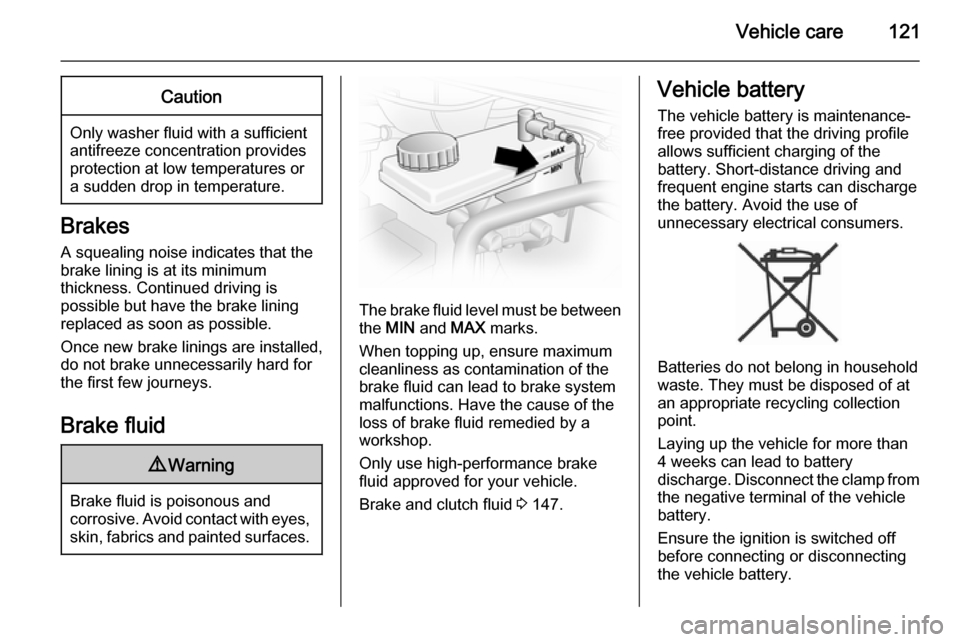
The brake fluid level must be betweenthe MIN and MAX marks.
When topping up, ensure maximum cleanliness as contamination of the
brake fluid can lead to brake system
malfunctions. Have the cause of the
loss of brake fluid remedied by a
workshop.
Only use high-performance brake
fluid approved for your vehicle.
Brake and clutch fluid 3 147.
Vehicle battery
The vehicle battery is maintenance-
free provided that the driving profile
allows sufficient charging of the
battery. Short-distance driving and frequent engine starts can discharge
the battery. Avoid the use of
unnecessary electrical consumers.
Batteries do not belong in household
waste. They must be disposed of at
an appropriate recycling collection
point.
Laying up the vehicle for more than
4 weeks can lead to battery
discharge. Disconnect the clamp from the negative terminal of the vehicle
battery.
Ensure the ignition is switched off
before connecting or disconnecting
the vehicle battery.
Page 124 of 173
122Vehicle care
Battery access
The vehicle battery is located beneath the front left hand seat floor
panel 3 139.
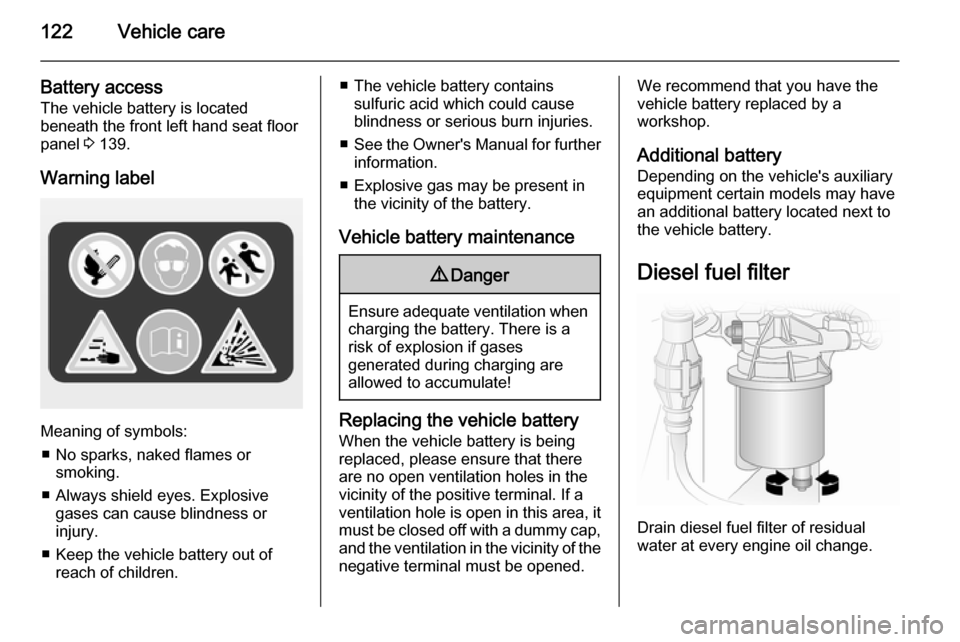
Warning label
Meaning of symbols: ■ No sparks, naked flames or smoking.
■ Always shield eyes. Explosive gases can cause blindness or
injury.
■ Keep the vehicle battery out of reach of children.
■ The vehicle battery containssulfuric acid which could cause
blindness or serious burn injuries.
■ See the Owner's Manual for further
information.
■ Explosive gas may be present in the vicinity of the battery.
Vehicle battery maintenance9 Danger
Ensure adequate ventilation when
charging the battery. There is a
risk of explosion if gases
generated during charging are
allowed to accumulate!
Replacing the vehicle battery
When the vehicle battery is being replaced, please ensure that there
are no open ventilation holes in the
vicinity of the positive terminal. If a
ventilation hole is open in this area, it
must be closed off with a dummy cap,
and the ventilation in the vicinity of the negative terminal must be opened.
We recommend that you have the
vehicle battery replaced by a
workshop.
Additional battery
Depending on the vehicle's auxiliary
equipment certain models may have
an additional battery located next to
the vehicle battery.
Diesel fuel filter
Drain diesel fuel filter of residual
water at every engine oil change.
Page 136 of 173
134Vehicle care9Warning
Do not drive faster than 50 mph.
Do not use for a lengthy period.
Steering and handling may be
affected.
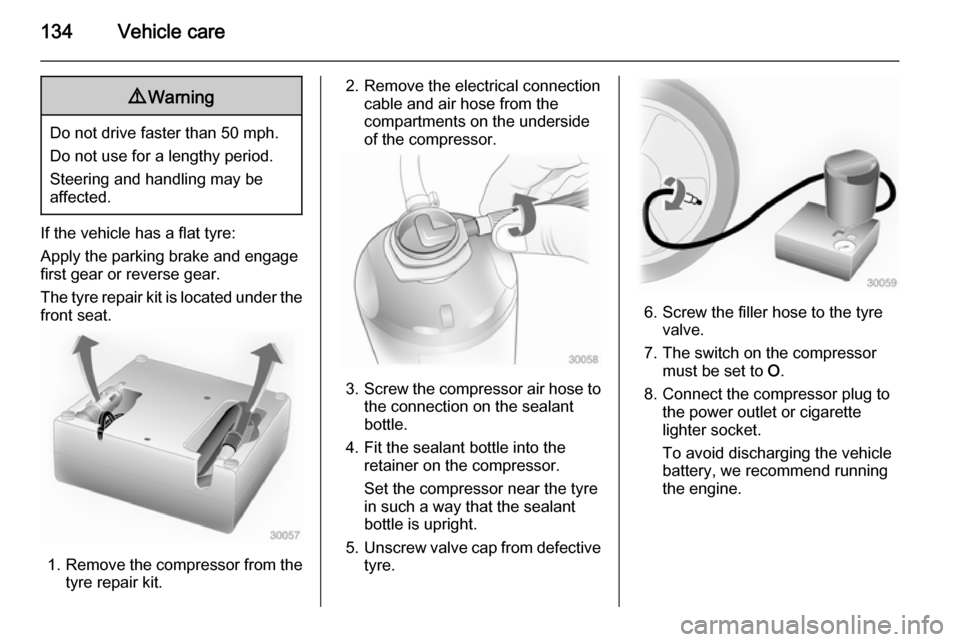
If the vehicle has a flat tyre:
Apply the parking brake and engage
first gear or reverse gear.
The tyre repair kit is located under the
front seat.
1. Remove the compressor from the
tyre repair kit.
2. Remove the electrical connection cable and air hose from the
compartments on the underside
of the compressor.
3. Screw the compressor air hose to
the connection on the sealant
bottle.
4. Fit the sealant bottle into the retainer on the compressor.
Set the compressor near the tyre
in such a way that the sealant
bottle is upright.
5. Unscrew valve cap from defective
tyre.
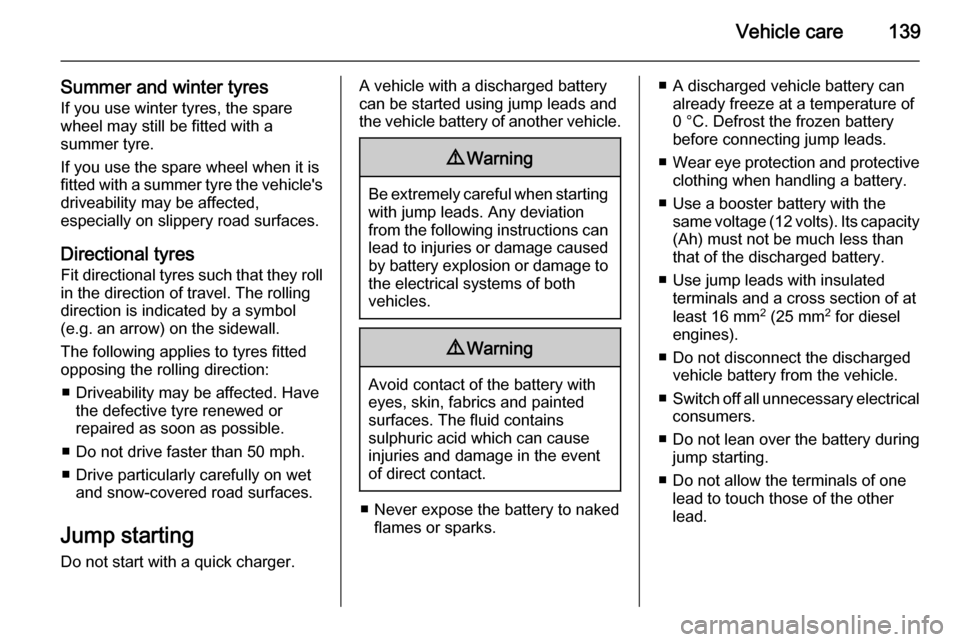
6. Screw the filler hose to the tyre valve.
7. The switch on the compressor must be set to O.
8. Connect the compressor plug to the power outlet or cigarette
lighter socket.
To avoid discharging the vehicle
battery, we recommend running
the engine.
Page 141 of 173
Vehicle care139
Summer and winter tyresIf you use winter tyres, the sparewheel may still be fitted with a
summer tyre.
If you use the spare wheel when it is
fitted with a summer tyre the vehicle's driveability may be affected,
especially on slippery road surfaces.
Directional tyres Fit directional tyres such that they roll
in the direction of travel. The rolling
direction is indicated by a symbol
(e.g. an arrow) on the sidewall.
The following applies to tyres fitted
opposing the rolling direction:
■ Driveability may be affected. Have the defective tyre renewed or
repaired as soon as possible.
■ Do not drive faster than 50 mph.
■ Drive particularly carefully on wet and snow-covered road surfaces.
Jump starting Do not start with a quick charger.A vehicle with a discharged battery
can be started using jump leads and the vehicle battery of another vehicle.9 Warning
Be extremely careful when starting
with jump leads. Any deviation
from the following instructions can
lead to injuries or damage caused
by battery explosion or damage to the electrical systems of both
vehicles.
9 Warning
Avoid contact of the battery with
eyes, skin, fabrics and painted
surfaces. The fluid contains
sulphuric acid which can cause
injuries and damage in the event
of direct contact.
■ Never expose the battery to naked
flames or sparks.
■ A discharged vehicle battery canalready freeze at a temperature of
0 °C. Defrost the frozen battery
before connecting jump leads.
■ Wear eye protection and protective
clothing when handling a battery.
■ Use a booster battery with the same voltage (12 volts). Its capacity(Ah) must not be much less than
that of the discharged battery.
■ Use jump leads with insulated terminals and a cross section of at
least 16 mm 2
(25 mm 2
for diesel
engines).
■ Do not disconnect the discharged vehicle battery from the vehicle.
■ Switch off all unnecessary electrical
consumers.
■ Do not lean over the battery during jump starting.
■ Do not allow the terminals of one lead to touch those of the other
lead.
Page 142 of 173
140Vehicle care
■ The vehicles must not come intocontact with each other during thejump starting process.
■ Apply the parking brake, transmission in neutral.
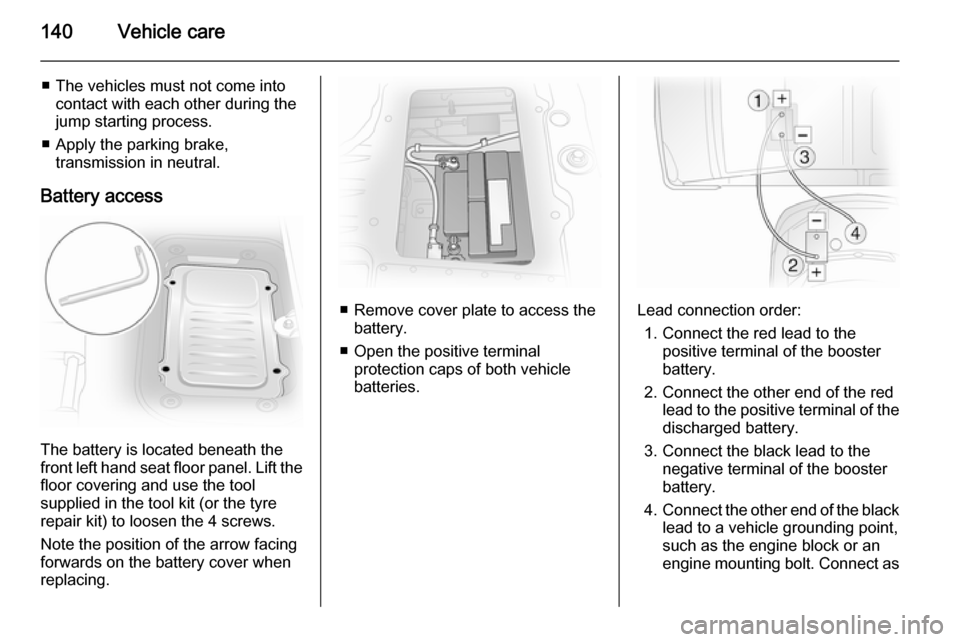
Battery access
The battery is located beneath the
front left hand seat floor panel. Lift the floor covering and use the tool
supplied in the tool kit (or the tyre
repair kit) to loosen the 4 screws.
Note the position of the arrow facing
forwards on the battery cover when
replacing.
■ Remove cover plate to access the battery.
■ Open the positive terminal protection caps of both vehicle
batteries.Lead connection order:
1. Connect the red lead to the positive terminal of the booster
battery.
2. Connect the other end of the red lead to the positive terminal of the
discharged battery.
3. Connect the black lead to the negative terminal of the boosterbattery.
4. Connect the other end of the black
lead to a vehicle grounding point,
such as the engine block or an
engine mounting bolt. Connect as
Page 143 of 173
Vehicle care141
far away from the discharged
vehicle battery as possible,
however at least 60 cm.
Route the leads so that they cannot
catch on rotating parts in the engine
compartment.
To start the engine: 1. Start the engine of the vehicle providing the jump start.
2. After 5 minutes, start the other engine. Start attempts should be
made for no longer than
15 seconds at an interval of
1 minute.
3. Allow both engines to idle for approx. 3 minutes with the leads
connected.
4. Switch on electrical consumers (e.g. headlights, heated rear
window) of the vehicle receiving
the jump start.
5. Reverse above sequence exactly when removing leads.Towing
Towing the vehicle
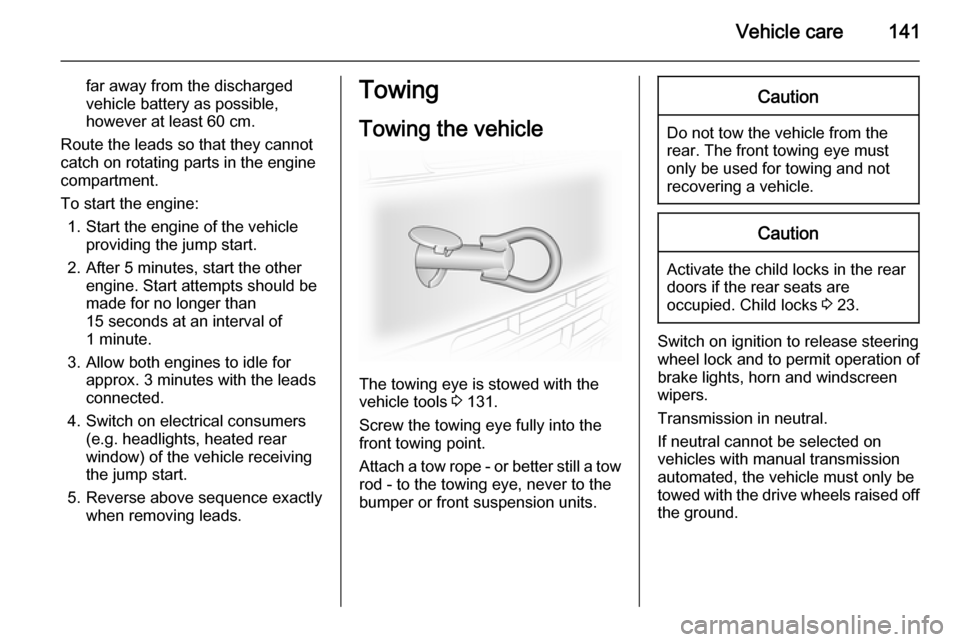
The towing eye is stowed with the
vehicle tools 3 131.
Screw the towing eye fully into the
front towing point.
Attach a tow rope - or better still a tow
rod - to the towing eye, never to the
bumper or front suspension units.
Caution
Do not tow the vehicle from the
rear. The front towing eye must
only be used for towing and not
recovering a vehicle.
Caution
Activate the child locks in the rear
doors if the rear seats are
occupied. Child locks 3 23.
Switch on ignition to release steering
wheel lock and to permit operation of
brake lights, horn and windscreen
wipers.
Transmission in neutral.
If neutral cannot be selected on
vehicles with manual transmission automated, the vehicle must only betowed with the drive wheels raised off the ground.
Page 168 of 173

166IndexAAccessories and vehicle modifications .......................... 115
Adjustable air vents .....................90
Airbag and belt tensioners ...........70
Airbag deactivation ................47, 70
Airbag system .............................. 42
Air conditioning regular operation 91
Air conditioning system ................ 85
Air intake ...................................... 91
Air vents........................................ 90
Alert .............................................. 75
Antifreeze ................................... 119
Antilock brake system ................ 101
Antilock brake system (ABS) .......72
Anti-theft alarm system ................26
Anti-theft locking system .............. 25 Appearance care ........................143
Armrest ........................................ 35
Ashtrays ....................................... 65 Automatic light control .................79
Automatic locking ........................23
Auxiliary heater ............................. 87
B Battery, jump starting.................. 139
Belts.............................................. 39
Bonnet ....................................... 116
Brake and clutch fluid .................147Brake assist ............................... 102
Brake fluid .................................. 121
Brakes ............................... 101, 121
Brake system ............................... 71
Breakdown.................................. 141
Bulb replacement ....................... 124
C Capacities .................................. 162
Car Pass ...................................... 18
Catalytic converter .......................96
Central locking system ................20
Centre high-mounted brake light 126
Changing tyre and wheel size ...133
Charging system .......................... 71
Child locks ................................... 23
Child restraint installation locations ................................... 49
Child restraint systems ................48
Cigarette lighter ........................... 64
Cleaning the vehicle ...................143
Climate control ............................. 15
Clock ............................................ 63
Code ............................................. 75
Control indicators.......................... 68
Control of the vehicle ...................93
Controls ........................................ 60
Controls in steering wheel ............60
Convex shape .............................. 28
Coolant ....................................... 119