weight VAUXHALL VIVARO 2014 User Guide
[x] Cancel search | Manufacturer: VAUXHALL, Model Year: 2014, Model line: VIVARO, Model: VAUXHALL VIVARO 2014Pages: 173, PDF Size: 4.11 MB
Page 114 of 173

112Driving and operating
For the values specific to your
vehicle, refer to the EEC Certificate of Conformity provided with your vehicle
or other national registration
documents.
General information The official fuel consumption and
specific CO 2 emission figures quoted
relate to the EU base model with
standard equipment.
Fuel consumption data and CO 2
emission data are determined
according to regulation R (EC) No.
715/2007 (in the applicable version),
taking into consideration the vehicle
weight in running order, as specified
by the regulation.
The figures are provided only for the
purpose of comparison between
different vehicle variants and must
not be taken as a guarantee for the
actual fuel consumption of a
particular vehicle.
Additional equipment may result in
slightly higher results than the stated
fuel consumption and CO 2 figures.Furthermore, fuel consumption is
dependent on personal driving style
as well as road and traffic conditions.Trailer hitch
General information
Entrust retrofitting of towing
equipment to a workshop. It may be
necessary to make changes that
affect the cooling system, heat
shields or other equipment. Only use
towing equipment that has been
approved for your vehicle.
Driving characteristics and
towing tips
In the case of trailers with brakes,
attach the breakaway stopping cable.
Before attaching a trailer, lubricatethe coupling ball. However, do not do
so if a stabiliser, which acts on the coupling ball, is being used to reduce snaking movements. For trailers with
low driving stability the use of a
stabiliser is recommended.
A maximum speed of 50 mph must
not be exceeded, even in countries
where higher speeds are permitted.
Page 115 of 173

Driving and operating113
If the trailer starts snaking, drive moreslowly, do not attempt to correct the
steering and brake sharply if
necessary.
When driving downhill, drive in the
same gear as if driving uphill and
drive at a similar speed.
Adjust tyre pressure to the value
specified for full load 3 163.
Trailer towing Trailer loads
The permissible trailer loads are
vehicle and engine-dependent
maximum values which must not be exceeded. The actual trailer load is
the difference between the actual
gross weight of the trailer and the
actual coupling socket load with the
trailer coupled.
The permissible trailer loads are
specified in the vehicle documents. In general, they are valid for gradients
up to max. 12 %.The permitted trailer load applies up
to the specified incline and up to an
altitude of 1000 metres above sea
level. Since engine power decreases
as altitude increases due to the air
becoming thinner, therefore reducing
climbing ability, the permissible gross
train weight also decreases by 10 %
for every 1000 metres of additional
altitude. The gross train weight does
not have to be reduced when driving
on roads with slight inclines (less than 8 %, e.g. motorways).
The permissible gross train weight
must not be exceeded. This weight is
specified on the identification plate
3 150.
Vertical coupling load
The vertical coupling load is the load
exerted by the trailer on the coupling
ball. It can be varied by changing the
weight distribution when loading the
trailer.
The maximum permissible vertical
coupling load is specified on the
towing equipment identification plate
and in the vehicle documents. Always aim for the maximum load, especiallyin the case of heavy trailers. The
vertical coupling load should never
fall below 25 kg.
In the case of trailer loads of
1200 kg or more, the vertical coupling load should not be less than 50 kg.
Rear axle load When the trailer is coupled and the
towing vehicle fully loaded (including
all occupants), the permissible rear
axle load (see identification plate or
vehicle documents) must not be
exceeded.
Towing equipmentCaution
When operating without a trailer,
remove the coupling ball bar.
Page 140 of 173
138Vehicle care
Put wheel bolts somewhere
where the threads will not be
soiled.
6. Change the wheel.
7. Screw in the wheel bolts.
8. Lower vehicle.
9. Tighten each wheel bolt in a crosswise sequence. Tighteningtorque is 140 Nm.
10. Refit wheel cover
11. Change the wheel.
12. Stow the replaced wheel 3 138
and the vehicle tools 3 131.
13. Have the new wheel balanced on the vehicle. Check the tyre
pressure of the installed tyre
3 163 and also the wheel bolt
torque as soon as possible.
Have the defective tyre renewed or
repaired.
Spare wheel Some vehicles are equipped with a
tyre repair kit instead of a spare wheel
3 133.Use of a spare wheel that is smaller
than the other wheels or together with winter tyres could affect driveability.
Have the defective tyre replaced as
soon as possible.
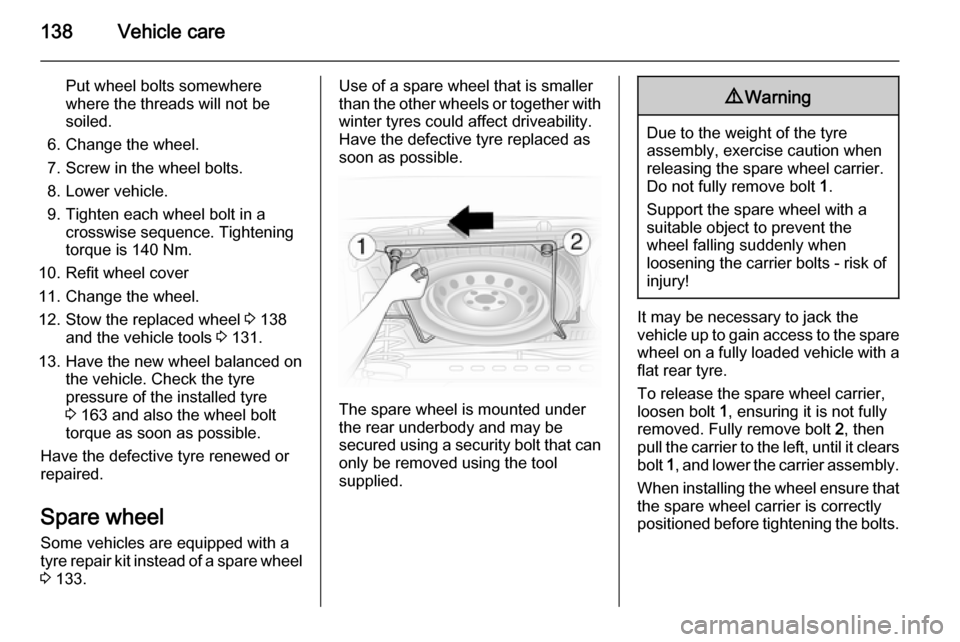
The spare wheel is mounted under
the rear underbody and may be
secured using a security bolt that can
only be removed using the tool
supplied.
9 Warning
Due to the weight of the tyre
assembly, exercise caution when
releasing the spare wheel carrier.
Do not fully remove bolt 1.
Support the spare wheel with a
suitable object to prevent the
wheel falling suddenly when
loosening the carrier bolts - risk of injury!
It may be necessary to jack the
vehicle up to gain access to the spare wheel on a fully loaded vehicle with a
flat rear tyre.
To release the spare wheel carrier,
loosen bolt 1, ensuring it is not fully
removed. Fully remove bolt 2, then
pull the carrier to the left, until it clears bolt 1, and lower the carrier assembly.
When installing the wheel ensure that
the spare wheel carrier is correctly
positioned before tightening the bolts.
Page 152 of 173
150Technical dataIdentification plate
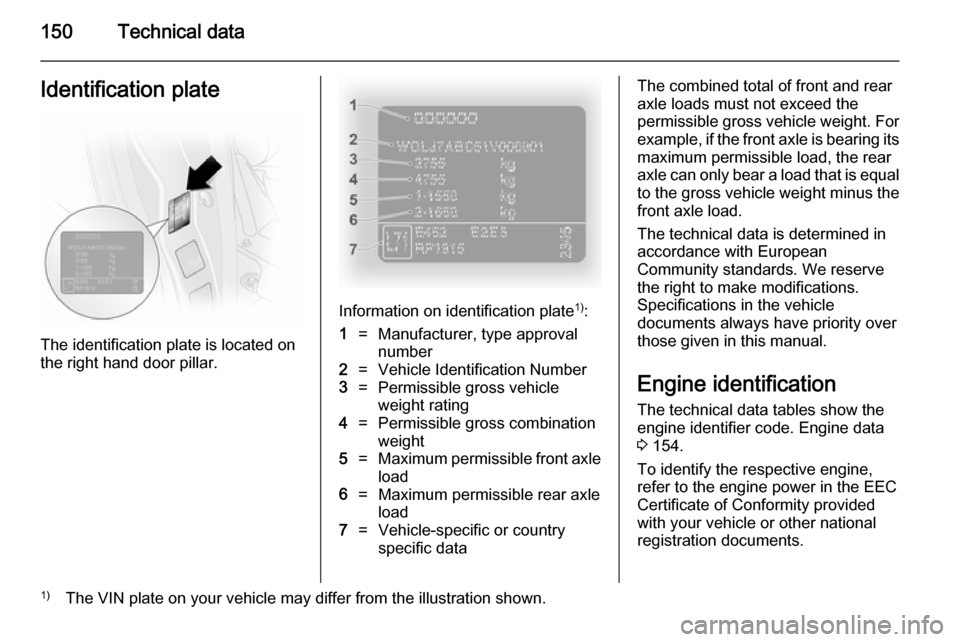
The identification plate is located on
the right hand door pillar.
Information on identification plate 1)
:
1=Manufacturer, type approval
number2=Vehicle Identification Number3=Permissible gross vehicle
weight rating4=Permissible gross combination
weight5=Maximum permissible front axle load6=Maximum permissible rear axle
load7=Vehicle-specific or country
specific dataThe combined total of front and rear
axle loads must not exceed the
permissible gross vehicle weight. For
example, if the front axle is bearing its
maximum permissible load, the rear
axle can only bear a load that is equal
to the gross vehicle weight minus the front axle load.
The technical data is determined in
accordance with European
Community standards. We reserve
the right to make modifications.
Specifications in the vehicle
documents always have priority over
those given in this manual.
Engine identification The technical data tables show the
engine identifier code. Engine data
3 154.
To identify the respective engine,
refer to the engine power in the EEC
Certificate of Conformity provided
with your vehicle or other national
registration documents.1) The VIN plate on your vehicle may differ from the illustration shown.
Page 158 of 173

156Technical dataVehicle weight
Kerb weight, basic modelModelWheelbaseRoofPayload ClassEngineKerb weight 6)7)VanShortStandard1000F4R1660F9Q1660M9R1678Standard1200F4R1660F9Q1669M9R1688High1200F4R1695F9Q1713M9R17606)
Kerb weight and gross vehicle weight increase on models fitted with bad road equipment package - refer to VIN plate.
7) Minimum vehicle weight according to Type Approval, including all fluids, vehicle tools and a 90% fuel load. Excludes
the weight of the driver and deletable options, e.g. spare wheel, bulkhead and sliding side load door. Final weight may
vary according to the specification of the vehicle, e.g. options, deleted options and accessories.
Page 159 of 173

Technical data157
ModelWheelbaseRoofPayload ClassEngineKerb weight6)7)VanLongStandard1200F4R1660F9Q1676M9R1724High1200F4R1745F9Q1761M9R18106)
Kerb weight and gross vehicle weight increase on models fitted with bad road equipment package - refer to VIN plate.
7) Minimum vehicle weight according to Type Approval, including all fluids, vehicle tools and a 90% fuel load. Excludes
the weight of the driver and deletable options, e.g. spare wheel, bulkhead and sliding side load door. Final weight may
vary according to the specification of the vehicle, e.g. options, deleted options and accessories.
Page 160 of 173

158Technical data
ModelWheelbaseRoofPayload ClassEngineKerb weight6)7)CombiShortStandard1000F4R1818F9Q1835M9R1883Standard1200F4R1829F9Q1846M9R1893LongStandard1200F4R1890F9Q1906M9R19546)
Kerb weight and gross vehicle weight increase on models fitted with bad road equipment package - refer to VIN plate.
7) Minimum vehicle weight according to Type Approval, including all fluids, vehicle tools and a 90% fuel load. Excludes
the weight of the driver and deletable options, e.g. spare wheel, bulkhead and sliding side load door. Final weight may
vary according to the specification of the vehicle, e.g. options, deleted options and accessories.
Page 161 of 173

Technical data159
ModelWheelbaseRoofPayload ClassEngineKerb weight6)7)Platform cabLongStandard1200F4R14498)F9Q14678)M9R1515 8)TourShortStandard900F4R1879F9Q-M9R19446)
Kerb weight and gross vehicle weight increase on models fitted with bad road equipment package - refer to VIN plate.
7) Minimum vehicle weight according to Type Approval, including all fluids, vehicle tools and a 90% fuel load. Excludes
the weight of the driver and deletable options, e.g. spare wheel, bulkhead and sliding side load door. Final weight may
vary according to the specification of the vehicle, e.g. options, deleted options and accessories.
8) Vehicle without body conversion.
Page 172 of 173

170
Vehicle dimensions .................... 160
Vehicle Identification Number ....149
Vehicle jack ................................ 131
Vehicle messages .......................75
Vehicle security ............................ 25
Vehicle specific data ......................3
Vehicle storage ........................... 115
Vehicle tools ............................... 131
Vehicle unlocking ........................... 6
Vehicle weight ........................... 156
Ventilation ..................................... 84
W
Warning chimes ........................... 75
Warning lights ............................... 65
Warning triangle .......................... 58
Washer and wiper systems .........14
Washer fluid ............................... 120
Washing the vehicle ...................143
Wheel changing .........................136
Wheel covers ............................. 133
Wheels and tyres .......................131
Windows ................................. 29, 30
Windscreen................................... 29
Windscreen wiper/washer ...........61
Winter tyres ............................... 131
Wiper blade replacement ..........123