air condition VAUXHALL VIVARO 2014 Owner's Manual
[x] Cancel search | Manufacturer: VAUXHALL, Model Year: 2014, Model line: VIVARO, Model: VAUXHALL VIVARO 2014Pages: 173, PDF Size: 4.11 MB
Page 87 of 173
Climate control85
■Open side air vents as required and
direct them towards door windows.
■ For simultaneous warming of the foot well, set air distribution control
to J.
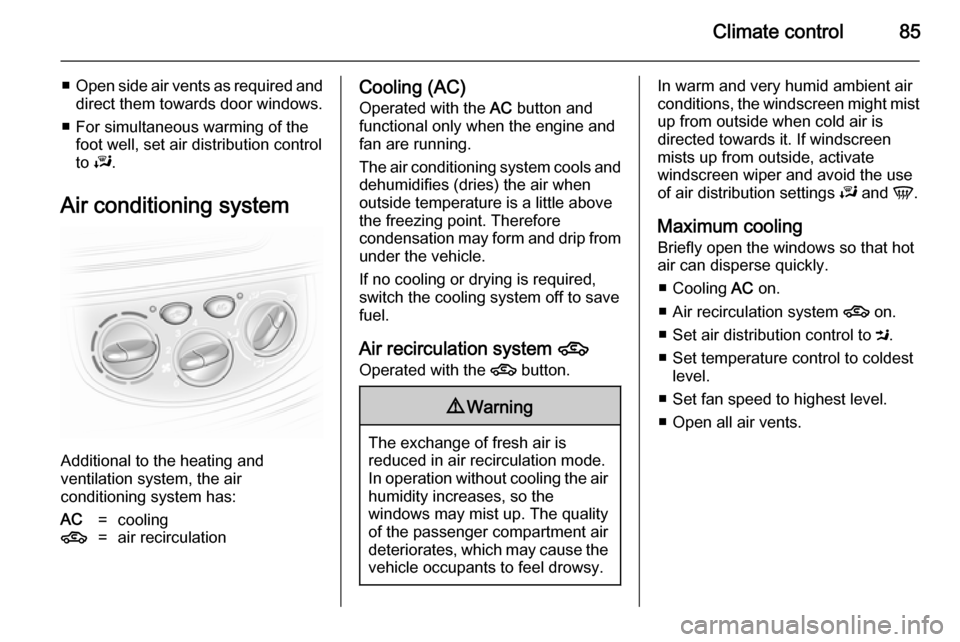
Air conditioning system
Additional to the heating and
ventilation system, the air
conditioning system has:
AC=cooling4=air recirculationCooling (AC)
Operated with the AC button and
functional only when the engine and
fan are running.
The air conditioning system cools and
dehumidifies (dries) the air when
outside temperature is a little above
the freezing point. Therefore
condensation may form and drip from under the vehicle.
If no cooling or drying is required,
switch the cooling system off to save
fuel.
Air recirculation system 4
Operated with the 4 button.9Warning
The exchange of fresh air is
reduced in air recirculation mode.
In operation without cooling the air humidity increases, so the
windows may mist up. The quality
of the passenger compartment air
deteriorates, which may cause the vehicle occupants to feel drowsy.
In warm and very humid ambient air
conditions, the windscreen might mist up from outside when cold air is
directed towards it. If windscreen
mists up from outside, activate
windscreen wiper and avoid the use
of air distribution settings J and V.
Maximum cooling Briefly open the windows so that hot
air can disperse quickly.
■ Cooling AC on.
■ Air recirculation system 4 on.
■ Set air distribution control to M.
■ Set temperature control to coldest level.
■ Set fan speed to highest level.
■ Open all air vents.
Page 88 of 173
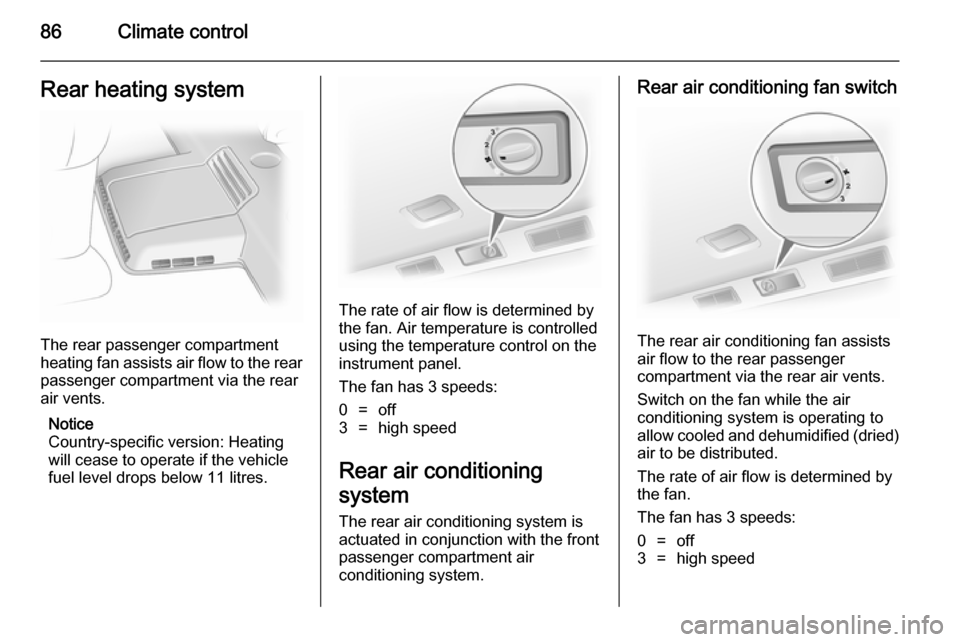
86Climate controlRear heating system
The rear passenger compartment
heating fan assists air flow to the rear
passenger compartment via the rear
air vents.
Notice
Country-specific version: Heating
will cease to operate if the vehicle
fuel level drops below 11 litres.
The rate of air flow is determined by
the fan. Air temperature is controlled
using the temperature control on the
instrument panel.
The fan has 3 speeds:
0=off3=high speed
Rear air conditioning
system
The rear air conditioning system is
actuated in conjunction with the front
passenger compartment air
conditioning system.
Rear air conditioning fan switch
The rear air conditioning fan assists
air flow to the rear passenger
compartment via the rear air vents.
Switch on the fan while the air
conditioning system is operating to
allow cooled and dehumidified (dried) air to be distributed.
The rate of air flow is determined by
the fan.
The fan has 3 speeds:
0=off3=high speed
Page 93 of 173
Climate control919Warning
Do not attach any objects to the
slats of the air vents. Risk of
damage and injury in case of an
accident.
Fixed air vents
Additional air vents are located
beneath the windscreen and door windows and in the foot wells.
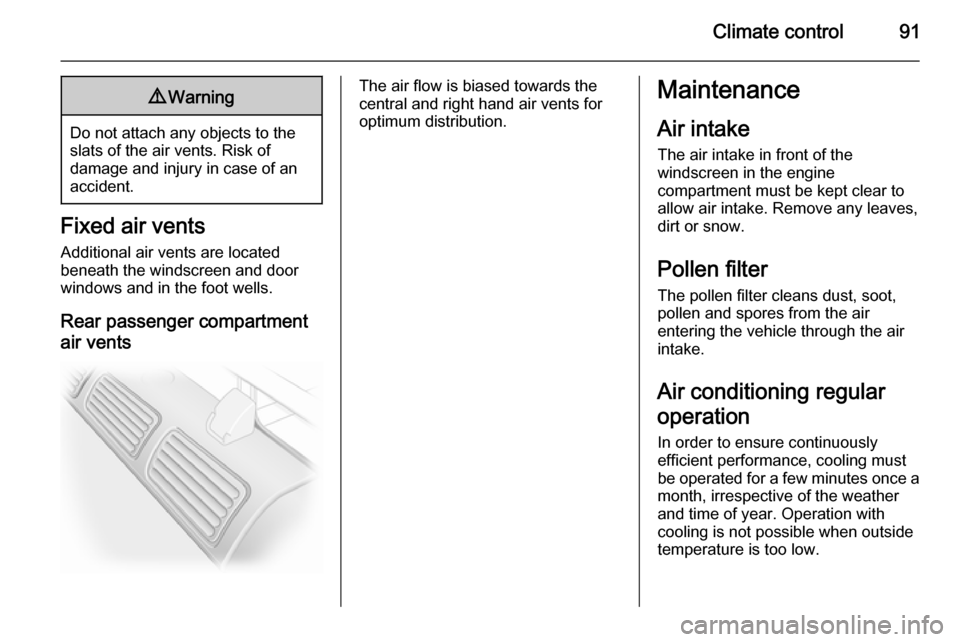
Rear passenger compartment
air vents
The air flow is biased towards the
central and right hand air vents for
optimum distribution.Maintenance
Air intake
The air intake in front of the
windscreen in the engine
compartment must be kept clear to
allow air intake. Remove any leaves,
dirt or snow.
Pollen filter
The pollen filter cleans dust, soot,
pollen and spores from the air
entering the vehicle through the air
intake.
Air conditioning regular
operation
In order to ensure continuously
efficient performance, cooling must
be operated for a few minutes once a month, irrespective of the weather
and time of year. Operation with
cooling is not possible when outside
temperature is too low.
Page 100 of 173

98Driving and operating
Always move the selector lever in the
appropriate direction as far as it will
go. Upon release, it automatically
returns to the centre position.N=Neutral.A/
M=Switch between automatic
and manual mode.
The transmission display
shows "A" when in automatic mode.R=Reverse gear.
Engage only when vehicle is
stationary. The transmission
display shows "R" when
reverse gear is engaged.+=Shift to a higher gear.-=Shift to a lower gear.
Starting off
When the engine is started, the
transmission is in automatic mode.
Depress the foot brake and move the selector lever towards + to engage
first gear. If R is selected,
reverse gear is engaged. The vehicle
starts to move when the foot brake is
released. To start off quickly, release
the foot brake and accelerate
immediately after engaging a gear.
In automatic mode the transmission
shifts to other gears automatically,
dependent on driving conditions.
To engage manual mode, move the
selector lever towards A/M. The
current gear will appear in the
transmission display. To engage
first gear, depress foot brake and
move selector lever towards + or -.
Shift to a higher or lower gear by
moving selector lever to + or -. Gears
can be skipped by moving the
selector lever repeatedly at short
intervals.
Stopping the vehicle
In automatic or manual mode,
first gear is engaged and the clutch is
released when the vehicle is stopped. In R, reverse gear remains engaged.
When stopping on gradients, engage parking brake or depress the foot
brake. To prevent overheating of the
clutch, an intermittent audiblewarning may sound as a signal to
depress the foot brake or apply the
parking brake.
Switch off engine if stopping for a lengthy period, e.g. in traffic jams.
When the vehicle is parked and the
driver's door is opened, a warning
chime will sound if neutral is not
selected or the foot brake has not
been depressed.
Engine braking
Automatic mode
When driving downhill, the manual
transmission automated does not shift into higher gears until a fairly
high engine speed has been reached. It shifts down in good time when
braking.
Manual mode
To utilise the engine braking effect,
select a lower gear in good time when
driving downhill.
Page 125 of 173
Vehicle care123
Place a container underneath the
filter housing. Loosen the knurled
screws on the filter cover and on the
lower part of the filter by approx. one
turn, to drain off the water.
The filter is drained as soon as diesel fuel emerges from the knurled screw
at the bottom. Retighten the two
screws.
Check diesel fuel filter at shorter
intervals if the vehicle is subjected to
extreme operating conditions.
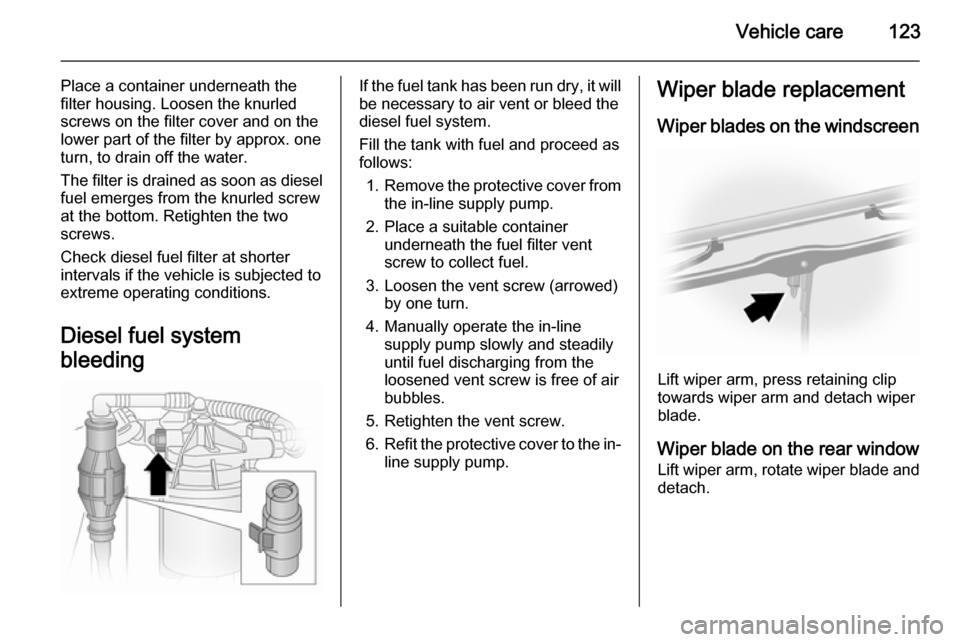
Diesel fuel system
bleedingIf the fuel tank has been run dry, it will be necessary to air vent or bleed the
diesel fuel system.
Fill the tank with fuel and proceed as
follows:
1. Remove the protective cover from
the in-line supply pump.
2. Place a suitable container underneath the fuel filter vent
screw to collect fuel.
3. Loosen the vent screw (arrowed) by one turn.
4. Manually operate the in-line supply pump slowly and steadily
until fuel discharging from the
loosened vent screw is free of air
bubbles.
5. Retighten the vent screw.
6. Refit the protective cover to the in-
line supply pump.Wiper blade replacement
Wiper blades on the windscreen
Lift wiper arm, press retaining clip
towards wiper arm and detach wiper
blade.
Wiper blade on the rear window Lift wiper arm, rotate wiper blade and
detach.
Page 132 of 173

130Vehicle care
SymbolApplicationZAir conditioningdHeated exterior mirrorsUHeated front seats,Power windowsLLeft-hand high beamNRight-hand high beamKWindscreen wiperZRadio, Infotainment system)Cigarette lighterBoilerRear passenger compart‐
ment heaterjHornaLeft-hand low beamWRight-hand low beameInstrument panelZHeatingdInterior lampSymbolApplicationuAntilock brake systemÜHeated rear windows+Clock, interior lights, radio,
Infotainment systemUCH
INJFuel injection systemfRear window washereRear widow wiperTLeft-hand sidelightSRight-hand sidelightUCentral locking:Electrically adjustable exte‐
rior mirrorsCStop control indicator,
daytime running lightsrRear fog lights>Front fog lightsSymbolApplication?Power outletTTachograph
Page 133 of 173
Vehicle care131Vehicle tools
Tools
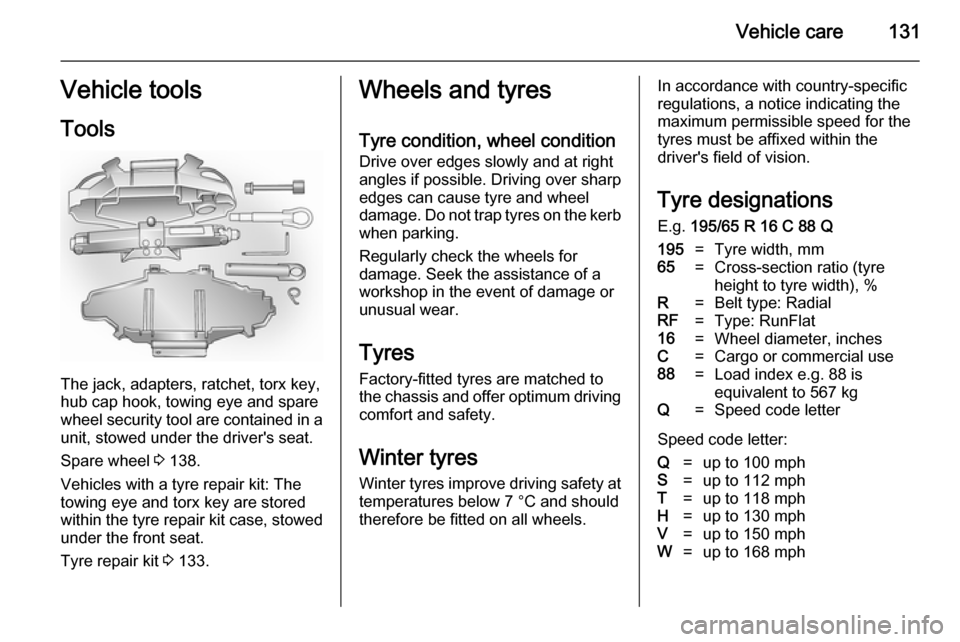
The jack, adapters, ratchet, torx key,
hub cap hook, towing eye and spare
wheel security tool are contained in a
unit, stowed under the driver's seat.
Spare wheel 3 138.
Vehicles with a tyre repair kit: The
towing eye and torx key are stored
within the tyre repair kit case, stowed
under the front seat.
Tyre repair kit 3 133.
Wheels and tyres
Tyre condition, wheel condition
Drive over edges slowly and at right
angles if possible. Driving over sharp
edges can cause tyre and wheel
damage. Do not trap tyres on the kerb when parking.
Regularly check the wheels for
damage. Seek the assistance of a
workshop in the event of damage or
unusual wear.
Tyres
Factory-fitted tyres are matched to the chassis and offer optimum driving comfort and safety.
Winter tyres Winter tyres improve driving safety attemperatures below 7 °C and shouldtherefore be fitted on all wheels.In accordance with country-specific
regulations, a notice indicating the
maximum permissible speed for the
tyres must be affixed within the
driver's field of vision.
Tyre designations E.g. 195/65 R 16 C 88 Q195=Tyre width, mm65=Cross-section ratio (tyre
height to tyre width), %R=Belt type: RadialRF=Type: RunFlat16=Wheel diameter, inchesC=Cargo or commercial use88=Load index e.g. 88 is
equivalent to 567 kgQ=Speed code letter
Speed code letter:
Q=up to 100 mphS=up to 112 mphT=up to 118 mphH=up to 130 mphV=up to 150 mphW=up to 168 mph
Page 146 of 173

144Vehicle care
Windows and windscreen wiperblades
Use a soft lint-free cloth or chamois leather together with window cleanerand insect remover.
When cleaning the rear window from
inside, always wipe in parallel to the
heating element to prevent damage.
For mechanical removal of ice, use a
sharp-edged ice scraper. Press the
scraper firmly against the glass so
that no dirt can get under it and
scratch the glass.
Clean smearing wiper blades with a
soft cloth and window cleaner.
Wheels and tyres
Do not use high-pressure jet
cleaners.
Clean rims with a pH-neutral wheel
cleaner.
Rims are painted and can be treated
with the same agents as the body.Paintwork damage
Rectify minor paintwork damage with
a touch-up pen before rust forms.
Have more extensive damage or rust
areas repaired by a workshop.
Underbody
Some areas of the vehicle underbody
have a PVC undercoating while other critical areas have a durable
protective wax coating.
After the underbody is washed, check
the underbody and have it waxed if
necessary.
Bitumen/rubber materials could
damage the PVC coating. Have
underbody work carried out by a
workshop.
Before and after winter, wash the
underbody and have the protective
wax coating checked.
Engine compartment
It is advisable to wash the engine compartment before and after winter
and preserve it with wax. Protect thealternator and brake fluid reservoir
with plastic sheets before washing
the engine.
When washing the engine with a
steam-jet cleaner, do not direct the
steam jet towards components of the
antilock brake system, air
conditioning system or the belt drive and its components.
After an engine wash, have all engine
compartment components preserved
thoroughly by a workshop using
protective wax.
Do not use high-pressure jet
cleaners.
Towing equipment
Do not clean the coupling ball bar with a steam-jet or high-pressure jet
cleaner.
Interior care Interior and upholstery
Only clean the vehicle interior,
including the instrument panel fascia
and panelling, with a dry cloth or
interior cleaner.
Page 167 of 173

Customer information165
■ Vehicle reactions in particulardriving situations (e.g. inflation of
an airbag, activation of the stability
regulation system)
■ Environmental conditions (e.g. temperature)
These data are exclusively technical
and help identifying and correcting
errors as well as optimizing vehicle
functions.
Motion profiles indicating travelled
routes cannot be created with these
data.
If services are used (e.g. repair
works, service processes, warranty cases, quality assurance),
employees of the service network
(manufacturer included) are able to
read out this technical information
from the event and error data storage
modules applying special diagnostic
devices. If required, you will receive
further information at these
workshops. After an error has been
corrected, the data are deleted from
the error storage module or they are
constantly overwritten.When using the vehicle, situations
may occur in which these technical
data related to other information
(accident report, damages on the
vehicle, witness statements etc.) may be associated with a specific person -
possibly, with the assistance of an
expert.
Additional functions contractually
agreed upon with the client (e.g.
vehicle location in emergency cases)
allow the transmission of particular vehicle data from the vehicle.Radio Frequency
Identification (RFID) RFID technology is used in somevehicles for functions such as tyre
pressure monitoring and ignition
system security. It is also used in
connection with conveniences such
as radio remote controls for door
locking/unlocking and starting, and in-
vehicle transmitters for garage door
openers. RFID technology in
Vauxhall vehicles does not use or
record personal information or link with any other Vauxhall system
containing personal information.
Page 168 of 173

166IndexAAccessories and vehicle modifications .......................... 115
Adjustable air vents .....................90
Airbag and belt tensioners ...........70
Airbag deactivation ................47, 70
Airbag system .............................. 42
Air conditioning regular operation 91
Air conditioning system ................ 85
Air intake ...................................... 91
Air vents........................................ 90
Alert .............................................. 75
Antifreeze ................................... 119
Antilock brake system ................ 101
Antilock brake system (ABS) .......72
Anti-theft alarm system ................26
Anti-theft locking system .............. 25 Appearance care ........................143
Armrest ........................................ 35
Ashtrays ....................................... 65 Automatic light control .................79
Automatic locking ........................23
Auxiliary heater ............................. 87
B Battery, jump starting.................. 139
Belts.............................................. 39
Bonnet ....................................... 116
Brake and clutch fluid .................147Brake assist ............................... 102
Brake fluid .................................. 121
Brakes ............................... 101, 121
Brake system ............................... 71
Breakdown.................................. 141
Bulb replacement ....................... 124
C Capacities .................................. 162
Car Pass ...................................... 18
Catalytic converter .......................96
Central locking system ................20
Centre high-mounted brake light 126
Changing tyre and wheel size ...133
Charging system .......................... 71
Child locks ................................... 23
Child restraint installation locations ................................... 49
Child restraint systems ................48
Cigarette lighter ........................... 64
Cleaning the vehicle ...................143
Climate control ............................. 15
Clock ............................................ 63
Code ............................................. 75
Control indicators.......................... 68
Control of the vehicle ...................93
Controls ........................................ 60
Controls in steering wheel ............60
Convex shape .............................. 28
Coolant ....................................... 119