climate control VAUXHALL VIVARO 2016.5 User Guide
[x] Cancel search | Manufacturer: VAUXHALL, Model Year: 2016.5, Model line: VIVARO, Model: VAUXHALL VIVARO 2016.5Pages: 211, PDF Size: 5 MB
Page 109 of 211
Climate control1079Warning
The exchange of fresh air is
reduced in air recirculation mode.
In operation without cooling the air humidity increases, so the
windows may mist up from inside.
The quality of the passenger
compartment air deteriorates,
which may cause the vehicle
occupants to feel drowsy.
To return to Automatic mode: Press
AUTO button.
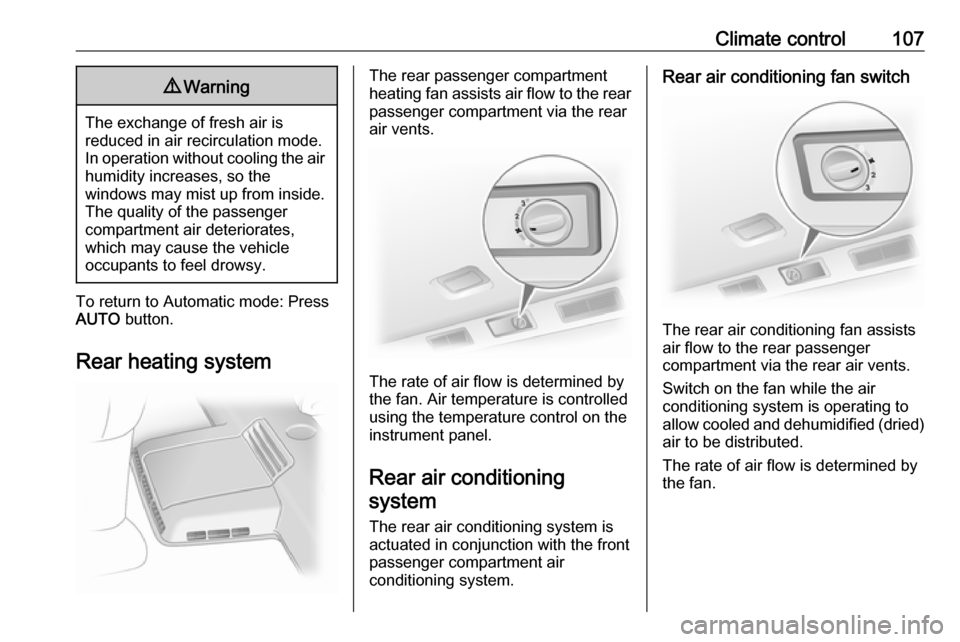
Rear heating system
The rear passenger compartment
heating fan assists air flow to the rear
passenger compartment via the rear
air vents.
The rate of air flow is determined by
the fan. Air temperature is controlled
using the temperature control on the
instrument panel.
Rear air conditioning system
The rear air conditioning system is
actuated in conjunction with the front
passenger compartment air
conditioning system.
Rear air conditioning fan switch
The rear air conditioning fan assists
air flow to the rear passenger
compartment via the rear air vents.
Switch on the fan while the air
conditioning system is operating to
allow cooled and dehumidified (dried) air to be distributed.
The rate of air flow is determined by
the fan.
Page 110 of 211

108Climate controlAuxiliary heater
Coolant heater The Eberspächer engine-
independent, fuel-powered coolant
heater provides rapid heating of the
engine coolant to enable heating of
the vehicle interior without the engine
running.9 Warning
Do not operate the system when
refuelling, when dust or
combustible vapours are present
or in enclosed spaces (e.g.
garage).
Before starting or programming the
system to start, turn the vehicle's
climate control system to heat, set the
air distribution to V and turn the fan
on.
Switch off when not required. Heating stops automatically after the
programmed runtime. It will also
cease to operate if the vehicle fuel
level drops too low.
During operation, power from the
vehicle battery is used. The driving
time should therefore be at least as
long as the heating time. For short
journey times, check the vehicle
battery regularly and recharge if
necessary.
To ensure efficient performance,
briefly operate the auxiliary heater
once a month.
Control units
The timer or remote control unit turns the system on and off, and is used to
programme specific departure times.
Timer1 Display:Displays preset,
weekday or preset
day, current time or preset time,
temperature, Z and
Y2 Temperature:Selects
temperature3 l:Adjusts values up4 k:Adjusts values
down5 Y:Selects heat
settings6 P:Selects preset
settings7 Þ:Selects time and
weekday settings
Page 111 of 211
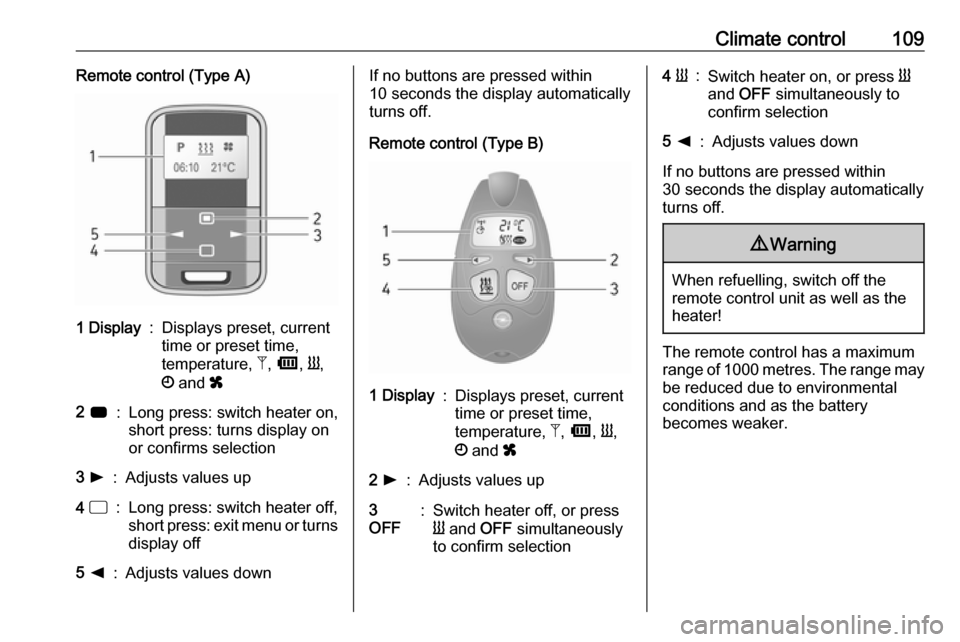
Climate control109Remote control (Type A)1 Display:Displays preset, current
time or preset time,
temperature, Z, Ü , Y ,
Ö and x2 7:Long press: switch heater on,
short press: turns display on
or confirms selection3 l:Adjusts values up4 d:Long press: switch heater off,
short press: exit menu or turns
display off5 k:Adjusts values downIf no buttons are pressed within
10 seconds the display automatically
turns off.
Remote control (Type B)1 Display:Displays preset, current
time or preset time,
temperature, Z, Ü , Y ,
Ö and x2 l:Adjusts values up3
OFF:Switch heater off, or press
Y and OFF simultaneously
to confirm selection4 Y:Switch heater on, or press Y
and OFF simultaneously to
confirm selection5 k:Adjusts values down
If no buttons are pressed within
30 seconds the display automatically
turns off.
9 Warning
When refuelling, switch off the
remote control unit as well as the
heater!
The remote control has a maximum
range of 1000 metres. The range may
be reduced due to environmental
conditions and as the battery
becomes weaker.
Page 112 of 211
110Climate control
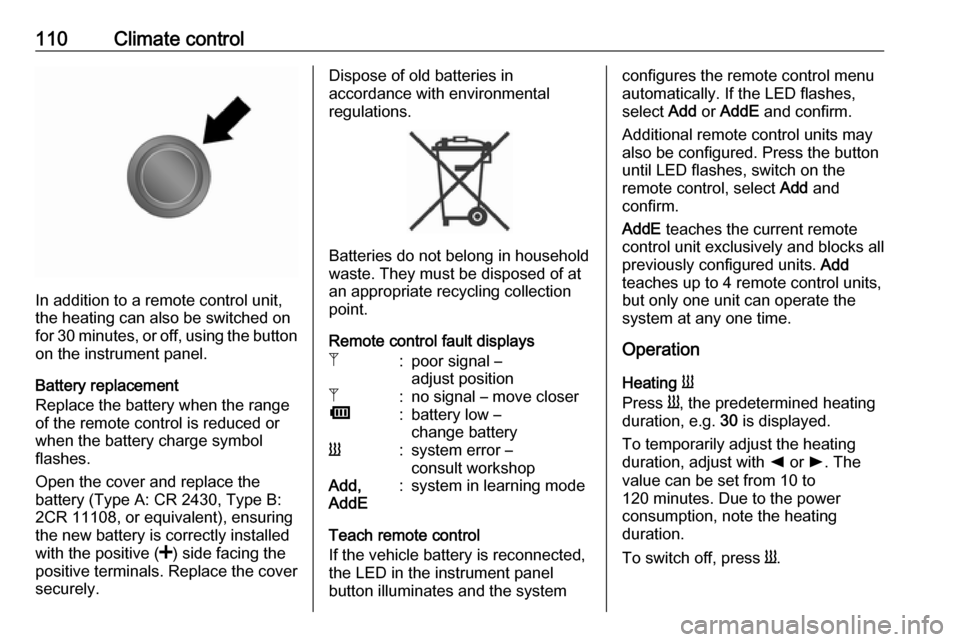
In addition to a remote control unit,
the heating can also be switched on
for 30 minutes, or off, using the button
on the instrument panel.
Battery replacement
Replace the battery when the range
of the remote control is reduced or when the battery charge symbol
flashes.
Open the cover and replace the
battery (Type A: CR 2430, Type B: 2CR 11108, or equivalent), ensuring
the new battery is correctly installed
with the positive ( <) side facing the
positive terminals. Replace the cover
securely.
Dispose of old batteries in
accordance with environmental
regulations.
Batteries do not belong in household
waste. They must be disposed of at
an appropriate recycling collection
point.
Remote control fault displays
Z:poor signal –
adjust positionZ:no signal – move closerÜ:battery low –
change batteryY:system error –
consult workshopAdd,
AddE:system in learning mode
Teach remote control
If the vehicle battery is reconnected, the LED in the instrument panel
button illuminates and the system
configures the remote control menu
automatically. If the LED flashes,
select Add or AddE and confirm.
Additional remote control units may
also be configured. Press the button
until LED flashes, switch on the
remote control, select Add and
confirm.
AddE teaches the current remote
control unit exclusively and blocks all
previously configured units. Add
teaches up to 4 remote control units,
but only one unit can operate the
system at any one time.
Operation
Heating Y
Press Y, the predetermined heating
duration, e.g. 30 is displayed.
To temporarily adjust the heating duration, adjust with k or l. The
value can be set from 10 to
120 minutes. Due to the power
consumption, note the heating
duration.
To switch off, press Y.
Page 113 of 211

Climate control111To change the default predeterminedheating duration, ensure the heater is switched off, press and hold k until
the display flashes and adjust with
k or l.
Programming P
Up to 3 preset departure times during
one day, or one preset departure time over one week can be programmed.
● Press P once to select preset
memory number 1.
● Press P twice to select preset
memory number 2.
● Press P three times to select
preset memory number 3.
● Press P again to exit the preset
memory.
Start heating within 24 hours ● Press P to select desired preset
memory number 1, 2 or 3.
● Briefly press k or l; the preset
time flashes.
● Adjust the preset time with k or
l .
● Press P to confirm and exit the
preset memory.Start heating up to 7 days
● Press P to select desired preset
memory number 1, 2 or 3.
● Briefly press k or l; the preset
time flashes.
● Adjust the preset time with k or
l .
● After 5 seconds the preset day flashes.
● Adjust the preset day with k or
l .
● The preset time and day are set once the display changes to the
current time.
Set time and weekday Þ
If the vehicle battery is disconnected
or its voltage is too low, the unit will
need to be reset.
● Press Þ until the time flashes.
● Press k or l to change the
current time.
● Time is stored when the display stops flashing.
● Wait for weekday to flash.● Press k or l to change the
weekday.
● Weekday is stored when the display stops flashing.
Heating level
The preferred heating level for
programmed departure times can be set between 10 to 30℃.
Adjust using the temperature
preselection dial.
Page 114 of 211
112Climate controlAir vents
Adjustable air vents At least one air vent must be open
while cooling is on, in order to prevent
the evaporator from icing up due to lack of air movement.9 Warning
Do not attach any objects to the
slats of the air vents. Risk of
damage and injury in case of an
accident.
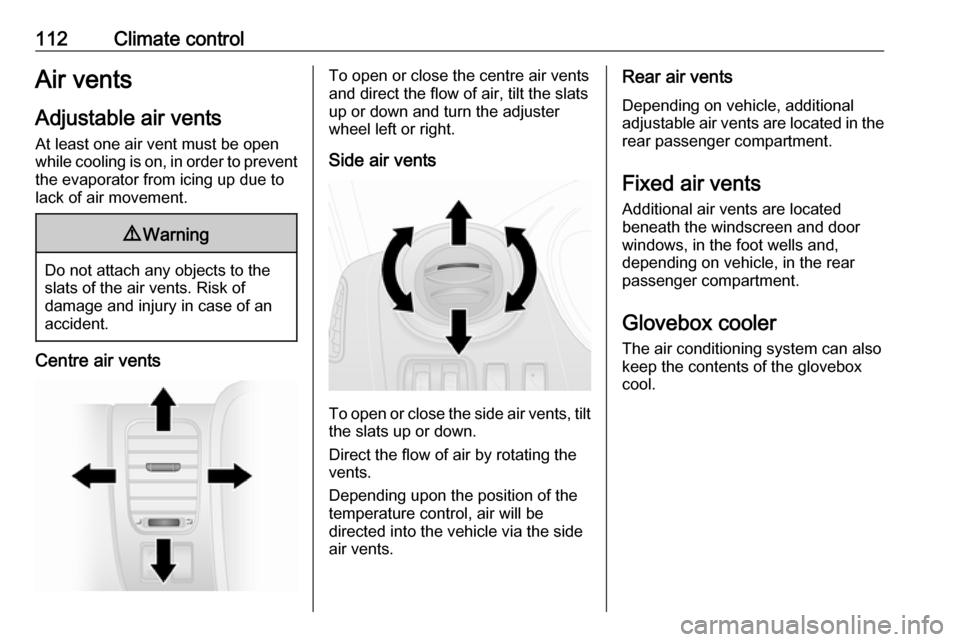
Centre air vents
To open or close the centre air vents
and direct the flow of air, tilt the slats
up or down and turn the adjuster
wheel left or right.
Side air vents
To open or close the side air vents, tilt the slats up or down.
Direct the flow of air by rotating the
vents.
Depending upon the position of the
temperature control, air will be
directed into the vehicle via the side
air vents.
Rear air vents
Depending on vehicle, additional
adjustable air vents are located in the
rear passenger compartment.
Fixed air vents Additional air vents are located
beneath the windscreen and door
windows, in the foot wells and,
depending on vehicle, in the rear
passenger compartment.
Glovebox cooler
The air conditioning system can also
keep the contents of the glovebox
cool.
Page 115 of 211

Climate control113Maintenance
Air intake The air intake in front of the
windscreen in the engine
compartment must be kept clear to
allow air intake. Remove any leaves,
dirt or snow.
Pollen filter
The pollen filter cleans dust, soot,
pollen and spores from the air
entering the vehicle through the air
intake.
Notice
Pollen filter is only fitted to vehicles
with air conditioning system.
Air conditioning regular operation
In order to ensure continuously
efficient performance, cooling must
be operated for a few minutes once a month, irrespective of the weather
and time of year. Operation with
cooling is not possible when outside
temperature is too low.Service
For optimal cooling performance, it is recommended that the climate control
system be checked annually, starting three years after initial vehicle
registration, including:
● functionality and pressure test
● heating functionality
● leakage check
● check of drive belts
● cleaning of condenser and evaporator drainage
● performance check
Page 123 of 211

Driving and operating121Conditions for an Autostop
The stop-start system checks if each
of the following conditions is fulfilled:
● the stop-start system is not manually deactivated
● the bonnet is fully closed
● the vehicle battery is sufficiently charged and in good condition
● the engine is warmed-up
● the engine coolant temperature is
not too high
● the outside temperature is not too
low or too high (e.g. below 0 °C
or above 35 °C)
● the brake vacuum is sufficient
● the defrosting function is not activated 3 105
● the self-cleaning function of the diesel particle filter is not active
3 122
● the Antilock brake system (ABS) 3 129, Traction Control system
(TC) 3 130 and ElectronicStability Program (ESP® Plus
)
3 131 ride control systems are
not actively engaged
● the vehicle has moved since the last Autostop
Otherwise an Autostop will be
inhibited.
Certain settings of the climate control
system may inhibit an Autostop. See
" Climate control " chapter for further
information 3 105
Restart of the engine by the driver
Depress the clutch pedal to restart the
engine.
Notice
If any gear is selected, the clutch pedal must be fully depressed to
restart the engine.
Control indicator Ï 3 89 extinguishes
in the instrument cluster when the engine is restarted.
Restart of the engine by the stop- start system
The selector lever must be in neutral
to enable an automatic restart.If one of the following conditions occurs during an Autostop, the
engine will be restarted automatically by the stop-start system:
● the stop-start system is manually
deactivated
● the bonnet is opened
● the vehicle battery is discharged
● the engine temperature is too low
● the brake vacuum is not sufficient
● the vehicle starts to move
● the defrosting function is activated 3 105
If an electrical accessory, e.g. a
portable CD player, is connected to
the power outlet, a brief power drop
during engine restart may be
noticeable.
Fault
If a fault occurs in the stop-start
system, the LED in Î illuminates,
and a corresponding message
appears in the DIC 3 90. Seek the
assistance of a workshop.
Vehicle messages 3 91.
Warning chimes 3 92.
Page 205 of 211

203Changing tyre and wheel size ...168
Charging system .......................... 86
Child locks ................................... 29
Child restraint installation locations ................................... 60
Child restraints.............................. 59
Child restraint systems ................59
Cigarette lighter ........................... 79
Cleaning the vehicle ...................177
Climate control ............................. 15
Climate control systems .............103
Clock ............................................ 77
Coat hooks ................................... 67
Coin holder ................................... 66
Control indicators.......................... 82
Control of the vehicle .................115
Controls ........................................ 75
Controls in steering wheel ............75
Convex shape .............................. 37 Coolant ....................................... 148
Coolant and antifreeze ...............182
Coolant heater ............................ 108
Cooling (A/C) .............................. 104
Cornering light .............................. 98
Cruise control ...................... 90, 133
Cupholders .................................. 67
Curtain airbag system .................. 57D
Danger, Warnings and Cautions ...4
Dashboard .................................... 10
Daytime running lights ............97, 98
Declaration of conformity ............199
DEF ............................................ 123
Demisting and defrosting ..............15
Diesel exhaust fluid ....................123
Diesel fuel filter .......................... 152
Diesel fuel system bleeding .......152
Diesel particle filter ....................122
Directional tyres ..................164, 173
Distance to service .......................81
Document tray .............................. 67
Door locks..................................... 23
Door open .................................... 90
Door panel storage .......................68
Doors ............................................ 29
Double cab ................................... 68
DPF (diesel particle filter) ...........122
Driver assistance systems ..........133
Driver Information Centre .............90
Driving characteristics and towing tips .............................. 142
Driving economically................... 114
Driving hints ................................ 114
E ECO mode .................................. 114
ecoScoring.................................... 93Electric adjustment ......................37
Electrical accessories ...................78
Electrical system......................... 159
Electronic climate control system 105
Electronic data recording ..............39
Electronic key system ...................22
Electronic Stability Program 87,
131, 143
Electronic Stability Program off ...87
End-of-life vehicle recovery .......145
Engine air filter............................ 148
Engine air flow indicator .............148
Engine coolant ........................... 148
Engine coolant temperature ........87
Engine data ............................... 187
Engine exhaust .......................... 122
Engine identification ...................185
Engine oil ...........147, 182, 186, 197
Engine oil additives ....................182
Engine oil level ............................ 92
Engine oil pressure ......................88
Engine oil viscosity grades .........182
Enhanced Traction function 130, 131
Entry lighting .............................. 101
Event data recorders ..................201
Exhaust gases ....................122, 176
Exit lighting ................................ 102
Exterior care .............................. 177
Exterior light ................................. 89