wheel VAUXHALL VIVARO 2016.5 Service Manual
[x] Cancel search | Manufacturer: VAUXHALL, Model Year: 2016.5, Model line: VIVARO, Model: VAUXHALL VIVARO 2016.5Pages: 211, PDF Size: 5 MB
Page 175 of 211
Vehicle care173Put wheel bolts somewhere
where the threads will not be
soiled.
6. Change the wheel. Spare wheel 3 173.
7. Screw in the wheel bolts.
8. Lower the vehicle and remove jack.
9. Tighten each of the wheel bolts in
a crosswise sequence using the
wheel wrench. Ensure the wrench
locates securely. The wrench
should turn clockwise to tighten
the bolts. Invert the wrench if
necessary.
Tightening torque is 160 Nm.
10. Replace the wheel cover, ensuring that the valve hole in thewheel cover is aligned with the
tyre valve before installing.
Notice
If applicable, fit anti-theft bolts
nearest the tyre valve (otherwise it
may not be possible to refit the wheel
cover).11. Stow the replaced wheel 3 173
and the vehicle tools 3 163.
12. Have the new wheel balanced on the vehicle.
Check the tyre pressure of the
installed tyre 3 198.
Check the wheel bolt torque.
Have the defective tyre renewed or
repaired as soon as possible.
Spare wheel
Some vehicles are equipped with a
tyre repair kit instead of a spare wheel 3 169.
If mounting a spare wheel which is
different from the other wheels, this
wheel might be classified as a
temporary spare wheel and the
corresponding speed limits apply,
even though no label indicates this.
Seek the assistance of a workshop to
check the applicable speed limit.Caution
The use of a spare wheel that is smaller than the other wheels or in combination with winter tyres
could affect driveability. Have the defective tyre replaced as soon as
possible.
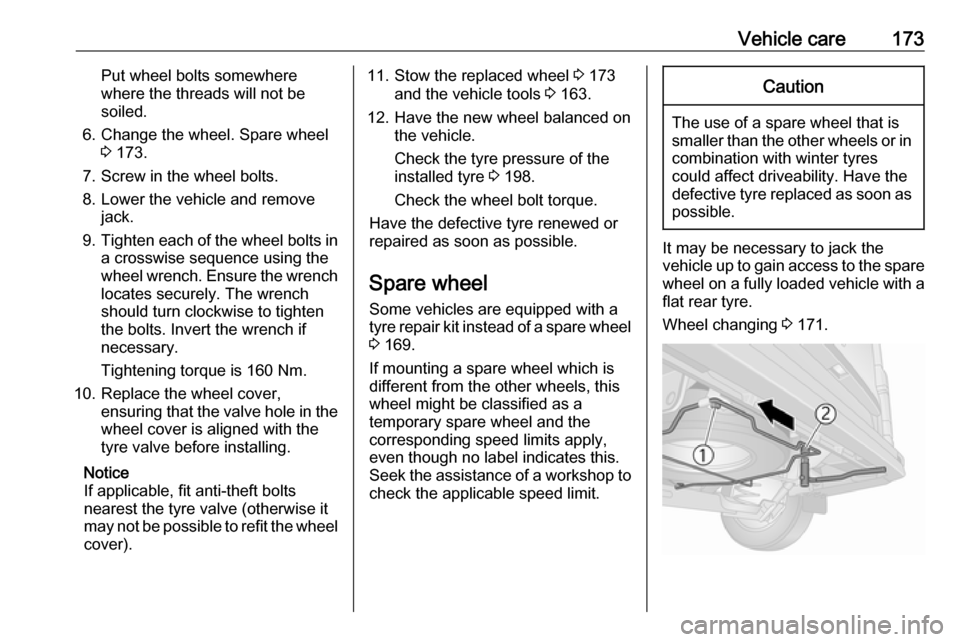
It may be necessary to jack the
vehicle up to gain access to the spare
wheel on a fully loaded vehicle with a
flat rear tyre.
Wheel changing 3 171.
Page 176 of 211
174Vehicle careThe spare wheel is mounted under
the rear underbody and may be
secured using a security bolt that can only be removed using the wheel bolt
sleeve supplied. Vehicle tools 3 163.9 Warning
Due to the weight of the tyre
assembly, exercise caution when
releasing the spare wheel carrier.
Do not fully remove bolt 1.
Support the spare wheel with a
suitable object to prevent the
wheel falling suddenly when
loosening the carrier bolts - risk of injury!
To release the spare wheel carrier,loosen bolt 1, ensuring it is not fully
removed. Fully remove bolt 2, then
pull the carrier to the left, until it clears bolt 1, and lower the carrier assembly.
When installing the wheel ensure that
the spare wheel carrier is correctly
positioned before tightening the bolts.
Summer and winter tyres
If you use winter tyres, the spare wheel may still be fitted with a
summer tyre.
If you use the spare wheel when it is
fitted with a summer tyre the vehicle's driveability may be affected,
especially on slippery road surfaces.
Directional tyres Fit directional tyres such that they rollin the direction of travel. The rolling
direction is indicated by a symbol
(e.g. an arrow) on the sidewall.
The following applies to tyres fitted
opposing the rolling direction:
● Driveability may be affected. Have the defective tyre renewed
or repaired as soon as possible
and fit it instead of the spare
wheel.
● Do not drive faster than 50 mph.
● Drive particularly carefully on wet
and snow-covered road
surfaces.Jump starting
Do not start with a quick charger.
A vehicle with a discharged battery
can be started using jump leads and the vehicle battery of another vehicle.9 Warning
Be extremely careful when starting
with jump leads. Any deviation
from the following instructions can
lead to injuries or damage caused
by battery explosion or damage to the electrical systems of both
vehicles.
9 Warning
Avoid contact of the battery with
eyes, skin, fabrics and painted
surfaces. The fluid contains
sulphuric acid which can cause
injuries and damage in the event
of direct contact.
● Never expose the battery to naked flames or sparks.
Page 178 of 211
176Vehicle carefar away from the discharged
vehicle battery as possible,
however at least 60 cm.
Route the leads so that they cannot
catch on rotating parts in the engine
compartment.
To start the engine: 1. Start the engine of the vehicle providing the jump start.
2. After 5 minutes, start the other engine. Start attempts should be
made for no longer than
15 seconds at an interval of
1 minute.
3. Allow both engines to idle for approx. 3 minutes with the leads
connected.
4. Switch on electrical consumers (e.g. headlights, heated rear
window) of the vehicle receiving
the jump start.
5. Reverse above sequence exactly when removing leads.Towing
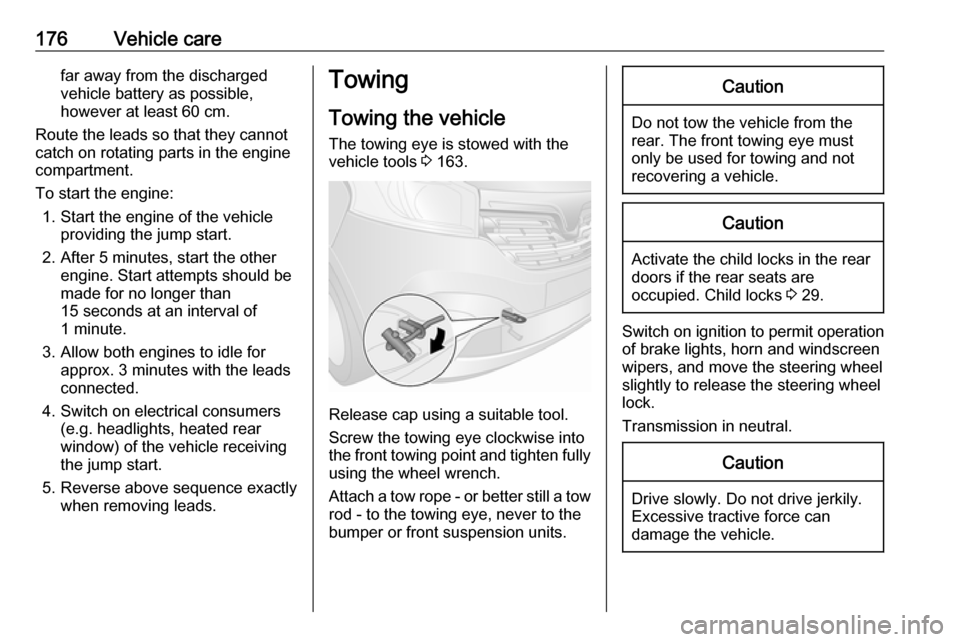
Towing the vehicle The towing eye is stowed with thevehicle tools 3 163.
Release cap using a suitable tool.
Screw the towing eye clockwise into
the front towing point and tighten fully
using the wheel wrench.
Attach a tow rope - or better still a tow rod - to the towing eye, never to the
bumper or front suspension units.
Caution
Do not tow the vehicle from the
rear. The front towing eye must
only be used for towing and not
recovering a vehicle.
Caution
Activate the child locks in the rear
doors if the rear seats are
occupied. Child locks 3 29.
Switch on ignition to permit operation
of brake lights, horn and windscreen
wipers, and move the steering wheel
slightly to release the steering wheel
lock.
Transmission in neutral.
Caution
Drive slowly. Do not drive jerkily.
Excessive tractive force can
damage the vehicle.
Page 180 of 211

178Vehicle careIf using a vehicle wash, comply with
the vehicle wash manufacturer's
instructions. The windscreen wipers and rear window wiper must be
switched off and the exterior mirrors
must be folded in. Remove antenna
and external accessories such as roof racks etc.
If you wash your vehicle by hand,
make sure that the insides of the
wheel housings are also thoroughly
rinsed out.
Clean edges and folds on opened
doors and the bonnet as well as the
areas they cover.Caution
Always use a cleaning agent with
a pH value of 4 to 9.
Do not use cleaning agents on hot surfaces.
Have the door hinges of all doors
greased by a workshop.
Do not clean the engine compartment with a steam-jet or high-pressure jet
cleaner.
Thoroughly rinse and leather-off the vehicle. Rinse leather frequently. Use
separate leathers for painted and
glass surfaces: remnants of wax on
the windows will impair vision.
Exterior lights
Headlight and other light covers are
made of plastic. Do not use any
abrasive or caustic agents, do not use
an ice scraper, and do not clean them
dry.
Polishing and waxing
Wax the vehicle regularly (at the
latest when water no longer beads).
Otherwise, the paintwork will dry out.
Polishing is necessary only if the paint
has become dull or if solid deposits
have become attached to it.
Paintwork polish with silicone forms a protective film, making waxing
unnecessary.
Unpainted plastic body parts must not
be treated with wax or polishing
agents.Matt filmed body parts or decor tapes must not be polished, to avoid
gleaming. Do not use hot wax
programmes in automatic car washes if the vehicle is equipped with theseparts.
Matt painted decor parts, e.g. mirror
housing cover, must not be polished.
Otherwise these parts would become
agleam or the colour would be
dissolved.
Windows and windscreen wiper
blades
Use a soft lint-free cloth or chamois
leather together with window cleaner and insect remover.
When cleaning the rear window from
inside, always wipe in parallel to the
heating element to prevent damage.
For mechanical removal of ice, use a
sharp-edged ice scraper. Press the
scraper firmly against the glass so
that no dirt can get under it and
scratch the glass.
Page 181 of 211

Vehicle care179Remove dirt residues from smearing
wiper blades by using a soft cloth and
window cleaner. Also make sure to
remove any residues such as wax,
insect residues and similar from the
window.
Ice residues, pollution and continuous wiping on dry windows will damage or
even destroy the wiper blades.
Wheels and tyres Do not use high-pressure jet
cleaners.
Clean rims with a pH-neutral wheel
cleaner.
Rims are painted and can be treated
with the same agents as the body.
Paintwork damage Rectify minor paintwork damage with
a touch-up pen before rust forms.
Have more extensive damage or rust areas repaired by a workshop.Underbody
Some areas of the vehicle underbody
have a PVC undercoating while other critical areas have a durable
protective wax coating.
After the underbody is washed, check
the underbody and have it waxed if
necessary.
Bitumen/rubber materials could
damage the PVC coating. Have
underbody work carried out by a
workshop.
Before and after winter, wash the
underbody and have the protective
wax coating checked.
Towing equipment
Do not clean the coupling ball bar with a steam-jet or high-pressure jet
cleaner.Interior care
Interior and upholstery Only clean the vehicle interior,
including the instrument panel fascia
and panelling, with a dry cloth or
interior cleaner.
Clean any leather upholstery with
clear water and a soft cloth. In case of
heavy soiling, use leather care.
The instrument cluster and the
displays should only be cleaned using
a soft damp cloth. If necessary use a
weak soap solution.
Clean fabric upholstery with a
vacuum cleaner and brush. Remove
stains with an upholstery cleaner.
Clothing fabrics may not be
colourfast. This could cause visible
discolourations, especially on light-
coloured upholstery. Removable
stains and discolourations should be
cleaned as soon as possible.
Clean seat belts with lukewarm water or interior cleaner.
Page 191 of 211

Technical data189Vehicle weightKerb weight, basic model
Optional equipment and accessories increase the kerb weight.
Loading information 3 73.ModelEngineWheelbaseRoofPayload ClassGross Vehicle Weight ratingKerb weight 4)5)VanR9ML1H1100027001661120029001661H2120029001760-1771L2H1120029001691-1695H21200290017754)
Kerb weight and gross vehicle weight increase on models fitted with bad road equipment package - refer to VIN plate.
5) Minimum vehicle weight according to Type Approval, including all fluids, vehicle tools and a 90% fuel load. Excludes the weight of
the driver and deletable options, e.g. spare wheel, bulkhead and sliding side load door. Final weight may vary according to the
specification of the vehicle, e.g. options, deleted options and accessories.
Page 192 of 211

190Technical dataModelEngineWheelbaseRoofPayload ClassGross Vehicle Weight ratingKerb weight4)5)CombiR9ML1H1100027001901120029001901L2H11200290019014)
Kerb weight and gross vehicle weight increase on models fitted with bad road equipment package - refer to VIN plate.
5) Minimum vehicle weight according to Type Approval, including all fluids, vehicle tools and a 90% fuel load. Excludes the weight of
the driver and deletable options, e.g. spare wheel, bulkhead and sliding side load door. Final weight may vary according to the
specification of the vehicle, e.g. options, deleted options and accessories.ModelEngineWheelbaseRoofPayload ClassGross Vehicle Weight ratingKerb weight 4)5)Platform cabR9ML2H11200290015504)
Kerb weight and gross vehicle weight increase on models fitted with bad road equipment package - refer to VIN plate.
5) Minimum vehicle weight according to Type Approval, including all fluids, vehicle tools and a 90% fuel load. Excludes the weight of
the driver and deletable options, e.g. spare wheel, bulkhead and sliding side load door. Final weight may vary according to the
specification of the vehicle, e.g. options, deleted options and accessories.
Page 193 of 211

Technical data191
ModelEngineWheelbaseTrim level
Additional minimum weights (approx.)6)Front axleRear axleTotalDouble cabR9ML1Base246185Mid276996Upper3278110L2Base315485Mid356196Upper41691106)
Final weight may vary according to the specification of the vehicle, e.g. options, deleted options and accessories. Refer to identification
plate on the right-hand door pillar.
Page 194 of 211
![VAUXHALL VIVARO 2016.5 Service Manual 192Technical dataVehicle dimensionsTypeVanCombiDouble cabPlatform cabWheelbaseL1L2L1L2L1L2L2Length [mm]4999539949995399499953995399Width without exterior mirrors [mm]1956195619561956195619561956Width](/img/38/19591/w960_19591-193.png "VAUXHALL VIVARO 2016.5 Service Manual 192Technical dataVehicle dimensionsTypeVanCombiDouble cabPlatform cabWheelbaseL1L2L1L2L1L2L2Length [mm]4999539949995399499953995399Width without exterior mirrors [mm]1956195619561956195619561956Width")
192Technical dataVehicle dimensionsTypeVanCombiDouble cabPlatform cabWheelbaseL1L2L1L2L1L2L2Length [mm]4999539949995399499953995399Width without exterior mirrors [mm]1956195619561956195619561956Width with two exterior mirrors [mm]2283228322832283228322832185Height - unladen (without antenna) [mm]H1
1971197119711971197119712700
H224652465-----Wheelbase [mm]3098349830983498309834983498Track width [mm]
Front
1615161516151615161516151615
Rear1628 7)1628 7)162816281628162816287)
1630 with H2 Roof height.
Page 195 of 211
![VAUXHALL VIVARO 2016.5 Service Manual Technical data193Loadspace dimensions
Wheelbase
VanL1L2Roof heightH1H2H1H2Maximum rear door aperture height [mm]1320182013201820Rear door aperture width (at floor) [mm]1391139113911391Maximum load are](/img/38/19591/w960_19591-194.png "VAUXHALL VIVARO 2016.5 Service Manual Technical data193Loadspace dimensions
Wheelbase
VanL1L2Roof heightH1H2H1H2Maximum rear door aperture height [mm]1320182013201820Rear door aperture width (at floor) [mm]1391139113911391Maximum load are")
Technical data193Loadspace dimensions
Wheelbase
VanL1L2Roof heightH1H2H1H2Maximum rear door aperture height [mm]1320182013201820Rear door aperture width (at floor) [mm]1391139113911391Maximum load area height [mm]1387189813871898Maximum load area width [mm]1662166216621662Width between wheel arches [mm]1268126812681268Maximum load floor length [mm]2537253729372937Maximum load floor length -
up to front passenger seat [mm] 8)2950295033503350Maximum load floor length -
up to front passenger footwell [mm] 8)3815381541504150Loading height unladen [mm]552527552525Sliding side door aperture width [mm]1229122912291229