ABS VAUXHALL VIVARO 2016.5 Owner's Manual
[x] Cancel search | Manufacturer: VAUXHALL, Model Year: 2016.5, Model line: VIVARO, Model: VAUXHALL VIVARO 2016.5Pages: 211, PDF Size: 5 MB
Page 76 of 211

74Instruments and controlsInstruments and
controlsControls ....................................... 75
Steering wheel adjustment ........75
Steering wheel controls .............75
Horn ........................................... 75
Steering column controls ...........75
Windscreen wiper/washer .........76
Rear window wiper/washer .......77
Outside temperature ..................77
Clock ......................................... 77
Power outlets ............................. 78
Cigarette lighter ......................... 79
Ashtrays .................................... 79
Warning lights, gauges and indi‐ cators ........................................... 79
Instrument cluster ......................79
Speedometer ............................. 79
Odometer .................................. 80
Trip odometer ............................ 80
Tachometer ............................... 80
Fuel gauge ................................ 81
Fuel economy gauge .................81
Service display .......................... 81
Control indicators ......................82
Turn signal ................................. 84Seat belt reminder.....................85
Airbag and belt tensioners .........85
Airbag deactivation ....................85
Charging system .......................86
Malfunction indicator light ..........86
Service vehicle soon .................86
Stop engine ............................... 86
Brake system ............................. 86
Antilock brake system (ABS) .....87
Upshift ....................................... 87
Electronic Stability Program ......87
Electronic Stability Program off ............................................. 87
Engine coolant temperature ......87
Preheating ................................. 88
AdBlue ....................................... 88
Tyre pressure monitoring system ...................................... 88
Engine oil pressure ....................88
Fuel economy mode ..................89
Low fuel ..................................... 89
Autostop .................................... 89
Exterior light .............................. 89
High beam ................................. 89
Fog light ..................................... 90
Rear fog light ............................. 90
Cruise control ............................ 90
Tachograph ............................... 90
Door open .................................. 90Information displays.....................90
Driver Information Centre ..........90
Vehicle messages ........................91
Warning chimes .........................92
Engine oil level .......................... 92
Trip computer ............................... 93
Tachograph .................................. 95
Page 86 of 211
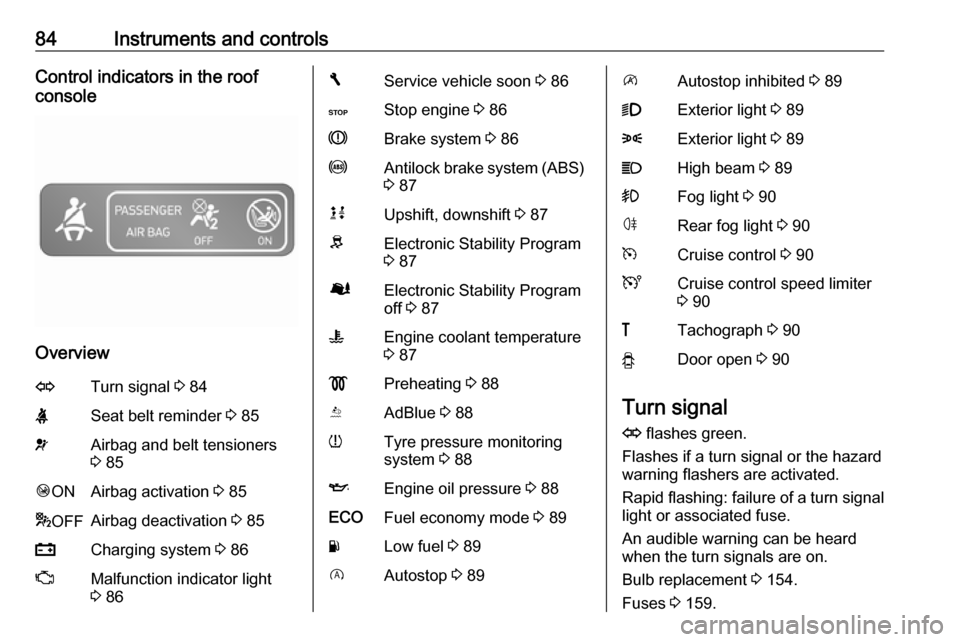
84Instruments and controlsControl indicators in the roof
console
Overview
OTurn signal 3 84XSeat belt reminder 3 85vAirbag and belt tensioners
3 85Ó ONAirbag activation 3 85* OFFAirbag deactivation 3 85pCharging system 3 86ZMalfunction indicator light
3 86FService vehicle soon 3 86CStop engine 3 86RBrake system 3 86uAntilock brake system (ABS)
3 87kjUpshift, downshift 3 87RElectronic Stability Program
3 87ØElectronic Stability Program
off 3 87WEngine coolant temperature
3 87!Preheating 3 88YAdBlue 3 88wTyre pressure monitoring
system 3 88IEngine oil pressure 3 88ECOFuel economy mode 3 89YLow fuel 3 89DAutostop 3 89\Autostop inhibited 3 899Exterior light 3 898Exterior light 3 89CHigh beam 3 89>Fog light 3 90øRear fog light 3 90mCruise control 3 90UCruise control speed limiter
3 90&Tachograph 3 90yDoor open 3 90
Turn signal
O flashes green.
Flashes if a turn signal or the hazard
warning flashers are activated.
Rapid flashing: failure of a turn signal
light or associated fuse.
An audible warning can be heard
when the turn signals are on.
Bulb replacement 3 154.
Fuses 3 159.
Page 89 of 211

Instruments and controls87If R illuminates together with control
indicator C and a warning chime,
there is a fault in the braking system.
A corresponding message also
appears in the Driver Information
Centre (DIC) 3 90. Seek the
assistance of a workshop
immediately.
Brake system 3 128.
Antilock brake system (ABS)
u illuminates yellow.
Illuminates briefly after the ignition is
switched on. The system is ready for
operation when u extinguishes.
If control indicator u does not go out
after a few seconds, or if it illuminates while driving, there is a fault in the
ABS. Control indicator F may also
illuminate in the instrument cluster
together a corresponding message in the Driver Information Centre (DIC)3 90. The brake system remains
operational but without ABS
regulation.If control indicators u, F , R and C
illuminate, there is a fault in the
braking system. A corresponding
message appears in the DIC. Seek
the assistance of a workshop
immediately.
Antilock brake system (ABS) 3 129.
Upshift k or j illuminates.
It is recommended to shift gear when
illuminated to improve fuel economy.
Electronic Stability Program
R flashes or illuminates yellow.
Illuminates briefly when the ignition is
switched on.
Flashing during driving The system is actively engaged.
Engine output may be reduced and
the vehicle may be braked
automatically to a small degree.Illuminates while driving
The system is not available. A
corresponding message also
appears in the Driver Information
Centre (DIC) 3 90.
ESP® Plus
3 131, Traction Control
system 3 130.
Electronic Stability Program
off
Ø illuminates green.
If ESP ®Plus
has been deactivated with
Ø on the instrument panel, control
indicator Ø illuminates and a
corresponding message appears in
the Driver Information Centre (DIC)
3 90.
ESP® Plus
3 131, Traction Control
system 3 130.
Engine coolant temperature
W illuminates blue or red.
Illuminates red briefly when the
ignition is switched on, then turns
blue.
Page 123 of 211

Driving and operating121Conditions for an Autostop
The stop-start system checks if each
of the following conditions is fulfilled:
● the stop-start system is not manually deactivated
● the bonnet is fully closed
● the vehicle battery is sufficiently charged and in good condition
● the engine is warmed-up
● the engine coolant temperature is
not too high
● the outside temperature is not too
low or too high (e.g. below 0 °C
or above 35 °C)
● the brake vacuum is sufficient
● the defrosting function is not activated 3 105
● the self-cleaning function of the diesel particle filter is not active
3 122
● the Antilock brake system (ABS) 3 129, Traction Control system
(TC) 3 130 and ElectronicStability Program (ESP® Plus
)
3 131 ride control systems are
not actively engaged
● the vehicle has moved since the last Autostop
Otherwise an Autostop will be
inhibited.
Certain settings of the climate control
system may inhibit an Autostop. See
" Climate control " chapter for further
information 3 105
Restart of the engine by the driver
Depress the clutch pedal to restart the
engine.
Notice
If any gear is selected, the clutch pedal must be fully depressed to
restart the engine.
Control indicator Ï 3 89 extinguishes
in the instrument cluster when the engine is restarted.
Restart of the engine by the stop- start system
The selector lever must be in neutral
to enable an automatic restart.If one of the following conditions occurs during an Autostop, the
engine will be restarted automatically by the stop-start system:
● the stop-start system is manually
deactivated
● the bonnet is opened
● the vehicle battery is discharged
● the engine temperature is too low
● the brake vacuum is not sufficient
● the vehicle starts to move
● the defrosting function is activated 3 105
If an electrical accessory, e.g. a
portable CD player, is connected to
the power outlet, a brief power drop
during engine restart may be
noticeable.
Fault
If a fault occurs in the stop-start
system, the LED in Î illuminates,
and a corresponding message
appears in the DIC 3 90. Seek the
assistance of a workshop.
Vehicle messages 3 91.
Warning chimes 3 92.
Page 131 of 211
Driving and operating129Control indicator R 3 86.
Vehicle messages 3 91.
Antilock brake system Antilock brake system (ABS)
prevents the wheels from locking.
ABS starts to regulate brake pressure
as soon as a wheel shows a tendency to lock. The vehicle remains
steerable, even during hard braking.
ABS control is made apparent
through a pulse in the brake pedal
and the noise of the regulation
process.
For optimum braking, keep the brake
pedal fully depressed throughout the
braking process, despite the fact that
the pedal is pulsating. Do not reduce
the pressure on the pedal.
After starting-off, the system performs a self-test which may be audible.
Control indicator u 3 87.
Fault
If control indicator u does not go out
a few seconds after the ignition is switched on, or if it illuminates whiledriving, there is a fault in the ABS.
Control indicator F 3 86 may also
illuminate in the instrument cluster together with a corresponding
message in the Driver Information
Centre (DIC). The brake system
remains operational but without ABS
regulation.9 Warning
If there is a fault in the ABS, the
wheels may be liable to lock due
to braking that is heavier than
normal. The advantages of ABS are no longer available. During
hard braking, the vehicle can no longer be steered and may
swerve.
If control indicators u, F , R 3 86
and C 3 86 illuminate, there is a fault
in the braking system. A
corresponding message also
appears in the DIC 3 90. Have the
cause of the fault remedied by a
workshop.
Vehicle messages 3 91.
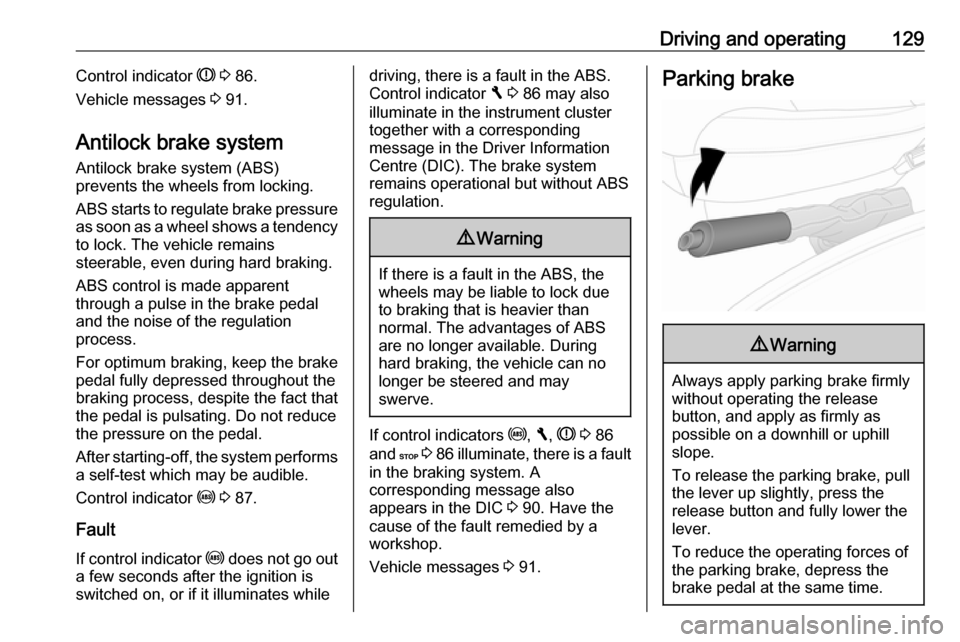
Parking brake9 Warning
Always apply parking brake firmly
without operating the release
button, and apply as firmly as
possible on a downhill or uphill
slope.
To release the parking brake, pull
the lever up slightly, press the
release button and fully lower the
lever.
To reduce the operating forces of
the parking brake, depress the
brake pedal at the same time.
Page 153 of 211

Vehicle care151battery. Short-distance driving and
frequent engine starts can discharge
the battery. Avoid the use of
unnecessary electrical consumers.
Batteries do not belong in household
waste. They must be disposed of at
an appropriate recycling collection
point.
Laying up the vehicle for more than
4 weeks can lead to battery
discharge.
Ensure the ignition is switched off
before connecting or disconnecting
the vehicle battery.
Replacing the vehicle battery In vehicles with an AGM (Absorptive
Glass Mat) battery, make sure to
have the battery replaced with
another AGM battery.
An AGM battery can be identified by
the label on the battery. We
recommend the use of an original
Vauxhall battery.
Notice
Using an AGM vehicle battery
different from the original Vauxhall
vehicle battery may result in a lower
performance of the stop-start
system.
We recommend that you have the
vehicle battery replaced by a
workshop.
Stop-start system 3 119.
Charging the vehicle battery9 Warning
On vehicles with stop-start
system, ensure that the charging potential does not exceed
14.6 volts when using a battery
charger. Otherwise the vehicle
battery might be damaged.
9 Danger
Ensure adequate ventilation when
charging the battery. There is a
risk of explosion if gases
generated during charging are
allowed to accumulate!
Jump starting 3 174.
Page 164 of 211

162Vehicle careNo.Circuit1Adblue injection battery2Vehicle battery (with electronic
key system)3APC battery backup (with elec‐
tronic key system)4Heating and ventilation system5Adaptations6Adaptations7Heating and ventilation system8Additional heating and ventila‐
tion / air conditioning system9Supplementary heating and
ventilation system10Electric exterior mirrors / addi‐
tional adaptations11Heated exterior mirrors12Radio / multimedia / electric
exterior mirrors / diagnostic
socket13Multimedia / trailer hitchNo.Circuit14Courtesy lights / battery
discharge protection15Fuel injection system / tyre pres‐ sure monitoring system / elec‐
tronic key system16Hazard warning flashers / turn
and lane-change signals17Central locking18Left-hand high beam / right-
hand low beam / tail lights / left- hand daytime running light19Front fog lights / rear fog lights /
number plate lighting20Alarm / horn / lighting / wiper21Instrument cluster22Light switch23Rear window wiper / wind‐
screen washer pump / horn24APC general battery25Reversing lightsNo.Circuit26Brake switch27Fuel injection / starter28Airbag / steering column lock29Passenger power window30Power steering31Brake lights32APC battery backup (with elec‐
tronic key system)33Service display34Cigarette lighter / power outlet35Right-hand high beam / left-
hand low beam / sidelights /
right-hand daytime running light36Brake lights / ABS / immobiliser37Interior lighting / air conditioning38Starting with electronic key
system39Rear window wiper40Warning chimes
Page 179 of 211
Vehicle care177When the engine is not running,
considerably more force is needed to
brake and steer.
To prevent the entry of exhaust fumes
from the towing vehicle, switch on the
air recirculation system 3 104 and
close the windows.
Seek the assistance of a workshop.
After towing, unscrew the towing eye
and replace cap.
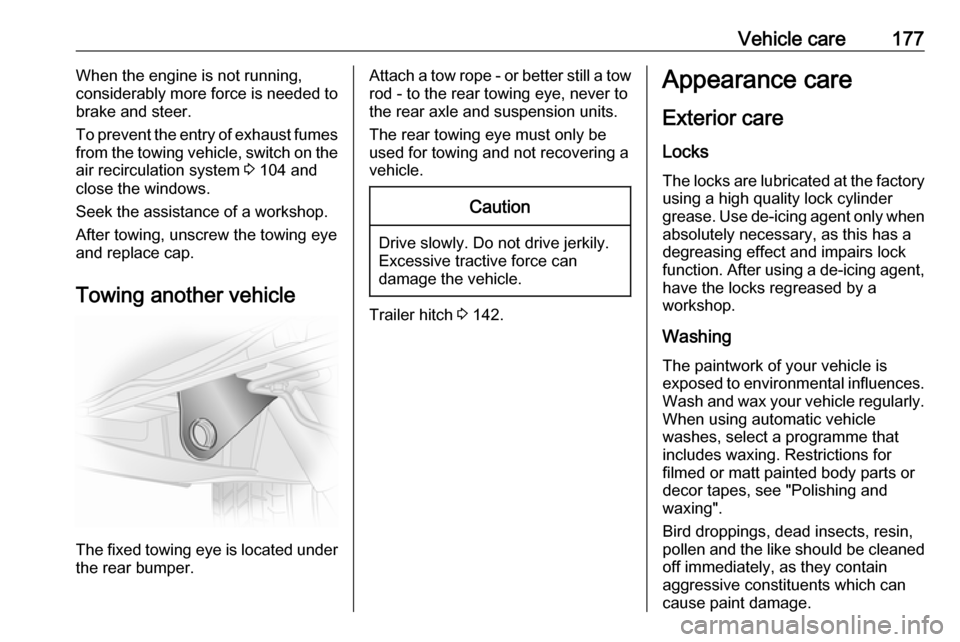
Towing another vehicle
The fixed towing eye is located under the rear bumper.
Attach a tow rope - or better still a tow
rod - to the rear towing eye, never to
the rear axle and suspension units.
The rear towing eye must only be
used for towing and not recovering a
vehicle.Caution
Drive slowly. Do not drive jerkily.
Excessive tractive force can
damage the vehicle.
Trailer hitch 3 142.
Appearance care
Exterior care
Locks The locks are lubricated at the factoryusing a high quality lock cylinder
grease. Use de-icing agent only when absolutely necessary, as this has adegreasing effect and impairs lockfunction. After using a de-icing agent,
have the locks regreased by a
workshop.
Washing
The paintwork of your vehicle is
exposed to environmental influences. Wash and wax your vehicle regularly.
When using automatic vehicle
washes, select a programme that
includes waxing. Restrictions for
filmed or matt painted body parts or decor tapes, see "Polishing and
waxing".
Bird droppings, dead insects, resin,
pollen and the like should be cleaned
off immediately, as they contain
aggressive constituents which can cause paint damage.
Page 185 of 211

Service and maintenance183Engine oil viscosity grades
The SAE viscosity grade gives
information of the thickness of the oil.
Multigrade oil is indicated by two figures, e.g. SAE 5W-30. The first
figure, followed by a W, indicates the
low temperature viscosity and the
second figure the high temperature viscosity.
Select the appropriate viscosity grade depending on the minimum ambient
temperature 3 186.
All of the recommended viscosity
grades are suitable for high ambient
temperatures.
Coolant and antifreeze
Use only silicate-free long life coolant (LLC) antifreeze approved for thevehicle. Consult a workshop.
The system is factory filled with
coolant designed for excellent
corrosion protection and frost
protection down to approx. -28 °C.
This concentration should be
maintained all year round. The use of additional coolant additives that
intend to give additional corrosionprotection or seal against minor leaks
can cause function problems. Liability
for consequences resulting from the
use of additional coolant additives will be rejected.
Brake fluid
Over time, brake fluid absorbs
moisture which will reduce braking
effectiveness. The brake fluid should therefore be replaced at the specified interval.
AdBlue Only use AdBlue to reduce the
nitrogen oxides in the exhaust
emission 3 123.
Page 204 of 211

202IndexAAbsorptive Glass Mat battery .....150
Accessories and vehicle modifications .......................... 145
Adaptive forward lighting .............98
Adblue .......................................... 93
AdBlue .......................... 88, 123, 182
AdBlue tank ................................ 197
Adjustable air vents ...................112
AGM battery ............................... 150
Airbag and belt tensioners ...........85
Airbag deactivation ................57, 85
Airbag label............................. 53, 57
Airbag system .............................. 53
Air conditioning regular operation ................................ 113
Air conditioning system .............. 104
Air intake .................................... 113
Air recirculation ...................104, 176
Air vents...................................... 112
Alert .............................................. 92
Antifreeze ................................... 148
Antilock brake system ................ 129
Antilock brake system (ABS) .......87
Anti-theft alarm system ................35
Anti-theft bolts............................. 171
Anti-theft locking system .............. 33
Anti-theft security lock ..................23
Appearance care ........................177
Armrest ........................................ 46Ashtrays ....................................... 79
Automatic anti-dazzle ..................39
Automatic fuel cut-off ..................119
Automatic light control .................97
Automatic locking ........................28
Autostop ....................... 89, 118, 119
Auxiliary heater ........................... 108
B Battery ........................................ 150
Battery discharge protection ......102
Battery, jump starting.................. 174
Belts.............................................. 49 Bench seat.................................... 68
BlueInjection ............................... 123
Bonnet ....................................... 146
Bottle holders................................ 68
Brake and clutch fluid .................182
Brake assist ............................... 130
Brake fluid .................................. 150 Brakes ............................... 128, 150
Brake system ............................... 86
Breakdown.................................. 176
Bulb replacement ....................... 154
C
Capacities .................................. 197
Car Pass ...................................... 20
Catalytic converter .....................123
Central locking system ................23
Centre high-mounted brake light 156