bonnet VAUXHALL VIVARO 2016.5 Owner's Manual
[x] Cancel search | Manufacturer: VAUXHALL, Model Year: 2016.5, Model line: VIVARO, Model: VAUXHALL VIVARO 2016.5Pages: 211, PDF Size: 5 MB
Page 13 of 211

In brief111Side air vents ...................... 112
2 Ashtray .................................. 79
Cupholder ............................ 67
3 Light switch .......................... 96
Rear fog light ......................... 99
Front fog lights .....................99
Exit lighting .......................... 102
Turn and lane-change
signals ................................... 99
Sidelights .............................. 96
Headlight flash, low beam
and high beam ......................97
4 Instruments .......................... 79
Driver Information Centre
(DIC) ..................................... 90
5 Horn ...................................... 75
Driver airbag ......................... 56
6 Windscreen wiper,
windscreen washer system ..76
Rear window wiper, rear
window washer system ........77
Trip computer ....................... 937Card reader for electronic
key system ............................ 22
8 Steering column controls ......75
9 Centre air vents ................... 112
10 Power outlet .......................... 78
Cigarette lighter ..................... 79
Coin tray, USB slot ................ 66
11 Driver Information Centre
(DIC) ..................................... 90
Trip computer ....................... 93
12 Front passenger airbag .........56
13 Glovebox .............................. 66
14 Heated exterior mirrors .........38
Heated rear window ..............41
Idle speed control ...............118
15 Power outlet .......................... 78
Cigarette lighter ..................... 79
16 Climate control system ........ 103
Electronic climate control
system ................................. 105
17 Ashtray .................................. 79
Cupholder ............................ 6718Hazard warning flashers .......98
Central locking system ..........23
19 Power button for electronic
key system .......................... 116
20 Eco button for fuel
economy mode ...................114
21 Stop-start system ................119
Cruise control and speed
limiter ................................. 133
22 Remote control on
steering wheel ......................75
Cruise control .....................133
23 Ignition switch with
steering wheel lock .............116
24 Steering wheel adjustment ...75
25 Bonnet release lever ...........146
26 Fuse box ............................. 160
27 Ultrasonic parking assist ....136
Electronic Stability
Program (ESP® Plus
)............ 131
Traction Control system
(TC) ..................................... 130
Page 37 of 211

Keys, doors and windows35Anti-theft alarm systemThe anti-theft alarm system is
operated in conjunction with the
central locking system 3 23.
It monitors: ● doors, tailgate, bonnet
● passenger compartment
● load compartment
● ignition
● interruption of alarm siren power supply
Activation All doors and the bonnet must be
closed.
Hazard warning lights flash to confirm activation. If the hazard warning lights
do not flash upon activation, a door or the bonnet is not fully closed.2-button and 3-button remote control
Press e to activate the anti-theft alarm
system.
Electronic key
For handsfree operation, the
electronic key must be outside the
vehicle, within a range of approx.
one metre of the front doors or load compartment.
Press the button on any exterior door
handle.
- or -
Page 94 of 211

92Instruments and controlsWarning chimesOnly one warning chime will sound at a time.
A corresponding message may also
appear in the Driver Information
Centre (DIC) when a warning chime
is sounded.
When starting the engine or whilst driving:
● If seat belt is not fastened 3 49.
● During operation of the turn and lane-change signals 3 99.
● During illumination of certain control indicators.
● If the parking assist detects an object 3 136.
● If the vehicle speed briefly exceeds a set limit 3 133,
3 136.
● If a door or the bonnet is not properly closed when vehicle
exceeds a certain speed.
● If there is a fault in the brake system 3 86.● If the vehicle battery is not
charging 3 86.
● If engine lubrication is interrupted
3 88.
● If AdBlue needs to be refilled or a
fault is present 3 123.
● If the electronic key is outside of the detection range.
Electronic key system 3 22,
Power button 3 116.
When the vehicle is parked and/or
the driver's door is opened:
● If the key has been left in the ignition.
● If the electronic key has been left
in the card reader.
Electronic key system 3 22,
Power button 3 116.
● If the vehicle is in an Autostop. Stop-start system 3 119.
● If the exterior lights are on.Engine oil level
If the minimum engine oil level is
reached, a message is displayed in
the Driver Information Centre (DIC)
3 90 for 30 seconds after the engine
is started.
Check oil level 3 147.
Page 100 of 211
98LightingHeadlights when drivingabroad
The asymmetrical headlight beam
extends visibility at the edge of the
road at the passenger side.
However, when driving in countries
where traffic drives on the opposite
side of the road, adjust the headlights to prevent dazzling of oncoming
traffic.
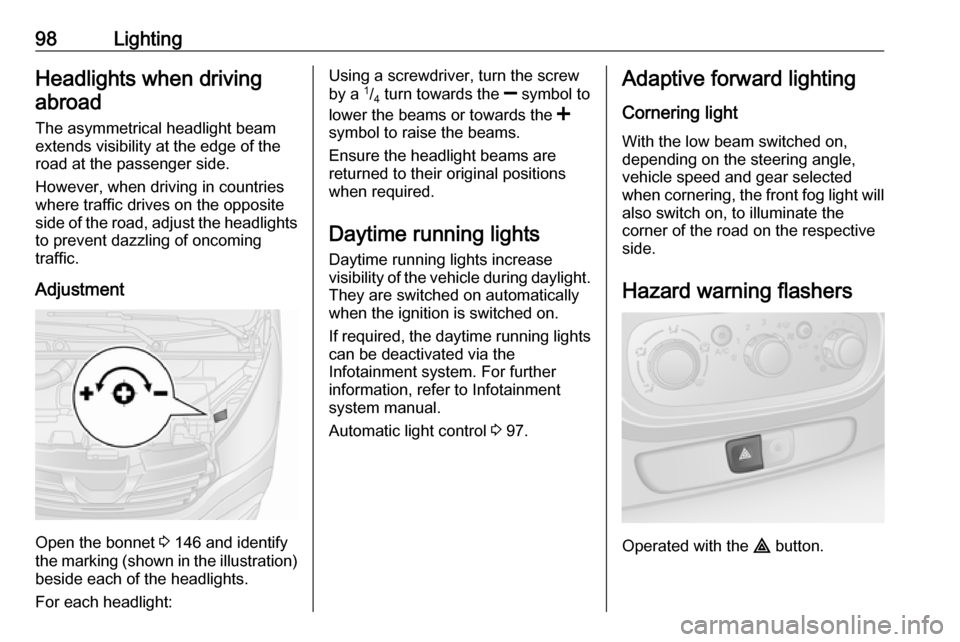
Adjustment
Open the bonnet 3 146 and identify
the marking (shown in the illustration)
beside each of the headlights.
For each headlight:
Using a screwdriver, turn the screw
by a 1
/4 turn towards the
] symbol to
lower the beams or towards the <
symbol to raise the beams.
Ensure the headlight beams are
returned to their original positions
when required.
Daytime running lights
Daytime running lights increase
visibility of the vehicle during daylight.
They are switched on automatically
when the ignition is switched on.
If required, the daytime running lights can be deactivated via the
Infotainment system. For further
information, refer to Infotainment
system manual.
Automatic light control 3 97.Adaptive forward lighting
Cornering light
With the low beam switched on,
depending on the steering angle,
vehicle speed and gear selected
when cornering, the front fog light will also switch on, to illuminate the
corner of the road on the respective
side.
Hazard warning flashers
Operated with the ¨ button.
Page 123 of 211

Driving and operating121Conditions for an Autostop
The stop-start system checks if each
of the following conditions is fulfilled:
● the stop-start system is not manually deactivated
● the bonnet is fully closed
● the vehicle battery is sufficiently charged and in good condition
● the engine is warmed-up
● the engine coolant temperature is
not too high
● the outside temperature is not too
low or too high (e.g. below 0 °C
or above 35 °C)
● the brake vacuum is sufficient
● the defrosting function is not activated 3 105
● the self-cleaning function of the diesel particle filter is not active
3 122
● the Antilock brake system (ABS) 3 129, Traction Control system
(TC) 3 130 and ElectronicStability Program (ESP® Plus
)
3 131 ride control systems are
not actively engaged
● the vehicle has moved since the last Autostop
Otherwise an Autostop will be
inhibited.
Certain settings of the climate control
system may inhibit an Autostop. See
" Climate control " chapter for further
information 3 105
Restart of the engine by the driver
Depress the clutch pedal to restart the
engine.
Notice
If any gear is selected, the clutch pedal must be fully depressed to
restart the engine.
Control indicator Ï 3 89 extinguishes
in the instrument cluster when the engine is restarted.
Restart of the engine by the stop- start system
The selector lever must be in neutral
to enable an automatic restart.If one of the following conditions occurs during an Autostop, the
engine will be restarted automatically by the stop-start system:
● the stop-start system is manually
deactivated
● the bonnet is opened
● the vehicle battery is discharged
● the engine temperature is too low
● the brake vacuum is not sufficient
● the vehicle starts to move
● the defrosting function is activated 3 105
If an electrical accessory, e.g. a
portable CD player, is connected to
the power outlet, a brief power drop
during engine restart may be
noticeable.
Fault
If a fault occurs in the stop-start
system, the LED in Î illuminates,
and a corresponding message
appears in the DIC 3 90. Seek the
assistance of a workshop.
Vehicle messages 3 91.
Warning chimes 3 92.
Page 146 of 211

144Vehicle careVehicle careGeneral Information...................145
Accessories and vehicle modifications .......................... 145
Vehicle storage ........................145
End-of-life vehicle recovery .....145
Vehicle checks ........................... 146
Performing work ......................146
Bonnet ..................................... 146
Engine oil ................................. 147
Engine air filter ........................ 148
Engine coolant ......................... 148
Power steering fluid .................149
Washer fluid ............................ 150
Brakes ..................................... 150
Brake fluid ............................... 150
Vehicle battery ......................... 150
Diesel fuel filter ........................152
Diesel fuel system bleeding .....152
Wiper blade replacement ........153
Bulb replacement .......................154
Headlights ............................... 154
Fog lights ................................. 154
Front turn signal lights .............155
Tail lights ................................. 155
Side turn signal lights ..............156Centre high-mounted brake
light ......................................... 156
Reversing light ......................... 157
Number plate light ...................157
Fog tail light ............................. 157
Interior lights ............................ 158
Instrument panel illumination ...158
Electrical system ........................159
Fuses ....................................... 159
Instrument panel fuse box .......160
Vehicle tools .............................. 163
Tools ........................................ 163
Wheels and tyres .......................164
Tyres ....................................... 164
Winter tyres ............................. 164
Tyre designations ....................164
Tyre pressure .......................... 164
Tyre pressure monitoring system .................................... 166
Tread depth ............................. 167
Changing tyre and wheel size . 168
Wheel covers ........................... 168
Tyre chains .............................. 168
Tyre repair kit .......................... 169
Wheel changing .......................171
Spare wheel ............................ 173
Jump starting ............................. 174Towing....................................... 176
Towing the vehicle ...................176
Towing another vehicle ...........177
Appearance care .......................177
Exterior care ............................ 177
Interior care ............................. 179
Page 147 of 211

Vehicle care145General Information
Accessories and vehicle modifications
We recommend the use of genuine
parts and accessories and factory
approved parts specific for your
vehicle type. We cannot assess or guarantee reliability of other products
- even if they have a regulatory or
otherwise granted approval.
Do not make any modifications to the
electrical system, e.g. changes of
electronic control units (chip tuning).Caution
When transporting the vehicle on
a train or on a recovery vehicle, the
mud flaps might be damaged.
Vehicle storage
Storage for a long period of time
If the vehicle is to be stored for several months:
● Wash and wax the vehicle.
● Have the wax in the engine compartment and underbody
checked.
● Clean and preserve rubber seals.
● Fill up fuel tank completely.
● Change the engine oil.
● Drain the washer fluid reservoir. ● Check the coolant antifreeze and
corrosion protection.
● Adjust tyre pressure to the value specified for full load.
● Park vehicle in a dry, well ventilated place. Engage first or
reverse gear. Prevent the vehicle from rolling.
● Do not apply the parking brake.
● Open the bonnet, close all doors and lock the vehicle.Putting back into operation
When the vehicle is to be put back into
operation:
● Check tyre pressure.
● Fill up the washer fluid reservoir. ● Check the engine oil level.
● Check the coolant level.
● Fit the number plate, if necessary.
End-of-life vehicle recovery
Information on end-of-life vehicle
recovery centres and the recycling of
end-of-life vehicles is available on our website. Only entrust this work to an
authorised recycling centre.
Page 148 of 211

146Vehicle careVehicle checks
Performing work9 Warning
Only perform engine compartment
checks when the ignition is off.
The cooling fan may start
operating even if the ignition is off.
9 Danger
The ignition system generates
extremely high voltages. Do not
touch.
The caps for topping up the engine oil, the coolant, the washer fluid and the
oil dipstick handle are yellow for ease
of identification.
Bonnet
Opening
Pull the release lever and return it to
its original position.
Move the safety catch (located
slightly right of centre) sideways to
the left vehicle side and open the
bonnet.
The bonnet is held open
automatically by a lifter.
If the bonnet is opened during an
Autostop, the engine will be restarted automatically for safety reasons.
Stop-start system 3 119.
Closing
Lower the bonnet and allow it to fall
into the latch from a low height
(approx. 30 cm). Check that the
bonnet is engaged.
Page 149 of 211

Vehicle care147Caution
Do not press the bonnet into the
latch, to avoid dents.
Engine oil
Check the engine oil level manually
on a regular basis to prevent damage
to the engine.
Ensure that the correct specification
of oil is used. Recommended fluids
and lubricants 3 182.
The maximum engine oil
consumption is 0.6 l per 1000 km.
Check with the vehicle on a level
surface. The engine must be at
operating temperature and switched
off for at least 10 minutes.
Pull out the dipstick, wipe it clean,
insert it to the stop on the handle, pull
out and read the engine oil level.
Caution
It is the owner's responsibility to
maintain the proper level of an
appropriate quality oil in the
engine.
When the engine oil level has
dropped to the MIN mark, top-up
engine oil.
Caution
Do not allow the engine oil level to drop below the minimum level!
We recommend the use of the same
grade of engine oil that was used at
the last change.
The engine oil level must not exceed the maximum mark MAX on the
dipstick.
Caution
Overfilled engine oil must be
drained or suctioned out.
To prevent spillage when
replenishing the engine oil, we
recommend using a funnel to top-up the engine oil. Ensure funnel is
securely located onto the filler pipe.
Page 180 of 211

178Vehicle careIf using a vehicle wash, comply with
the vehicle wash manufacturer's
instructions. The windscreen wipers and rear window wiper must be
switched off and the exterior mirrors
must be folded in. Remove antenna
and external accessories such as roof racks etc.
If you wash your vehicle by hand,
make sure that the insides of the
wheel housings are also thoroughly
rinsed out.
Clean edges and folds on opened
doors and the bonnet as well as the
areas they cover.Caution
Always use a cleaning agent with
a pH value of 4 to 9.
Do not use cleaning agents on hot surfaces.
Have the door hinges of all doors
greased by a workshop.
Do not clean the engine compartment with a steam-jet or high-pressure jet
cleaner.
Thoroughly rinse and leather-off the vehicle. Rinse leather frequently. Use
separate leathers for painted and
glass surfaces: remnants of wax on
the windows will impair vision.
Exterior lights
Headlight and other light covers are
made of plastic. Do not use any
abrasive or caustic agents, do not use
an ice scraper, and do not clean them
dry.
Polishing and waxing
Wax the vehicle regularly (at the
latest when water no longer beads).
Otherwise, the paintwork will dry out.
Polishing is necessary only if the paint
has become dull or if solid deposits
have become attached to it.
Paintwork polish with silicone forms a protective film, making waxing
unnecessary.
Unpainted plastic body parts must not
be treated with wax or polishing
agents.Matt filmed body parts or decor tapes must not be polished, to avoid
gleaming. Do not use hot wax
programmes in automatic car washes if the vehicle is equipped with theseparts.
Matt painted decor parts, e.g. mirror
housing cover, must not be polished.
Otherwise these parts would become
agleam or the colour would be
dissolved.
Windows and windscreen wiper
blades
Use a soft lint-free cloth or chamois
leather together with window cleaner and insect remover.
When cleaning the rear window from
inside, always wipe in parallel to the
heating element to prevent damage.
For mechanical removal of ice, use a
sharp-edged ice scraper. Press the
scraper firmly against the glass so
that no dirt can get under it and
scratch the glass.