seat adjustment VAUXHALL VIVARO 2016.5 Owner's Manual
[x] Cancel search | Manufacturer: VAUXHALL, Model Year: 2016.5, Model line: VIVARO, Model: VAUXHALL VIVARO 2016.5Pages: 211, PDF Size: 5 MB
Page 9 of 211
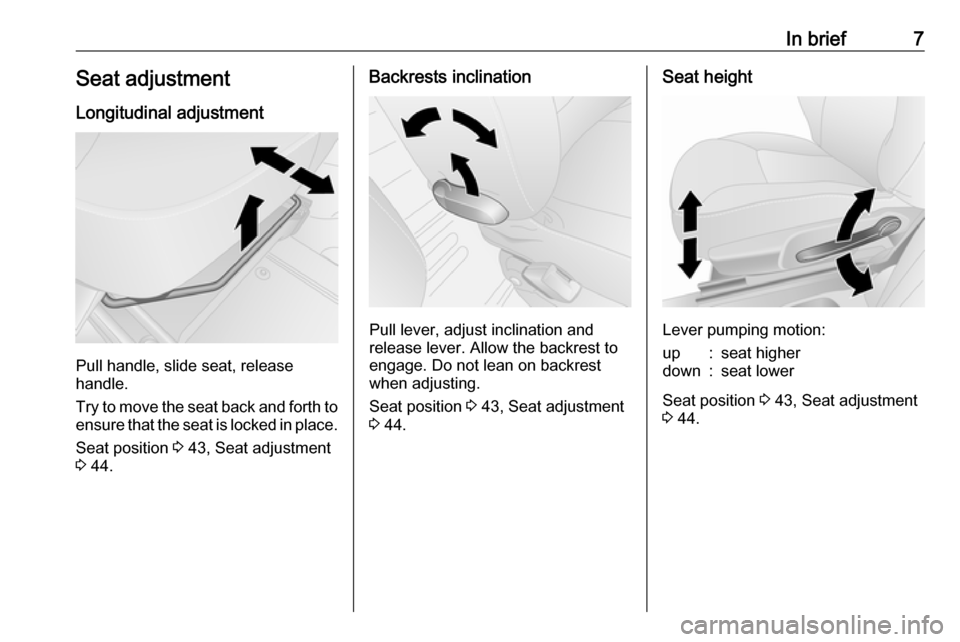
In brief7Seat adjustmentLongitudinal adjustment
Pull handle, slide seat, release
handle.
Try to move the seat back and forth to ensure that the seat is locked in place.
Seat position 3 43, Seat adjustment
3 44.
Backrests inclination
Pull lever, adjust inclination and
release lever. Allow the backrest to
engage. Do not lean on backrest
when adjusting.
Seat position 3 43, Seat adjustment
3 44.
Seat height
Lever pumping motion:
up:seat higherdown:seat lower
Seat position 3 43, Seat adjustment
3 44.
Page 10 of 211
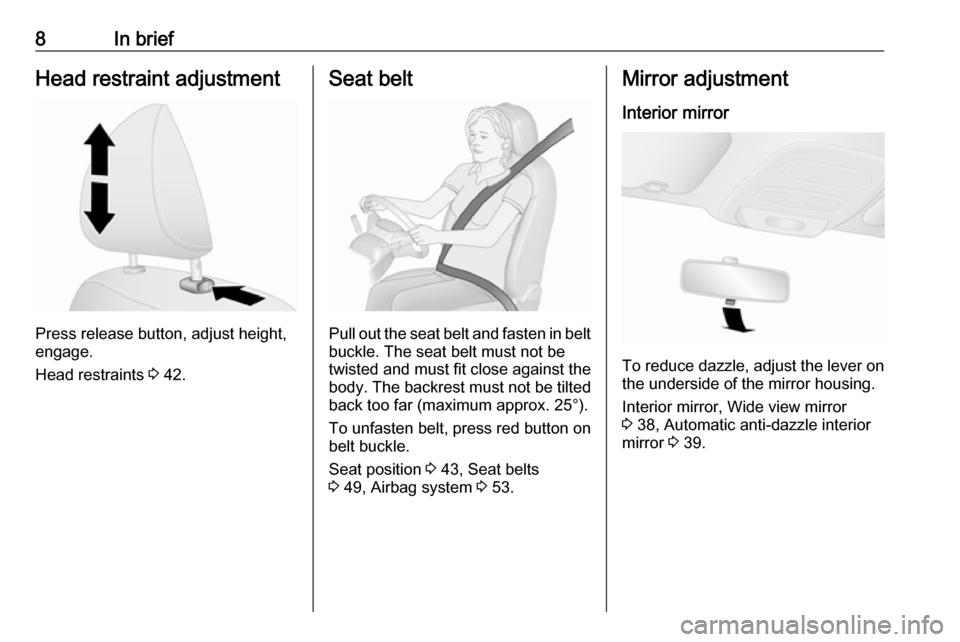
8In briefHead restraint adjustment
Press release button, adjust height,
engage.
Head restraints 3 42.
Seat belt
Pull out the seat belt and fasten in belt
buckle. The seat belt must not be
twisted and must fit close against the
body. The backrest must not be tilted back too far (maximum approx. 25°).
To unfasten belt, press red button on belt buckle.
Seat position 3 43, Seat belts
3 49, Airbag system 3 53.
Mirror adjustment
Interior mirror
To reduce dazzle, adjust the lever on the underside of the mirror housing.
Interior mirror, Wide view mirror
3 38, Automatic anti-dazzle interior
mirror 3 39.
Page 44 of 211
42Seats, restraintsSeats, restraintsHead restraints............................ 42
Front seats ................................... 43
Seat position .............................. 43
Seat adjustment ........................44
Seat folding ............................... 45
Armrest ...................................... 46
Heating ...................................... 46
Rear seats ................................... 46
Seat belts ..................................... 49
Three-point seat belt .................50
Airbag system .............................. 53
Front airbag system ...................56
Side airbag system ....................56
Curtain airbag system ...............57
Airbag deactivation ....................57
Child restraints ............................. 59
Child restraint systems ..............59
Child restraint installation locations ................................... 60
Isofix child restraint systems .....65
Top-tether fastening eyes ..........65Head restraints
Position9 Warning
Only drive with the head restraint
set to the proper position.
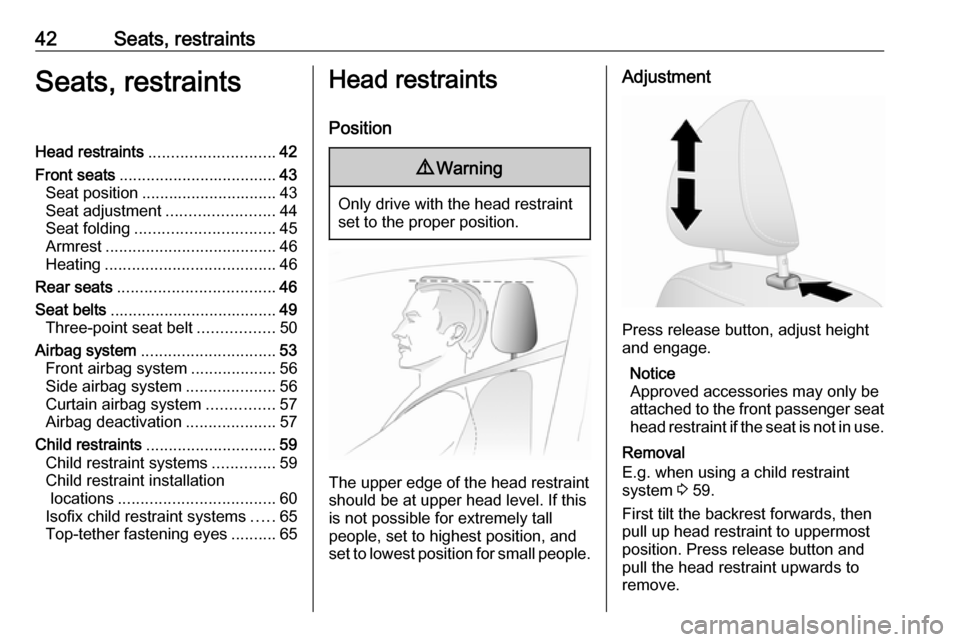
The upper edge of the head restraint
should be at upper head level. If this
is not possible for extremely tall
people, set to highest position, and
set to lowest position for small people.
Adjustment
Press release button, adjust height
and engage.
Notice
Approved accessories may only be
attached to the front passenger seat head restraint if the seat is not in use.
Removal
E.g. when using a child restraint
system 3 59.
First tilt the backrest forwards, then
pull up head restraint to uppermost
position. Press release button and
pull the head restraint upwards to
remove.
Page 46 of 211
44Seats, restraints● Sit with shoulders as far backagainst the backrest as possible.
Set the backrest rake so that it is possible to reach the steering
wheel with arms slightly bent.
Maintain contact between
shoulders and the backrest when turning the steering wheel. Do
not angle the backrest too far
back. We recommend a
maximum rake of approx. 25°.
● Adjust the steering wheel 3 75.
● Adjust the head restraint 3 42.
● Adjust the height of the seat belt 3 50.
● Adjust the lumbar support so that
it supports the natural shape of the spine 3 44.
Seat adjustment Drive only with engaged seats and
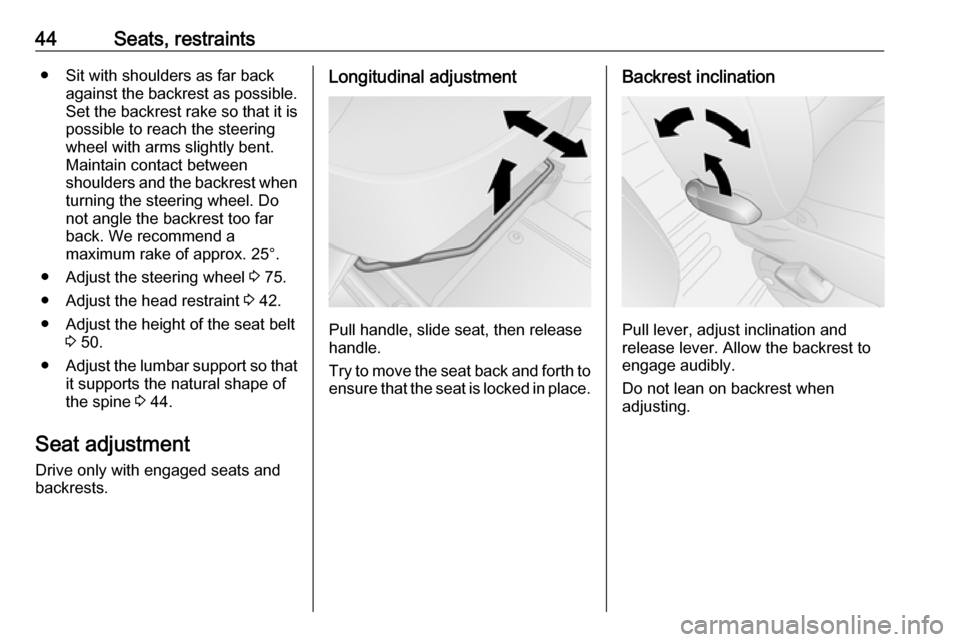
backrests.Longitudinal adjustment
Pull handle, slide seat, then release
handle.
Try to move the seat back and forth to ensure that the seat is locked in place.
Backrest inclination
Pull lever, adjust inclination and
release lever. Allow the backrest to
engage audibly.
Do not lean on backrest when
adjusting.
Page 53 of 211

Seats, restraints51
Loose or bulky clothing prevents the
belt from fitting snugly. Do not place
objects such as handbags or mobile
phones between the belt and your body.
9 Warning
The belt must not rest against hard
or fragile objects in the pockets of
your clothing.
Height adjustment
Slide adjuster up or down to desired
position:
● Pull belt out slightly.
● Tilt adjuster downwards to disengage then slide height
adjustment downwards or push
the height adjustment up without
tilting adjuster.
Adjust the height so that the belt lies across the shoulder. It must not lie
across the throat or upper arm.
9 Warning
Do not adjust while driving.
Page 62 of 211

60Seats, restraintsChild restraint installation locations
Permissible options for fitting a child restraint system Front seats - Van
Weight and age class
Single front passenger seat 1Double front passenger seat
activated airbag
deactivated
or without airbag
activated airbag
deactivated
or without airbagcentreouterGroup 0: up to 10 kg
or approx. 10 months
Group 0+: up to 13 kg
or approx. 2 years
XUXXU
Group I: 9 to 18 kg
or approx. 8 months to 4 yearsXUXXUGroup II: 15 to 25 kg
or approx. 3 to 7 years
Group III: 22 to 36 kg
or approx. 6 to 12 years
XUXXU
1:Forward-facing child restraints: Remove head restraint 3 42. Slide seat as far back as possible. Set seat height to
highest position. Maximum backrest rake is 25°. Seat adjustment 3 44.
Page 63 of 211

Seats, restraints61Front seats - Combi, Double cab
Weight and age class
Single front passenger seat1Double front passenger seat
activated airbag
deactivated
or without airbag
activated airbag
deactivated
or without airbagcentreouterGroup 0: up to 10 kg
or approx. 10 months
Group 0+: up to 13 kg
or approx. 2 years
XUXXU
Group I: 9 to 18 kg
or approx. 8 months to 4 yearsXU 2XXU2Group II: 15 to 25 kg
or approx. 3 to 7 years
Group III: 22 to 36 kg
or approx. 6 to 12 years
XXXXX
1:If adjustable, slide seat as far back as possible and set seat height to highest position. Maximum backrest rake is
25°. Seat adjustment 3 44.2:Rear-facing child restraints only for this weight and age class.
Page 64 of 211

62Seats, restraintsRear seats - Combi, Double cabWeight and age class2nd row seats13rd row seatsGroup 0: up to 10 kg
or approx. 10 months
Group 0+: up to 13 kg
or approx. 2 years
UU
Group I: 9 to 18 kg
or approx. 8 months to 4 yearsU 2U2Group II: 15 to 25 kg
or approx. 3 to 7 years
Group III: 22 to 36 kg
or approx. 6 to 12 years
U 2U2
1:If necessary, slide adjustable front seat forwards to install a child restraint system on these seats. There may not be
enough clearance to install particular child restraint systems on vehicles fitted with fixed front seats.2:Forward-facing child restraints: Remove head restraint 3 42 before installing child restraint. The seat in front of this
installation position must not be more than halfway back on its runners. Maximum backrest rake is 25°. Seat adjustment
3 44.U:Suitable for universal category restraint systems for use in this weight and age class, in conjunction with three-point
seat belt.X:Seat position not suitable for children in this weight and age class.
Page 66 of 211

64Seats, restraints1:If necessary, slide adjustable front seat forwards to install a child restraint system on these seats. There may not be
enough clearance to install a child restraint system on vehicles fitted with fixed front seats.2:Forward-facing child restraints: Remove head restraint 3 42 before installing child restraint. The seat in front of this
installation position must not be more than halfway back on its runners. Maximum backrest rake is 25°. Seat adjustment
3 44.IUF:Suitable for ISOFIX forward-facing child restraint systems of universal category approved for use in this weight class.X:No ISOFIX child restraint system approved in this weight class.IL:Suitable for particular ISOFIX restraint systems of the 'specific-vehicle', 'restricted' or 'semi-universal' categories.
The ISOFIX restraint system must be approved for the specific vehicle type.
ISOFIX size class and seat device
A - ISO/F3:Forward-facing child restraint system for children of maximum size in the weight class 9 to 18 kg.B - ISO/F2:Forward-facing child restraint system for smaller children in the weight class 9 to 18 kg.B1 - ISO/F2X:Forward-facing child restraint system for smaller children in the weight class 9 to 18 kg.C - ISO/R3:Rear-facing child restraint system for children of maximum size in the weight class up to 18 kg.D - ISO/R2:Rear-facing child restraint system for smaller children in the weight class up to 18 kg.E - ISO/R1:Rear-facing child restraint system for young children in the weight class up to 13 kg.
Page 71 of 211
Storage69
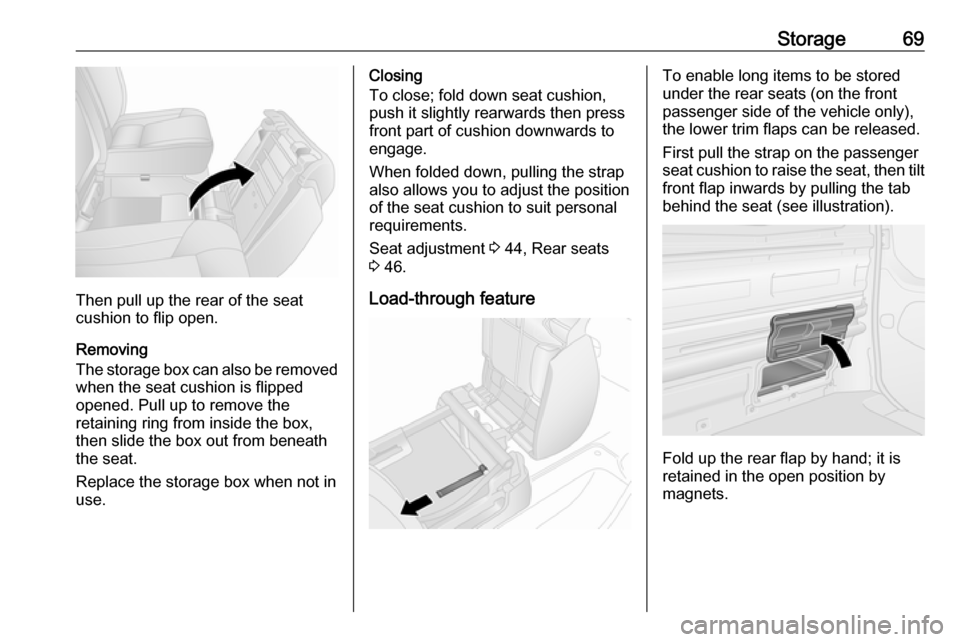
Then pull up the rear of the seat
cushion to flip open.
Removing
The storage box can also be removed when the seat cushion is flipped
opened. Pull up to remove the
retaining ring from inside the box,
then slide the box out from beneath
the seat.
Replace the storage box when not in
use.
Closing
To close; fold down seat cushion,
push it slightly rearwards then press
front part of cushion downwards to
engage.
When folded down, pulling the strap
also allows you to adjust the position
of the seat cushion to suit personal
requirements.
Seat adjustment 3 44, Rear seats
3 46.
Load-through featureTo enable long items to be stored
under the rear seats (on the front
passenger side of the vehicle only),
the lower trim flaps can be released.
First pull the strap on the passenger
seat cushion to raise the seat, then tilt front flap inwards by pulling the tab
behind the seat (see illustration).
Fold up the rear flap by hand; it is
retained in the open position by
magnets.