fuel VAUXHALL VIVARO 2016 Owner's Guide
[x] Cancel search | Manufacturer: VAUXHALL, Model Year: 2016, Model line: VIVARO, Model: VAUXHALL VIVARO 2016Pages: 209, PDF Size: 4.86 MB
Page 140 of 209
138Driving and operatingFuel
Fuel for diesel engines Only use diesel fuel that complies
with EN 590. The fuel must have low
sulphur content (max. 10 ppm).
Equivalent standardised fuels with a
biodiesel (= FAME according to
EN14214) content of max. 7% by
volume (like DIN 51628 or equivalent
standards) may be used.
In countries outside the European
Union, use Euro-Diesel fuel with a
sulphur concentration below 50 ppm.Caution
Use of fuel that does not comply to EN 590 or similar can lead to
engine powerloss, increased wear
or engine damage and loss of
warranty.
Do not use marine diesel oils, heating
oils, Aquazole and similar diesel-
water emulsions. Diesel fuels must
not be diluted with fuels for petrol
engines.
The flow and filterability of diesel fuels are temperature-dependent. When
temperatures are low, refuel with
diesel fuel with guaranteed winter
properties.
Diesel fuel filter 3 150, diesel fuel
system bleeding 3 151.
Refuelling9 Danger
Before refuelling, switch off engine
and any external heaters with
combustion chambers.
Vehicles with stop-start system:
The engine must be switched off
and the ignition key removed, to avoid risk of engine being
restarted automatically by the
system.
Switch off any mobile phones.
Follow the operating and safety
instructions of the filling station
when refuelling.
9 Danger
Fuel is flammable and explosive.
No smoking. No naked flames or
sparks.
If you can smell fuel in your
vehicle, have the cause of this
remedied immediately by a
workshop.
Caution
In case of misfuelling, do not
switch on ignition.
Notice
To ensure the fuel level is displayed
correctly, the ignition must be
switched off before refuelling. Avoid
minor fuel top-ups (e.g. less than
5 litres) to ensure accurate readings.
The fuel filler flap is located on the left-
hand side of the vehicle.
The fuel filler flap can only be opened
if the vehicle is unlocked and the left-
hand door is opened.
Pull flap to open.
Page 141 of 209
Driving and operating139
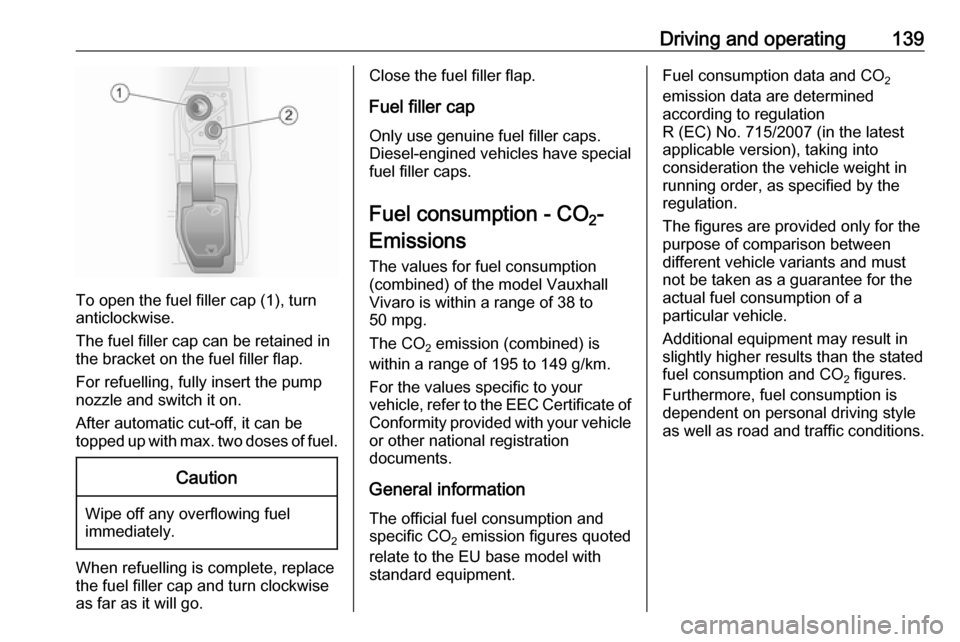
To open the fuel filler cap (1), turn
anticlockwise.
The fuel filler cap can be retained in
the bracket on the fuel filler flap.
For refuelling, fully insert the pump
nozzle and switch it on.
After automatic cut-off, it can be
topped up with max. two doses of fuel.
Caution
Wipe off any overflowing fuel
immediately.
When refuelling is complete, replace
the fuel filler cap and turn clockwise
as far as it will go.
Close the fuel filler flap.
Fuel filler cap Only use genuine fuel filler caps.Diesel-engined vehicles have special
fuel filler caps.
Fuel consumption - CO 2-
Emissions
The values for fuel consumption
(combined) of the model Vauxhall
Vivaro is within a range of 38 to
50 mpg.
The CO 2 emission (combined) is
within a range of 195 to 149 g/km.
For the values specific to your
vehicle, refer to the EEC Certificate of
Conformity provided with your vehicle or other national registration
documents.
General information
The official fuel consumption and
specific CO 2 emission figures quoted
relate to the EU base model with
standard equipment.Fuel consumption data and CO 2
emission data are determined
according to regulation
R (EC) No. 715/2007 (in the latest
applicable version), taking into
consideration the vehicle weight in
running order, as specified by the
regulation.
The figures are provided only for the
purpose of comparison between
different vehicle variants and must
not be taken as a guarantee for the
actual fuel consumption of a
particular vehicle.
Additional equipment may result in
slightly higher results than the stated fuel consumption and CO 2 figures.
Furthermore, fuel consumption is dependent on personal driving style
as well as road and traffic conditions.
Page 144 of 209

142Vehicle careVehicle careGeneral Information...................143
Accessories and vehicle modifications .......................... 143
Vehicle storage ........................143
End-of-life vehicle recovery .....144
Vehicle checks ........................... 144
Performing work ......................144
Bonnet ..................................... 144
Engine oil ................................. 145
Engine air filter ........................ 146
Engine coolant ......................... 147
Power steering fluid .................147
Washer fluid ............................ 148
Brakes ..................................... 148
Brake fluid ............................... 148
Vehicle battery ......................... 149
Diesel fuel filter ........................150
Diesel fuel system bleeding .....151
Wiper blade replacement ........152
Bulb replacement .......................152
Headlights ............................... 152
Fog lights ................................. 153
Front turn signal lights .............154
Tail lights ................................. 154
Side turn signal lights ..............155Centre high-mounted brake
light ......................................... 155
Reversing light ......................... 155
Number plate light ...................156
Fog tail light ............................. 156
Interior lights ............................ 156
Instrument panel illumination ...157
Electrical system ........................157
Fuses ....................................... 157
Instrument panel fuse box .......159
Vehicle tools .............................. 162
Tools ........................................ 162
Wheels and tyres .......................163
Tyres ....................................... 163
Winter tyres ............................. 163
Tyre designations ....................163
Tyre pressure .......................... 163
Tyre pressure monitoring system .................................... 164
Tread depth ............................. 167
Changing tyre and wheel size . 167
Wheel covers ........................... 167
Tyre chains .............................. 168
Tyre repair kit .......................... 168
Wheel changing .......................171
Spare wheel ............................ 172
Jump starting ............................. 174Towing....................................... 175
Towing the vehicle ...................175
Towing another vehicle ...........176
Appearance care .......................177
Exterior care ............................ 177
Interior care ............................. 178
Page 145 of 209

Vehicle care143General Information
Accessories and vehicle modifications
We recommend the use of genuine
parts and accessories and factory
approved parts specific for your
vehicle type. We cannot assess or guarantee reliability of other products
- even if they have a regulatory or
otherwise granted approval.
Do not make any modifications to the
electrical system, e.g. changes of
electronic control units (chip tuning).Caution
When transporting the vehicle on
a train or on a recovery vehicle, the
mud flaps might be damaged.
Vehicle storage
Storage for a long period of time
If the vehicle is to be stored for several months:
● Wash and wax the vehicle.
● Have the wax in the engine compartment and underbody
checked.
● Clean and preserve rubber seals.
● Fill up fuel tank completely.
● Change the engine oil.
● Drain the washer fluid reservoir. ● Check the coolant antifreeze and
corrosion protection.
● Adjust tyre pressure to the value specified for full load.
● Park vehicle in a dry, well ventilated place. Engage first or
reverse gear. Prevent the vehicle from rolling.
● Do not apply the parking brake.● Open the bonnet, close all doors and lock the vehicle.
● Disconnect the clamp from the negative terminal of the vehicle
battery. Beware that all systems
are not functional, e.g. anti-theft
alarm system.
Putting back into operation When the vehicle is to be put back into
operation:
● Connect the clamp to the negative terminal of the vehicle
battery. Activate the electronics
of the power windows.
● Check tyre pressure.
● Fill up the washer fluid reservoir.
● Check the engine oil level.
● Check the coolant level.
● Fit the number plate, if necessary.
Page 152 of 209

150Vehicle careNotice
Using an AGM vehicle battery
different from the original Vauxhall vehicle battery may result in a lower performance of the stop-start
system.
We recommend that you have the
vehicle battery replaced by a
workshop.
Stop-start system 3 117.
Charging the vehicle battery9 Warning
On vehicles with stop-start
system, ensure that the charging potential does not exceed
14.6 volts when using a battery
charger. Otherwise the vehicle
battery might be damaged.
9 Danger
Ensure adequate ventilation when
charging the battery. There is a
risk of explosion if gases
generated during charging are
allowed to accumulate!
Jump starting 3 174.
Warning label
Meaning of symbols: ● No sparks, naked flames or smoking.
● Always shield eyes. Explosive gases can cause blindness or
injury.
● Keep the vehicle battery out of reach of children.
● The vehicle battery contains sulfuric acid which could cause
blindness or serious burn
injuries.
● See the Owner's Manual for further information.
● Explosive gas may be present in the vicinity of the battery.
Diesel fuel filter
The diesel fuel filter is accessible from the underside of the vehicle.
Page 153 of 209
Vehicle care151
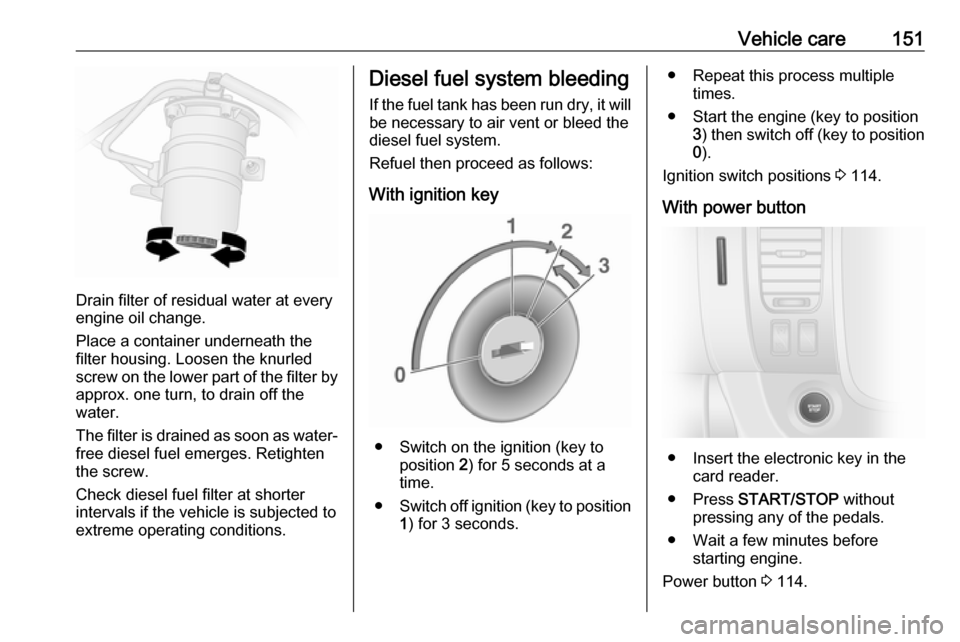
Drain filter of residual water at every
engine oil change.
Place a container underneath the
filter housing. Loosen the knurled
screw on the lower part of the filter by approx. one turn, to drain off the
water.
The filter is drained as soon as water-
free diesel fuel emerges. Retighten
the screw.
Check diesel fuel filter at shorter
intervals if the vehicle is subjected to
extreme operating conditions.
Diesel fuel system bleeding
If the fuel tank has been run dry, it will be necessary to air vent or bleed the
diesel fuel system.
Refuel then proceed as follows:
With ignition key
● Switch on the ignition (key to position 2) for 5 seconds at a
time.
● Switch off ignition (key to position
1 ) for 3 seconds.
● Repeat this process multiple
times.
● Start the engine (key to position 3) then switch off (key to position
0 ).
Ignition switch positions 3 114.
With power button
● Insert the electronic key in the card reader.
● Press START/STOP without
pressing any of the pedals.
● Wait a few minutes before starting engine.
Power button 3 114.
Page 163 of 209

Vehicle care161No.Circuit1Adblue injection battery2Vehicle battery (with electronic
key system)3APC battery backup (with elec‐
tronic key system)4Heating and ventilation system5Adaptations6Adaptations7Heating and ventilation system8Additional heating and ventila‐
tion / air conditioning system9Supplementary heating and
ventilation system10Electric exterior mirrors / addi‐
tional adaptations11Heated exterior mirrors12Radio / multimedia / electric
exterior mirrors / diagnostic
socket13Multimedia / trailer hitchNo.Circuit14Courtesy lights / battery
discharge protection15Fuel injection system / tyre pres‐ sure monitoring system / elec‐
tronic key system16Hazard warning flashers / turn
and lane-change signals17Central locking18Left-hand high beam / right-
hand low beam / tail lights / left- hand daytime running light19Front fog lights / rear fog lights /
number plate lighting20Alarm / horn / lighting / wiper21Instrument cluster22Light switch23Rear window wiper / wind‐
screen washer pump / horn24APC general battery25Reversing lightsNo.Circuit26Brake switch27Fuel injection / starter28Airbag / steering column lock29Passenger power window30Power steering31Brake lights32APC battery backup (with elec‐
tronic key system)33Service display34Cigarette lighter / power outlet35Right-hand high beam / left-
hand low beam / sidelights /
right-hand daytime running light36Brake lights / ABS / immobiliser37Interior lighting / air conditioning38Starting with electronic key
system39Rear window wiper40Warning chimes
Page 166 of 209

164Vehicle careThe tyre pressure information labelon the driver's door frame indicates
the original equipment tyres and the
correspondent tyre pressures.
Always inflate tyres to the pressures
shown on the label.
Tyre pressures 3 196.
The tyre pressure data refers to cold tyres. It applies to summer and winter tyres.
Always inflate the spare tyre to the
pressure specified for full load.
Incorrect tyre pressures will impair
safety, vehicle handling, comfort and
fuel economy and will increase tyre
wear.
Tyre pressures differ depending on
various options. For the correct tyre
pressure value, follow the procedure
below:
1. Identify the engine identifier code.
Engine data 3 186.
2. Identify the respective tyre.
The tyre pressure tables show all possible tyre combinations 3 196.For the tyres approved for your
vehicle, refer to the EEC Certificate of
Conformity provided with your vehicle
or other national registration
documents.
The driver is responsible for correct
adjustment of tyre pressure.9 Warning
If the pressure is too low, this can
result in considerable tyre warm-
up and internal damage, leading to tread separation and even to tyre
blow-out at high speeds.
Tyre pressure monitoring
system
The Tyre Pressure Monitoring
System (TPMS) uses radio and
sensor technology to check tyre
pressure levels.
Caution
Tyre pressure monitoring system
warns only about low tyre pressure condition and does not replace
regular tyre maintenance by the
driver.
All wheels must be equipped with pressure sensors and the tyres must
have the prescribed pressure.
Notice
In countries where the tyre pressure
monitoring system is legally
required, the use of wheels without
pressure sensors will invalidate the
vehicle type approval.
The TPMS sensors monitor the air
pressure in the tyres and transmit tyre pressure readings to a receiver
located in the vehicle.
Tyre pressure chart 3 196.
Tyre pressures in display
The current tyre pressures can be
shown in the Driver Information
Centre (DIC) 3 89.
Page 188 of 209

186Technical dataEngine dataSales designation1.6 CDTi 901.6 CDTi 1151.6 CDTi BiTurbo 1201.6 CDTi BiTurbo 140Engine identifier codeR9M 408R9M 408R9M 450R9M 450Number of cylinders4444Piston displacement [cm3
]1598159815981598Engine power [kW] (PS)66 (90)85 (115)88 (120)103 (140)at rpm3500350035003500Torque [Nm]260300320340at rpm1500175015001750Fuel typeDieselDieselDieselDiesel
Page 189 of 209

Technical data187Vehicle weightKerb weight, basic model
Optional equipment and accessories increase the kerb weight.
Loading information 3 71.ModelEngineWheelbaseRoofPayload ClassGross Vehicle Weight ratingKerb weight 1)2)VanR9ML1H1100027001661120029001661H2120029001760-1771L2H1120029001691-1695H21200290017751)
Kerb weight and gross vehicle weight increase on models fitted with bad road equipment package - refer to VIN plate.
2) Minimum vehicle weight according to Type Approval, including all fluids, vehicle tools and a 90% fuel load. Excludes the weight of
the driver and deletable options, e.g. spare wheel, bulkhead and sliding side load door. Final weight may vary according to the
specification of the vehicle, e.g. options, deleted options and accessories.