brake VAUXHALL VIVARO 2016 Owner's Guide
[x] Cancel search | Manufacturer: VAUXHALL, Model Year: 2016, Model line: VIVARO, Model: VAUXHALL VIVARO 2016Pages: 209, PDF Size: 4.86 MB
Page 157 of 209

Vehicle care155Side turn signal lights
1. Release lamp assembly fromwing by depressing clips using a
suitable tool and lift out lamp
assembly from aperture.
2. Remove bulb holder from lamp assembly by rotating
anticlockwise and renew bulb.
3. Install bulb holder in lamp assembly and install lamp
assembly into aperture.
Centre high-mounted brake light
1. Open the rear doors/tailgate.
2. Remove the 2 bolts from inside the rear doors/tailgate.
3. From outside the vehicle, remove the bulb holder by releasing the
clips with a flat blade screwdriver.
4. Renew bulb.
5. Install bulb holder and replace the
2 bolts.
Reversing light
1. Remove the 2 screws (using the tool supplied) and remove lamp
assembly.
2. Rotate bulb housing anticlockwise
to separate from lamp assembly.
3. Renew lower bulb.
Page 163 of 209

Vehicle care161No.Circuit1Adblue injection battery2Vehicle battery (with electronic
key system)3APC battery backup (with elec‐
tronic key system)4Heating and ventilation system5Adaptations6Adaptations7Heating and ventilation system8Additional heating and ventila‐
tion / air conditioning system9Supplementary heating and
ventilation system10Electric exterior mirrors / addi‐
tional adaptations11Heated exterior mirrors12Radio / multimedia / electric
exterior mirrors / diagnostic
socket13Multimedia / trailer hitchNo.Circuit14Courtesy lights / battery
discharge protection15Fuel injection system / tyre pres‐ sure monitoring system / elec‐
tronic key system16Hazard warning flashers / turn
and lane-change signals17Central locking18Left-hand high beam / right-
hand low beam / tail lights / left- hand daytime running light19Front fog lights / rear fog lights /
number plate lighting20Alarm / horn / lighting / wiper21Instrument cluster22Light switch23Rear window wiper / wind‐
screen washer pump / horn24APC general battery25Reversing lightsNo.Circuit26Brake switch27Fuel injection / starter28Airbag / steering column lock29Passenger power window30Power steering31Brake lights32APC battery backup (with elec‐
tronic key system)33Service display34Cigarette lighter / power outlet35Right-hand high beam / left-
hand low beam / sidelights /
right-hand daytime running light36Brake lights / ABS / immobiliser37Interior lighting / air conditioning38Starting with electronic key
system39Rear window wiper40Warning chimes
Page 169 of 209

Vehicle care167Tread depthCheck tread depth at regular
intervals.
Tyres should be replaced for safety
reasons at a tread depth of 2-3 mm
(4 mm for winter tyres).
For safety reasons it is recommended
that the tread depth of the tyres on
one axle should not vary by more than
2 mm.
The legally permissible minimum
tread depth (1.6 mm) has been
reached when the tread has worn
down as far as one of the tread wear
indicators (TWI). Their position is
indicated by markings on the
sidewall.
Tyres age, even if they are not used.
We recommend tyre replacement
every 6 years.
Changing tyre and wheel size
If tyres of a different size than those fitted at the factory are used, it may be necessary to reprogramme the
speedometer as well as the nominal
tyre pressure and make other vehicle modifications.
After converting to a different tyre
size, have the label with tyre
pressures replaced.9 Warning
Use of unsuitable tyres or wheels
may lead to accidents and will
invalidate the vehicle type
approval.
Wheel covers
Wheel covers and tyres that are
factory approved for the respective
vehicle and comply with all of the
relevant wheel and tyre combination requirements must be used.
If the wheel covers and tyres used are
not factory approved, the tyres must
not have a rim protection ridge.
Wheel covers must not impair brake
cooling.9 Warning
Use of unsuitable tyres or wheel
covers could lead to sudden
pressure loss and thereby
accidents.
Page 170 of 209

168Vehicle careTyre chains
Tyre chains are only permitted on the
front wheels.
Always use fine mesh chains that add no more than 15 mm to the tyre tread
and the inboard sides (including chain lock).
For tyre size 215/60 R17, consult a
workshop.
9 Warning
Damage may lead to tyre blowout.
Wheel covers on steel wheels may
come into contact with parts of the
chains. In such cases, remove the
wheel covers.
Tyre chains may only be used at
speeds up to 30 mph and, when
travelling on roads that are free of
snow, they may only be used for brief
periods since they are subject to rapid wear on a hard road and may snap.
The use of tyre chains is not permitted on the temporary spare wheel.
Tyre repair kit Minor damage to the tyre tread or
sidewall can be repaired with the tyre
repair kit.
Do not remove foreign bodies from
the tyres.
Tyre damage exceeding 4 mm or that is at tyre sidewall near the rim cannot
be repaired with the tyre repair kit.9 Warning
Do not drive faster than 50 mph.
Do not use for a lengthy period.
Steering and handling may be
affected.
If the vehicle has a flat tyre:
Apply the parking brake and engage
first gear or reverse gear.
The tyre repair kit is located under the
driver's seat. Vehicle tools 3 162.
1. Remove the compressor and sealant bottle from the tyre repairkit case.
2. Remove the electrical connection cable and air hose from the
compartments on the underside
of the compressor.
Page 173 of 209

Vehicle care171Notice
The driving characteristics of the
repaired tyre is severely affected, therefore have this tyre replaced.
If unusual noise is heard or the
compressor becomes hot, turn
compressor off for at least
30 minutes.
Pay attention to storage information
and expiry date on sealant bottle. Its
sealing capability is not guaranteed
after this time.
Replace the used sealant bottle. Dispose of the sealant bottle as
prescribed by applicable laws.
Wheel changing
Some vehicles are equipped with a
tyre repair kit instead of a spare wheel 3 168.
Make the following preparations and
observe the following information:
● Park the vehicle on a level, firm and non-slippery surface. The
front wheels must be in the
straight-ahead position.
● Apply the parking brake and engage first gear or reverse gear.● Remove the spare wheel 3 172.
● Never change more than one wheel at a time.
● Use the jack only to change wheels in case of puncture, not
for a seasonal winter or summer
tyre change.
● If the ground on which the vehicle
is standing is soft, a solid board
(max. 1 cm thick) should be
placed under the jack.
● Take heavy objects out of the vehicle before jacking up.
● No people or animals may be in the vehicle when it is jacked-up.
● Never crawl under a jacked-up vehicle.
● Do not start the engine when the vehicle is raised on the jack.
● Clean wheel bolts/nuts and thread with a clean cloth before
mounting the wheel.9 Warning
Do not grease wheel bolt, wheel
nut and wheel nut cone.
1. Remove the wheel cover (using the hook supplied). Vehicle tools
3 162.
2. Loosen each of the wheel bolts by
half a turn using the wheel
wrench. Ensure the wrench
locates securely. The wrench
should turn anticlockwise to
loosen the bolts. Invert the wrench if necessary.
Page 176 of 209
174Vehicle careJump startingDo not start with a quick charger.
A vehicle with a discharged battery
can be started using jump leads and the vehicle battery of another vehicle.9 Warning
Be extremely careful when starting
with jump leads. Any deviation
from the following instructions can
lead to injuries or damage caused
by battery explosion or damage to the electrical systems of both
vehicles.
9 Warning
Avoid contact of the battery with
eyes, skin, fabrics and painted
surfaces. The fluid contains
sulphuric acid which can cause
injuries and damage in the event
of direct contact.
● Never expose the battery to naked flames or sparks.
● A discharged vehicle battery canalready freeze at a temperature
of 0 °C. Defrost the frozen battery
before connecting jump leads.
● Wear eye protection and protective clothing when
handling a battery.
● Use a booster battery with the same voltage (12 volts). Its
capacity (Ah) must not be much less than that of the discharged
battery.
● Use jump leads with insulated terminals and a cross section of
at least 16 mm 2
(25 mm 2
for
diesel engines).
● Do not disconnect the discharged
vehicle battery from the vehicle.
● Switch off all unnecessary electrical consumers.
● Do not lean over the battery during jump starting.
● Do not allow the terminals of one
lead to touch those of the other
lead.
● The vehicles must not come into contact with each other during
the jump starting process.● Apply the parking brake, transmission in neutral.
● Open the positive terminal protection caps of both batteries.
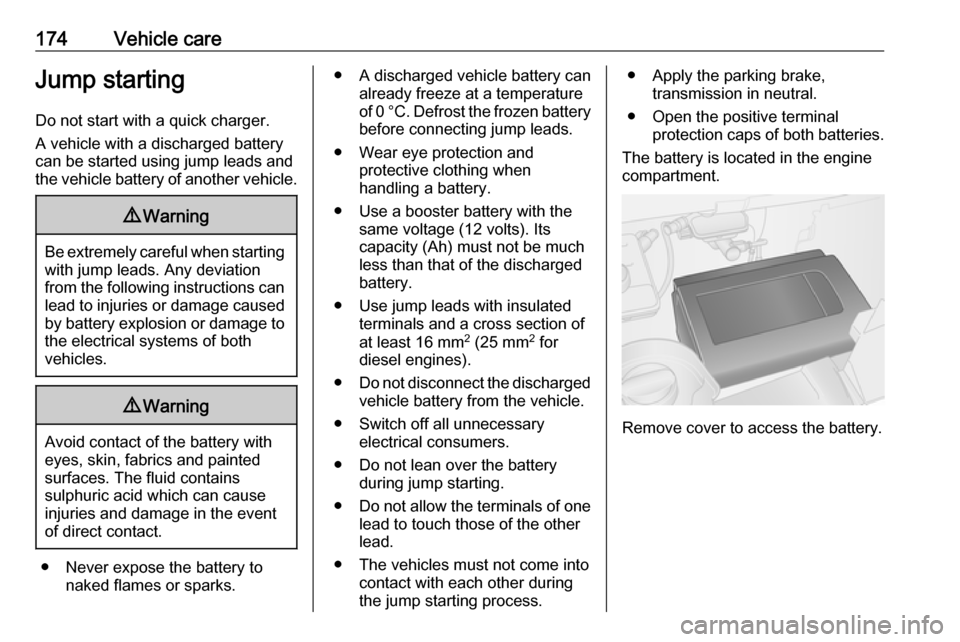
The battery is located in the engine
compartment.
Remove cover to access the battery.
Page 178 of 209
176Vehicle careCaution
Do not tow the vehicle from the
rear. The front towing eye must
only be used for towing and not
recovering a vehicle.
Caution
Activate the child locks in the rear
doors if the rear seats are
occupied. Child locks 3 28.
Switch on ignition to permit operation
of brake lights, horn and windscreen
wipers, and move the steering wheel
slightly to release the steering wheel
lock.
Transmission in neutral.
Caution
Drive slowly. Do not drive jerkily.
Excessive tractive force can
damage the vehicle.
When the engine is not running,
considerably more force is needed to
brake and steer.
To prevent the entry of exhaust fumes
from the towing vehicle, switch on the air recirculation system 3 102 and
close the windows.
Seek the assistance of a workshop.
After towing, unscrew the towing eye
and replace cap.
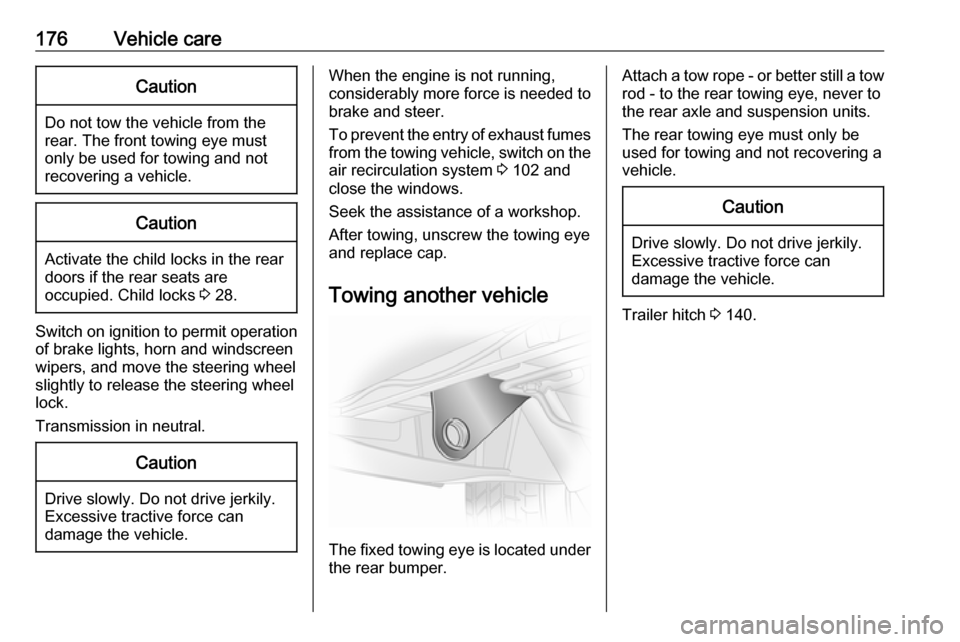
Towing another vehicle
The fixed towing eye is located under the rear bumper.
Attach a tow rope - or better still a tow
rod - to the rear towing eye, never to
the rear axle and suspension units.
The rear towing eye must only be
used for towing and not recovering a
vehicle.Caution
Drive slowly. Do not drive jerkily.
Excessive tractive force can
damage the vehicle.
Trailer hitch 3 140.
Page 184 of 209

182Service and maintenanceAdditional engine oil additives
The use of additional engine oil
additives could cause damage and
invalidate the warranty.
Engine oil viscosity grades
The SAE viscosity grade gives
information of the thickness of the oil.
Multigrade oil is indicated by two
figures, e.g. SAE 5W-30. The first
figure, followed by a W, indicates the
low temperature viscosity and the
second figure the high temperature viscosity.
Select the appropriate viscosity grade
depending on the minimum ambient
temperature 3 185.
All of the recommended viscosity
grades are suitable for high ambient
temperatures.
Coolant and antifreeze
Use only silicate-free long life coolant (LLC) antifreeze approved for the
vehicle. Consult a workshop.
The system is factory filled with
coolant designed for excellent
corrosion protection and frost
protection down to approx. -28 °C.This concentration should be
maintained all year round. The use of additional coolant additives that
intend to give additional corrosion
protection or seal against minor leaks
can cause function problems. Liability
for consequences resulting from the
use of additional coolant additives will be rejected.
Brake fluid
Over time, brake fluid absorbs
moisture which will reduce braking
effectiveness. The brake fluid should
therefore be replaced at the specified interval.
AdBlue Only use AdBlue to reduce the
nitrogen oxides in the exhaust
emission 3 121.
Page 202 of 209

200IndexAAbsorptive Glass Mat battery .....149
Accessories and vehicle modifications .......................... 143
Adaptive forward lighting .............97
Adblue .......................................... 91
AdBlue .......................... 87, 121, 181
AdBlue tank ................................ 195
Adjustable air vents ...................109
AGM battery ............................... 149
Airbag and belt tensioners ...........84
Airbag deactivation ................56, 84
Airbag label............................. 52, 56
Airbag system .............................. 52
Air conditioning regular operation ................................ 110
Air conditioning system .............. 102
Air intake .................................... 110
Air recirculation ...................102, 175
Air vents...................................... 109
Alert .............................................. 90
Antifreeze ................................... 147
Antilock brake system ................ 126
Antilock brake system (ABS) .......86
Anti-theft alarm system ................33
Anti-theft bolts............................. 171
Anti-theft locking system .............. 32
Anti-theft security lock ..................23
Appearance care ........................177
Armrest ........................................ 45Ashtrays ....................................... 78
Automatic anti-dazzle ..................38
Automatic fuel cut-off ..................117
Automatic light control .................95
Automatic locking ........................28
Autostop ............................... 88, 116
Auxiliary heater ........................... 106
B Battery ........................................ 149
Battery, jump starting.................. 174
Belts.............................................. 48 Bench seat.................................... 67
BlueInjection ............................... 121
Bonnet ....................................... 144
Bottle holders................................ 66
Brake and clutch fluid .................181
Brake assist ............................... 127
Brake fluid .................................. 148
Brakes ............................... 126, 148
Brake system ............................... 85
Breakdown.................................. 175
Bulb replacement ....................... 152
C Capacities .................................. 195
Car Pass ...................................... 20
Catalytic converter .....................121
Central locking system ................23
Centre high-mounted brake light 155
Changing tyre and wheel size ...167
Page 204 of 209

202F
Fault messages ............................ 90
First aid kit ................................... 70
Fixed air vents ........................... 110
Fog light ....................................... 88
Fog lights .............................. 98, 153
Fog tail light ............................... 156
Folding centre seatback ...............66
Folding front centre passenger seat ........................................... 44
Folding mirrors ............................. 36
Foot well lights .............................. 99
Front airbag system .....................55
Front courtesy lights .....................99
Front door pockets........................ 66
Front fog lights ........................ 95, 98
Front seats.................................... 42
Front storage ................................ 66
Front turn signal lights ...............154
Fuel consumption - CO 2-
Emissions ............................... 139
Fuel cut-off system .....................117
Fuel economy gauge ....................80
Fuel economy mode .....................88
Fuel economy rating ...............90, 91
Fuel for diesel engines ..............138
Fuel gauge ................................... 80 Fuel tank ..................................... 195
Fuse box ..................................... 159
Fuses ......................................... 157G
Gauges ......................................... 78
General information ...................140
Glovebox ..................................... 65
Glovebox cooler ......................... 110
Glove box lighting .........................99
H Hand brake ................................. 126
Hand brake - see Parking brake. 127
Hazard warning flashers ..............97
Headlight flash ............................. 96
Headlight range adjustment ........96
Headlights ...................... 95, 96, 152
Headlights when driving abroad ..96
Head restraint adjustment .............8
Head restraints ............................ 41
Heated exterior mirrors .................15
Heated mirrors ............................. 37
Heated rear window ...............15, 40
Heating ........................................ 45
Heating and ventilation system . 101
Heat-reflecting windscreen ...........38
High beam ............................. 88, 96
Hill start assist ........................... 127
Horn ....................................... 14, 74
I
Identification plate .....................184
Idle speed control .......................116
Ignition switch positions .............114Immobiliser .................................. 35
Indicators ...................................... 78
Info-display ................................... 89
Information displays...................... 89
Initial drive information.................... 6
Instrument cluster ........................78
Instrument panel fuse box .........159
Instrument panel illumination .....157
Instrument panel illumination control ...................................... 98
Instrument panel overview ........... 10
Instrument panel storage ..............65
Instrument panel tray ....................65
Interior care ............................... 178
Interior lighting .............................. 98
Interior lights ........................ 99, 156
Interior mirrors .............................. 37
Introduction .................................... 3
Isofix child restraint systems ........ 64
J Jack ............................................ 162
Journey record.............................. 91
Jump starting ............................. 174
K
Keys ............................................. 19
Keys, locks ................................... 19