lock VAUXHALL VIVARO 2016 Repair Manual
[x] Cancel search | Manufacturer: VAUXHALL, Model Year: 2016, Model line: VIVARO, Model: VAUXHALL VIVARO 2016Pages: 209, PDF Size: 4.86 MB
Page 163 of 209

Vehicle care161No.Circuit1Adblue injection battery2Vehicle battery (with electronic
key system)3APC battery backup (with elec‐
tronic key system)4Heating and ventilation system5Adaptations6Adaptations7Heating and ventilation system8Additional heating and ventila‐
tion / air conditioning system9Supplementary heating and
ventilation system10Electric exterior mirrors / addi‐
tional adaptations11Heated exterior mirrors12Radio / multimedia / electric
exterior mirrors / diagnostic
socket13Multimedia / trailer hitchNo.Circuit14Courtesy lights / battery
discharge protection15Fuel injection system / tyre pres‐ sure monitoring system / elec‐
tronic key system16Hazard warning flashers / turn
and lane-change signals17Central locking18Left-hand high beam / right-
hand low beam / tail lights / left- hand daytime running light19Front fog lights / rear fog lights /
number plate lighting20Alarm / horn / lighting / wiper21Instrument cluster22Light switch23Rear window wiper / wind‐
screen washer pump / horn24APC general battery25Reversing lightsNo.Circuit26Brake switch27Fuel injection / starter28Airbag / steering column lock29Passenger power window30Power steering31Brake lights32APC battery backup (with elec‐
tronic key system)33Service display34Cigarette lighter / power outlet35Right-hand high beam / left-
hand low beam / sidelights /
right-hand daytime running light36Brake lights / ABS / immobiliser37Interior lighting / air conditioning38Starting with electronic key
system39Rear window wiper40Warning chimes
Page 170 of 209

168Vehicle careTyre chains
Tyre chains are only permitted on the
front wheels.
Always use fine mesh chains that add no more than 15 mm to the tyre tread
and the inboard sides (including chain lock).
For tyre size 215/60 R17, consult a
workshop.
9 Warning
Damage may lead to tyre blowout.
Wheel covers on steel wheels may
come into contact with parts of the
chains. In such cases, remove the
wheel covers.
Tyre chains may only be used at
speeds up to 30 mph and, when
travelling on roads that are free of
snow, they may only be used for brief
periods since they are subject to rapid wear on a hard road and may snap.
The use of tyre chains is not permitted on the temporary spare wheel.
Tyre repair kit Minor damage to the tyre tread or
sidewall can be repaired with the tyre
repair kit.
Do not remove foreign bodies from
the tyres.
Tyre damage exceeding 4 mm or that is at tyre sidewall near the rim cannot
be repaired with the tyre repair kit.9 Warning
Do not drive faster than 50 mph.
Do not use for a lengthy period.
Steering and handling may be
affected.
If the vehicle has a flat tyre:
Apply the parking brake and engage
first gear or reverse gear.
The tyre repair kit is located under the
driver's seat. Vehicle tools 3 162.
1. Remove the compressor and sealant bottle from the tyre repairkit case.
2. Remove the electrical connection cable and air hose from the
compartments on the underside
of the compressor.
Page 173 of 209

Vehicle care171Notice
The driving characteristics of the
repaired tyre is severely affected, therefore have this tyre replaced.
If unusual noise is heard or the
compressor becomes hot, turn
compressor off for at least
30 minutes.
Pay attention to storage information
and expiry date on sealant bottle. Its
sealing capability is not guaranteed
after this time.
Replace the used sealant bottle. Dispose of the sealant bottle as
prescribed by applicable laws.
Wheel changing
Some vehicles are equipped with a
tyre repair kit instead of a spare wheel 3 168.
Make the following preparations and
observe the following information:
● Park the vehicle on a level, firm and non-slippery surface. The
front wheels must be in the
straight-ahead position.
● Apply the parking brake and engage first gear or reverse gear.● Remove the spare wheel 3 172.
● Never change more than one wheel at a time.
● Use the jack only to change wheels in case of puncture, not
for a seasonal winter or summer
tyre change.
● If the ground on which the vehicle
is standing is soft, a solid board
(max. 1 cm thick) should be
placed under the jack.
● Take heavy objects out of the vehicle before jacking up.
● No people or animals may be in the vehicle when it is jacked-up.
● Never crawl under a jacked-up vehicle.
● Do not start the engine when the vehicle is raised on the jack.
● Clean wheel bolts/nuts and thread with a clean cloth before
mounting the wheel.9 Warning
Do not grease wheel bolt, wheel
nut and wheel nut cone.
1. Remove the wheel cover (using the hook supplied). Vehicle tools
3 162.
2. Loosen each of the wheel bolts by
half a turn using the wheel
wrench. Ensure the wrench
locates securely. The wrench
should turn anticlockwise to
loosen the bolts. Invert the wrench if necessary.
Page 174 of 209

172Vehicle care
3.Place lifting pad spigot of the jack
under the jacking hole located
nearest the wheel concerned.
Ensure the jack is positioned
correctly. The jack base must be
on the ground directly below the
jacking hole in a manner that
prevents it from slipping.
4. Install wrench onto the jack and raise the vehicle by turning the
wrench until the wheel is clear of
the ground.
5. Unscrew wheel bolts completely by turning anticlockwise and wipe
clean with a cloth.
Put wheel bolts somewhere
where the threads will not be
soiled.
6. Change the wheel. Spare wheel 3 172.
7. Screw in the wheel bolts.
8. Lower the vehicle and remove jack.
9. Tighten each of the wheel bolts in
a crosswise sequence using the
wheel wrench. Ensure the wrench locates securely. The wrench
should turn clockwise to tighten
the bolts. Invert the wrench if
necessary.
Tightening torque is 160 Nm.
10. Replace the wheel cover, ensuring that the valve hole in thewheel cover is aligned with the
tyre valve before installing.
Notice
If applicable, fit anti-theft bolts
nearest the tyre valve (otherwise it
may not be possible to refit the wheel
cover).11. Stow the replaced wheel 3 172
and the vehicle tools 3 162.
12. Have the new wheel balanced on the vehicle.
Check the tyre pressure of the
installed tyre 3 196.
Check the wheel bolt torque.
Have the defective tyre renewed or
repaired as soon as possible.
Spare wheel
Some vehicles are equipped with a tyre repair kit instead of a spare wheel
3 168.
If mounting a spare wheel which is
different from the other wheels, this
wheel might be classified as a
temporary spare wheel and the
corresponding speed limits apply,
even though no label indicates this.
Seek the assistance of a workshop to
check the applicable speed limit.
Page 177 of 209
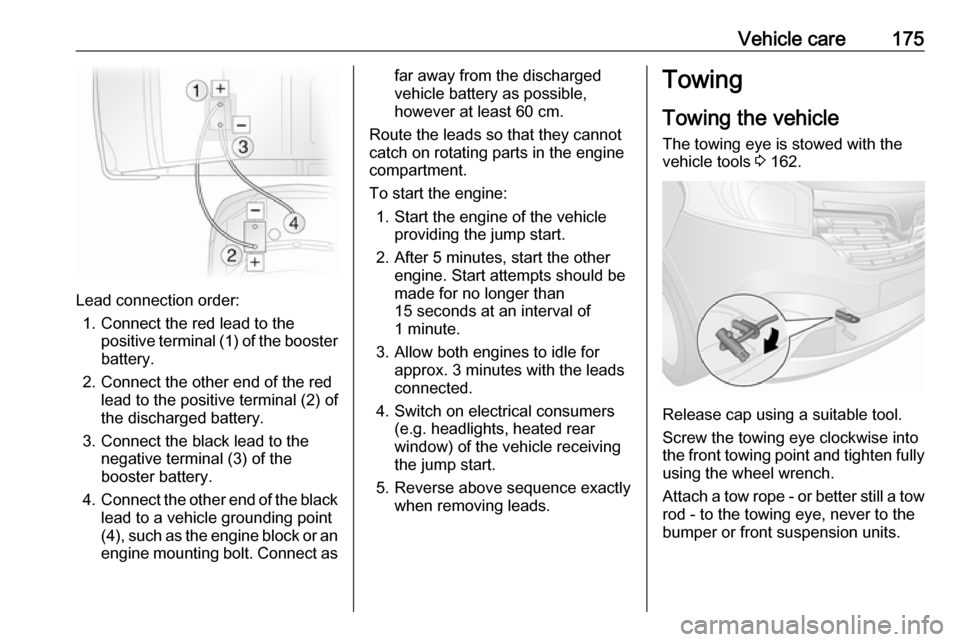
Vehicle care175
Lead connection order:1. Connect the red lead to the positive terminal (1) of the booster
battery.
2. Connect the other end of the red lead to the positive terminal (2) of
the discharged battery.
3. Connect the black lead to the negative terminal (3) of the
booster battery.
4. Connect the other end of the black
lead to a vehicle grounding point
(4), such as the engine block or an
engine mounting bolt. Connect as
far away from the discharged
vehicle battery as possible,
however at least 60 cm.
Route the leads so that they cannot
catch on rotating parts in the engine
compartment.
To start the engine: 1. Start the engine of the vehicle providing the jump start.
2. After 5 minutes, start the other engine. Start attempts should be
made for no longer than
15 seconds at an interval of
1 minute.
3. Allow both engines to idle for approx. 3 minutes with the leads
connected.
4. Switch on electrical consumers (e.g. headlights, heated rear
window) of the vehicle receiving
the jump start.
5. Reverse above sequence exactly when removing leads.Towing
Towing the vehicle The towing eye is stowed with thevehicle tools 3 162.
Release cap using a suitable tool.
Screw the towing eye clockwise into
the front towing point and tighten fully
using the wheel wrench.
Attach a tow rope - or better still a tow rod - to the towing eye, never to the
bumper or front suspension units.
Page 178 of 209
176Vehicle careCaution
Do not tow the vehicle from the
rear. The front towing eye must
only be used for towing and not
recovering a vehicle.
Caution
Activate the child locks in the rear
doors if the rear seats are
occupied. Child locks 3 28.
Switch on ignition to permit operation
of brake lights, horn and windscreen
wipers, and move the steering wheel
slightly to release the steering wheel
lock.
Transmission in neutral.
Caution
Drive slowly. Do not drive jerkily.
Excessive tractive force can
damage the vehicle.
When the engine is not running,
considerably more force is needed to
brake and steer.
To prevent the entry of exhaust fumes
from the towing vehicle, switch on the air recirculation system 3 102 and
close the windows.
Seek the assistance of a workshop.
After towing, unscrew the towing eye
and replace cap.
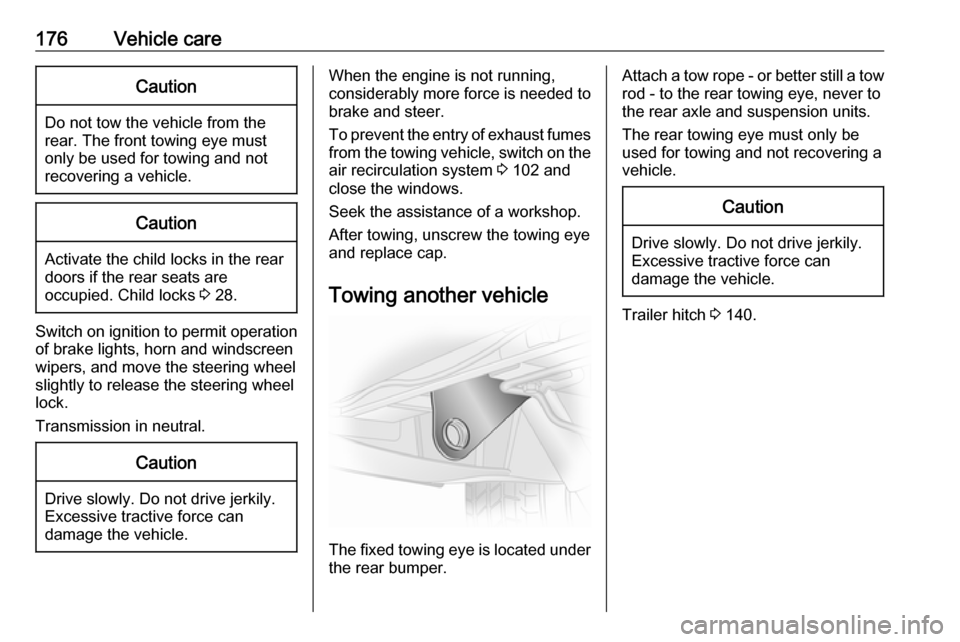
Towing another vehicle
The fixed towing eye is located under the rear bumper.
Attach a tow rope - or better still a tow
rod - to the rear towing eye, never to
the rear axle and suspension units.
The rear towing eye must only be
used for towing and not recovering a
vehicle.Caution
Drive slowly. Do not drive jerkily.
Excessive tractive force can
damage the vehicle.
Trailer hitch 3 140.
Page 179 of 209

Vehicle care177Appearance care
Exterior care LocksThe locks are lubricated at the factoryusing a high quality lock cylinder
grease. Use de-icing agent only when
absolutely necessary, as this has a
degreasing effect and impairs lock
function. After using a de-icing agent,
have the locks regreased by a
workshop.
WashingThe paintwork of your vehicle is
exposed to environmental influences.
Wash and wax your vehicle regularly.
When using automatic vehicle
washes, select a programme that
includes waxing. Restrictions for
filmed or matt painted body parts or decor tapes, see "Polishing and
waxing".
Bird droppings, dead insects, resin,
pollen and the like should be cleaned
off immediately, as they contain
aggressive constituents which can cause paint damage.If using a vehicle wash, comply with
the vehicle wash manufacturer's
instructions. The windscreen wipers
and rear window wiper must be
switched off and the exterior mirrors
must be folded in. Remove antenna
and external accessories such as roof racks etc.
If you wash your vehicle by hand,
make sure that the insides of the
wheel housings are also thoroughly
rinsed out.
Clean edges and folds on opened
doors and the bonnet as well as the
areas they cover.Caution
Always use a cleaning agent with
a pH value of 4 to 9.
Do not use cleaning agents on hot surfaces.
Have the door hinges of all doors
greased by a workshop.
Do not clean the engine compartment with a steam-jet or high-pressure jet
cleaner.
Thoroughly rinse and leather-off the vehicle. Rinse leather frequently. Use
separate leathers for painted and
glass surfaces: remnants of wax on
the windows will impair vision.
Exterior lights
Headlight and other light covers are
made of plastic. Do not use any
abrasive or caustic agents, do not use
an ice scraper, and do not clean them
dry.
Polishing and waxing
Wax the vehicle regularly (at the
latest when water no longer beads).
Otherwise, the paintwork will dry out.
Polishing is necessary only if the paint
has become dull or if solid deposits
have become attached to it.
Paintwork polish with silicone forms a protective film, making waxing
unnecessary.
Unpainted plastic body parts must not
be treated with wax or polishing
agents.
Page 201 of 209

Customer information199Vehicle data recording
and privacy
Event data recorders Data storage modules in the
vehicle
A large number of electronic
components of your vehicle contain
data storage modules temporarily or
permanently storing technical data
about the condition of the vehicle,
events and errors. In general, this
technical information documents the
condition of parts, modules, systems
or the environment:
● operating conditions of system components (e.g. filling levels)
● status messages of the vehicle and its single components (e.g.
number of wheel revolutions / rotational speed, deceleration,
lateral acceleration)
● dysfunctions and defects in important system components● vehicle reactions in particulardriving situations (e.g. inflation of
an airbag, activation of the
stability regulation system)
● environmental conditions (e.g. temperature)
These data are exclusively technical
and help identifying and correcting
errors as well as optimising vehicle
functions.
Motion profiles indicating travelled
routes cannot be created with these
data.
If services are used (e.g. repair
works, service processes, warranty
cases, quality assurance),
employees of the service network
(manufacturer included) are able to
read out this technical information
from the event and error data storage
modules applying special diagnostic
devices. If required, you will receive
further information at these
workshops. After an error has been
corrected, the data are deleted from
the error storage module or they are
constantly overwritten.When using the vehicle, situations
may occur in which these technical
data related to other information
(accident report, damages on the
vehicle, witness statements etc.) may
be associated with a specific person - possibly, with the assistance of an
expert.
Additional functions contractually
agreed upon with the client (e.g.
vehicle location in emergency cases)
allow the transmission of particular vehicle data from the vehicle.
Radio Frequency
Identification (RFID)
RFID technology is used in some
vehicles for functions such as tyre
pressure monitoring and ignition
system security. It is also used in
connection with conveniences such
as radio remote controls for door
locking/unlocking and starting, and in-
vehicle transmitters for garage door
openers. RFID technology in
Vauxhall vehicles does not use or
record personal information or link
with any other Vauxhall system
containing personal information.
Page 202 of 209

200IndexAAbsorptive Glass Mat battery .....149
Accessories and vehicle modifications .......................... 143
Adaptive forward lighting .............97
Adblue .......................................... 91
AdBlue .......................... 87, 121, 181
AdBlue tank ................................ 195
Adjustable air vents ...................109
AGM battery ............................... 149
Airbag and belt tensioners ...........84
Airbag deactivation ................56, 84
Airbag label............................. 52, 56
Airbag system .............................. 52
Air conditioning regular operation ................................ 110
Air conditioning system .............. 102
Air intake .................................... 110
Air recirculation ...................102, 175
Air vents...................................... 109
Alert .............................................. 90
Antifreeze ................................... 147
Antilock brake system ................ 126
Antilock brake system (ABS) .......86
Anti-theft alarm system ................33
Anti-theft bolts............................. 171
Anti-theft locking system .............. 32
Anti-theft security lock ..................23
Appearance care ........................177
Armrest ........................................ 45Ashtrays ....................................... 78
Automatic anti-dazzle ..................38
Automatic fuel cut-off ..................117
Automatic light control .................95
Automatic locking ........................28
Autostop ............................... 88, 116
Auxiliary heater ........................... 106
B Battery ........................................ 149
Battery, jump starting.................. 174
Belts.............................................. 48 Bench seat.................................... 67
BlueInjection ............................... 121
Bonnet ....................................... 144
Bottle holders................................ 66
Brake and clutch fluid .................181
Brake assist ............................... 127
Brake fluid .................................. 148
Brakes ............................... 126, 148
Brake system ............................... 85
Breakdown.................................. 175
Bulb replacement ....................... 152
C Capacities .................................. 195
Car Pass ...................................... 20
Catalytic converter .....................121
Central locking system ................23
Centre high-mounted brake light 155
Changing tyre and wheel size ...167
Page 203 of 209

201Charging system .......................... 84
Child locks ................................... 28
Child restraint installation locations ................................... 59
Child restraints.............................. 57
Child restraint systems ................57
Cigarette lighter ........................... 78
Cleaning the vehicle ...................177
Climate control ............................. 15
Climate control systems .............101
Clock ............................................ 76
Coat hooks ................................... 66
Coin holder ................................... 65
Control indicators.......................... 81
Control of the vehicle .................113
Controls ........................................ 74
Controls in steering wheel ............74
Convex shape .............................. 36
Coolant ....................................... 147
Coolant and antifreeze ...............181
Coolant heater ............................ 106
Cooling (AC) ............................... 102
Cornering light .............................. 97
Cruise control ...................... 88, 131
Cupholders .................................. 66
Curtain airbag system .................. 56
D Danger, Warnings and Cautions ...4
Dashboard .................................... 10Daytime running lights............95, 97
Declaration of conformity ............197
DEF ............................................ 121
Demisting and defrosting ..............15
Diesel exhaust fluid ....................121
Diesel fuel filter .......................... 150
Diesel fuel system bleeding .......151
Diesel particle filter ....................120
Directional tyres ..................163, 172
Distance to service .......................80
Document tray .............................. 66
Door locks..................................... 23
Door open .................................... 89
Doors ............................................ 29
Double cab ................................... 67
DPF (diesel particle filter) ...........120
Driver assistance systems ..........131
Driver Information Centre .............89
Driving characteristics and towing tips .............................. 140
Driving economically................... 112
Driving hints ................................ 112
E ECO mode .................................. 112
ecoScoring.................................... 91
Electric adjustment ......................36
Electrical accessories ...................77
Electrical system......................... 157
Electronic climate control system 103Electronic data recording..............38
Electronic key system ...................22
Electronic Stability Program 86,
129, 141
Electronic Stability Program off ...86
End-of-life vehicle recovery .......144
Engine air filter............................ 146
Engine air flow indicator .............146
Engine coolant ........................... 147
Engine coolant temperature ........86
Engine data ............................... 186
Engine exhaust .......................... 120
Engine identification ...................184
Engine oil ...........145, 181, 185, 195
Engine oil additives ....................181
Engine oil level ............................ 91
Engine oil pressure ......................87
Engine oil viscosity grades .........181
Enhanced Traction function 128, 129
Entry lighting .............................. 100
Event data recorders ..................199
Exhaust gases ....................120, 175
Exit lighting ................................ 100
Exterior care .............................. 177
Exterior light ................................. 88
Exterior lighting ......................12, 95
Exterior mirrors ............................. 36