lock VAUXHALL VIVARO 2018 Workshop Manual
[x] Cancel search | Manufacturer: VAUXHALL, Model Year: 2018, Model line: VIVARO, Model: VAUXHALL VIVARO 2018Pages: 233, PDF Size: 5.73 MB
Page 134 of 233
132Driving and operatingThese functions stop working when
the driver's door is opened and the
vehicle is locked.
Notice
Always take the electronic key with you when exiting the vehicle.
The electronic key being left in the
card reader is indicated by a warning
chime 3 102 and a message in the
Driver Information Centre 3 101
when the driver's door is opened.9 Danger
Never leave an electronic key
inside the vehicle when children or animals are left in the vehicle, to
avoid unintended operation of
windows, doors or engine. Risk of
fatal injury.
Fault
If the engine cannot be started, the
cause may be one of the following:
● Fault in electronic key.
● Electronic key out of reception range.
● Battery voltage too low.
● Overload of the central locking system by operating at frequentintervals, the power supply is
interrupted for a short time.
● Interference from higher-power radio waves from other sources.
Battery replacement 3 20.
Central locking system 3 24.
Electronic key system 3 22.
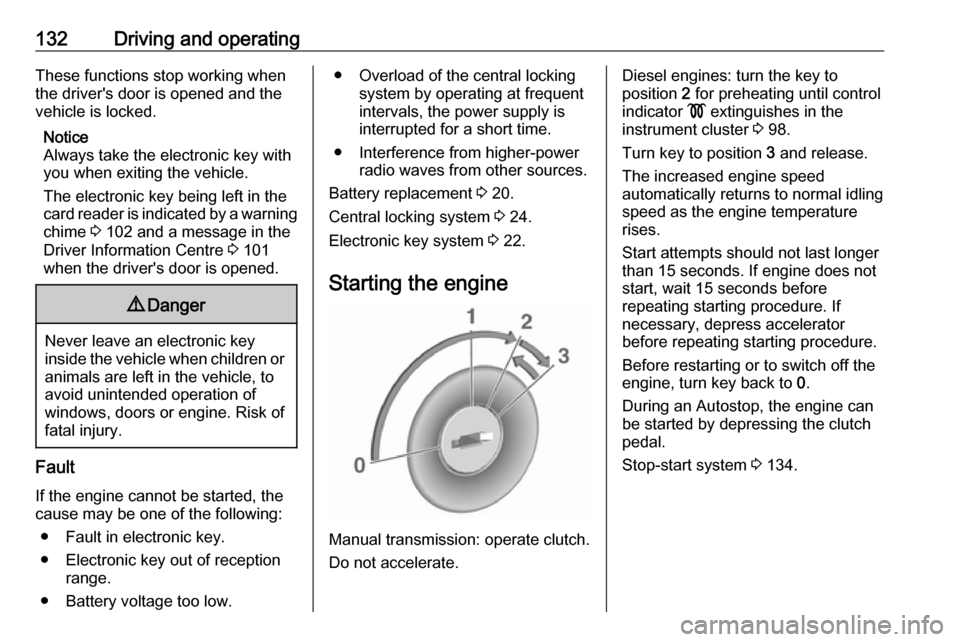
Starting the engine
Manual transmission: operate clutch.
Do not accelerate.
Diesel engines: turn the key to
position 2 for preheating until control
indicator ! extinguishes in the
instrument cluster 3 98.
Turn key to position 3 and release.
The increased engine speed
automatically returns to normal idling
speed as the engine temperature
rises.
Start attempts should not last longer
than 15 seconds. If engine does not
start, wait 15 seconds before
repeating starting procedure. If
necessary, depress accelerator
before repeating starting procedure.
Before restarting or to switch off the
engine, turn key back to 0.
During an Autostop, the engine can
be started by depressing the clutch
pedal.
Stop-start system 3 134.
Page 138 of 233

136Driving and operating● the defrosting function is notactivated
● the climate control system does not inhibit an Autostop
● the brake vacuum is sufficient
● the self-cleaning function of the diesel particle filter is not active
3 138
● the Antilock brake system (ABS) 3 146, Traction Control system
(TC) 3 147 and Electronic
Stability Program (ESP® Plus
)
3 148 ride control systems are
not actively engaged
● the vehicle has moved since the last Autostop
Otherwise an Autostop will be
inhibited.
Certain settings of the climate control
system may also inhibit an Autostop.
See " Climate control " chapter for
further information 3 116.
Immediately after motorway driving
an Autostop may be inhibited.
New vehicle running-in 3 130.Vehicle battery discharge protection
To ensure reliable engine restarts, several battery discharge protection
features are implemented as part of
the stop-start system.
Restart of the engine by the driver
Depress the clutch pedal to restart the
engine.
Notice
If any gear is selected, the clutch
pedal must be fully depressed to
restart the engine.
If the engine does not restart first
time, depress clutch pedal fully again.
Alternatively, press button Î to
restart the engine while in an
Autostop.
Control indicator Ï 3 99 extinguishes
in the instrument cluster when the engine is restarted.
Restart of the engine by the stop- start system
The selector lever must be in neutral
to enable an automatic restart.If one of the following conditions
occurs during an Autostop, the
engine will be restarted automatically
by the stop-start system:
● the vehicle battery is discharged
● the outside temperature is too low or too high (e.g. below 0 °C
or above 30 °C)
● the defrosting function is activated 3 116
● the brake vacuum is not sufficient
● the brake pedal is operated repeatedly
● the vehicle starts to move
An automatic engine restart may not
be possible if a door or the bonnet is
open.
If an electrical accessory, e.g. a
portable CD player, is connected to
the power outlet, a brief power drop
during engine restart may be
noticeable.
If the Infotainment system is active,
audio sound may briefly be reduced
or interrupted during the restart.
Page 139 of 233

Driving and operating137Fault
If a fault occurs in the stop-start
system, the LED in Î illuminates,
and a corresponding message
appears in the Driver Information
Centre 3 100 . Seek the assistance of
a workshop.
Vehicle messages 3 101.
Warning chimes 3 102.
Parking9 Warning
● Do not park the vehicle on an
easily ignitable surface. The
high temperature of the
exhaust system could ignite the
surface.
● Always apply parking brake without pressing release
button. Apply as firmly as
possible on a downhill slope or
uphill slope. Depress brake
pedal at the same time to
reduce operating force.
● Switch off the engine.
● If the vehicle is on a level surface or uphill slope, engage
first gear. On an uphill slope,
turn the front wheels away from
the kerb.
If the vehicle is on a downhill
slope, engage reverse gear.
Turn the front wheels towards the kerb.
● Close the windows.
● Remove the ignition key from the ignition switch. Turn the
steering wheel until the
steering wheel lock is felt to
engage.
● Lock the vehicle by pressing e on
the remote control 3 24.
Activate the anti-theft alarm
system 3 36.
● The engine cooling fans may run
after the engine has been
switched off 3 164.
Caution
After running at high engine
speeds or with high engine loads,
operate the engine briefly at a low load or run in neutral for approx.30 seconds before switching off, in
order to protect the turbocharger.
Vehicle storage 3 163.
Page 144 of 233
142Driving and operatingIllumination of control indicators Y
and F may be accompanied by a
warning chime.
Warning chimes 3 102.
Refilling AdBlueCaution
Only use AdBlue that complies
with European standards
DIN 70 070 and ISO 22241-1.
Do not use additives.
Do not dilute AdBlue.
Otherwise the selective catalytic
reduction system could be
damaged.
Notice
If AdBlue must be refilled at very low temperatures, the refilling of AdBlue
may not be detected by the system.
In this case, park the vehicle in a
space with a higher ambient
temperature until AdBlue is
liquefied.
Notice
If engine starting is prohibited due to low AdBlue level, we recommend
refilling the tank completely or with a volume of at least ten litres of AdBlue(depending on AdBlue
consumption).
Avoid minor top-ups (e.g. less than ten litres), otherwise the system may
not detect a refill.
Notice
When unscrewing the protective cap from the filler neck, ammonia fumes
may emerge. Do not inhale as the fumes have a pungent smell. The
fumes are not harmful by inhalation.
The vehicle must be parked on a level
surface.
The filler neck for AdBlue is located
behind the fuel filler flap, located on
the left-hand side of the vehicle.
The fuel filler flap can only be opened if the vehicle is unlocked and the left-
hand door is opened.9 Danger
Vehicles with stop-start system:
The engine must be switched off
and the ignition key removed, to
avoid risk of engine being
restarted automatically by the
system.
Capacities 3 216.
Page 145 of 233
Driving and operating143Filling station9Danger
Follow the operating and safety
instructions of the filling station
when refilling AdBlue.
1. Switch off engine and remove key
from ignition switch.
2. Open left-hand door and pull fuel filler flap to open.
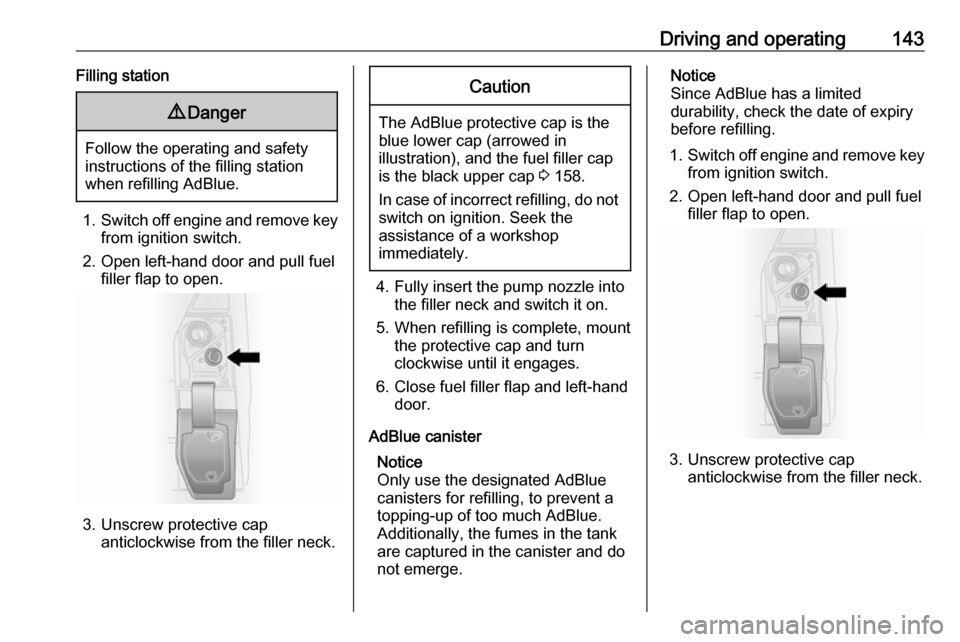
3. Unscrew protective capanticlockwise from the filler neck.
Caution
The AdBlue protective cap is the
blue lower cap (arrowed in
illustration), and the fuel filler cap
is the black upper cap 3 158.
In case of incorrect refilling, do not switch on ignition. Seek the
assistance of a workshop
immediately.
4. Fully insert the pump nozzle into the filler neck and switch it on.
5. When refilling is complete, mount the protective cap and turn
clockwise until it engages.
6. Close fuel filler flap and left-hand door.
AdBlue canister Notice
Only use the designated AdBlue
canisters for refilling, to prevent a
topping-up of too much AdBlue.
Additionally, the fumes in the tank
are captured in the canister and do
not emerge.
Notice
Since AdBlue has a limited
durability, check the date of expiry
before refilling.
1. Switch off engine and remove key
from ignition switch.
2. Open left-hand door and pull fuel filler flap to open.
3. Unscrew protective capanticlockwise from the filler neck.
Page 146 of 233

144Driving and operatingCaution
The AdBlue protective cap is the
blue lower cap (arrowed in
illustration), and the fuel filler cap
is the black upper cap 3 158.
In case of incorrect refilling, do not switch on ignition. Seek the
assistance of a workshop
immediately.
4. Open AdBlue canister.
5. Mount one end of the hose on the
canister and screw the other end
on the filler neck.
6. Lift the canister until it is empty, or
until the flow from the canister has
stopped. This can take up to five
minutes.
7. Place the canister on the ground to empty the hose, wait 15
seconds.
8. Unscrew the hose from the filler neck.
9.Mount the protective cap and turn
clockwise until it engages.
10. Close fuel filler flap and left-hand door.
Notice
Dispose of AdBlue canister
according to environmental
requirements. Hose can be reused
after flushing with clear water before
AdBlue dries out.
Notice
Allow the vehicle to idle for at least
ten seconds to allow the system to
detect the AdBlue refill.
Failure to observe this procedure will
result in the system only recognising the AdBlue refill after approx.
20 minutes of driving.
If the AdBlue refill is detected
successfully, AdBlue level warnings
will disappear.
If the AdBlue refill is not detected
some time after running the engine,
seek the assistance of a workshop.
Filler cap
Only use genuine filler caps. AdBlue
tank has a special filler cap.Fault
If the system detects an operating fault, control indicator Y illuminates
together with F and a warning chime.
Seek the assistance of a workshop
immediately.
A corresponding message appears in the Driver Information Centre 3 100.
Page 148 of 233
146Driving and operatingControl indicator R 3 96.
Vehicle messages 3 101.
Antilock brake system Antilock brake system (ABS)
prevents the wheels from locking.
ABS starts to regulate brake pressure as soon as a wheel shows a tendency to lock. The vehicle remains
steerable, even during hard braking.
ABS control is made apparent
through a pulse in the brake pedal
and the noise of the regulation
process.
For optimum braking, keep the brake
pedal fully depressed throughout the
braking process, despite the fact that
the pedal is pulsating. Do not reduce
the pressure on the pedal.
After starting-off, the system performs
a self-test which may be audible.
Control indicator u 3 97.
Fault
If control indicator u does not go out
a few seconds after the ignition is switched on, or if it illuminates whiledriving, there is a fault in the ABS.
Control indicator F 3 96 may also
illuminate in the instrument cluster
together with a corresponding
message in the Driver Information
Centre. The brake system remains operational but without ABS
regulation.9 Warning
If there is a fault in the ABS, the
wheels may be liable to lock due
to braking that is heavier than
normal. The advantages of ABS are no longer available. During
hard braking, the vehicle can no longer be steered and may
swerve.
If control indicators u, F , R 3 96
and C 3 96 illuminate, there is a fault
in the braking system. A
corresponding message also
appears in the Driver Information
Centre 3 100. Have the cause of the
fault remedied by a workshop.
Vehicle messages 3 101.
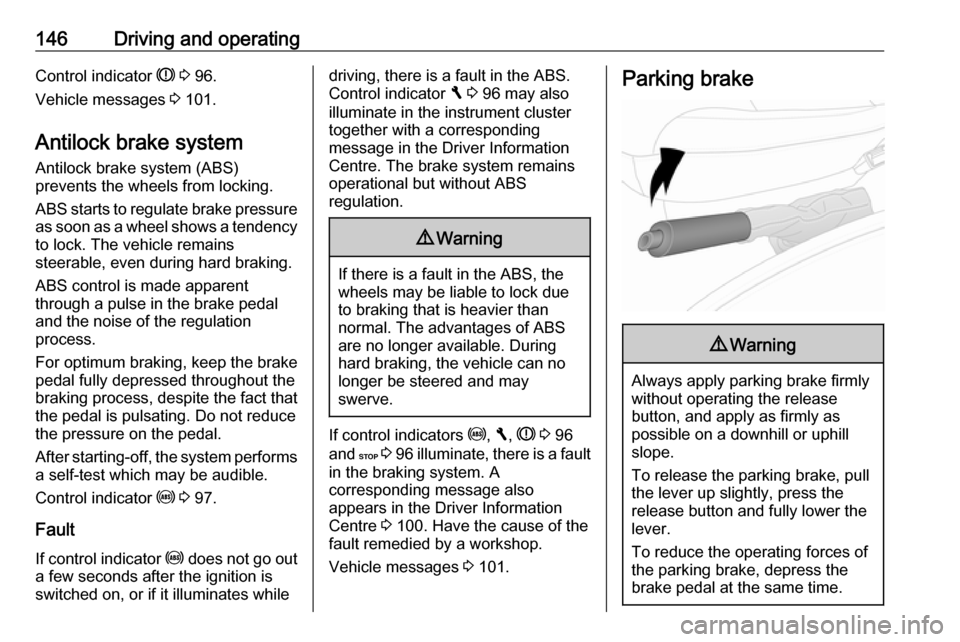
Parking brake9 Warning
Always apply parking brake firmly
without operating the release
button, and apply as firmly as
possible on a downhill or uphill
slope.
To release the parking brake, pull
the lever up slightly, press the
release button and fully lower the
lever.
To reduce the operating forces of
the parking brake, depress the
brake pedal at the same time.
Page 152 of 233
150Driving and operatingEngine Drag Torque Control
The engine drag torque control
system is an integral feature of
ESP® Plus
. When downshifting under
slippery road conditions, the engine speed and torque increases to help
prevent locking of the drive wheels
during sudden deceleration.
Fault
If the system detects a fault, control indicator b 3 97 illuminates together
with F 3 96 in the instrument cluster
and a corresponding message
appears in the Driver Information
Centre 3 100.
The Electronic stability program
(ESP® Plus
) is not operational. Have
the cause of the fault remedied by a workshop.
Vehicle messages 3 101.Driver assistance
systems9 Warning
Driver assistance systems are
developed to support the driver
and not to replace the driver's
attention.
The driver accepts full
responsibility when driving the
vehicle.
When using driver assistance
systems, always take care
regarding the current traffic
situation.
Cruise control
The cruise control can store and
maintain speeds of 20 mph and
above. Deviations from the stored
speeds may occur when driving uphill or downhill.
For safety reasons, the cruise control cannot be activated until the brake
pedal has been operated once.
Do not use the cruise control if it is not
advisable to maintain a constant
speed.
Control indicators U and m 3 100.
Activation
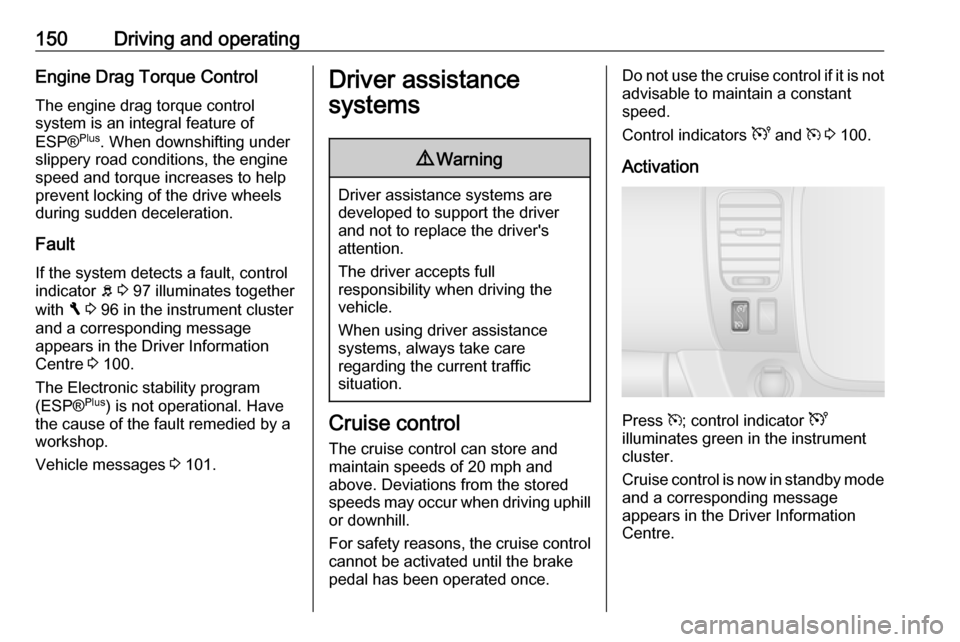
Press m; control indicator U
illuminates green in the instrument
cluster.
Cruise control is now in standby mode
and a corresponding message
appears in the Driver Information
Centre.
Page 161 of 233
Driving and operating159Caution
In case of misfuelling, do not
switch on ignition.
Notice
To ensure the fuel level is displayed
correctly, the ignition must be
switched off before refuelling. Avoid
minor fuel top-ups (e.g. less than
five litres) to ensure accurate
readings.
The fuel filler flap is located on the left-
hand side of the vehicle.
The fuel filler flap can only be opened
if the vehicle is unlocked and the left- hand door is opened.
Notice
Do not open the left-hand sliding
side door during refuelling.
Pull flap to open.
Caution
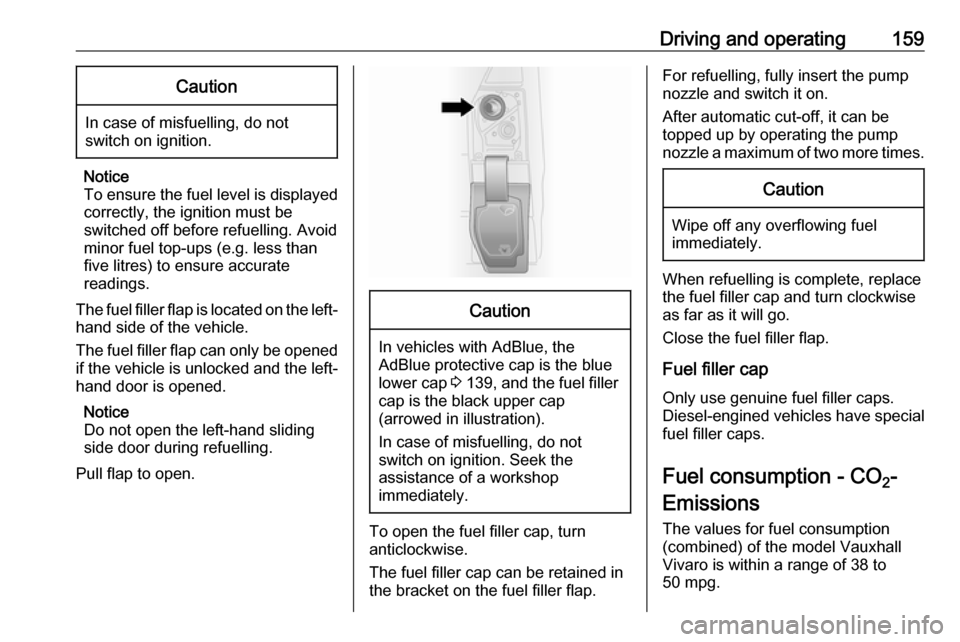
In vehicles with AdBlue, the
AdBlue protective cap is the blue
lower cap 3 139 , and the fuel filler
cap is the black upper cap
(arrowed in illustration).
In case of misfuelling, do not
switch on ignition. Seek the
assistance of a workshop
immediately.
To open the fuel filler cap, turn
anticlockwise.
The fuel filler cap can be retained in
the bracket on the fuel filler flap.
For refuelling, fully insert the pump
nozzle and switch it on.
After automatic cut-off, it can be
topped up by operating the pump
nozzle a maximum of two more times.Caution
Wipe off any overflowing fuel
immediately.
When refuelling is complete, replace
the fuel filler cap and turn clockwise
as far as it will go.
Close the fuel filler flap.
Fuel filler cap Only use genuine fuel filler caps.Diesel-engined vehicles have special
fuel filler caps.
Fuel consumption - CO 2-
Emissions
The values for fuel consumption
(combined) of the model Vauxhall
Vivaro is within a range of 38 to
50 mpg.
Page 165 of 233

Vehicle care163General Information
Accessories and vehicle modifications
We recommend the use of genuine
parts and accessories and factory
approved parts specific for your
vehicle type. We cannot assess or guarantee reliability of other products
- even if they have a regulatory or
otherwise granted approval.
Any modification, conversion or other changes made to standard vehicle
specifications (including, without
limitation, software modifications,
modifications of the electronic control
units) may invalidate the warranty
offered by Vauxhall. Furthermore,
such changes may impact fuel
consumption, CO 2 emissions and
other emissions of the vehicle and
cause the vehicle to no longer
conform to the operating permit,
impacting the validity of your vehicle
registration.Caution
When transporting the vehicle on
a train or on a recovery vehicle, the
mud flaps might be damaged.
Vehicle storage
Storage for a long period of time
If the vehicle is to be stored for several months:
● Wash the vehicle. Wax painted parts of the vehicle.
Exterior care 3 198.
● Have the wax in the engine compartment and underbody
checked.
● Clean and preserve rubber seals.
● Fill up fuel tank completely.
● Change the engine oil.
● Drain the washer fluid reservoir. ● Check the coolant antifreeze and
corrosion protection.
● Adjust tyre pressure to the value specified for full load.
● Park vehicle in a dry, wellventilated place. Engage first or
reverse gear. Prevent the vehicle from rolling.
● Do not apply the parking brake.
● Open the bonnet, close all doors and lock the vehicle.
Putting back into operation
When the vehicle is to be put back into
operation:
● Check tyre pressure.
● Fill up the washer fluid reservoir. ● Check the engine oil level.
● Check the coolant level.
● Since the durability of AdBlue is limited to two years, fluid should
be exchanged if it is too old. Seek the assistance of a workshop.
● Fit the number plate, if necessary.