Electrical VAUXHALL VIVARO C 2020 User Guide
[x] Cancel search | Manufacturer: VAUXHALL, Model Year: 2020, Model line: VIVARO C, Model: VAUXHALL VIVARO C 2020Pages: 289, PDF Size: 10.16 MB
Page 243 of 289
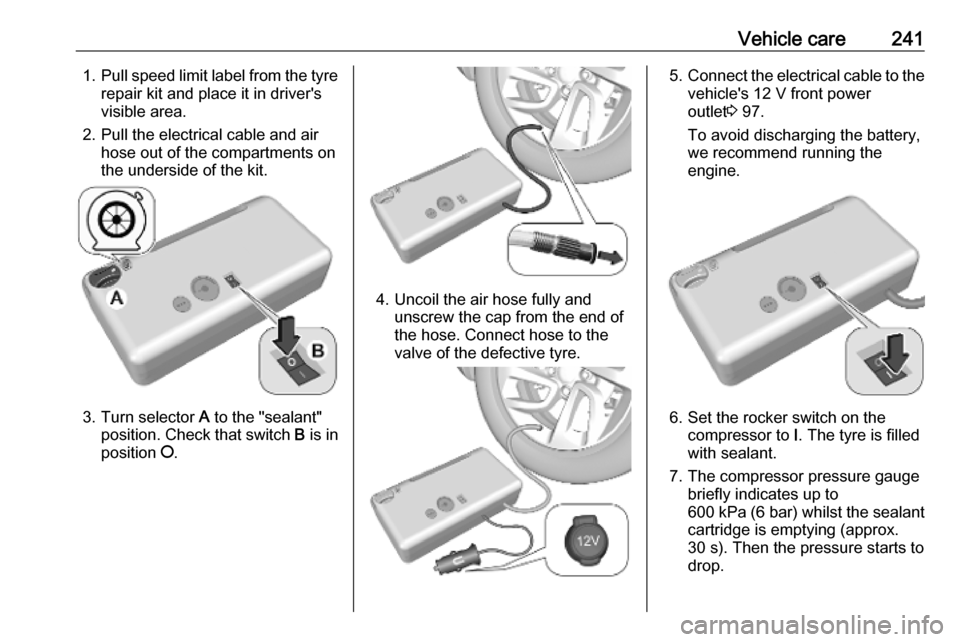
Vehicle care2411.Pull speed limit label from the tyre
repair kit and place it in driver's
visible area.
2. Pull the electrical cable and air hose out of the compartments on
the underside of the kit.
3. Turn selector A to the "sealant"
position. Check that switch B is in
position J.
4. Uncoil the air hose fully and
unscrew the cap from the end of
the hose. Connect hose to the
valve of the defective tyre.
5. Connect the electrical cable to the
vehicle's 12 V front power
outlet 3 97.
To avoid discharging the battery,
we recommend running the
engine.
6. Set the rocker switch on the compressor to I. The tyre is filled
with sealant.
7. The compressor pressure gauge briefly indicates up to
600 kPa (6 bar) whilst the sealant
cartridge is emptying (approx.
30 s). Then the pressure starts to
drop.
Page 251 of 289
Vehicle care249
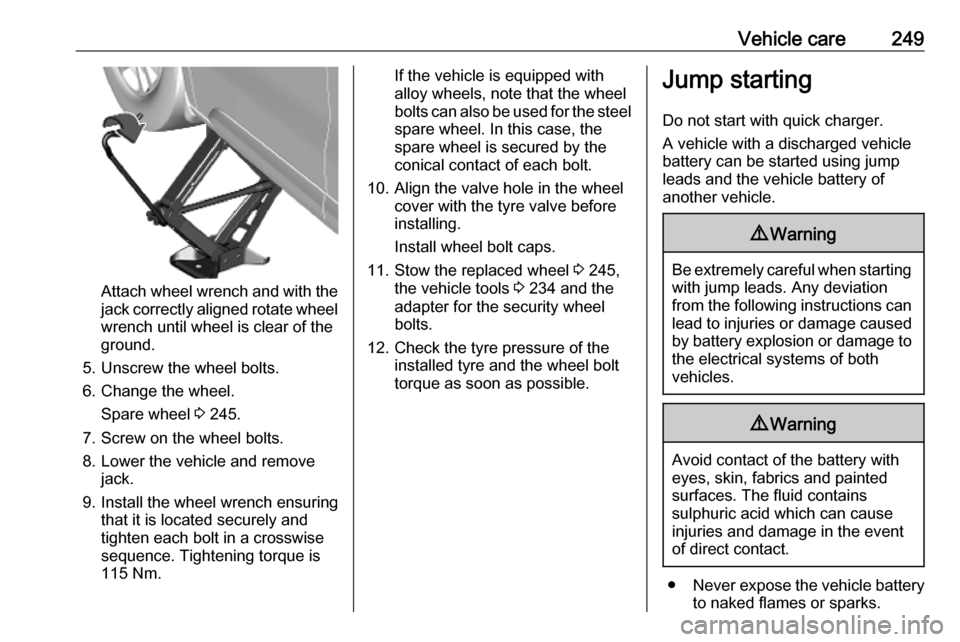
Attach wheel wrench and with the
jack correctly aligned rotate wheel wrench until wheel is clear of the
ground.
5. Unscrew the wheel bolts. 6. Change the wheel. Spare wheel 3 245.
7. Screw on the wheel bolts.
8. Lower the vehicle and remove jack.
9. Install the wheel wrench ensuring that it is located securely and
tighten each bolt in a crosswise
sequence. Tightening torque is
115 Nm.
If the vehicle is equipped with
alloy wheels, note that the wheel
bolts can also be used for the steel spare wheel. In this case, the
spare wheel is secured by the
conical contact of each bolt.
10. Align the valve hole in the wheel cover with the tyre valve before
installing.
Install wheel bolt caps.
11. Stow the replaced wheel 3 245,
the vehicle tools 3 234 and the
adapter for the security wheel bolts.
12. Check the tyre pressure of the installed tyre and the wheel bolttorque as soon as possible.Jump starting
Do not start with quick charger.
A vehicle with a discharged vehicle
battery can be started using jump
leads and the vehicle battery of
another vehicle.9 Warning
Be extremely careful when starting
with jump leads. Any deviation
from the following instructions can
lead to injuries or damage caused
by battery explosion or damage to the electrical systems of both
vehicles.
9 Warning
Avoid contact of the battery with
eyes, skin, fabrics and painted
surfaces. The fluid contains
sulphuric acid which can cause
injuries and damage in the event
of direct contact.
● Never expose the vehicle battery
to naked flames or sparks.
Page 252 of 289

250Vehicle care● A discharged vehicle battery canalready freeze at a temperature
of 0 °C. Defrost the frozen battery before connecting jump leads.
● Wear eye protection and protective clothing when
handling a battery.
● Use a booster battery with the same voltage (12 V). Its capacity
(Ah) must not be much less than
that of the discharged vehicle
battery.
● Use jump leads with insulated terminals and a cross section of
at least 16 mm 2
(25 mm 2
for
diesel engines).
● Do not disconnect the discharged
vehicle battery from the vehicle.
● Switch off all unnecessary electrical consumers.
● Do not lean over the vehicle battery during jump starting.
● Do not allow the terminals of one
lead to touch those of the other
lead.● The vehicles must not come into contact with each other during
the jump starting process.
● Apply the parking brake, transmission in neutral,
automatic transmission in P.
Open the positive terminal protection
caps of both vehicle batteries.
Lead connection order: 1. Connect the red lead to the positive terminal of the booster
battery.
2. Connect the other end of the red lead to the positive terminal of the
discharged battery.
3. Connect the black lead to the negative terminal of the boosterbattery.
4. Connect the other end of the black
lead to a vehicle grounding point
of your vehicle in the engine
compartment.
Route the leads so that they cannot
catch on rotating parts in the engine
compartment.
To start the engine: 1. Start the engine of the vehicle providing the jump.
2. After 5 minutes, start the other engine. Start attempts should be
made for no longer than 15
seconds at an interval of 1 minute.
3. Allow both engines to idle for approx. three minutes with the
leads connected.
4. Switch on electrical consumers e.g. headlights, heated rear
window of the vehicle receiving
the jump start.
5. Reverse above sequence exactly when removing leads.
Page 285 of 289

283Climate control systems.............138
Clock............................................. 97
Control indicators........................ 109
Control of the vehicle .................152
Controls ........................................ 93
Convex shape .............................. 38
Coolant and antifreeze ...............262
Cornering lights .......................... 132
Cruise control ....................114, 173
Cupholders .................................. 77
Curtain airbag system .................. 64
D Danger, Warnings and Cautions ...4
Daytime running lights ...............132
Declaration of conformity ............273
DEF ............................................ 161
Deflation detection system .........113
Diesel exhaust fluid ....................161
Diesel fuel system bleeding .......218
Door open .................................. 115
Doors ...................................... 30, 32
Driver alert .................................. 201
Driver assistance systems ..........173
Driver Information Centre ...........115
Driving characteristics and towing tips .............................. 205
Driving hints ................................ 152E
Electric adjustment ......................38
Electrical system......................... 230
Electronic climate control system 142
Electronic driving programmes ..167
Electronic key system ...................23
Electronic Stability Control and Traction Control system ..112, 170
Emergency call ........................... 127
End-of-life vehicle recovery .......212
Engine compartment fuse box ...231
Engine coolant ........................... 214
Engine coolant temperature ......112
Engine coolant temperature gauge ..................................... 107
Engine data ............................... 268
Engine exhaust .......................... 160
Engine identification ...................265
Engine oil ................... 213, 262, 266
Engine oil level monitor ..............108
Engine oil pressure ....................113
Entry lighting .............................. 136
Event data recorders ..................277
Exhaust filter ....................... 112, 160
Exit lighting ................................ 136
Exterior care .............................. 253
Exterior light ............................... 114
Exterior lighting ....................12, 129
Exterior mirrors ............................. 38F
Fault ........................................... 167
Fixed air vents ........................... 149
Floor mats................................... 256
Folding front seat ..........................50
Folding mirrors ............................. 39
Folding tray .................................. 85
Forward collision alert................. 186
Front airbag system .....................63
Front fog lights ...........114, 133, 224
Front pedestrian protection ........190
Front seats.................................... 47
Front storage ................................ 78
Front turn lights .......................... 224
Fuel for diesel engines ..............203
Fuel gauge ................................. 106 Fuses ......................................... 230
G
Gauges ....................................... 104
Gear selection ........................... 165
Gear shifting ............................... 112
General information ...................205
Glass panel .................................. 45
Glovebox ..................................... 77
Glovebox cooler ......................... 149
H
Halogen headlights ....................219
Hand brake ................................. 169
Hazard warning flashers ............132