heating VAUXHALL ZAFIRA 2014.5 User Guide
[x] Cancel search | Manufacturer: VAUXHALL, Model Year: 2014.5, Model line: ZAFIRA, Model: VAUXHALL ZAFIRA 2014.5Pages: 219, PDF Size: 7.83 MB
Page 123 of 219
Climate control121
Heated rear window Ü 3 41.
The preselected temperature is
automatically regulated. In the
automatic mode the fan speed and air distribution automatically regulate the
air flow.
The system can be manually adapted by use of air distribution and air flow
controls.
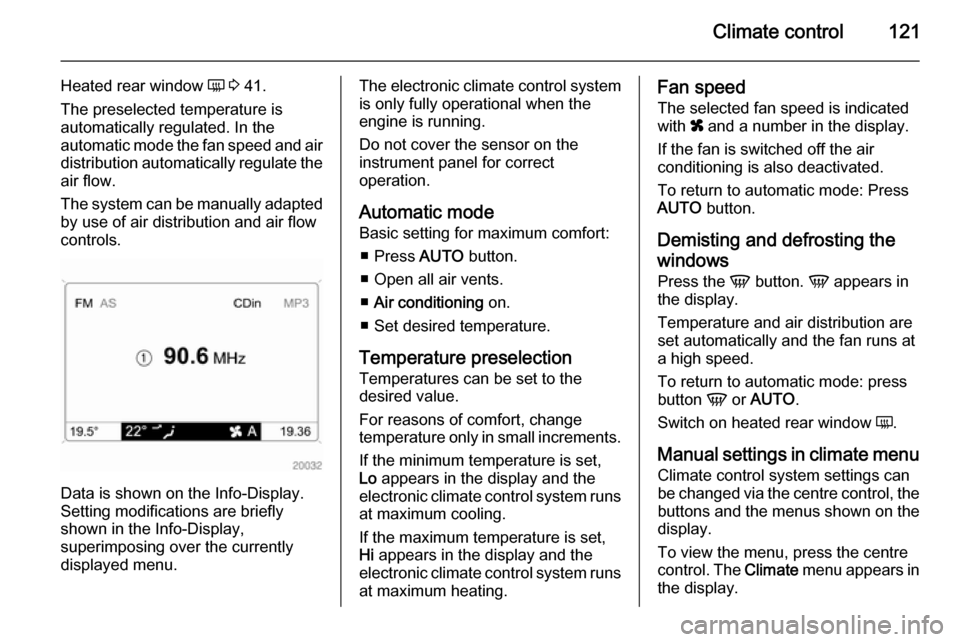
Data is shown on the Info-Display.
Setting modifications are briefly
shown in the Info-Display,
superimposing over the currently
displayed menu.
The electronic climate control system
is only fully operational when the
engine is running.
Do not cover the sensor on the
instrument panel for correct
operation.
Automatic mode
Basic setting for maximum comfort:
■ Press AUTO button.
■ Open all air vents.
■ Air conditioning on.
■ Set desired temperature.
Temperature preselection Temperatures can be set to the
desired value.
For reasons of comfort, change
temperature only in small increments.
If the minimum temperature is set,
Lo appears in the display and the
electronic climate control system runs at maximum cooling.
If the maximum temperature is set,
Hi appears in the display and the
electronic climate control system runs
at maximum heating.Fan speed
The selected fan speed is indicated
with x and a number in the display.
If the fan is switched off the air
conditioning is also deactivated.
To return to automatic mode: Press
AUTO button.
Demisting and defrosting the
windows
Press the V button. V appears in
the display.
Temperature and air distribution are
set automatically and the fan runs at
a high speed.
To return to automatic mode: press
button V or AUTO .
Switch on heated rear window Ü.
Manual settings in climate menu
Climate control system settings can
be changed via the centre control, the
buttons and the menus shown on the display.
To view the menu, press the centre
control. The Climate menu appears in
the display.
Page 126 of 219

124Climate control
Open slats and adjust direction of airflow.
To close the vents, direct slats
downwards.9 Warning
Do not attach any objects to the
slats of the air vents. Risk of
damage and injury in case of an
accident.
Fixed air vents
Additional air vents are located
beneath the windscreen and door windows and in the foot wells.
Maintenance
Air intake
The air intakes in front of the
windscreen in the engine
compartment must be kept clear to
allow air intake. Remove any leaves,
dirt or snow.
Pollen filter
The pollen filter cleans dust, soot,
pollen and spores from the air
entering the vehicle through the air
intake.
Air conditioning regular
operation In order to ensure continuously
efficient performance, cooling must
be operated for a few minutes once a
month, irrespective of the weather
and time of year. Operation with
cooling is not possible when outside
temperature is too low.
Service For optimal cooling performance, it isrecommended that the climate control
system be checked annually, starting three years after initial vehicle
registration, including:
■ Functionality and pressure test■ Heating functionality
■ Leakage check
■ Check of drive belts
■ Cleaning of condenser and evaporator drainage
■ Performance check
Page 128 of 219

126Driving and operatingIgnition switch positions0=Ignition off1=Steering wheel lock released,ignition off2=Ignition on, for diesel engine:
preheating3=StartingStarting the engine
Starting engine with ignition
switch
Operate clutch and brake, automatic
transmission in P or N.
Do not operate accelerator pedal.
Diesel engines: turn the key to
position 2 for preheating until control
indicator ! goes out.
Turn key briefly to position 3 and
release key when engine is running.
Before restarting or to switch off the engine, turn key back to 0.
Starting engine with the
Start/Stop button
The electronic key must be inside the
vehicle. Operate clutch and brake,
automatic transmission in P or N.
Do not operate accelerator pedal.
Diesel engines: press the button
briefly to start preheating, move the
steering wheel slightly to release the
steering wheel lock, wait until control
indicator ! goes out and then press
button for 1 second and release when
the engine is running.
Page 147 of 219
Driving and operating145Fuel
Fuel for petrol engines Only use unleaded fuel that complies
with European standard EN 228 or
E DIN 51626-1 or equivalent.
Your engine is capable to run with
E10 fuel that fulfills these standards.
E10 fuel contains up to 10 %
bioethanol.
Use fuel with the recommended
octane rating 3 202. Use of fuel with
too low an octane rating can reduce
engine power and torque and slightly
increases fuel consumption.Caution
Do not use fuel or fuel additives
that contain metallic compounds
such as manganese-based
additives. This may cause engine
damage.
Caution
Use of fuel that does not comply to EN 228 or E DIN 51626-1 or
equivalent can lead to deposits or
engine damage and may affect
your warranty.
Caution
Use of fuel with too low an octane
rating could lead to uncontrolled combustion and engine damage.
Fuel for diesel engines
Only use diesel fuel that complies
with EN 590.
In countries outside the European
Union use Euro-Diesel fuel with a
sulfur concentration below 50 ppm.
Caution
Use of fuel that does not comply to EN 590 or similar can lead to
engine powerloss, increased wear
or engine damage and may affect
your warranty.
Do not use marine diesel oils, heating
oils, Aquazole and similar diesel-
water emulsions. Diesel fuels must
not be diluted with fuels for petrol
engines.
Refuelling
Page 170 of 219
168Vehicle careEngine compartment fuse
box
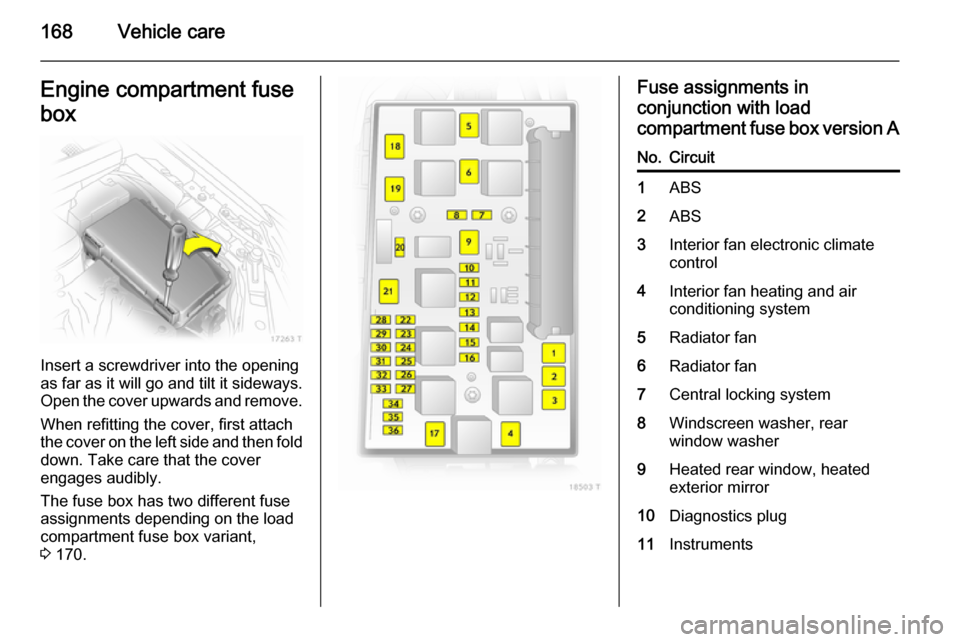
Insert a screwdriver into the opening
as far as it will go and tilt it sideways.
Open the cover upwards and remove.
When refitting the cover, first attach
the cover on the left side and then fold
down. Take care that the cover
engages audibly.
The fuse box has two different fuse
assignments depending on the load
compartment fuse box variant,
3 170.
Fuse assignments in
conjunction with load
compartment fuse box version ANo.Circuit1ABS2ABS3Interior fan electronic climate
control4Interior fan heating and air
conditioning system5Radiator fan6Radiator fan7Central locking system8Windscreen washer, rear
window washer9Heated rear window, heated
exterior mirror10Diagnostics plug11Instruments
Page 171 of 219

Vehicle care169
No.Circuit12Mobile telephone, Infotainment
system, display13Courtesy light14Windscreen wiper15Windscreen wiper16Horn, ABS, brake light switch,
air conditioning system17Diesel fuel filter or air condi‐
tioning system18Starter19–20Horn21Engine electronics22Engine electronics23Headlight range adjustment24Fuel pump25–26Engine electronicsNo.Circuit27Heating, air conditioning
system, air quality sensor28–29Power steering30Engine electronics31Rear window wiper32Brake light switch33Headlight range adjustment,
light switch, clutch switch,
instrument, driver's door
module34Steering column control unit35Infotainment system36Cigarette lighter, front power
outletFuse assignments in
conjunction with load
compartment fuse box version BNo.Circuit1ABS2ABS3Interior fan electronic climate control4Interior fan heating and air
conditioning system5Radiator fan6Radiator fan7Windscreen washer system8Horn9Headlight washer system10Emergency unlocking of central
locking system11–12–
Page 172 of 219
170Vehicle care
No.Circuit13Fog light14Windscreen wiper15Windscreen wiper16Control module electronics,
Open&Start system, ABS,
brake light switch17Diesel fuel filter heating18Starter19Transmission electronics20Air conditioning system21Engine electronics22Engine electronics23Adaptive forward lighting, head‐
light range adjustment24Fuel pump25Transmission electronics26Engine electronics27Power steeringNo.Circuit28Transmission electronics29Transmission electronics30Engine electronics31Adaptive forward fighting, head‐ light range adjustment32Brake system, air conditioning
system, clutch switch33Adaptive forward lighting, head‐
light range adjustment, light
switch34Steering column control unit35Infotainment system36Mobile telephone, Infotainment
system, displayLoad compartment fuse
box
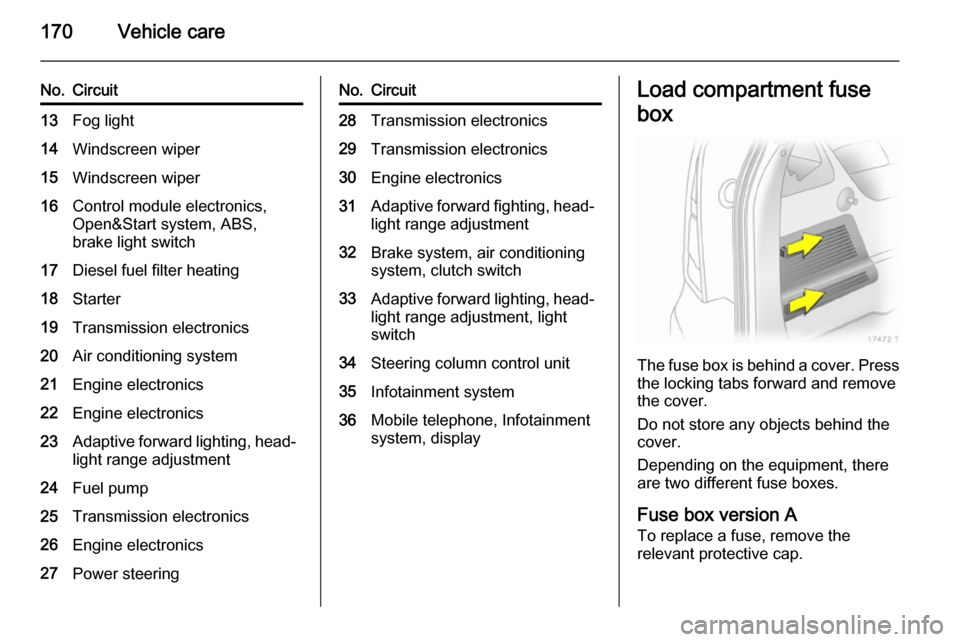
The fuse box is behind a cover. Press
the locking tabs forward and remove
the cover.
Do not store any objects behind the
cover.
Depending on the equipment, there
are two different fuse boxes.
Fuse box version A
To replace a fuse, remove the
relevant protective cap.
Page 173 of 219
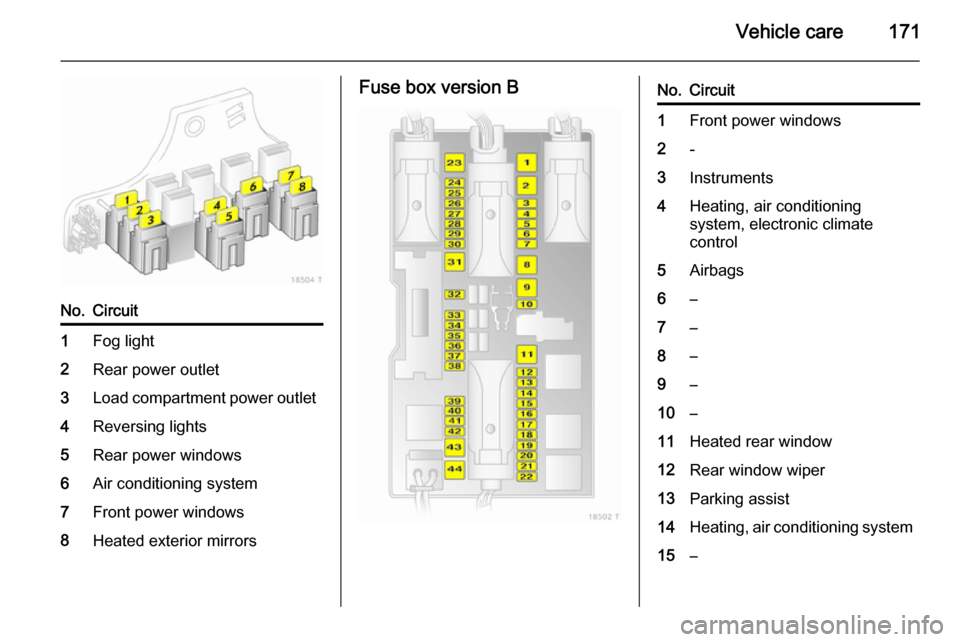
Vehicle care171
No.Circuit1Fog light2Rear power outlet3Load compartment power outlet4Reversing lights5Rear power windows6Air conditioning system7Front power windows8Heated exterior mirrorsFuse box version BNo.Circuit1Front power windows2-3Instruments4Heating, air conditioning
system, electronic climate
control5Airbags6–7–8–9–10–11Heated rear window12Rear window wiper13Parking assist14Heating, air conditioning system15–
Page 174 of 219

172Vehicle care
No.Circuit16Open&Start system17Rain sensor, air quality sensor,
tyre pressure monitoring
system, interior mirror18Instruments, switches19–20CDC21Heated exterior mirrors22–23Rear power windows24Diagnostics plug25–26Electrical foldable exterior
mirrors27Ultrasonic sensor, anti-theft
alarm system28–No.Circuit29Cigarette lighter, front power
outlet30Rear power outlet31–32–33Open&Start system34–35Rear power outlet36Socket for towing equipment37–38Central locking system, terminal
3039Left seat heating40Right seat heating41–42–No.Circuit43–44–
Page 192 of 219

190Vehicle care
If using a car wash, comply with the
car wash manufacturer's instructions. The windscreen wipers and rear
window wiper must be switched off.
Remove antenna and external
accessories such as roof racks etc.
If you wash your vehicle by hand,
make sure that the insides of the
wheel housings are also thoroughly
rinsed out.
Clean edges and folds on opened
doors and the bonnet as well as the
areas they cover.Caution
Always use a cleaning agent with
a pH value of 4 to 9.
Do not use cleaning agents on hot surfaces.
Have the door hinges of all doors
greased by a workshop.
Do not clean the engine compartment with a steam-jet or high-pressure jet
cleaner.
Thoroughly rinse and leather-off the vehicle. Rinse leather frequently. Use
separate leathers for painted and
glass surfaces: remnants of wax on
the windows will impair vision.
Exterior lights
Headlight and other light covers are
made of plastic. Do not use any
abrasive or caustic agents, do not use an ice scraper, and do not clean them
dry.
Polishing and waxing Wax the vehicle regularly (at the
latest when water no longer beads).
Otherwise, the paintwork will dry out.
Polishing is necessary only if the paint
has become dull or if solid deposits
have become attached to it.
Paintwork polish with silicone forms a
protective film, making waxing
unnecessary.
Plastic body parts must not be treated with wax or polishing agents.Windows and windscreen wiper
blades
Use a soft lint-free cloth or chamois leather together with window cleanerand insect remover.
When cleaning the rear window from
inside, always wipe in parallel to the
heating element to prevent damage.
For mechanical removal of ice, use a
sharp-edged ice scraper. Press the
scraper firmly against the glass so
that no dirt can get under it and
scratch the glass.
Clean smearing wiper blades with a
soft cloth and window cleaner.
Moonroof
Never clean with solvents or abrasive
agents, fuels, aggressive media
(e.g. paint cleaner, acetone-
containing solutions etc.), acidic or
highly alkaline media or abrasive
pads. Do not apply wax or polishing
agents to the middle part of the
moonroof.