manual transmission VAUXHALL ZAFIRA 2014.5 User Guide
[x] Cancel search | Manufacturer: VAUXHALL, Model Year: 2014.5, Model line: ZAFIRA, Model: VAUXHALL ZAFIRA 2014.5Pages: 219, PDF Size: 7.83 MB
Page 133 of 219

Driving and operating131
Do not accelerate while engaging a
gear. Never depress the accelerator
pedal and brake pedal at the same
time.
When a gear is engaged, the vehicle
slowly begins to creep when the
brake is released.
Gears 3, 2, 13, 2, 1=Transmission does not
shift above the selected
gear.
Press button on selector lever to
engage 3 or 1.
Only select 3, 2 or 1 to prevent
automatic upshifting or as an aid in
engine braking.
Engine braking
To utilise the engine braking effect, select a lower gear in good time when
driving downhill.
Rocking the vehicle
Rocking the vehicle is only
permissible if the vehicle is stuck in
sand, mud or snow. Move the selector
lever between D and R in a repeat
pattern. Do not race the engine and
avoid sudden acceleration.
Parking
Apply the parking brake and engage P .
The ignition key can only be removed
when the selector lever is in position
P .Manual mode
Move selector lever out of position D
towards the left and then forwards or backwards.
+=Shift to a higher gear.-=Shift to a lower gear.
If a higher gear is selected when
vehicle speed is too low, or a lower
gear when vehicle speed is too high,
the shift is not executed.
If engine speed is too low, the
transmission automatically shifts to a
lower gear above a specific vehicle
speed.
Page 134 of 219

132Driving and operating
No automatic shifting to a higher geartakes place at a high engine speed.
For reasons of safety, kickdown is
also available in manual mode.
Electronic driving
programmes ■ Following a cold start, the operating
temperature programme increases
engine speed to quickly bring the
catalytic converter to the required
temperature.
■ The automatic neutral shift function
automatically shifts to idling when
the vehicle is stopped with a
forward gear engaged.
■ When Sport mode is engaged, the vehicle shifts at higher engine
speeds (unless cruise control is
on). Sport mode 3 141.Winter programme T
Activate the Winter programme to
assist starting off on a slippery road surface.
Activation on vehicles without manual
mode
Press the T button with P, R , N , D or
3 engaged. The vehicle starts off in
3rd gear.
Activation on vehicles with manual mode
In automatic mode, press the T
button. Depending on road
conditions, the vehicles starts off in 2nd or 3rd gear.
Deactivation
The Winter programme is switched off by:
■ pressing the T button again,
■ manually selecting 2 or 1,
■ changing to manual mode,
■ turning off the ignition,
■ or if the transmission oil temperature is too high.
Page 135 of 219

Driving and operating133
Kickdown
If the accelerator pedal is pressed
past the pressure point, the
transmission shifts to a lower gear depending on engine speed.
Fault
In the event of a fault, A illuminates.
The transmission no longer shifts
automatically. Continued travel is
possible with manual shifting.
Have the cause of the fault remedied
by a workshop.
Version without manual mode
2nd gear is not available. Manual
shifting:1=1st gear2=3rd gear3, D=4th gear
Version with manual mode
Only the highest gear is available.
Depending on the fault, 2nd gear may also be available in manual mode.
Interruption of power
supply
In the event of an interruption of
power supply, the selector lever
cannot be moved out of the P or N
position.
If the battery is discharged, start the
vehicle using jump leads 3 186.
If the battery is not the cause of the fault, release selector lever:
1. Apply parking brake.
2. Remove ashtray insert 3 83.
Slacken the screw on the metal
cover and remove the two pieces.
Vehicle tools 3 173.
3. Unclip ashtray holder or cover: reach into the opening at the top
edge, unclip the ashtray holder or
cover and remove.
Page 136 of 219

134Driving and operating
4. Pull the loop and move theselector lever out of P or N. If P or
N is engaged again, the selector
lever will be locked in position
again. Have the cause of the
power supply interruption
remedied by a workshop.
5. Put on ashtray holder or cover and
engage.
6. Fasten the metal cover with the screw. Fit the ashtray insert 3 83.
Manual transmission
To engage reverse, with the vehicle
stationary wait 3 seconds after
declutching and then press the
release button on the selector lever
and engage the gear.
If the gear does not engage, set the
lever to neutral, release the clutch
pedal and depress again; then repeat
gear selection.
Do not slip the clutch unnecessarily.
When operating, depress the clutch
pedal completely. Do not use the
pedal as a foot rest.
Caution
It is not advisable to drive with the hand resting on the selector lever.
Page 137 of 219

Driving and operating135Manual transmission
automated
The Easytronic transmission permits manual (manual mode) or automatic
gear shifting (automatic mode), both
with automatic clutch control.
Transmission display
Shows the mode and current gear.
The display flashes for a few seconds
when A, M or R is selected with the
engine running and the foot brake not
activated.
If the Winter programme is activated,
T is illuminated.
Starting the engine
Depress the foot brake when starting
the engine. If the foot brake is not
depressed, j illuminates in the
instrument, "N" flashes in the
transmission display and the engine
cannot be started.
Starting is not possible if all brake
lights fail.
When the foot brake is depressed, the
transmission automatically shifts to
N upon start. There may be a slight
delay.Selector lever
Always move the selector lever in the
appropriate direction as far as it will
go. Upon release, it automatically
returns to the centre position.
N=Neutral.A=Switch between automatic and
manual mode. The
transmission display shows A
or M.R=Reverse gear. Engage only
when vehicle is stationary.+=Shift to a higher gear.-=Shift to a lower gear.
Page 138 of 219
136Driving and operating
Starting off
Depress the foot brake and move the selector lever to A, + or -. The
transmission is in automatic mode
and first gear is engaged. If R is
selected, reverse gear is engaged.
The vehicle starts to move when the
brake is released.
To start off without depressing the
foot brake, accelerate immediately
after engaging a gear.
If neither the accelerator nor the
brake pedal are depressed, no gear is engaged and A or R flashes for a
brief time in the display.
Stopping the vehicle In A, first gear is engaged and the
clutch is released when the vehicle is
stopped. In R, reverse gear remains
engaged.
Engine braking Automatic mode
When driving downhill, the manual
transmission automated does not shift into higher gears until a fairlyhigh engine speed has been reached. It shifts down in good time when
braking.
Manual mode
To utilise the engine braking effect, select a lower gear in good time when
driving downhill.
Rocking the vehicle
Rocking the vehicle is only
permissible if the vehicle is stuck in
sand, mud or snow. Move the selector
lever between R and A in a repeat
pattern. Do not race the engine and avoid sudden acceleration.
Parking Apply the parking brake. The most
recently engaged gear (see
transmission display) remains
engaged. With N, no gear is engaged.
When the ignition is switched off the
transmission no longer responds to
movement of the selector lever.Manual mode
If a higher gear is selected when the
engine speed is too low, or a lower
gear when the speed is too high, the
shift is not executed. This prevents
the engine from running at too low or too high an engine speed.
If engine speed is too low, the
transmission automatically shifts to a
lower gear.
If engine speed is too high, the
transmission only switches to a higher gear via kickdown.
When + or - is selected in automatic
mode, the transmission switches to
manual mode and shifts accordingly.
Electronic driving
programmes ■ Following a cold start, the operating
temperature programme increasesengine speed to quickly bring the
catalytic converter to the required
temperature.
Page 139 of 219

Driving and operating137
■ The adaptive programme tailorsgearshifting to the driving
conditions, e.g. greater load or
gradients.
■ When Sport mode is engaged, shift
times are reduced and the
transmission shifts at higher engine speeds (unless cruise control is
on). Sport mode 3 141.
Winter programme T
Activate the Winter programme if you
have problems starting off on a
slippery road surface.
Activation
Press the T button. The transmission
switches to automatic mode. The
vehicle starts off in 2nd gear. Sport
mode is deactivated.
Deactivation
The Winter programme is switched off by:
■ pressing the T button again
■ turning off the ignition,
■ switching to manual mode (when switched back to automatic mode,
the Winter programme is again
active)
■ when clutch temperature is too highKickdown
If the accelerator pedal is pressed
past the pressure point, the
transmission shifts to a lower gear depending on engine speed.
Fault
To prevent damage to the manual transmission automated, the clutch is
engaged automatically at high clutch
temperatures.
A illuminates in the event of a fault.
Continued driving is possible. Manual
mode cannot be used for shifting.
Page 145 of 219
Driving and operating143
With automatic transmission or
manual transmission automated, only
activate cruise control in automatic
mode.
Control indicator m 3 93.
Activation Briefly press the m button: the current
speed is stored and maintained.
Vehicle speed can be increased by
depressing the accelerator pedal.
When the accelerator pedal is
released, the previously stored speed
is resumed.
The speed is saved until the ignition
is switched off.
To resume the saved speed, briefly
press the g button at a speed above
30 km/h.
Increase speed With cruise control active, hold down
button m or briefly press it repeatedly:
speed is increased continuously or in
small increments.
When button m is released the
current speed is stored and
maintained.Reduce speed
With cruise control active, hold down
button g or briefly press it repeatedly:
speed is reduced continuously or in
small increments.
When button g is released the current
speed is stored and maintained.
Deactivation
Briefly press the § button: cruise
control is deactivated.
Automatic deactivation:
■ Vehicle speed below approx. 30 km/h
■ The brake pedal is depressed
■ The clutch pedal is depressed
■ Selector lever in N.Object detection
systems
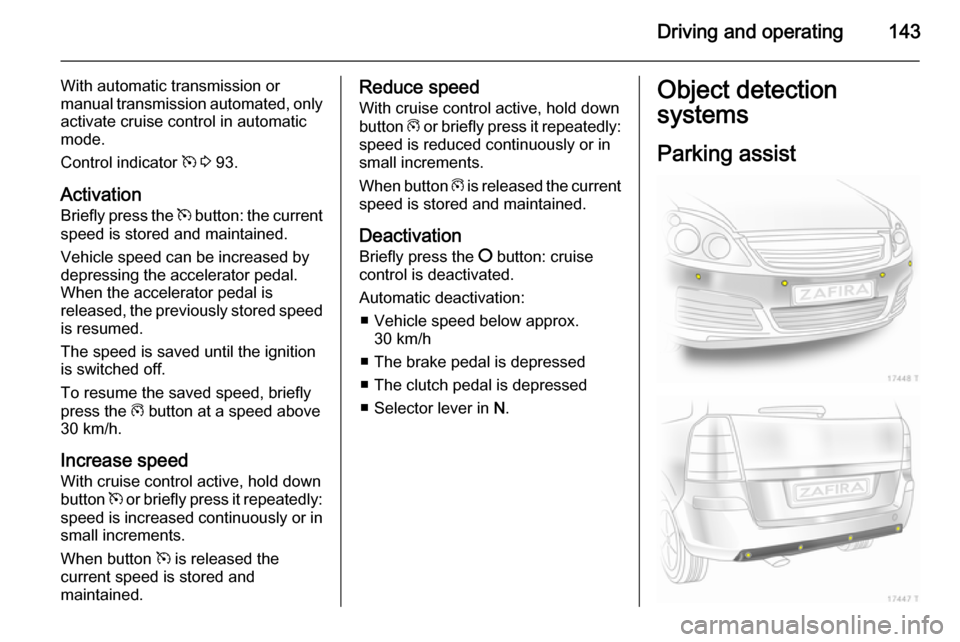
Parking assist
Page 178 of 219
176Vehicle care
The tyre pressure tables show allpossible tyre combinations 3 206.
For the tyres approved for your
vehicle, refer to the EEC Certificate of Conformity provided with your vehicle
or other national registration
documents.
The driver is responsible for correct
adjustment of tyre pressure.9 Warning
If the pressure is too low, this can
result in considerable tyre warm-
up and internal damage, leading to tread separation and even to tyre
blow-out at high speeds.
Tyre pressure monitoring
system
The tyre pressure monitoring system
continually checks the pressure of all
four wheels when vehicle speed
exceeds a certain limit.
All wheels must be equipped with
pressure sensors and the tyres must
have the prescribed pressure.
When a low tyre condition is detected,
A illuminates. If A comes on, stop as
soon as possible and inflate the tyres as recommended in this manual. Tyre pressures 3 206.
After inflating the tyres to the
appropriate pressure, A may stay
illuminated. Pressure change will be
recognized as the vehicles is driven.
Notice
In countries where the tyre pressure
monitoring system is legally
required, the use of wheels without
pressure sensors will invalidate the
vehicle type approval.
The current tyre pressures may be
shown in the Info-Display 3 107.
Vehicle messages, tyre pressure 3 102.
Control indicator w 3 91.
If the tyre pressure shall be reduced
or increased, switch off ignition.
w may come on in cool weather when
the vehicle is first started and then
turn off as the vehicle is driven. Thiscould be an early indicator that the air
pressure is getting low and needs to
be inflated to the proper pressure.
A spare or temporary spare wheel is
not equipped with pressure sensors.
The tyre pressure monitoring system
is not operational for these wheels
and w illuminates.
Winter tyres or additional wheel sets
have to be fitted with sensors,
otherwise the system will not work
and w will indicate malfunction by
flashing one minute and then
illuminate continuously.
The use of commercially available
liquid tyre repair kits can impair the
function of the system. Factory-
approved repair kits can be used.
External high-power radio equipment
could disrupt the tyre pressure
monitoring system.
Unsuited rims can impair the
transmission quality of the tyre
pressure monitoring system sensors.
Page 190 of 219
188Vehicle care
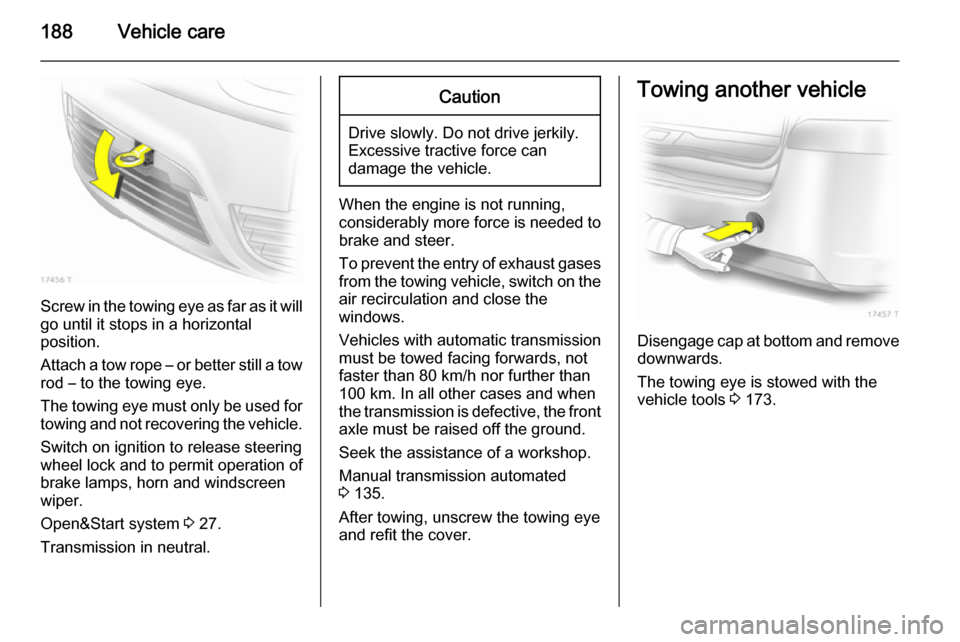
Screw in the towing eye as far as it will
go until it stops in a horizontal
position.
Attach a tow rope – or better still a tow
rod – to the towing eye.
The towing eye must only be used for towing and not recovering the vehicle.
Switch on ignition to release steering
wheel lock and to permit operation of
brake lamps, horn and windscreen
wiper.
Open&Start system 3 27.
Transmission in neutral.
Caution
Drive slowly. Do not drive jerkily.
Excessive tractive force can
damage the vehicle.
When the engine is not running,
considerably more force is needed to
brake and steer.
To prevent the entry of exhaust gases from the towing vehicle, switch on the
air recirculation and close the
windows.
Vehicles with automatic transmission
must be towed facing forwards, not faster than 80 km/h nor further than
100 km. In all other cases and when
the transmission is defective, the front axle must be raised off the ground.
Seek the assistance of a workshop.
Manual transmission automated
3 135.
After towing, unscrew the towing eye
and refit the cover.
Towing another vehicle
Disengage cap at bottom and remove
downwards.
The towing eye is stowed with the
vehicle tools 3 173.