fuel VAUXHALL ZAFIRA 2014.5 Owner's Guide
[x] Cancel search | Manufacturer: VAUXHALL, Model Year: 2014.5, Model line: ZAFIRA, Model: VAUXHALL ZAFIRA 2014.5Pages: 219, PDF Size: 7.83 MB
Page 131 of 219

Driving and operating129
The control indicator ! extinguishes
as soon as the self-cleaning
operation is complete.
If A illuminates additionally, cleaning
is not possible, seek the assistance of
a workshop.
Catalytic converter
The catalytic converter reduces the
amount of harmful substances in the
exhaust gases.
Caution
Fuel grades other than those listed on pages 3 145, 3 202 could
damage the catalytic converter or
electronic components.
Unburnt petrol will overheat and
damage the catalytic converter.
Therefore avoid excessive use of the starter, running the fuel tank
dry and starting the engine by
pushing or towing.
In the event of misfiring, uneven
engine running, a reduction in engine performance or other unusual
problems, have the cause of the fault
rectified by a workshop as soon as
possible. In an emergency, driving
can be continued for a short period,
keeping vehicle speed and engine
speed low.
Automatic transmission
The automatic transmission makes
automatic shifting possible
(automatic mode) and the version
with ActiveSelect also makes manual
shifting possible (manual mode).
Transmission display
The mode or selected gear is shown
in the transmission display.
Page 147 of 219
Driving and operating145Fuel
Fuel for petrol engines Only use unleaded fuel that complies
with European standard EN 228 or
E DIN 51626-1 or equivalent.
Your engine is capable to run with
E10 fuel that fulfills these standards.
E10 fuel contains up to 10 %
bioethanol.
Use fuel with the recommended
octane rating 3 202. Use of fuel with
too low an octane rating can reduce
engine power and torque and slightly
increases fuel consumption.Caution
Do not use fuel or fuel additives
that contain metallic compounds
such as manganese-based
additives. This may cause engine
damage.
Caution
Use of fuel that does not comply to EN 228 or E DIN 51626-1 or
equivalent can lead to deposits or
engine damage and may affect
your warranty.
Caution
Use of fuel with too low an octane
rating could lead to uncontrolled combustion and engine damage.
Fuel for diesel engines
Only use diesel fuel that complies
with EN 590.
In countries outside the European
Union use Euro-Diesel fuel with a
sulfur concentration below 50 ppm.
Caution
Use of fuel that does not comply to EN 590 or similar can lead to
engine powerloss, increased wear
or engine damage and may affect
your warranty.
Do not use marine diesel oils, heating
oils, Aquazole and similar diesel-
water emulsions. Diesel fuels must
not be diluted with fuels for petrol
engines.
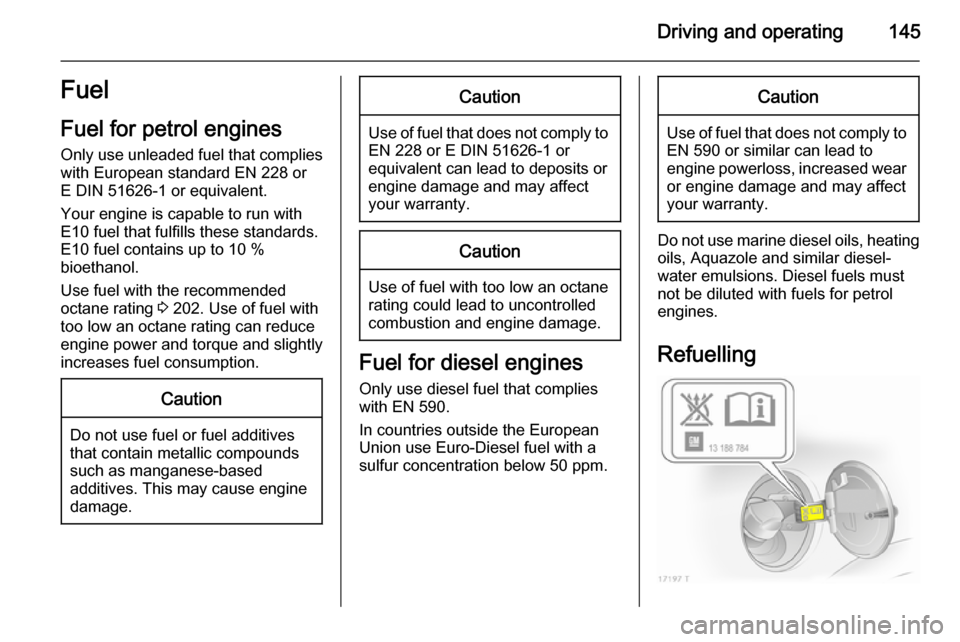
Refuelling
Page 148 of 219
146Driving and operating9Danger
Before refuelling, switch off engine
and any external heaters with
combustion chambers (identified
by sticker on fuel filler flap). Switch off any mobile phones.
Follow the operating and safety
instructions of the filling station
when refuelling.
9 Danger
Fuel is flammable and explosive.
No smoking. No naked flames or
sparks.
If you can smell fuel in your
vehicle, have the cause of this
remedied immediately by a
workshop.
Caution
In case of misfuelling, do not
switch on ignition.
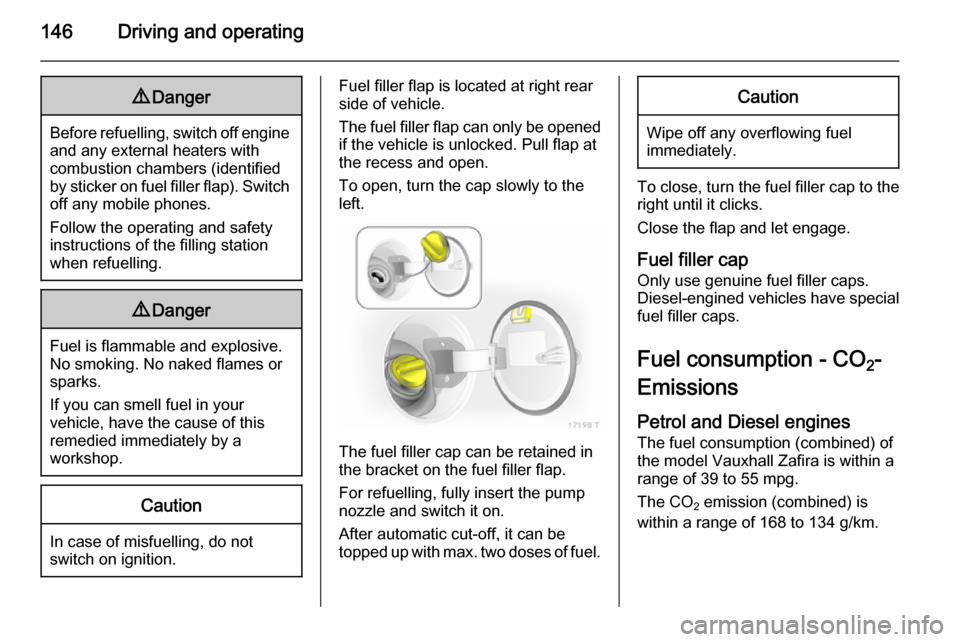
Fuel filler flap is located at right rear
side of vehicle.
The fuel filler flap can only be opened
if the vehicle is unlocked. Pull flap at
the recess and open.
To open, turn the cap slowly to the
left.
The fuel filler cap can be retained in
the bracket on the fuel filler flap.
For refuelling, fully insert the pump
nozzle and switch it on.
After automatic cut-off, it can be
topped up with max. two doses of fuel.
Caution
Wipe off any overflowing fuel
immediately.
To close, turn the fuel filler cap to the right until it clicks.
Close the flap and let engage.
Fuel filler cap
Only use genuine fuel filler caps. Diesel-engined vehicles have special
fuel filler caps.
Fuel consumption - CO 2-
Emissions
Petrol and Diesel engines
The fuel consumption (combined) of the model Vauxhall Zafira is within a
range of 39 to 55 mpg.
The CO 2 emission (combined) is
within a range of 168 to 134 g/km.
Page 149 of 219

Driving and operating147
For the values specific to your
vehicle, refer to the EEC Certificate of Conformity provided with your vehicle
or other national registration
documents.
General information The official fuel consumption and
specific CO 2 emission figures quoted
relate to the EU base model with
standard equipment.
Fuel consumption data and CO 2
emission data are determined
according to regulation
R (EC) No. 715/2007 (in the latest
applicable version), taking into
consideration the vehicle weight in
running order, as specified by the
regulation.
The figures are provided only for the
purpose of comparison between
different vehicle variants and must
not be taken as a guarantee for the
actual fuel consumption of a
particular vehicle. Additional
equipment may result in slightly
higher results than the stated
consumption and CO 2 figures.Furthermore, fuel consumption is
dependent on personal driving style
as well as road and traffic conditions.
Natural gas
The fuel consumption information
was obtained using reference fuel
G20 (methane proportion
99 - 100 mol%) under prescribed
driving conditions. When using
natural gas with a lower proportion of
methane, the fuel consumption can
differ from the specified values.Trailer hitch
General information
Only use towing equipment that has
been approved for your vehicle.
Entrust retrofitting of towing
equipment to a workshop. It may be
necessary to make changes that
affect the cooling system, heat
shields or other equipment.
Fitting of towing equipment could
cover the opening of the towing eye.
If this is the case, use the coupling ball
bar for towing. Always keep the
coupling ball bar in the vehicle.
Installation dimensions of factory-
fitted towing equipment 3 208.
Driving characteristics and towing tips Before attaching a trailer, lubricate
the coupling ball. However, do not do
so if a stabiliser, which acts on the
coupling ball, is being used to reduce snaking movements.
Page 154 of 219

152Vehicle careVehicle careGeneral Information...................152
Vehicle checks ........................... 153
Bulb replacement .......................159
Electrical system ........................166
Vehicle tools .............................. 173
Wheels and tyres .......................173
Jump starting ............................. 186
Towing ....................................... 187
Appearance care .......................189General Information
Accessories and vehicle
modifications
We recommend using genuine parts and accessories and factory
approved parts specific for your
vehicle type. We cannot assess or guarantee reliability of other products
- even if they have a regulatory or
otherwise granted approval.
Do not make any modifications to the electrical system, e.g. changes of
electronic control units (chip tuning).Caution
When transporting the vehicle on
a train or on a recovery vehicle, the
mud flaps might be damaged.
Vehicle storage
Storage for a long period of time
Following must be done if the vehicle
should be stored for several months:
■ Wash and wax the vehicle.
■ Have the wax in the engine compartment and underbody
checked.
■ Clean and preserve rubber seals.
■ Fill up fuel tank completely.
■ Change engine oil.
■ Drain washer fluid reservoir.
■ Check coolant antifreeze.
■ Adjust tyre pressure to the value specified for full load.
■ Park vehicle in dry, well ventilated place. Engage first or reverse gear
or set selector lever to P. Prevent
the vehicle from rolling.
■ Do not apply parking brake.
Page 160 of 219

158Vehicle care
Meaning of symbols:■ No sparks, naked flames or smoking.
■ Always shield eyes. Explosive gases can cause blindness or
injury.
■ Keep the vehicle battery out of the reach of children.
■ The vehicle battery contains sulphuric acid which could cause
blindness or serious burn injuries.
■ See the Owner's Manual for further
information.
■ Explosive gas may be present in the vicinity of the vehicle battery.Diesel fuel system
bleeding
If the tank has been run dry, the diesel fuel system must be bled. Switch on
the ignition three times for
15 seconds at a time. Then crank the
engine for a maximum of
40 seconds. Repeat this process after
no less than 5 seconds. If the engine
fails to start, seek the assistance of a workshop.Wiper blade replacement
Service setting for front windscreen wipers
Switch off the ignition but do not
remove ignition key or open driver's
door.
Within 4 seconds, push the wiper
lever down and release as soon as
the wipers are vertical.
Page 171 of 219
Vehicle care169
No.Circuit12Mobile telephone, Infotainment
system, display13Courtesy light14Windscreen wiper15Windscreen wiper16Horn, ABS, brake light switch,
air conditioning system17Diesel fuel filter or air condi‐
tioning system18Starter19–20Horn21Engine electronics22Engine electronics23Headlight range adjustment24Fuel pump25–26Engine electronicsNo.Circuit27Heating, air conditioning
system, air quality sensor28–29Power steering30Engine electronics31Rear window wiper32Brake light switch33Headlight range adjustment,
light switch, clutch switch,
instrument, driver's door
module34Steering column control unit35Infotainment system36Cigarette lighter, front power
outletFuse assignments in
conjunction with load
compartment fuse box version BNo.Circuit1ABS2ABS3Interior fan electronic climate control4Interior fan heating and air
conditioning system5Radiator fan6Radiator fan7Windscreen washer system8Horn9Headlight washer system10Emergency unlocking of central
locking system11–12–
Page 172 of 219
170Vehicle care
No.Circuit13Fog light14Windscreen wiper15Windscreen wiper16Control module electronics,
Open&Start system, ABS,
brake light switch17Diesel fuel filter heating18Starter19Transmission electronics20Air conditioning system21Engine electronics22Engine electronics23Adaptive forward lighting, head‐
light range adjustment24Fuel pump25Transmission electronics26Engine electronics27Power steeringNo.Circuit28Transmission electronics29Transmission electronics30Engine electronics31Adaptive forward fighting, head‐ light range adjustment32Brake system, air conditioning
system, clutch switch33Adaptive forward lighting, head‐
light range adjustment, light
switch34Steering column control unit35Infotainment system36Mobile telephone, Infotainment
system, displayLoad compartment fuse
box
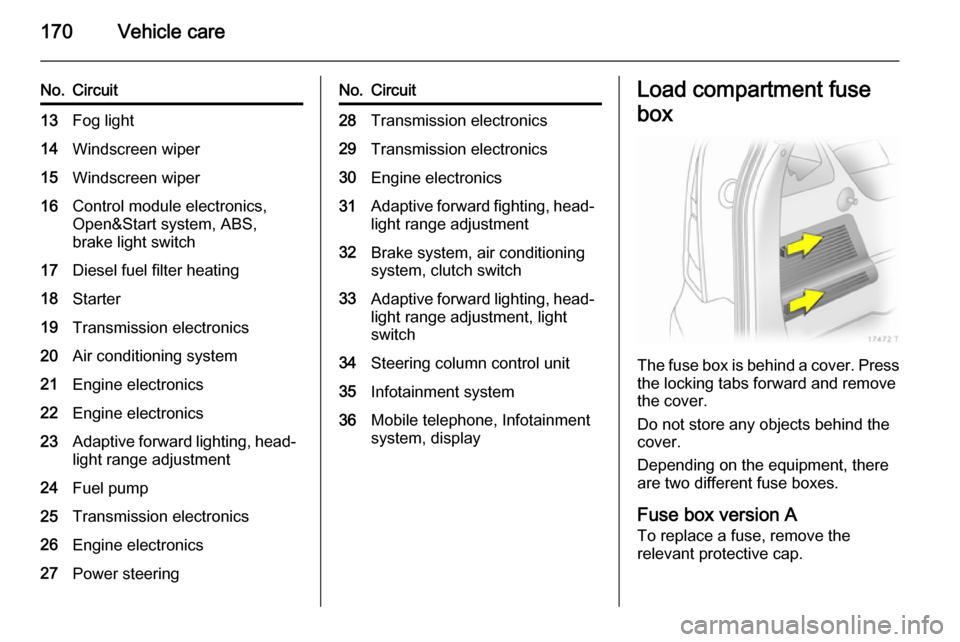
The fuse box is behind a cover. Press
the locking tabs forward and remove
the cover.
Do not store any objects behind the
cover.
Depending on the equipment, there
are two different fuse boxes.
Fuse box version A
To replace a fuse, remove the
relevant protective cap.
Page 177 of 219

Vehicle care175
91=Load index e.g. 91 is
equivalent to 618 kgH=Speed code letter
Speed code letter:
Q=up to 160 km/hS=up to 180 km/hT=up to 190 km/hH=up to 210 km/hV=up to 240 km/hW=up to 270 km/h
Tyre pressure
Check the pressure of cold tyres at
least every 14 days and before any long journey. Do not forget the spare
wheel. This also applies to vehicles
with tyre pressure monitoring.Remove the valve cap key from the
fuel filler flap and use it to unscrew the
valve cap.
On vehicles with tyre pressure
monitoring system, screw the adapter
to the valve.
Tyre pressure 3 206 and on the label
on the inside of the fuel filler flap.
The tyre pressure data refer to cold
tyres. It applies to summer and winter tyres.
Always inflate the spare wheel to the
pressure specified for full load.
The ECO tyre pressure serves to
achieve the smallest amount of fuel
consumption possible. It must not be used with run-flat tyres.
Incorrect tyre pressures will impair
safety, vehicle handling, comfort and
fuel economy and will increase tyre
wear.
Tyre pressures differ depending on
various options. For the correct tyre
pressure value, follow the procedure
below:
1. Identify drive axle and body style.
2. Identify the engine identifier code.
Engine data 3 202.
3. Identify the respective tyre.
Page 192 of 219
190Vehicle care
If using a car wash, comply with the
car wash manufacturer's instructions. The windscreen wipers and rear
window wiper must be switched off.
Remove antenna and external
accessories such as roof racks etc.
If you wash your vehicle by hand,
make sure that the insides of the
wheel housings are also thoroughly
rinsed out.
Clean edges and folds on opened
doors and the bonnet as well as the
areas they cover.Caution
Always use a cleaning agent with
a pH value of 4 to 9.
Do not use cleaning agents on hot surfaces.
Have the door hinges of all doors
greased by a workshop.
Do not clean the engine compartment with a steam-jet or high-pressure jet
cleaner.
Thoroughly rinse and leather-off the vehicle. Rinse leather frequently. Use
separate leathers for painted and
glass surfaces: remnants of wax on
the windows will impair vision.
Exterior lights
Headlight and other light covers are
made of plastic. Do not use any
abrasive or caustic agents, do not use an ice scraper, and do not clean them
dry.
Polishing and waxing Wax the vehicle regularly (at the
latest when water no longer beads).
Otherwise, the paintwork will dry out.
Polishing is necessary only if the paint
has become dull or if solid deposits
have become attached to it.
Paintwork polish with silicone forms a
protective film, making waxing
unnecessary.
Plastic body parts must not be treated with wax or polishing agents.Windows and windscreen wiper
blades
Use a soft lint-free cloth or chamois leather together with window cleanerand insect remover.
When cleaning the rear window from
inside, always wipe in parallel to the
heating element to prevent damage.
For mechanical removal of ice, use a
sharp-edged ice scraper. Press the
scraper firmly against the glass so
that no dirt can get under it and
scratch the glass.
Clean smearing wiper blades with a
soft cloth and window cleaner.
Moonroof
Never clean with solvents or abrasive
agents, fuels, aggressive media
(e.g. paint cleaner, acetone-
containing solutions etc.), acidic or
highly alkaline media or abrasive
pads. Do not apply wax or polishing
agents to the middle part of the
moonroof.