turn VOLKSWAGEN BEETLE 2004 Owner's Guide
[x] Cancel search | Manufacturer: VOLKSWAGEN, Model Year: 2004, Model line: BEETLE, Model: VOLKSWAGEN BEETLE 2004Pages: 138, PDF Size: 48.59 MB
Page 116 of 138
Downloaded from www.Manualslib.com manuals search engine Switch off the adaptive cruise control (ACC) temporarily in the following
situations
J""'("'n First read and observe the Introductory
L-.kJ.l ir"'formation and safety warnings & on
page 226.
The adapttve cruise contro l (ACC) should be
s it c hed off in the following situations due t o sys
tem limitations -~:
• When turning off roads. driving around round
abouts, narrow curves. joining motorways, exiting
from motorways or driving through road works, to
prevent th e vehicle from unnecessarily accelerat
ing to the set speed in these situations
• When driving through a tunnel as this situation
could impair the system function.
• On roads with more than one lane, if other vehi
cles are driving more s lowly in the fast la ne . The
slower vehicles in the other lane would be o ve rtak
en from the right side in this case.
• In heavy rain, snow or spray as vehicles tra ve l
ling
ahead cannot be monitored sufficiently or
maybe cannot be monitored a t all.
Special driving situations
A WARNING
Failure to switch off the ACC in the above
mentioned situations can cause acciden ts
and result in serious injuries.
• Switch off the ACC in critical driving situa.
tions.
r:1 Failure to switch off the adaptive cru ise con
~ trol in the above-mentioned situations can
cause a violation of legal requirements. <
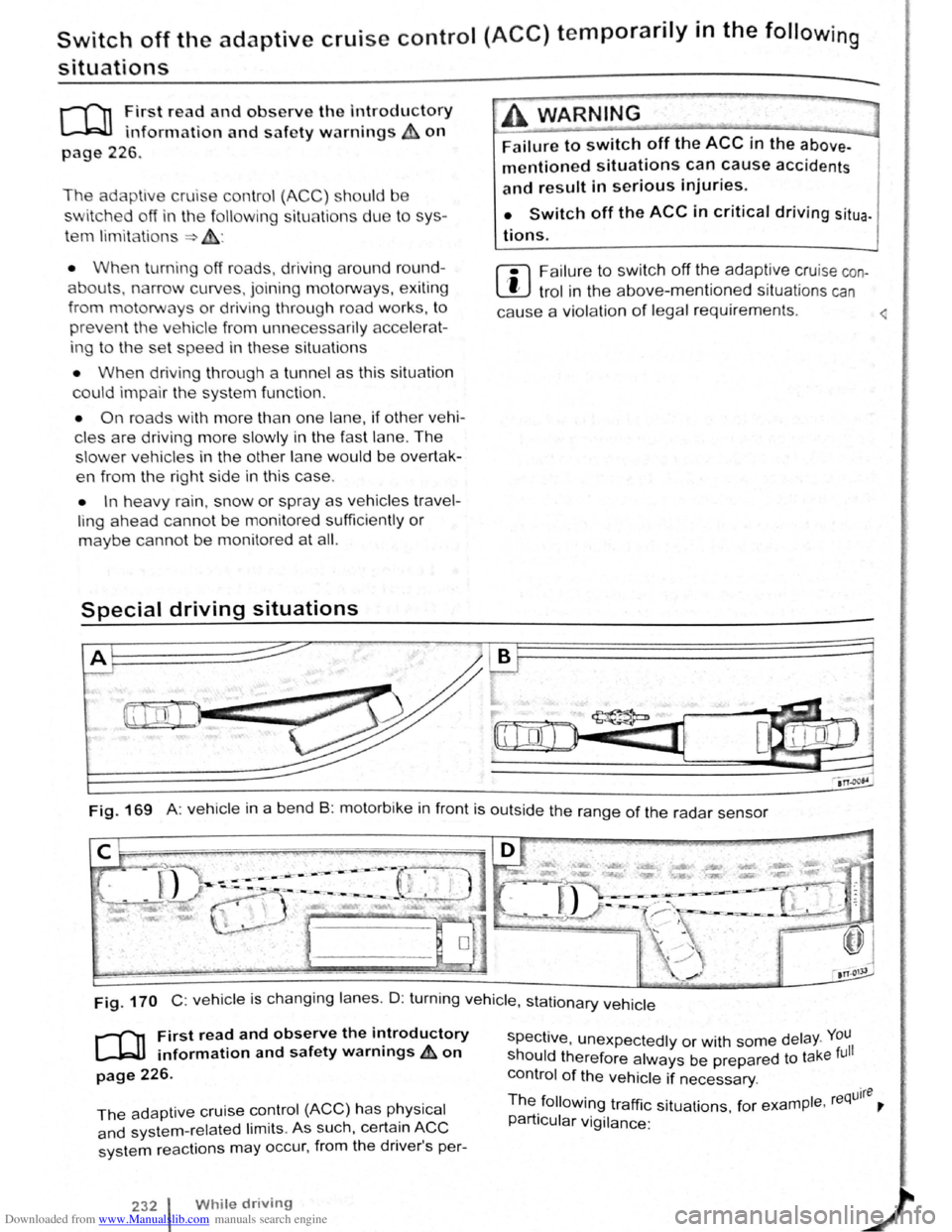
Fig. 169 A: vehicle in a bend B: motorbike in front is outside the range of the radar sensor
0
Fig. 170 C: veh icle is changing lanes . D : turn ing vehi cle , stationary vehicle
r-('n First read and observe the introductory
~ information and safety warnings~ on
page 226.
The adaptive cruise control (ACC) has physical
and system-rel ated limits . As such, certain ACC
system reactions may occur, from the driver's per-
232 While driving
spective , unexpectedly or with some delay. You
should therefore always be prepared to take full
control of the vehicle if necessary .
Th . quire e followmg traffic situations for example , re ~
particular vigilance: '
Page 117 of 138
Downloaded from www.Manualslib.com manuals search engine I ation to standstill (only vehicles with pece er )
rnatic gearbox 3uto hicle travelling ahead brakes to a standst1ll ,
If a ;~c will also brake your vehicle to a s tands till.
~:e vehicle is then he ld stationary by th e brakes.
Stationary phase (only vehicles with
autornatic gearbox)
If the adap tive cruise control has decele ra t d the
vehicle to a standstill, the adapt.ive cruise contr o l
will not be switched off automatically wh en the
brake pedal is depressed .
The electronic parking brake will be activated auto4
matically and the adap tive cruise control will be
switched off if one of the following situations occurs
while the vehicle is stationary:
• The safety be lt is unfastened .
• The driver's door is opened.
• The ignition is switched off.
• The stationary phase lasts longer than approxi4
mately 3 minutes .
Driving off after a stationary phase (only
vehicles with automatic gearbox)
After a stationary phase, the adaptive cruise con
trol can start the vehicle moving automatically as
soon as the vehicle in front begins to move again.
Overtaking
If the turn signal is activated when starting an over
taking manoeuvre , the adaptive cruise control ac
celerates the vehicle automatically and thus re
duces the distance to the vehicle in front.
If you move your vehicle into the overtaking lane
and there is no vehicle ahead of you , the ACC will
automatically increase the speed to your set level
and maintain it.
Acceleration can be stopped at any point
by de
Pressing the brake pedal or pressing the @ button
on the multifunction steering wheel ~page 229.
When driving through bends
While dr iving through bends, the radar sensor may
sometimes lose the ve hicle travelling ahead or
rnay r eac t to a ve hicle in the next lane
; Fig. 169 A. In such situations, the vehicle might
.
ecel e rate unnec essarily or not react to the veh icle
In front. In this case the driver must override the
Abcc by depressing the accelerator, or interrupt the rak· lng procedure by depressing the brake peda l
or Pressing the ~ button on the multifunction
ste · ~ enng wh eel ~page 229.
Driving In tunn I
Th rnd~u nso r run .tton mt y lH n slt11.l clln tun ·
n Is. Sw1tch off th ACC m tunn I•
Narrow v e hlcl
situation
nd · zl -z g tr ff c
Vehicles with special load or p cl
equipment
Any load or cc sari th, t pr
trude from tile sld , r r or ov r 111 r o f o f th v •
hicle m y no t be d t et d y th ACC .
Swit ch
off the ACC wh n tt1 v 'hi cl ~h ld h e
special lo d or sp ci I equi pm nt o r whil ov rt ;Jk·
ing such vehic les. If req uir d. brak th v hi I
yourself.
When othe r vehicles change lane
V ehicles that are ve ry close whon th y mov Into
your lane can onl y be do tec t d by th r d. r s n
sors when they h ave moved Into the s nsor r ng
This w ill resul t in a late r action by th dap tiv
cruise control
F1g. 17 0 C. If r quir d , br ke th e
vehicl e your self.
Stationary vehicles
The ACC do es not de tec t st tionary obj cts durin
a journey , such as st tion ary traffic
or a ve hi cl
th at has brok en down .
If a stationary ve hi cle is hidd en behind a ve hi cle
th at h as been detected by
the adap tive cruis e con
trol and this vehic le turns off the road or changes
la ne , the adaptive cruise contr ol will not be ble to
re ac t to the s ta tion ary vehicle Fig.
170 D. If re-
quired, brake the vehic le yourself.
Oncoming vehicles and vehicles crossing
your path
The adap tive cruise contro l does not react to ap
proaching vehicles or v ehicles crossing your p th.
Metal
objects
M eta l objects, such as tracks In the road or m et 1
plates used in roadworks, can confuse the radar
sensor and cause in correc t reactions from the
adap tive cr uise con trol.
..,..
Driver assist systems 233