air VOLKSWAGEN BEETLE 2013 3.G User Guide
[x] Cancel search | Manufacturer: VOLKSWAGEN, Model Year: 2013, Model line: BEETLE, Model: VOLKSWAGEN BEETLE 2013 3.GPages: 268, PDF Size: 4.18 MB
Page 88 of 268

Driving with an open rear hatch can lead to serious personal injury. If you have to drive with an open rear hatch, make sure that all objects and the hatch itself are properly secured and take appropriate measures to keep toxic exhaust fumes from entering the vehicle.
WARNING
Driving with an unlatched or open rear hatch can lead to serious personal injury.
x Never transport objects larger than those that fit completely in the luggage compartment, because the rear hatch cannot be fully closed properly.
x After closing the rear hatch, always pull up on it to make sure that it is properly closed and cannot open suddenly when the vehicle is moving.
x Always stow all objects securely in the luggage compartment. Loose objects can fall out of the luggage compartment and injure others on the road behind you.
x Drive carefully; anticipate what other drivers will do.
x Avoid abrupt or sudden acceleration, steering, or braking, because the unlatched rear hatch can move suddenly.
x Always mark objects sticking out from the luggage compartment clearly for others to see. Obey all applicable legal requirements.
x Never use the rear hatch to “clamp” or “hold” objects that stick out of the luggage compartment.
x Always remove any luggage rack or other rack mounted on the rear hatch (along with any luggage on the rack) before driving with an open rear hatch.
WARNING
Driving with an open rear hatch can cause poisonous carbon monoxide in the engine exhaust to get into the passenger compartment.
x Carbon monoxide causes drowsiness, inattentiveness, poisoning, and loss of consciousness. It can lead to accidents and severe personal injuries.
x Always keep the rear hatch closed while driving to help keep poisonous exhaust fumes from being drawn into the vehicle.
x Never transport objects that are too large to fit completely into the luggage area, because then the rear hatch cannot be fully closed.
x If you absolutely must drive with an open rear hatch, do the following to reduce the risk of carbon monoxide poisoning:
– Close all windows and the power sunroof.
– Switch off the climate control system's air recirculation feature.
– Open all air vents in the instrument panel.
– Set the fresh air fan to the highest speed.
NOTICE
The open rear hatch changes the vehicle length and height.
Driving a loaded vehicle
Page 92 of 268

WARNING
Unsecured or incorrectly stowed items can fly through the vehicle, causing serious personal
injury during hard braking or sharp steering or in an accident. Loose items can also be struck
and thrown through the passenger compartment by the front airbags if they inflate. To help
reduce the risk of serious personal injury:
x Always stow all objects securely in the vehicle. Always put luggage and heavy items in the
luggage compartment.
x Always secure objects in the passenger compartment properly with suitable straps so that
they cannot move into the deployment zone of a side or front airbag during sudden braking,
in a sudden maneuver, or in a collision.
x Always keep storage compartments closed while driving.
x Never stow hard, heavy, or sharp objects in the vehicle's open storage compartments, on
the luggage compartment cover, or on the top of the instrument panel.
x Always remove hard, heavy, or sharp objects from clothing and bags in the vehicle
interior and stow them securely in the luggage compartment.
WARNING
Transporting heavy objects causes the handling characteristics of the vehicle to change and
increases braking distances. Heavy loads which are not properly stowed or secured in the
vehicle can lead to a loss of vehicle control and cause serious personal injury.
x Transporting heavy items causes the handling characteristics of the vehicle to change by
shifting the vehicle's center of gravity.
x Always distribute luggage evenly and as low as possible within the vehicle. The vehicle
capacity weight figures apply when the load is distributed evenly in the vehicle (passengers
and luggage).
x Always stow luggage and heavy items in the luggage compartment as far forward of the
rear axle as possible.
x Never exceed the vehicle's Gross Vehicle Weight Rating or Gross Axle Weight Ratings,
which are printed on the Safety Compliance Certification Label located on the door jamb of
the driver door. Exceeding the permissible weight can cause the vehicle to skid and behave
differently.
x Always adapt your speed and driving style to accommodate your payload and its weight
distribution within your vehicle.
x Be especially cautious and gentle when stepping on the accelerator pedal and avoid
sudden braking and other maneuvers.
x Brake earlier than you would if you were not driving a loaded vehicle.
NOTICE
The defroster heating wires or antenna in the rear window can be damaged by objects that rub
against them.
Page 119 of 268
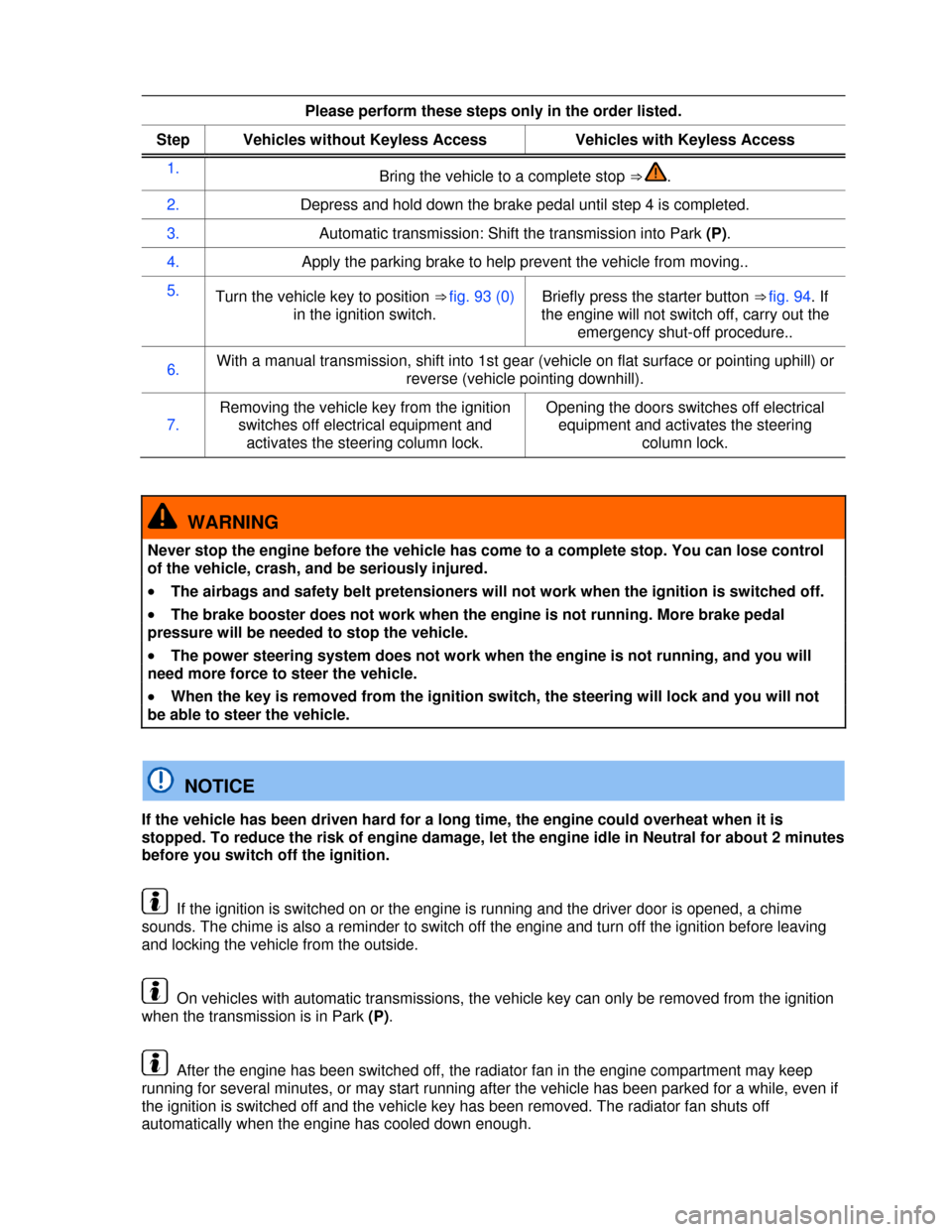
Please perform these steps only in the order listed.
Step Vehicles without Keyless AccessVehicles with Keyless Access
1. Bring the vehicle to a complete stop ⇒ .
2. Depress and hold down the brake pedal until step 4 is completed.
3. Automatic transmission: Shift the transmission into Park (P).
4. Apply the parking brake to help prevent the vehicle from moving..
5. Turn the vehicle key to position ⇒ fig. 93 (0)
in the ignition switch.
Briefly press the starter button ⇒ fig. 94. If
the engine will not switch off, carry out the
emergency shut-off procedure..
6. With a manual transmission, shift into 1st gear (vehicle on flat surface or pointing uphill) or
reverse (vehicle pointing downhill).
7.
Removing the vehicle key from the ignition
switches off electrical equipment and
activates the steering column lock.
Opening the doors switches off electrical
equipment and activates the steering
column lock.
WARNING
Never stop the engine before the vehicle has come to a complete stop. You can lose control
of the vehicle, crash, and be seriously injured.
x The airbags and safety belt pretensioners will not work when the ignition is switched off.
x The brake booster does not work when the engine is not running. More brake pedal
pressure will be needed to stop the vehicle.
x The power steering system does not work when the engine is not running, and you will
need more force to steer the vehicle.
x When the key is removed from the ignition switch, the steering will lock and you will not
be able to steer the vehicle.
NOTICE
If the vehicle has been driven hard for a long time, the engine could overheat when it is
stopped. To reduce the risk of engine damage, let the engine idle in Neutral for about 2 minutes
before you switch off the ignition.
If the ignition is switched on or the engine is running and the driver door is opened, a chime
sounds. The chime is also a reminder to switch off the engine and turn off the ignition before leaving
and locking the vehicle from the outside.
On vehicles with automatic transmissions, the vehicle key can only be removed from the ignition
when the transmission is in Park (P).
After the engine has been switched off, the radiator fan in the engine compartment may keep
running for several minutes, or may start running after the vehicle has been parked for a while, even if
the ignition is switched off and the vehicle key has been removed. The radiator fan shuts off
automatically when the engine has cooled down enough.
Page 137 of 268

Brake system malfunction
If you brake and find that the vehicle doesn't brake nearly as well as it used to (sudden increase in
stopping distance), a brake circuit may have failed. The brake warning light H or "2!+% will come on
and a message may appear in the instrument cluster display. If you believe the vehicle is safe to drive,
immediately take it to the nearest authorized Volkswagen dealer or authorized Volkswagen Service
Facility for repair. Drive slowly and very carefully, allow for the longer stopping distance, and be ready
to push longer and harder on the brake pedal to slow the vehicle down.
Brake booster
The brake booster works only when the engine is running. It increases the force on the brakes above
and beyond the pressure put on the brake pedal by the driver.
If the brake booster is not working, or if the vehicle has to be towed, you will have to push the brake
pedal harder to make up for the lack of booster assistance and the resulting longer stopping distance
⇒ .
WARNING
New brake pads do not provide maximum braking performance.
x New brake pads do not have the best stopping power for the first 200 miles (320 km) and
must be “broken in.” You can compensate for the slightly reduced braking force by putting
more pressure on the brake pedal.
x Drive with extra care while the new brake pads are being broken in. This reduces the risk
of collisions and serious personal injuries due to a loss of control over the vehicle.
x Never follow other vehicles too closely or put yourself into other situations that might
require sudden, hard braking, especially when the brake pads have not been broken in.
WARNING
Overheated brakes will reduce the vehicle's stopping power and increase stopping distances
considerably.
x When driving downhill, the brakes have to work especially hard and heat up quickly.
x Before driving downhill, especially on hills that are long or steep, always reduce speed
and shift into lower gear (manual or automatic transmission). This will let the vehicle use
engine braking and reduce the load on the brakes. Otherwise, the brake system could
overheat and possibly fail. Only use the brakes when you need them to slow the vehicle down
more or to stop.
x A damaged front spoiler or a non-standard spoiler can reduce airflow to the brakes and
make them overheat.
WARNING
Wet brakes or brakes coated with ice or road salt react slower and need longer stopping
distances.
x Carefully apply the brakes to test them.
x Always dry brakes and clean off ice and salt coatings with a few cautious brake
applications when visibility, weather, road and traffic conditions permit.
Page 142 of 268

Changing brake fluid
Brake fluid must be changed according to the service schedule in your ⇒ Booklet Warranty and
Maintenance. Have the brake fluid checked by an authorized Volkswagen dealer or an authorized
Volkswagen Service Facility. Refill only with new brake fluid that meets the standards listed above.
WARNING
Brake failure and reduced brake performance can be caused by not having enough brake
fluid in the reservoir or by old or incorrect brake fluid.
x Check the brake system and brake fluid level regularly.
x Always change the brake fluid according to the service schedule in your
⇒ Booklet Warranty and Maintenance.
x Hard braking with old brake fluid may cause vapor lock. Vapor lock reduces braking
performance, increases stopping distances and can even cause total brake failure.
x Always make sure that only the correct brake fluid is used. Only use brake fluid that
expressly conforms to VW Standard 501 14 or, if it is not available, only use a high-quality
brake fluid that conforms to U.S. Standard FMVSS 116 DOT 4 requirements.
x Using another brake fluid, or one that is not of high quality, can impair the function of the
brake system and reduce its effectiveness. If the container does not say that the brake fluid
complies with VW Standard 501 14, or U.S. Standard FMVSS 116 DOT 4, do not use it.
x The brake fluid must be new.
WARNING
Brake fluid is poisonous.
x To reduce the risk of poisoning, never use food, beverage or other non-original containers
to store brake fluid. Someone might be misled by the original label on the container, or by the
shape of the container, and drink the brake fluid. This could occur even if you relabel the
container as “brake fluid.”
x Only store brake fluid in the closed, original container and keep it out of the reach of
children.
NOTICE
Brake fluid will damage vehicle paint, plastic parts, and tires. Wipe any brake fluid off vehicle
paint and other vehicle parts immediately.
Brake fluid can pollute the environment. Brake fluid that has leaked out must be collected and
disposed of properly, following all applicable environmental regulations.
Page 144 of 268
Calm and smooth driving
Consistency is more important than speed. The more smoothly you drive, the less fuel the vehicle
consumes.
When driving on the highway or freeway, a constant, moderate speed is more efficient and economical
than constantly accelerating and braking. Usually you can reach your destination just as quickly by
driving at a moderate, but steady speed.
The cruise control system can assist in maintaining a uniform driving style.
Moderate use of extra electrical loads
Comfort inside the vehicle is nice and important, but it is important to use them in an environmentally
conscious manner.
Some devices can increase fuel consumption when activated (examples):
x Climate control system (air conditioner): If the air conditioner has to produce starkly contrasting
temperatures, it requires a large amount of energy, which is generated by the engine. The temperature
in the vehicle should therefore not be extremely different from that of the outside temperature. It may
be helpful to ventilate the vehicle before driving and then to drive a short distance with the windows
open. After that, switch on the air conditioner with the windows closed. Keep the windows closed when
driving at high speeds. Open windows increase fuel consumption.
x Switch off seat heating once it has served its purpose.
x Switch off the rear window defroster as soon as the windows are free of fog and ice.
Additional factors that increase fuel consumption (examples):
x Malfunctioning engine control.
x Driving in the mountains.
NOTICE
Never let the vehicle coast or roll down a hill in Neutral (N), especially when the engine is not
running. The transmission will not be lubricated and will be damaged.
Fuel-efficient driving
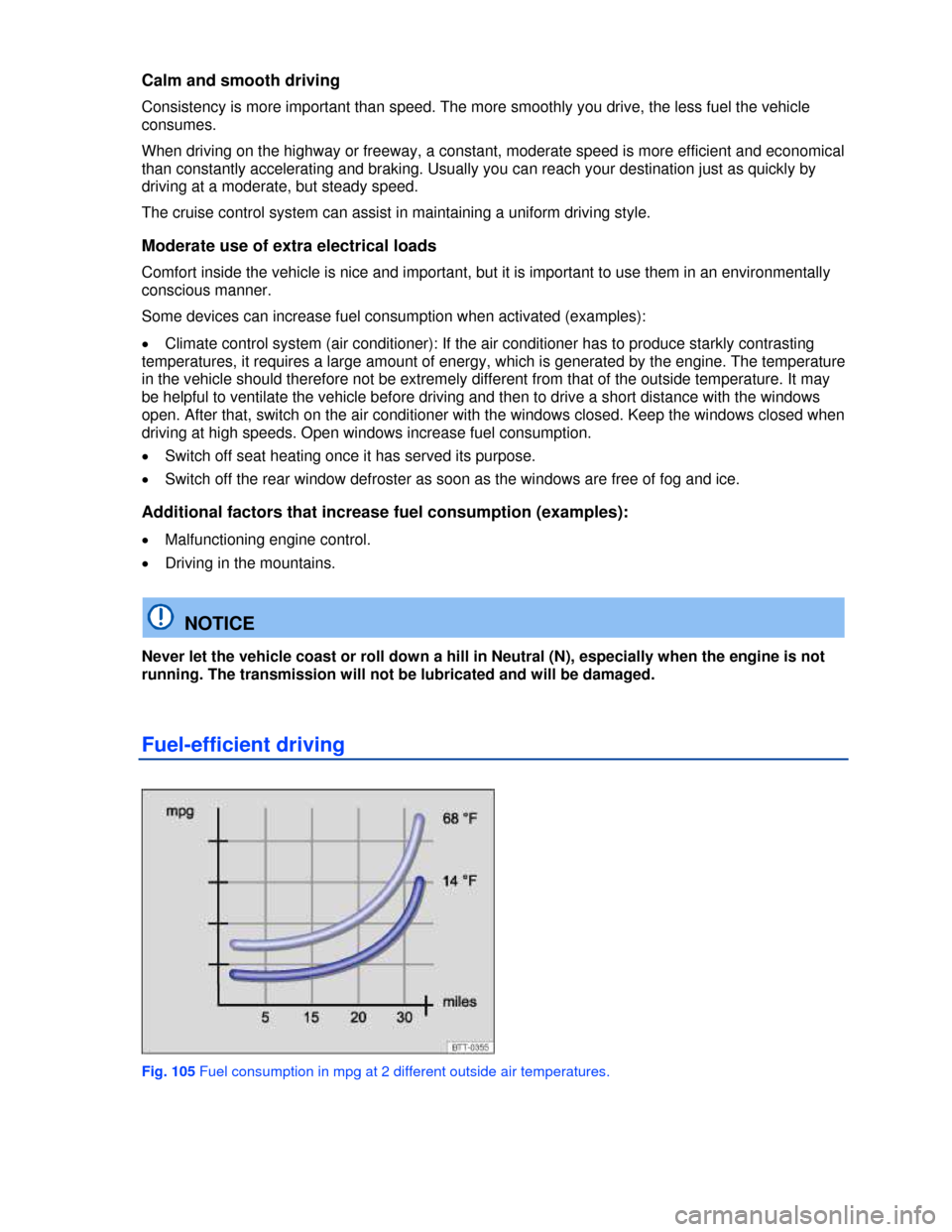
Fig. 105 Fuel consumption in mpg at 2 different outside air temperatures.
Page 145 of 268
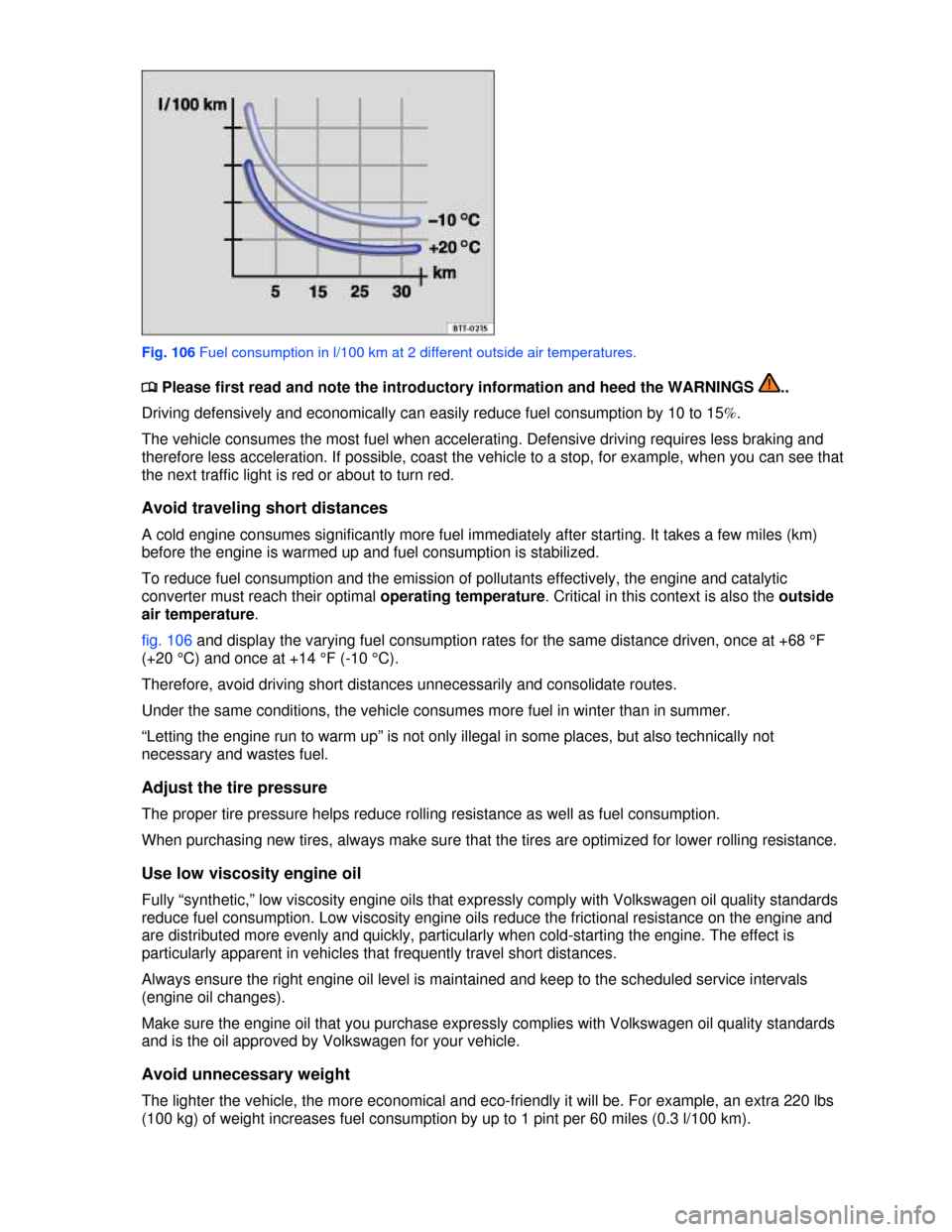
Fig. 106 Fuel consumption in l/100 km at 2 different outside air temperatures.
Page 156 of 268

WARNING
Incorrect tire pressures and/or underinflation can cause sudden tire failure, loss of control,
collision, serious personal injury or even death.
x When the warning symbol appears in the instrument cluster, stop and inspect the tires.
x Incorrect tire pressure and/or underinflation can cause increased tire wear and can affect
the handling of the vehicle and stopping ability.
x Incorrect tire pressures and/or underinflation can also lead to sudden tire failure,
including a blowout and sudden deflation, causing loss of vehicle control.
x The driver is responsible for the correct tire pressures for all tires on the vehicle. The
recommended tire pressure values are listed on a sticker inside the driver door..
x The TPMS can only work correctly when all tires on the vehicle are filled to the correct
cold tire inflation pressure.
x Using incorrect tire pressure values can cause accidents or other damage. Always inflate
the tires to the correct specified cold tire pressure values for the tires installed on the vehicle.
x Always maintain correct cold tire inflation pressure so that TPMS can do its job.
x Always inflate tires to the recommended and correct tire pressure before driving off.
x Driving with underinflated tires causes them to flex (bend) more, letting them get too hot,
resulting in tread separation, sudden tire failure, and loss of control.
x Excessive speed and/overloading can cause heat build-up, sudden tire failure and loss of
control.
x If the tire pressure is too low or too high, the tires will wear prematurely and the vehicle
will not handle well.
x If the tire is not “flat” and you do not have to change a wheel immediately, drive carefully
and at reduced speed to the nearest service station to check the tire pressure and add air as
required.
x When replacing tires or wheel rims on vehicles equipped with TPMS always read and heed
the information and all WARNINGS regarding., Tires and wheels.
x The Tire Pressure Monitoring System must be recalibrated using the SET button whenever
you remove and remount or change any wheel or tire on the vehicle, even if the reinstalled or
replacement wheels and tires are identical to those that were removed and even if the tire
pressure does not change.or! Bookmark not defined..
WARNING
Improper use of the SET button can cause the TPMS to give false warnings or to give no
warning despite dangerously low tire pressure.or! Bookmark not defined..
Underinflation increases fuel consumption and tire wear.
Do not rely solely on the Tire Pressure Monitoring System. Check your tires regularly to make
sure they are properly inflated and have no signs of damage, such as punctures, cuts, cracks, and
blisters. Remove any objects that become embedded in the tire tread but have not penetrated into the
body of tire itself.
When you take delivery of the vehicle, the Tire Pressure Monitoring System is calibrated for the
factory-recommended cold tire inflation pressure for the tires on your vehicle, as shown on the label
inside the driver door..
x The system must be recalibrated using the SET button whenever you remove and remount or
change any wheel or tire on the vehicle, even if the reinstalled or replacement wheels and tires are
Page 157 of 268

identical to those that were removed and even if the tire pressure does not change.or! Bookmark not
defined..
x If you have to adjust the tire pressure on a warm tire, fill the tire with 2.0 - 4.35 psi (20 - 30 kPa)
more than the pressure specified on the tire pressure label inside the driver door..
x If the TPMS determines that the air pressure in at least one tire is too low, carefully check the
pressure in all 4 tires with an accurate tire pressure gauge. Low tire pressure usually cannot be
determined by looking at the tire. This is especially true of low-profile tires.
If you have work done on your wheels or tires, inform the workshop that the vehicle is equipped
with a Tire Pressure Monitoring System (TPMS).
New tires may expand slightly the first time they are driven at high speeds, which can trigger a
tire pressure warning. Remember that tire pressure can only be properly measured when the tire is
“cold”..
Only replace old tires with tires that have been approved by Volkswagen for your vehicle type.
Applicable only in the United States
Indicator light (telltale)
Page 160 of 268

Heating and air conditioning