keyless VOLKSWAGEN BEETLE 2013 3.G User Guide
[x] Cancel search | Manufacturer: VOLKSWAGEN, Model Year: 2013, Model line: BEETLE, Model: VOLKSWAGEN BEETLE 2013 3.GPages: 268, PDF Size: 4.18 MB
Page 118 of 268
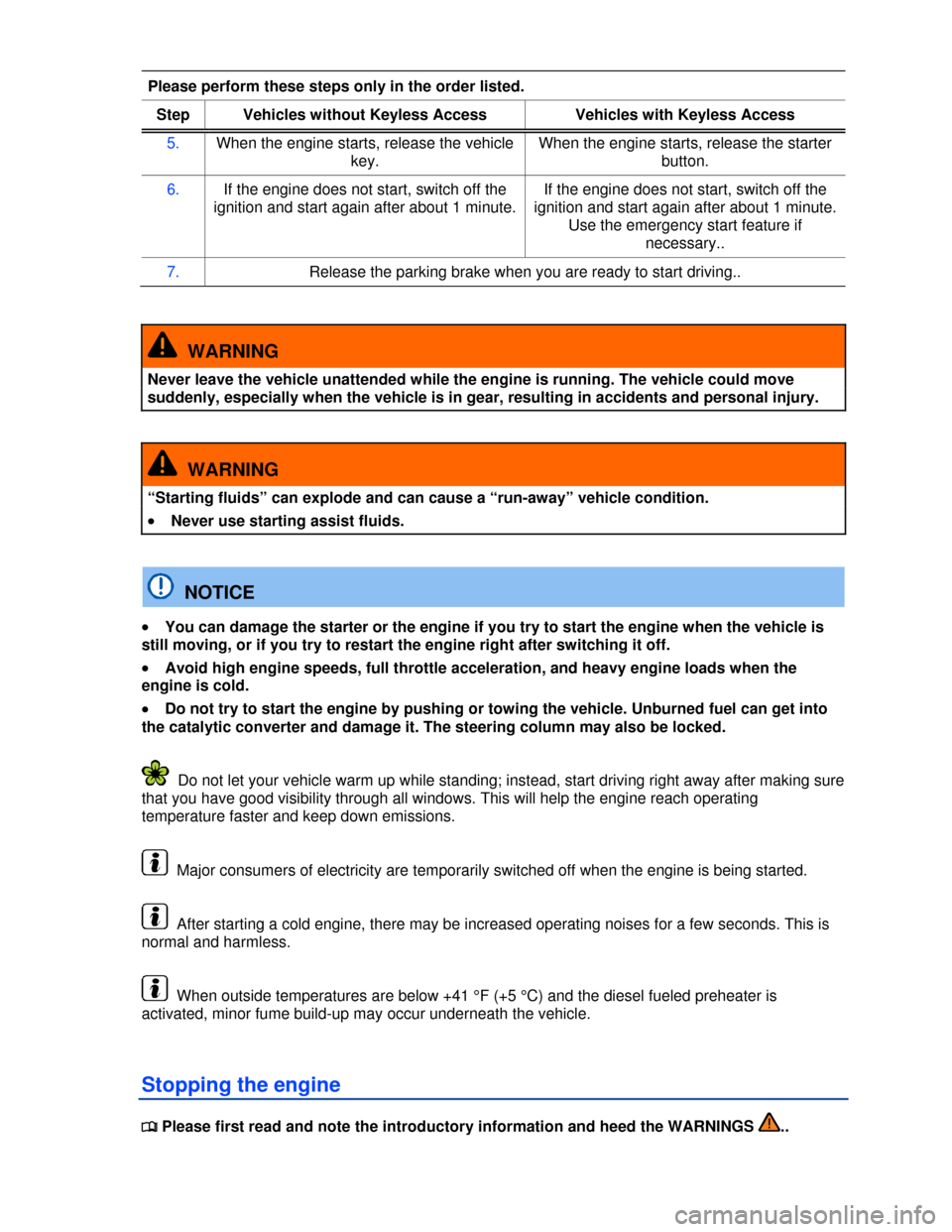
Please perform these steps only in the order listed.
Step Vehicles without Keyless AccessVehicles with Keyless Access
5. When the engine starts, release the vehicle
key.
When the engine starts, release the starter
button.
6. If the engine does not start, switch off the
ignition and start again after about 1 minute.
If the engine does not start, switch off the
ignition and start again after about 1 minute.
Use the emergency start feature if
necessary..
7. Release the parking brake when you are ready to start driving..
WARNING
Never leave the vehicle unattended while the engine is running. The vehicle could move
suddenly, especially when the vehicle is in gear, resulting in accidents and personal injury.
WARNING
“Starting fluids” can explode and can cause a “run-away” vehicle condition.
x Never use starting assist fluids.
NOTICE
x You can damage the starter or the engine if you try to start the engine when the vehicle is
still moving, or if you try to restart the engine right after switching it off.
x Avoid high engine speeds, full throttle acceleration, and heavy engine loads when the
engine is cold.
x Do not try to start the engine by pushing or towing the vehicle. Unburned fuel can get into
the catalytic converter and damage it. The steering column may also be locked.
Do not let your vehicle warm up while standing; instead, start driving right away after making sure
that you have good visibility through all windows. This will help the engine reach operating
temperature faster and keep down emissions.
Major consumers of electricity are temporarily switched off when the engine is being started.
After starting a cold engine, there may be increased operating noises for a few seconds. This is
normal and harmless.
When outside temperatures are below +41 °F (+5 °C) and the diesel fueled preheater is
activated, minor fume build-up may occur underneath the vehicle.
Stopping the engine
Page 119 of 268
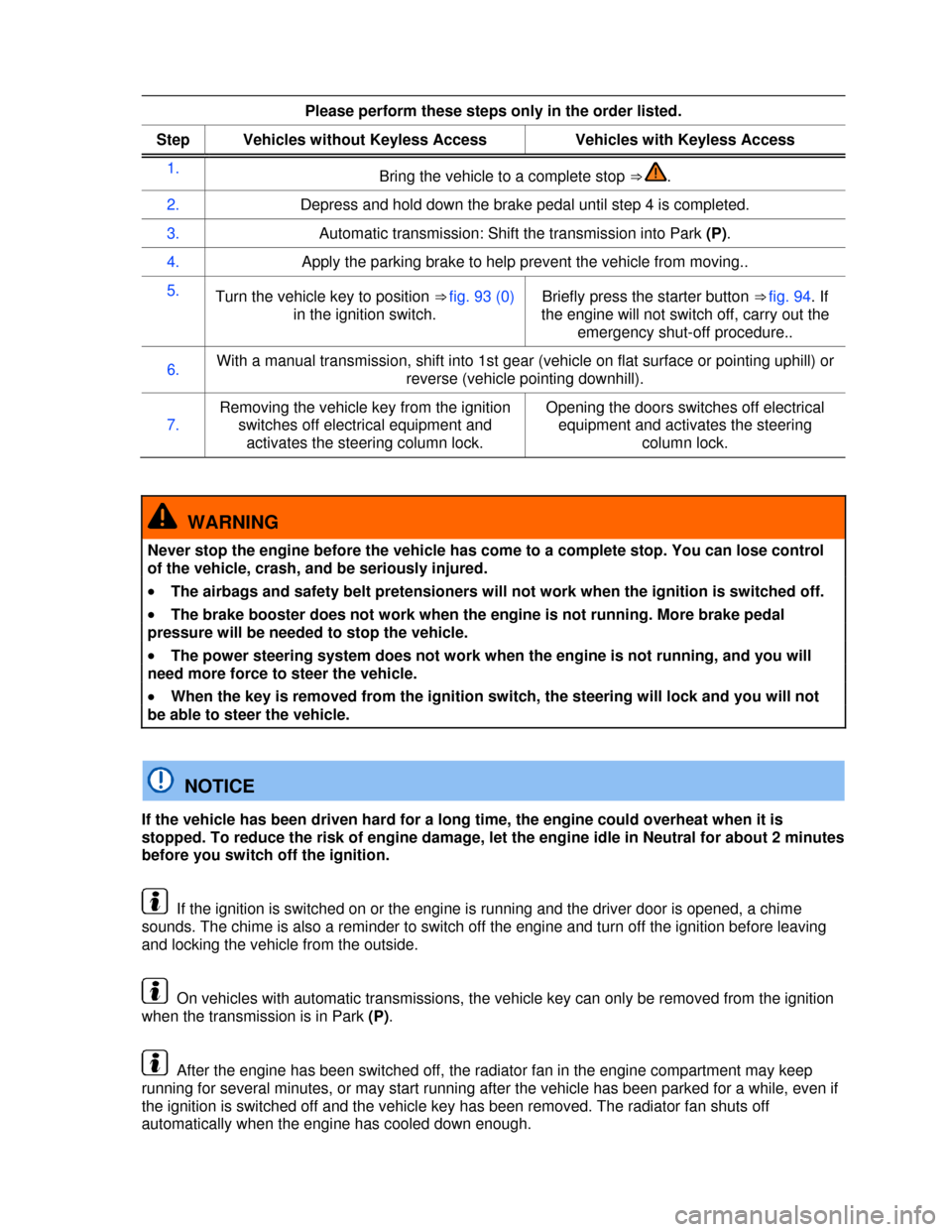
Please perform these steps only in the order listed.
Step Vehicles without Keyless AccessVehicles with Keyless Access
1. Bring the vehicle to a complete stop ⇒ .
2. Depress and hold down the brake pedal until step 4 is completed.
3. Automatic transmission: Shift the transmission into Park (P).
4. Apply the parking brake to help prevent the vehicle from moving..
5. Turn the vehicle key to position ⇒ fig. 93 (0)
in the ignition switch.
Briefly press the starter button ⇒ fig. 94. If
the engine will not switch off, carry out the
emergency shut-off procedure..
6. With a manual transmission, shift into 1st gear (vehicle on flat surface or pointing uphill) or
reverse (vehicle pointing downhill).
7.
Removing the vehicle key from the ignition
switches off electrical equipment and
activates the steering column lock.
Opening the doors switches off electrical
equipment and activates the steering
column lock.
WARNING
Never stop the engine before the vehicle has come to a complete stop. You can lose control
of the vehicle, crash, and be seriously injured.
x The airbags and safety belt pretensioners will not work when the ignition is switched off.
x The brake booster does not work when the engine is not running. More brake pedal
pressure will be needed to stop the vehicle.
x The power steering system does not work when the engine is not running, and you will
need more force to steer the vehicle.
x When the key is removed from the ignition switch, the steering will lock and you will not
be able to steer the vehicle.
NOTICE
If the vehicle has been driven hard for a long time, the engine could overheat when it is
stopped. To reduce the risk of engine damage, let the engine idle in Neutral for about 2 minutes
before you switch off the ignition.
If the ignition is switched on or the engine is running and the driver door is opened, a chime
sounds. The chime is also a reminder to switch off the engine and turn off the ignition before leaving
and locking the vehicle from the outside.
On vehicles with automatic transmissions, the vehicle key can only be removed from the ignition
when the transmission is in Park (P).
After the engine has been switched off, the radiator fan in the engine compartment may keep
running for several minutes, or may start running after the vehicle has been parked for a while, even if
the ignition is switched off and the vehicle key has been removed. The radiator fan shuts off
automatically when the engine has cooled down enough.
Page 149 of 268

To help make it more difficult to steal your vehicle, you should always make sure the steering column
is locked before leaving the vehicle.
Electronic steering column lock
Vehicles with Keyless Access: The steering column is locked if the driver door is opened with the
ignition switched off. The vehicle must be standing still and the transmission must be in Park (P) on an
automatic transmission vehicle.
If the driver door is opened before the ignition is switched off, the electronic steering column lock is
activated only after the vehicle has been locked with the vehicle key or via the sensor in the door
handle.
Mechanical steering column lock
Vehicles without Keyless Access: The steering column is locked if the vehicle is stationary and the
vehicle key is removed from the ignition switch.
Engaging the steering column
lock
Disengaging the steering column
lock
Parking the vehicle.. Turn the steering wheel slightly to
take pressure off the steering
column lock.
Remove the vehicle key. Insert the vehicle key into the
ignition switch.
Turn the steering wheel slightly until
you hear the steering column lock
engage.
Hold the steering wheel in this
position and turn the ignition switch.
Power steering
Power steering automatically adjusts to driving speed, steering torque, and the steering angle of the
wheels. Power steering works only when the engine is running.
If power steering is reduced or lost completely, it will be much harder to steer and control the vehicle.
Counter-steering assistance
Counter-steering assistance is part of Electronic Stability Control (ESC). This feature makes it easier
for the driver to control the vehicle in difficult situations. For example, if you have to brake hard on a
surface that provides uneven traction, the vehicle could pull to the right or left. ESC detects this
situation and helps the driver counter-steer with additional steering power ⇒ .
WARNING
The counter-steering assistance in ESC can do no more than help the driver steer in difficult
situations. The driver must still control the vehicle. The vehicle does not steer by itself with
this feature!
NOTICE
If the ignition is off, the steering column lock will engage and the vehicle cannot be steered.
For this reason, you must leave the ignition on when going through an automatic car wash, for
example, so that the wheels will still steer.
Page 177 of 268

WARNING
The engine compartment of any motor vehicle is a potentially dangerous area and can cause
serious personal injury.
x Always use extreme caution when doing any work in the engine compartment. Always
follow commonly accepted safety practices and use common sense. Never risk personal
injury.
x Never perform any work in the engine compartment unless you know exactly how to carry
out the job and have the correct technical information and the correct tools.
x If you are uncertain about what to do, have the work performed by an authorized
Volkswagen dealer, an authorized Volkswagen Service Facility, or another qualified
workshop. Serious personal injury may result from improperly performed work.
x We strongly recommend that you always have HID – High Intensity Discharge (Xenon)
headlights and HB2 (H4) bulbs replaced by a qualified technician. Serious personal injury
may result from improperly performed work.
x Never open or close the engine hood if steam or coolant is escaping. Hot steam or coolant
can cause serious burns. Always wait until you no longer see or hear steam or coolant
escaping from the engine.
x Always let the engine cool down completely before carefully opening the hood.
x Hot parts of the engine and the exhaust system will burn skin on contact.
x When the engine has cooled down and you are ready to open the hood:
– Firmly apply the parking brake and shift the transmission into Park (P) (automatic) or
Neutral (manual only).
– Take the vehicle key out of the ignition.
– On vehicles with Keyless Access, make sure that the remote control vehicle key is out
of range of the vehicle and that the vehicle cannot be started by depressing the starter
button..
– Always keep children and others away from the engine compartment and never leave
them unsupervised.
x The engine coolant system is under pressure when the engine is hot. Never unscrew the
coolant expansion tank cap when the engine is hot. Hot coolant can spray out and cause
severe burns and other serious injuries.
– Turn the cap slowly and very carefully in a counterclockwise direction while applying
light downward pressure on the top of the cap.
– Always protect your face, hands, and arms from hot escaping coolant or steam by
covering the cap with a large, thick rag.
x Never spill fluids on the engine or exhaust system when refilling. Spilling fluids onto hot
parts of the engine or exhaust system can cause a fire.
Page 189 of 268

Hot steam and hot engine coolant can cause serious burns.
x Never open the hood if you see steam or coolant escaping from the engine compartment.
Always wait until you no longer see or hear steam or coolant escaping from the engine.
x Always let the engine cool down completely before carefully opening the hood. Hot
components will burn skin on contact.
x When the engine has cooled down and you are ready to open the hood:
– Firmly apply the parking brake and shift the transmission into Park (P) (automatic) or
Neutral (manual only).
– Take the vehicle key out of the ignition.
– On vehicles with Keyless Access, make sure that the remote control vehicle key is out
of range of the vehicle and that the vehicle cannot be started by depressing the starter
button..
– Always keep children and others away from the engine compartment and never leave
them unsupervised.
x The engine coolant system is under pressure when the engine is hot. Never unscrew the
coolant expansion tank cap when the engine is hot. Hot coolant can spray out and cause
severe burns and other serious injuries.
– Turn the cap slowly and very carefully in a counterclockwise direction while applying
light downward pressure on the top of the cap.
– Always protect your face, hands, and arms from hot escaping coolant or steam by
covering the cap with a large, thick rag.
x Never spill fluids on the engine or exhaust system when refilling. Spilling fluids onto hot
parts of the engine or exhaust system can cause a fire. Under some conditions, the ethylene
glycol in engine coolant can catch fire.
NOTICE
x Use distilled water only when adding coolant! All other types of water contain chemical
compounds that can cause extensive corrosion damage to the engine. This can even lead to
engine failure. If you have added non-distilled water, take the vehicle immediately to an
authorized Volkswagen dealer or an authorized Volkswagen Service Facility to have the
coolant system drained, flushed, and refilled completely with the proper coolant.
x Refill engine coolant only up to the top edge of the marked fill range . Excess engine
coolant may be forced out of the engine cooling system when it gets hot and cause damage.
x In the case of significant engine coolant loss, refill engine coolant only when the engine is
completely cooled down. Significant engine coolant loss is a sign of leaks in the cooling
system. Have the engine cooling system checked immediately by an authorized Volkswagen
dealer or an authorized Volkswagen Service Facility. Otherwise the engine may be damaged!
Page 231 of 268

Declaration of Compliance, Telecommunications and
Electronic Systems
Radio Frequency Devices and Radiocommunication Equipment User Manual Notice.
Radio-based equipment
x Mobile Phone Package
x Electronic immobilizer
x Remote control vehicle key
x Keyless Access locking and starting system
These devices comply with:
FCC Part 15.19
These devices comply with Part 15 of the FCC Rules. Operation is subject to the following
2 conditions:
(1) This device may not cause harmful interference, and
(2) this device must accept any interference received, including interference that may cause undesired
operation.
FCC Part 15.21
CAUTION:
Changes or modifications not expressly approved by the party responsible for compliance could void
the user's authority to operate the equipment.
These devices comply with RSS-210 of Industry Canada.
Operation is subject to the following 2 conditions:
(1) this device may not cause interference, and
(2) this device must accept any interference, including interference that may cause undesired
operation of the device.
The manufacturer is not responsible for any radio or TV interference caused by unauthorized
modifications to this equipment.