steering wheel VOLKSWAGEN BEETLE 2015 Owner´s Manual
[x] Cancel search | Manufacturer: VOLKSWAGEN, Model Year: 2015, Model line: BEETLE, Model: VOLKSWAGEN BEETLE 2015Pages: 370, PDF Size: 5.28 MB
Page 216 of 370

not always be able to help you master situations where there is a sudden change in the coefficient of friction of the road surface. When there is a section of dry road that is suddenly covered with water, slush or snow, ESC cannot perform the same way it would on a dry surface. If the vehicle “hydro-planes” (rides on a cushion of water instead of the road surface), ESC will not be able to help you steer the vehicle because contact with the pavement has been interrupted and the vehicle cannot be braked or steered. During fast cornering, particularly on winding roads, ESC cannot always deal as effectively with difficult driving situations as it can at lower speeds.
Always adjust your speed and driving style to visibility, road, traffic, and weather conditions. ESC cannot override the vehicle's physical limits, increase the available traction, or keep a vehicle on the road if road departure is a result of driver inattention. Instead, ESC improves the possibility of keeping the vehicle under control and on the road during extreme maneuvers by using the driver's steering inputs to help keep the vehicle going in the intended direction. If you are traveling at a speed that causes you to run off the road before ESC can provide any assistance, you may not experience the benefits of ESC.
ESC includes and/or works together with the ABS, BAS, ASR, EDL, and XDL systems (see below). ESC is switched on all the time and cannot be switched off.
Anti-Lock Brake System (ABS)
ABS helps to keep the wheels from locking up and helps to maintain the driver's ability to steer and control the vehicle. This means the vehicle is less likely to skid, even during hard braking:
x Push the brake pedal down hard and hold it there. Don't take your foot off the pedal or reduce the force on the pedal!
x Do not “pump” the brake pedal or let up on it!
x Steer the vehicle while pushing down hard on the brake pedal.
x ABS stops working if you release or let up on the brake.
When ABS is doing its job, you will notice a slight vibration through the brake pedal and hear a noise. ABS cannot shorten the stopping distance under all conditions. The stopping distance may even be longer, for instance, when driving on gravel or on newly fallen snow covering an icy or slip-pery surface.
Brake Assist (BAS)
The Brake Assist System can help to reduce stopping distances. If you press the brake pedal very quickly, BAS detects an emergency situation. It then very quickly builds up full brake system pressure, maximizing braking power and reducing the stopping distance. This way, ABS can be activated more quickly and efficiently.
Do not reduce pressure on the brake pedal! BAS switches off automatically as soon as you release or let up on the brake.
Anti-Slip Regulation (ASR)
ASR reduces engine power directed to spinning wheels and adjusts power to the road conditions. Even under poor road conditions, ASR can make it easier to get moving, accelerate, and climb hills.
ESC and ASR can help when driving on loose surfaces (such as gravel) and in deep snow. If you get stuck in deep snow, you may be able to get going again by “rocking” the vehicle back and forth. ESC and ASR recognize this special driving situation and automatically increase the speed of the front wheels. Keep pressing the accelerator and let ESC increase the speed of the front wheels to help you keep moving or get moving again.
Electronic Differential Lock (EDL and XDL)
EDL is applied during regular straight-line acceleration. EDL gently brakes a drive wheel that has lost traction (spinning) and redirects the drive force to other drive wheels. In extreme cases, EDL automat-ically switches off to keep the brake from overheating. As soon as the brake has cooled down, EDL automatically switches on again.
XDL is an extension of the Electronic Differential Lock system. XDL does not react to drive wheel slippage when driving straight ahead. Instead, XDL detects slippage of the inside front wheel during
Page 308 of 370

WARNING
Improper care and servicing, and improper modification and repair work, can increase the risk of personal injury and death by preventing an airbag from deploying when needed or deploying an airbag unexpectedly:
x Never repair, adjust, or change any parts of the airbag system.
x All work on the airbag system, steering wheel, instrument panel, front seats or electrical system (including the installation of audio equipment, mobile telephones and CB radios, etc.) should be performed by authorized Volkswagen dealers or authorized Volkswagen Service Facilities. They have the necessary manuals, training, and special equipment.
x The airbag system can be activated only once. After an airbag has inflated, it must be replaced.
x Use only original equipment airbags approved by Volkswagen. Have them installed by a trained technician who has the necessary tools and diagnostic equipment to properly replace any airbag in your vehicle and assure system effectiveness in a crash.
x Never permit salvaged or recycled airbags to be installed in your vehicle.
Undeployed airbag modules and safety belt pretensioners are classified as Perchlorate Material. Special handling may apply – see http://www.dtsc.ca.gov/hazardouswaste/perchlorate. Obey all applicable legal requirements regarding handling and disposal of the vehicle or parts of its restraint system, including airbag modules and safety belts with pretensioners. Authorized Volkswagen dealers and authorized Volkswagen Service Facilities are familiar with the requirements, and we recommend that you have them perform this service for you.
Notice about data recorded by the Event Data Recorder and vehicle
control modules
Page 310 of 370

Therefore we strongly recommend that you use your mobile telephone in your vehicle only when it is properly attached to an appropriate cradle mounted on a base plate on the instrument panel.
Because of the large number and variety of mobile telephones on the market and the frequency with which new models are introduced, Volkswagen does not offer cradles for mobile telephones. Please check with the manufacturer of the mobile telephone that you plan to use.
Bluetooth® is a registered trademark of Bluetooth® SIG, Inc.
WARNING
A mobile phone on the seat, instrument panel or in other places can be thrown around the inside of the vehicle during a sudden braking maneuver, a crash or other accident and injure vehicle occupants.
x Never place or attach accessories or other objects (such as cup holders, telephone brackets, note pads, navigation systems, large, heavy or bulky objects) on the doors, on the windshield, over or near the area marked “AIRBAG” on the steering wheel, instrument panel, backrests or between these areas and the occupant. Such objects could cause serious injury in a collision, especially if an airbag inflates.
WARNING
Using a mobile phone or CB radio inside the vehicle without a properly installed and separate outside antenna can be dangerous to your health and that of your passengers because the electromagnetic radiation energy that mobile phones and CB radios emit may be above established limits. This also applies if the outside antenna is not installed properly.
x Always keep the mobile phone antenna at least 8 in. (20 cm) away from pacemakers. Heart specialists advise that mobile phones can adversely affect the way pacemakers work.
x Never carry a mobile phone that is switched on in the breast pocket directly over a pacemaker.
x If you suspect there may be interference with a pacemaker or other medical device, switch the mobile phone off immediately.
Portable iPhone® holder
Fig. 148 On the center console. A: Removing the iPhone® holder, B: Installing the cover for the mount.
Page 362 of 370
WARNING
Towing a vehicle changes the way it handles and brakes. To help reduce the risk of an accident and serious personal injury, note the following:
x The driver of the vehicle that is being towed:
– Since the brake booster also does not work when the engine is stopped, you will need to press harder on the brake pedal to slow down or stop. Always be alert so as not to rear-end the towing vehicle.
– Will have to use considerably more force to turn the steering wheel because the power steering is not working.
x The driver of the vehicle that is doing the towing:
– Must accelerate gradually and gently and avoid jerking movements.
– Must not brake hard or steer sharply.
– Must brake earlier and more gently than in normal driving.
NOTICE
x Be careful not to damage the paint when installing and removing the towing eye and the cover for the threaded hole behind the bumper.
x Unburned fuel can get into the catalytic converter during towing and damage it.
Towing on a commercial tow truck
Page 363 of 370

x If the vehicle battery is dead (because the electronic steering column lock engages and cannot be released).
x If you have to tow an automatic transmission vehicle more than 30 miles (50 km).
WARNING
It is not safe for children or other persons to ride in a vehicle that is being towed.
x Never let children or anyone else remain in the vehicle while it is being towed.
NOTICE
The drive axle rotates while the vehicle is being towed with its rear wheels off the ground. This can damage the automatic transmission.
x Never tow automatic transmission vehicle with the rear wheels off the ground.
x Tow manual transmission vehicles with the rear wheels off the ground only if it is certain that no transmission fluid can leak out.
Tips on towing
Page 364 of 370
When not to tow your vehicle
In the following situations, the vehicle cannot be towed and must be transported on a flatbed truck or trailer:
x If transmission fluid has leaked out of the transmission.
x If there is little or no oil in the transmission because of damage to your vehicle, it must be moved with the drive wheels off the ground.
x If the front and rear wheels cannot turn.
x When the vehicle battery is dead, because the steering may remain disabled and it may not be possible to release the electronic steering column lock.
x If you have to tow an automatic transmission vehicle more than 30 miles (50 km).
x If the steering or the wheel clearance might be impaired, for example, after an accident.
Towing other vehicles
x Obey all legal requirements
x Read and heed all towing information in the owner's manual for the other vehicle.
A vehicle can be towed only if the electronic steering column lock is released. In case of a power loss or malfunctions of the electrical system, the engine may have to be jump-started in order to release the electronic steering column lock.
Installing the front towing eye
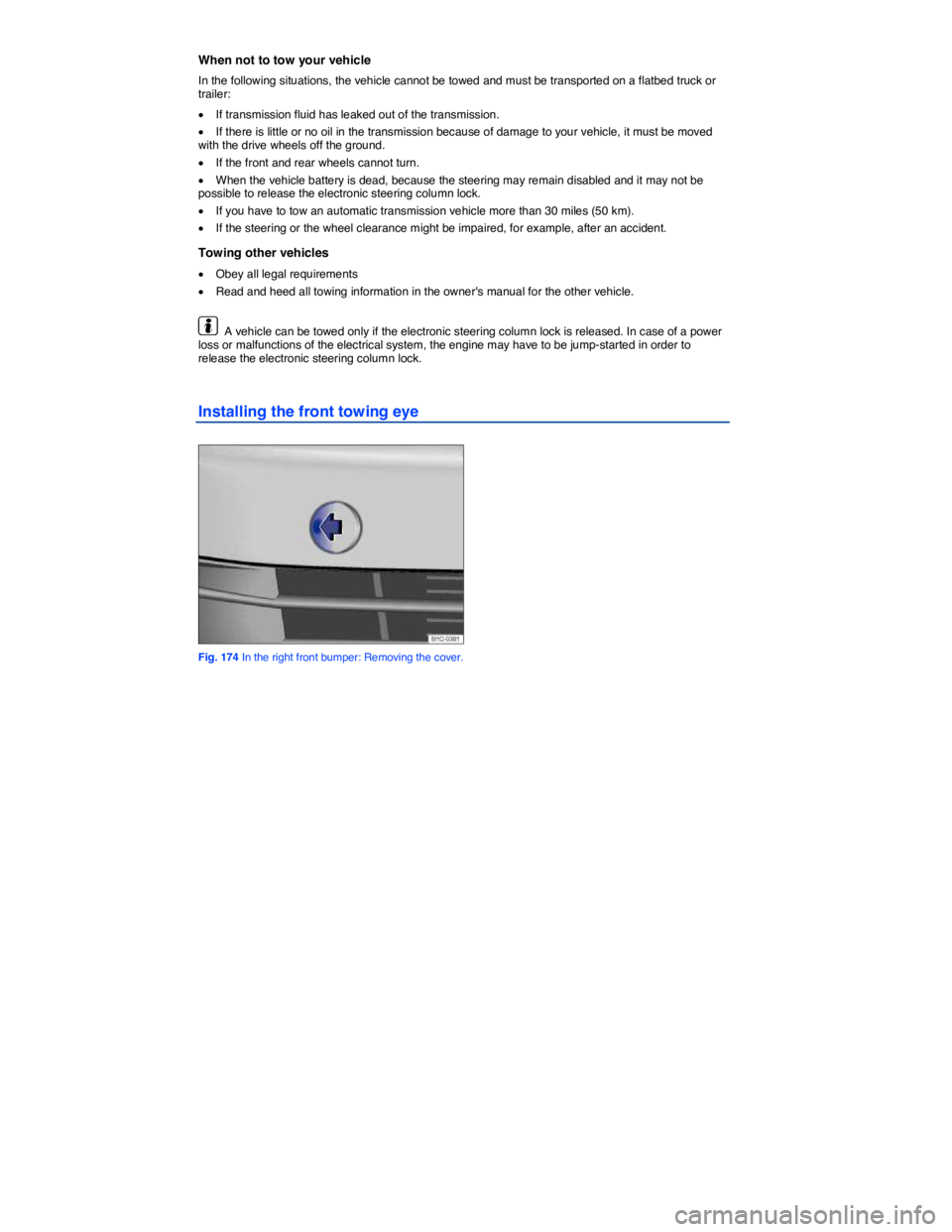
Fig. 174 In the right front bumper: Removing the cover.