service VOLKSWAGEN CC 2011 Workshop Manual
[x] Cancel search | Manufacturer: VOLKSWAGEN, Model Year: 2011, Model line: CC, Model: VOLKSWAGEN CC 2011Pages: 578, PDF Size: 6.64 MB
Page 250 of 578

Tire labeling
(example)
Meaning
Consumer information regarding comparison to specified base
tires (standardized test procedure) ⇒ ⇒ page 284:
TREADWEAR 220 Relative service life expectancy of the tire
referenced to a U.S.-specific standard test.
TRACTION A Traction rating under wet conditions (AA, A,
B or C).
TEMPERATURE A Temperature stability of the tire at increased
test bench speeds (A, B or C).
Additional numbers found on the tire could either be tire manu-
facturer internal labels or country-specific labels (such as for
Brazil and China).
Unidirectional tires
Unidirectional tires are designed to rotate only in one direction. Unidi-
rectional tires have arrows on the sidewalls that show the direction of
rotation. Make sure you mount the tire so that it rotates in the proper
direction. The tire's performance with regard to hydroplaning, traction,
noise, and wear is worse if it is not mounted in the proper direction of
rotation.
If you have to mount a tire opposite to its proper direction of rotation,
you must drive more carefully, since the tire is no longer being used
as designed. This is particularly important on wet roads. You must
replace or remount the tire as soon as possible in order to restore the
correct direction of rotation.
Load rating code
The load index indicates the maximum permissible load per individual
tire in pounds (kilograms).
91 1356 lbs (615 kg)
92 1388 lbs (630 kg)
93 1433 lbs (650 kg)
95 1521 lbs (690 kg)
Page 253 of 578

ter tire performance decreases with age – independent of the tread
profile depth.
When using winter tires:
Obey state and country-specific legal requirements.
Install winter tires on all 4 wheels.
Use winter tires only under wintry road conditions.
Only use winter tires with dimensions approved for the vehicle.
Use only winter tires of the same tire belt design, the same dimen-
sions (tread circumference), and the same tread design.
Follow speed restrictions according to the winter tire's speed rating
code letter ⇒ .
Speed restrictions
Winter tires are certified up to a top speed identified by speed rating
code letters on the side wall ⇒ Tire labeling.
In some vehicle models it is possible to set a speed warning in the
menu in the instrument cluster display ⇒ Volkswagen Information
System.
Top speed rating and tire inflation pressure for V winter tires depend
on the engine installed in your vehicle. Be sure to ask you authorized
Volkswagen dealer or authorized Volkswagen Service Facility about
the maximum permissible speed and the required tire inflation pres-
sure for the winter tires that you plan to use.
WARNING
Driving faster than the maximum speed for which the winter
tires on your vehicle were designed can cause sudden tire fail-
ure including a blowout and sudden deflation, loss of control,
crashes and serious personal injuries.
Winter tires have a maximum speed rating that may be lower
than your vehicle's maximum speed.
Never drive faster than the maximum speed for which the
winter tires installed on your vehicle are rated because tires
that are driven faster than their rated speed can fail suddenly.
Never exceed the maximum load rating for the winter tires
installed on your vehicle.
Page 254 of 578

Install summer tires promptly in the spring. Summer tires offer
better handling characteristics for temperatures above +45 °F (+7 °C).
They are quieter, do not wear as quickly, and reduce fuel consump-
tion.
If factory-installed wheels and/or tires are replaced when in-
stalling winter tires, make sure that the wheels are equipped with
sensors that are compatible with the factory-installed Tire Pressure
Monitoring System and that the tires are also compatible with the sys-
tem. If new tires are not identical to those that were removed and re-
quire different cold tire inflation pressure, the tire inflation pressure
values must be reprogrammed for the TPMS. Please see your author-
ized Volkswagen dealer or authorized Volkswagen Service Facility ⇒
The Tire Pressure Monitoring System must be recalibrated whenever
you remove and remount or change any wheel or tire on the vehicle,
even if the reinstalled or replacement wheels and tires are identical to
those that were removed and even if the tire pressure does not
change.
If necessary, ask your authorized Volkswagen dealer or author-
ized Volkswagen Service Facility about permissible winter tire dimen-
sions.
Snow chains
Page 255 of 578
Remove center hubcaps and decorative rim rings before installing
snow chains ⇒ . However, for safety reasons, caps must be in-
stalled on the wheel bolts. These are available from authorized
Volkswagen dealers and authorized Volkswagen Service Facilities.
Compact spare wheel
For technical reasons, snow chains cannot be used on the compact
spare
If you must use snow chains and have a compact spare wheel
mounted, move the compact spare wheel to the rear axle if a front tire
has to be replaced. The tire taken off the rear axle can then be used
to replace the flat front tire. Be sure to install the unidirectional tires so
that they will run in the proper direction. Volkswagen recommends
installing the snow chains before mounting the wheel to the vehicle.
WARNING
Using the wrong snow chains or installing snow chains im-
properly can cause accidents and severe personal injuries.
Always use the proper snow chains.
Follow the installation instructions provided by the snow
chain manufacturer.
Never exceed the permissible speed limit when driving with
snow chains.
NOTICE
Remove snow chains when roads are free of snow. Otherwise,
the chains can damage the tires, impair vehicle handling and can
be quickly worn down.
Snow chains can scratch or damage wheel rims if they have
direct contact with the rims. Volkswagen recommends using
coated snow chains.
Glossary of tire and loading terminology
Page 265 of 578

Treadwear
The treadwear grade is a comparative rating based on the wear rate
of the tire when tested under controlled conditions on a specified
government test course.
For example, a tire graded 150 (Treadwear-value 150) would wear
one-and-one-half (1 1/2) times as well on the government course as a
tire graded 100.
The relative performance of tires depends upon the actual conditions
of their use, however, and may depart significantly from the norm due
to variations in driving habits, service practices and differences in
road characteristics and climate.
Traction
The traction grades, from highest to lowest, are AA, A, B, and C.
Those grades represent the tire's ability to stop on wet pavement as
measured under controlled conditions on specified government test
surfaces of asphalt and concrete. A tire marked C may have poor
traction performance ⇒ .
Temperature
The temperature grades are A (the highest), B, and C representing
the tire's resistance to the generation of heat, and its ability to dissi-
pate heat when tested under controlled conditions on a specified in-
door laboratory test wheel.
Sustained high temperature can cause the material of the tire to de-
generate and reduce tire life, and excessive temperature can lead to
sudden tire failure.
The grade C corresponds to a level of performance which all passen-
ger car tires must meet under the Federal Motor Vehicle Safety
Standard No. 109. Grades B and A represent higher levels of perfor-
mance on the laboratory test wheel than the minimum required by law
⇒ .
WARNING
The traction grade assigned to this tire is based on straight-
ahead braking traction tests, and does not include acceleration,
cornering, hydroplaning or peak traction characteristics.
Page 268 of 578

WARNING
Incorrect tire pressures and/or underinflation can cause sudden
tire failure, loss of control, collision, serious personal injury or
even death.
When the warning symbol appears in the instrument cluster,
stop and inspect the tires.
Incorrect tire pressure and/or underinflation can cause in-
creased tire wear and can affect the handling of the vehicle and
stopping ability.
Incorrect tire pressures and/or underinflation can also lead to
sudden tire failure, including a blowout and sudden deflation,
causing loss of vehicle control.
The driver is responsible for the correct tire pressures for all
tires on the vehicle. The recommended tire pressure values are
listed on a sticker inside the driver door ⇒ Tire inflation pres-
sure.
The TPMS can only work correctly when all tires on the vehi-
cle are filled to the correct cold tire inflation pressure specified
for the tires installed on the vehicle.
Using incorrect tire pressure values can cause accidents or
other damage. Always inflate the tires to the correct specified
cold tire pressure values for the tires installed on the vehicle.
Always maintain correct cold tire inflation pressure so that
TPMS can do its job.
Always inflate tires to the recommended and correct tire
pressure before driving off.
Driving with underinflated tires causes them to flex (bend)
more, letting them get too hot, resulting in tread separation,
sudden tire failure, and loss of control.
Excessive speed and/overloading can cause heat build-up,
sudden tire failure, and loss of control.
If the tire pressure is too low or too high, the tires will wear
prematurely and the vehicle will not handle well.
If the tire is not “flat” and you do not have to change a wheel
immediately, drive carefully and at reduced speed to the near-
est service station to check the tire pressure and add air as re-
quired.
Page 270 of 578

Do not rely only on the Tire Pressure Monitoring System. Check
your tires regularly to make sure they are properly inflated and have
no signs of damage, such as punctures, cuts, cracks, and blisters.
Remove any objects that become embedded in the tire tread but have
not penetrated into the body of tire itself.
The Tire Pressure Monitoring System checks for the factory-
recommended inflation pressure, as shown on the label inside the
driver door ⇒ Tire inflation pressure.
For replacement tires that require a different inflation pressure, the
TPMS must be adjusted to the new pressure specification by an au-
thorized Volkswagen dealer or an authorized Volkswagen Service
Facility. Only one value can be entered for each tire; see the tire infla-
tion pressure label on the driver door pillar ⇒ Tire inflation pressure.
To help prevent damage to the sensor and valve, do not put exces-
sive force on the valve when checking the tire pressure. Do not try to
bend the valve.
If sensors have to be replaced, have the valves changed at the
same time.
The tire valve gaskets must be replaced whenever a tire is mount-
ed on the rim. Your authorized Volkswagen dealer or authorized
Volkswagen Service Facility has a valve seal and gasket kit for this
purpose. Always make sure that a valve seal and gasket kit is also
used whenever a sensor is replaced.
If you have to adjust the tire pressure on a “warm” tire, fill the tire
with 2.0 - 4.35 psi (20 - 30 kPa) more than the pressure specified on
the tire pressure label.
When the TPMS determines that the air pressure in at least one
tire is too low, carefully check the pressure in all 4 tires with an accu-
rate tire pressure gauge. Low tire pressure usually cannot be deter-
mined by looking at the tire. This is especially true of low-profile tires.
A Declaration of Compliance with the United States FCC and
Industry Canada regulations is found in the Consumer Information
section of this Manual ⇒ Declaration of Compliance, Telecommunica-
tions and Electronic Systems.
Page 275 of 578
If the tire is not “flat” and you do not have to change the tire
or wheel immediately, drive at reduced speed to the nearest
service station to check the tire pressure and add air as re-
quired.
When replacing tires or wheel rims on vehicles equipped with
TPMS, always read and heed the information and all WARN-
INGS in the section ⇒ Tires and wheels.
WARNING
Failure to heed warning lights and instrument cluster text mes-
sages can cause the vehicle to break down in traffic and result
in a collision and serious personal injury.
Never ignore warning lights or text WARNINGS.
Always stop the vehicle as soon as it is safe to do so.
NOTICE
Failure to heed warning lights or text WARNINGS can result in
vehicle damage.
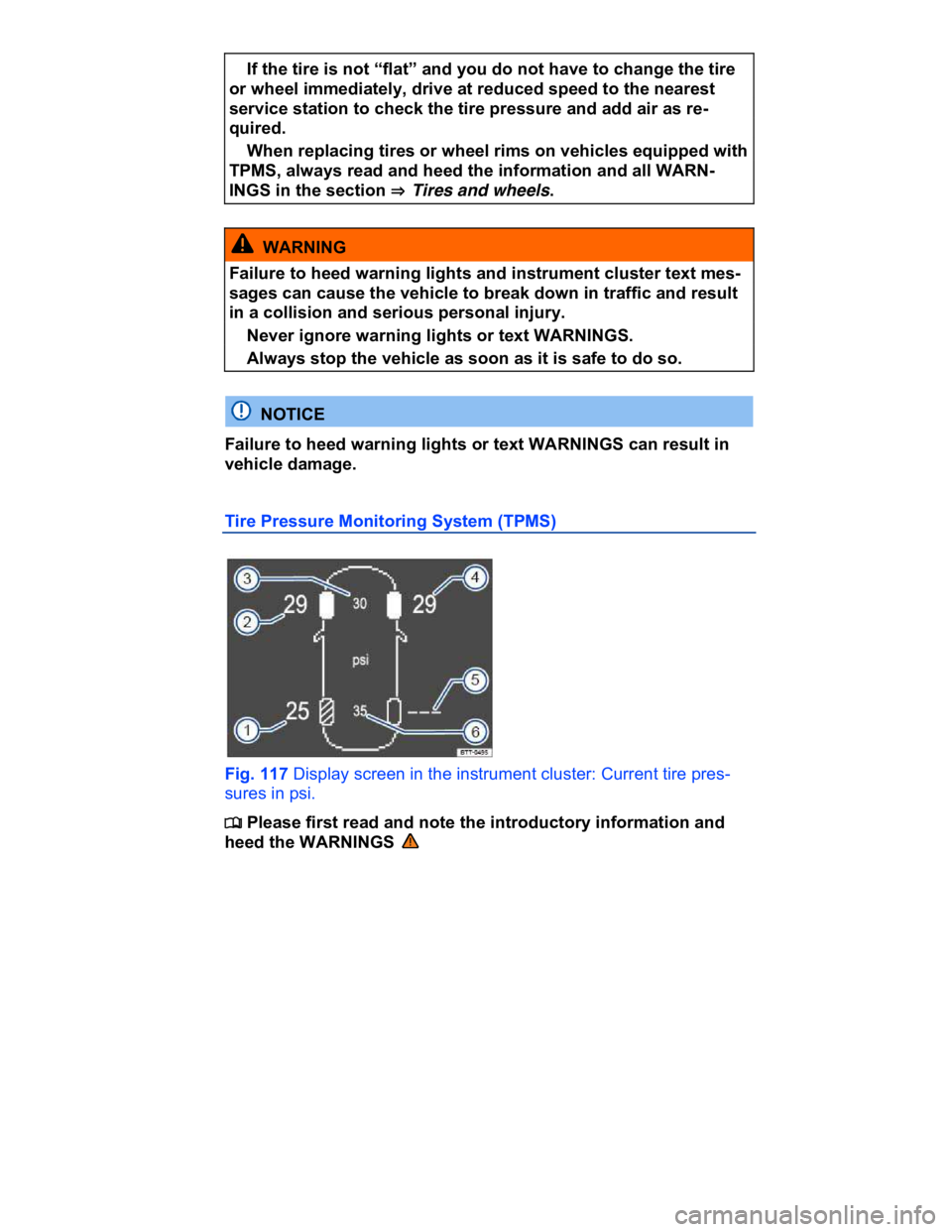
Tire Pressure Monitoring System (TPMS)
Fig. 117 Display screen in the instrument cluster: Current tire pres-
sures in psi.
Page 276 of 578

The Tire Pressure Monitoring System uses a pressure sensor in each
wheel. Signals from the sensors are transmitted to the TPMS.
The TPMS checks the tire pressure of all 4 tires while you are driving
and warns if there is a loss of pressure while the vehicle is moving.
Pressure loss that is 25% or more of the benchmark value pro-
grammed into the system is signaled by the indicator light (telltale)
described above, by acoustic warnings, and by text messages in the
instrument cluster display.
If you mount tires of a different size than the factory installed tires, an
authorized Volkswagen dealer or an authorized Volkswagen Service
Facility can adjust the benchmark TPMS tire pressure to match the
new tires. Without this adjustment, TPMS may not work correctly or at
all.
The tire pressure recommended for the tires originally installed on the
vehicle is on a sticker on the driver door jamb ⇒ Tire inflation pres-
sure.
Display in the instrument cluster
The display in the instrument cluster shows the vehicle with the actual
and benchmark tire pressures of all 4 road wheels ⇒ fig. 117
Tire pressure display screen
⇒ fig. 117 Meaning
(1) Tire pressure warning, left rear
tire.
(2) Current tire pressure, front left
tire.
(3) Benchmark pressure, front tires
(4) Current tire pressure, front right
tire.
(5) No data received, right rear tire.
(6) Benchmark pressure, rear tires
Page 325 of 578

gency shift program lets you drive the vehicle, but at a reduced speed
and without being able to use all of the forward gears.
In some cases, vehicles with a DSG® Direct Shift Gearbox automatic
transmission may not be able to shift into reverse. It is then impos-
sible to drive the vehicle backwards.
In any event, have the automatic transmission checked by an author-
ized Volkswagen dealer or authorized Volkswagen Service Facility.
Overheating of Direct Shift Gearbox (DSG®) automatic
transmission
The DSG® automatic transmission may overheat, for example, due to
frequent starts, extended “creeping,” or stop-and-go traffic. Overheat-
ing is indicated by the warning light