brake VOLKSWAGEN CC 2014 User Guide
[x] Cancel search | Manufacturer: VOLKSWAGEN, Model Year: 2014, Model line: CC, Model: VOLKSWAGEN CC 2014Pages: 578, PDF Size: 6.64 MB
Page 214 of 578

Trailer taillights
Trailer lights must meet all regulations ⇒ Hitching up and connecting
a trailer.
Never connect the trailer lights directly to the electrical system of your
vehicle.
Outside mirrors
If you cannot see the traffic behind you using the regular outside mir-
rors, then you must install extended mirrors. Extended mirrors may
also be required by law in some countries/states/provinces. Always
adjust the outside mirrors before driving. It's vital that you always
have a clear view to the rear of the vehicle.
Maximum power consumption for the trailer
Do not exceed the power ratings listed in the chart below.
Electrical load Maximum power
Brake lights total 108 watts
Turn signals per side 54 watts
Side marker lights total 100 watts
Taillights total 54 watts
WARNING
An improperly installed or incorrect trailer hitch can cause a
trailer to separate from the tow vehicle and cause serious per-
sonal injuries.
If you don't have to tow a trailer any more, remove the entire
trailer hitch. Always seal all bolt holes to prevent water and
deadly exhaust fumes from getting into the vehicle.
NOTICE
If the trailer lights are not connected properly, the vehicle's
electronics may be damaged.
Page 219 of 578

Starting off with a trailer on hills
Depending on how steep the hill is and the combined towing weight, a
parked vehicle with trailer can roll backwards when you first start
moving.
When starting off with a trailer on a hill:
Depress and hold the brake pedal (and depress and hold the clutch
- manual transmission).
Press the G button once to deactivate the electronic parking brake
⇒ Braking and parking.
Press the G button again and hold it to use the electronic parking
brake to help prevent the vehicle and trailer from rolling backwards. If
applicable, follow the instructions for the Hill Hold feature ⇒ Starting
assistance systems.
Shift into first gear or Drive D ⇒ Shifting.
Release the brake pedal.
Drive ahead slowly at first. If your vehicle has manual transmission,
slowly let out the clutch.
Do not release the G button until the engine starts to move the
vehicle forward. If your vehicle has an automatic transmission, you
can also depress and hold the brake pedal for added braking and
then let up on the brake pedal when you feel that the vehicle “wants”
to move forward.
Drive ahead slowly.
Page 220 of 578
WARNING
Improper trailer towing can cause loss of vehicle control and
serious personal injury.
Driving with a trailer and carrying heavy or bulky items
changes the way the vehicle handles and increases the dis-
tance it needs to stop safely.
Always watch what is happening up ahead and around you.
Brake earlier than you would if you were not towing a trailer.
Always adapt your speed and driving to the heavier load and
the weight distribution in the vehicle. Take road, weather, traf-
fic, and visibility conditions into account as well.
Reduce your speed even more than you otherwise would
when going downhill and under unfavorable load, weather, or
wind conditions.
Drive especially carefully and accelerate gently. Always avoid
sudden maneuvers and hard braking.
Be especially careful when passing other vehicles.
Reduce speed immediately if the trailer shows even the
slightest sign of swaying.
Never try to stop the swaying by accelerating.
Always obey speed limits. In some areas speed limits for ve-
hicles towing trailers are lower than for vehicles without trail-
ers.
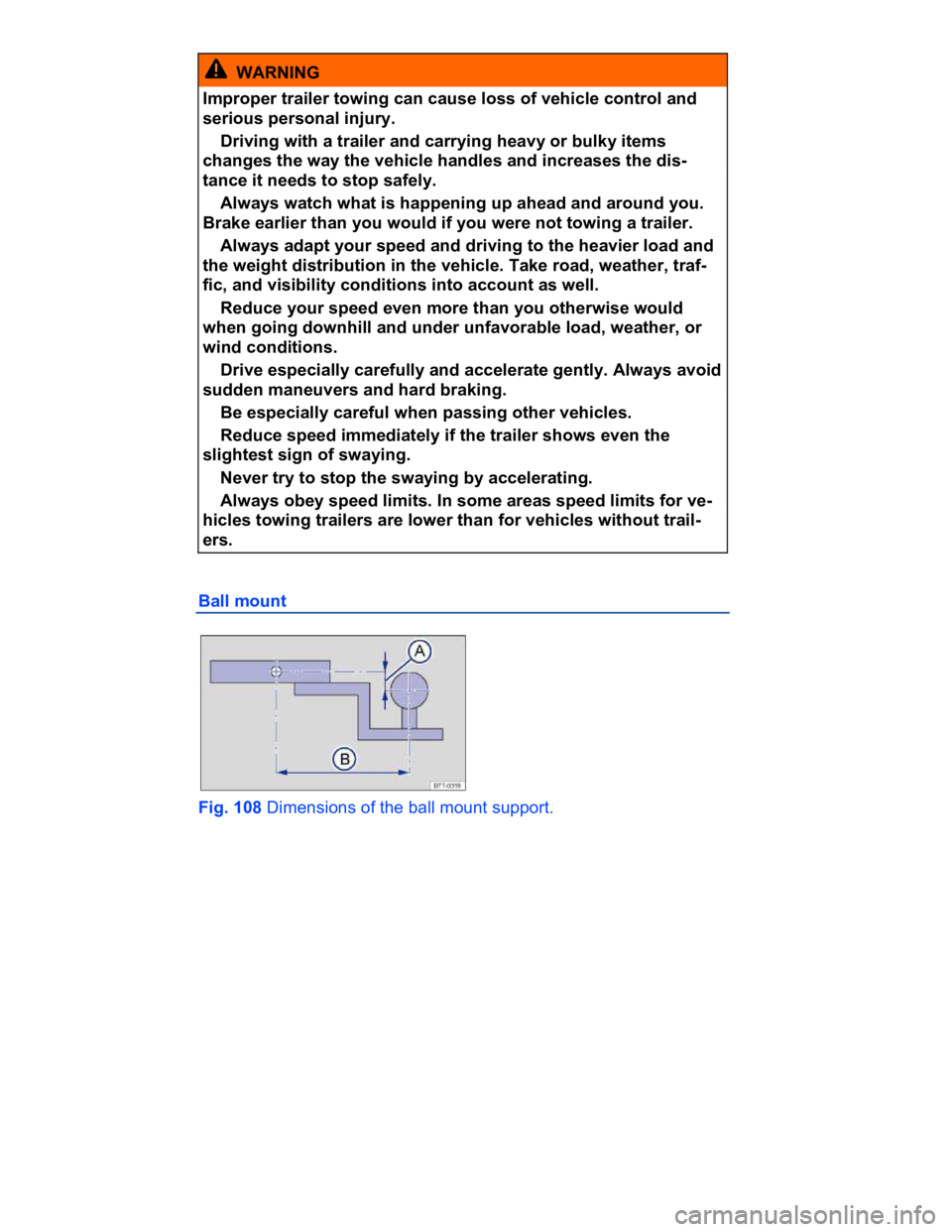
Ball mount
Fig. 108 Dimensions of the ball mount support.
Page 225 of 578
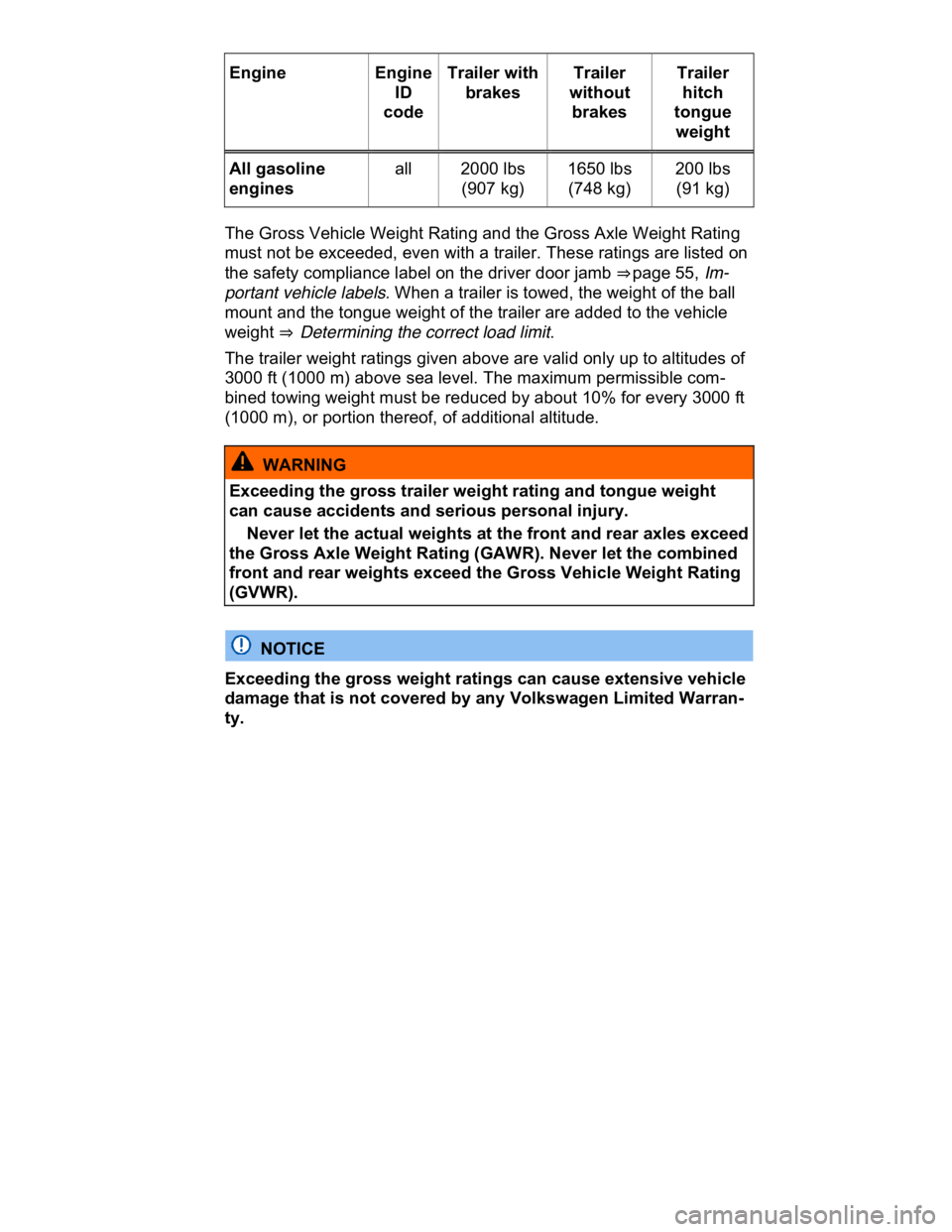
Engine Engine
ID
code
Trailer with
brakes
Trailer
without
brakes
Trailer
hitch
tongue
weight
All gasoline
engines
all 2000 lbs
(907 kg)
1650 lbs
(748 kg)
200 lbs
(91 kg)
The Gross Vehicle Weight Rating and the Gross Axle Weight Rating
must not be exceeded, even with a trailer. These ratings are listed on
the safety compliance label on the driver door jamb ⇒ page 55, Im-
portant vehicle labels. When a trailer is towed, the weight of the ball
mount and the tongue weight of the trailer are added to the vehicle
weight ⇒ Determining the correct load limit.
The trailer weight ratings given above are valid only up to altitudes of
3000 ft (1000 m) above sea level. The maximum permissible com-
bined towing weight must be reduced by about 10% for every 3000 ft
(1000 m), or portion thereof, of additional altitude.
WARNING
Exceeding the gross trailer weight rating and tongue weight
can cause accidents and serious personal injury.
Never let the actual weights at the front and rear axles exceed
the Gross Axle Weight Rating (GAWR). Never let the combined
front and rear weights exceed the Gross Vehicle Weight Rating
(GVWR).
NOTICE
Exceeding the gross weight ratings can cause extensive vehicle
damage that is not covered by any Volkswagen Limited Warran-
ty.
Page 230 of 578

The tires and wheels are essential parts of the vehicle's design. The
tires and wheels approved by Volkswagen are specially matched to
the characteristics of the vehicle for good road holding and safe han-
dling when in good condition and properly inflated.
Avoiding tire damage
If you must drive over a curb or other obstacle, drive very slowly
and as much as possible at a right angle to the curb with the tire tread
of both front wheels contacting the curb at the same time.
Regularly check tires for damage, such as punctures, cuts, tears
and blisters.
Remove embedded material in the tread profile that has not yet
penetrated the inside of the tire ⇒ Tire wear and damage.
Heed all warning messages from the Tire Pressure Monitoring Sys-
tem
Replace worn or damaged tires immediately ⇒ Tire wear and
damage.
Damage to tires and wheels is often not readily visible. If you notice
unusual vibration or the vehicle pulls to one side, this may indicate
that one of the tires is damaged. The tires must be checked immedi-
ately for hidden damage by an authorized Volkswagen dealer or an
authorized Volkswagen Service Facility. See also ⇒ Tire wear and
damage.
Never exceed the load and permissible maximum speed rating of
the tires ⇒ Tire labeling.
Always keep aggressive chemicals including grease, oil, gasoline
and brake fluid off the tires, including the spare wheel ⇒ .
Replace missing valve caps immediately.
Unidirectional tires
Unidirectional tires are designed to rotate only in one direction. Unidi-
rectional tires have arrows on the sidewalls that show the direction of
rotation ⇒ Tire labeling. Unidirectional tires must always be mounted
according to the specified direction of rotation in order to deliver their
best grip, braking performance, low road noise, and good wear as
well as good hydroplaning resistance.
If you have to mount a tire opposite to its proper direction of rotation,
you must drive more carefully, since the tire is no longer being used
as designed. This is particularly important on wet roads. You must
Page 235 of 578
sure values stored in your vehicle's TPMS may have to be adjusted
(reprogrammed). This requires professional assistance. For more
information, contact your authorized Volkswagen dealer or authorized
Volkswagen Service Facility.
Installing replacement tires with steel cord body plies in the tire side-
wall may cause malfunction of the TPMS, and is not recommended
(cord material information in molded on the tire sidewall).
Always check the TPMS indicator light after replacing one or more
tires on your vehicle. If the indicator light is on, the TPMS is not work-
ing properly. Your replacement tire might be incompatible with the
system, or some component of the TPMS may be damaged.
For detailed information about TPMS, how it works and what you
need to know ⇒ Tire Pressure Monitoring System (TPMS).
WARNING
New tires tend to be slippery and must be broken in.
Always drive with special care for the first 350 miles (560 km)
to help reduce the risk of losing control, a collision, and serious
personal injuries.
WARNING
Tires must have the required clearance. Tires that do not have
enough clearance can rub against parts of the vehicle body,
suspension, and brake system, causing brake system failure,
tread delamination, and sudden blowouts.
Always make sure that new tires are not larger than the tires
approved for your vehicle and that the new tires do not rub
against parts of the vehicle.
NOTICE
When switching to different tires, make certain the valves and
sensors are not damaged.
Never drive without valve stem caps. The valves and sensors
could be damaged.
Page 256 of 578

Accessory weight
The combined weight (in excess of those standard items which may
be replaced) of automatic transmission, electro-mechanical power
steering, power brakes, power windows, power seats, radio, and
heater, to the extent that these items are available as factory-installed
equipment (whether installed or not).
Aspect ratio
The ratio of sidewall height to tire width, expressed as a percentage.
A number of 70 (0.7:1 or 70%) or lower indicates a low-profile tire with
a shorter sidewall for improved steering response and better overall
handling on dry pavement.
Bead
The part of a tire made of steel wires, wrapped or reinforced by ply
cords, with the shape and structure to ensure proper fit to the wheel
rim.
Bead separation
A breakdown of the bond between components in the bead.
Carcass
The tire structure, except tread and sidewall rubber which, when in-
flated, bears the load.
Chunking
The breaking away of pieces of the tread or sidewall.
Cord
The strands of material forming the plies in the tire.
Cord separation
The parting of cords from adjacent rubber compounds.
Cracking
Any parting within the tread, sidewall, or inner liner of the tire extend-
ing to cord material.
Cold tire inflation pressure
The tire pressure recommended by the vehicle manufacturer for a tire
of a specified size that has not been driven for more than a couple of
Page 258 of 578

Normal occupant weight
Means 150 lbs (68 kilograms) times the number of occupants seated
in the vehicle up to the total seating capacity of your vehicle.
Occupant distribution
The placement of passengers in a vehicle.
Outer diameter
The diameter of a new, properly inflated tire.
Overall width
Total width measured at the exterior sidewalls of an inflated tire, in-
cluding the additional width of labeling, decorations, or protective
bands or ribs.
Passenger car tire
A tire intended for use on passenger cars, multipurpose passenger
vehicles, and trucks, that have a gross vehicle weight rating (GVWR)
of 10,000 pounds or less.
Ply
A layer of rubber-coated parallel cords.
Ply separation
A parting of rubber compound between adjacent plies.
Pneumatic tire
A mechanical device made of rubber, chemicals, fabric, and steel or
other materials, that, when mounted on an automotive wheel, pro-
vides the traction and contains the gas or fluid that sustains the load.
Production options weight
The combined weight of installed regular production options weighing
over 5 lbs (2.3 kg) more than the standard items they replace, and not
previously considered as curb weight or accessory weight. These
include, for example, heavy-duty brakes, ride levelers, roof rack,
heavy-duty battery, and special trim.
Radial ply tires
A pneumatic tire in which the ply cords that extend to the beads are
laid at substantially 90 degrees to the centerline of the tread.
Page 263 of 578

WARNING
Overloading a vehicle can cause loss of vehicle control, a crash
or other accident, serious personal injury, and even death.
Carrying more weight than your vehicle was designed to car-
ry will prevent the vehicle from handling properly and increase
the risk of the loss of vehicle control.
The brakes on a vehicle that has been overloaded may not be
able to stop the vehicle in a safe distance.
Tires on a vehicle that has been overloaded can fail sudden-
ly, including a blowout and sudden deflation, causing loss of
control and a crash.
Always make sure that the total load being transported – in-
cluding the weight of a trailer hitch and the tongue weight of a
loaded trailer – does not make the vehicle heavier than the ve-
hicle's Gross Vehicle Weight Rating.
Determining the correct load limit
Page 299 of 578

WARNING
Switching off the engine while the vehicle is moving can make
the vehicle harder to stop and result in loss of vehicle control,
leading to collisions and severe personal injuries.
Brake and steering assistance systems, the airbag system,
safety belt pretensioners, and other vehicle safety features only
work when the engine is running.
Switch off the engine only when the vehicle is not moving.
WARNING
To reduce the risk of serious personal injury when starting and
running the vehicle's engine:
Never start the engine or let it run in a confined or enclosed
area. Engine exhaust contains carbon monoxide, a poisonous,
colorless, and odorless gas. Carbon monoxide can cause un-
consciousness and death.
Never leave the vehicle unattended with the engine running.
The vehicle could move suddenly or some other unexpected
event could occur, resulting in property damage or personal
injury.
Never use starting assist fluids. Starting fluids can explode
and can cause a “run-away” vehicle condition.
WARNING
The vehicle exhaust system and the catalytic converter get very
hot. They can cause fires and serious personal injury.
Never park the vehicle where the hot exhaust system or cata-
lytic converter could ignite flammable materials, such as brush,
leaves, dry grass, spilled fuel, etc.
Never apply additional undercoating or rust proofing on or
near the exhaust manifold, exhaust pipes, catalytic converter,
or heat shields.