engine VOLKSWAGEN CORRADO 1990 Repair Manual
[x] Cancel search | Manufacturer: VOLKSWAGEN, Model Year: 1990, Model line: CORRADO, Model: VOLKSWAGEN CORRADO 1990Pages: 906, PDF Size: 6.56 MB
Page 497 of 906
EMISSION CONTROL VISUAL INSPECTION PROCEDURES
Article Text (p. 3)
1990 Volkswagen Corrado
For Volkswagen Technical Site: http://vw.belcom.ru
Copyright © 1998 Mitchell Repair Information Company, LLC
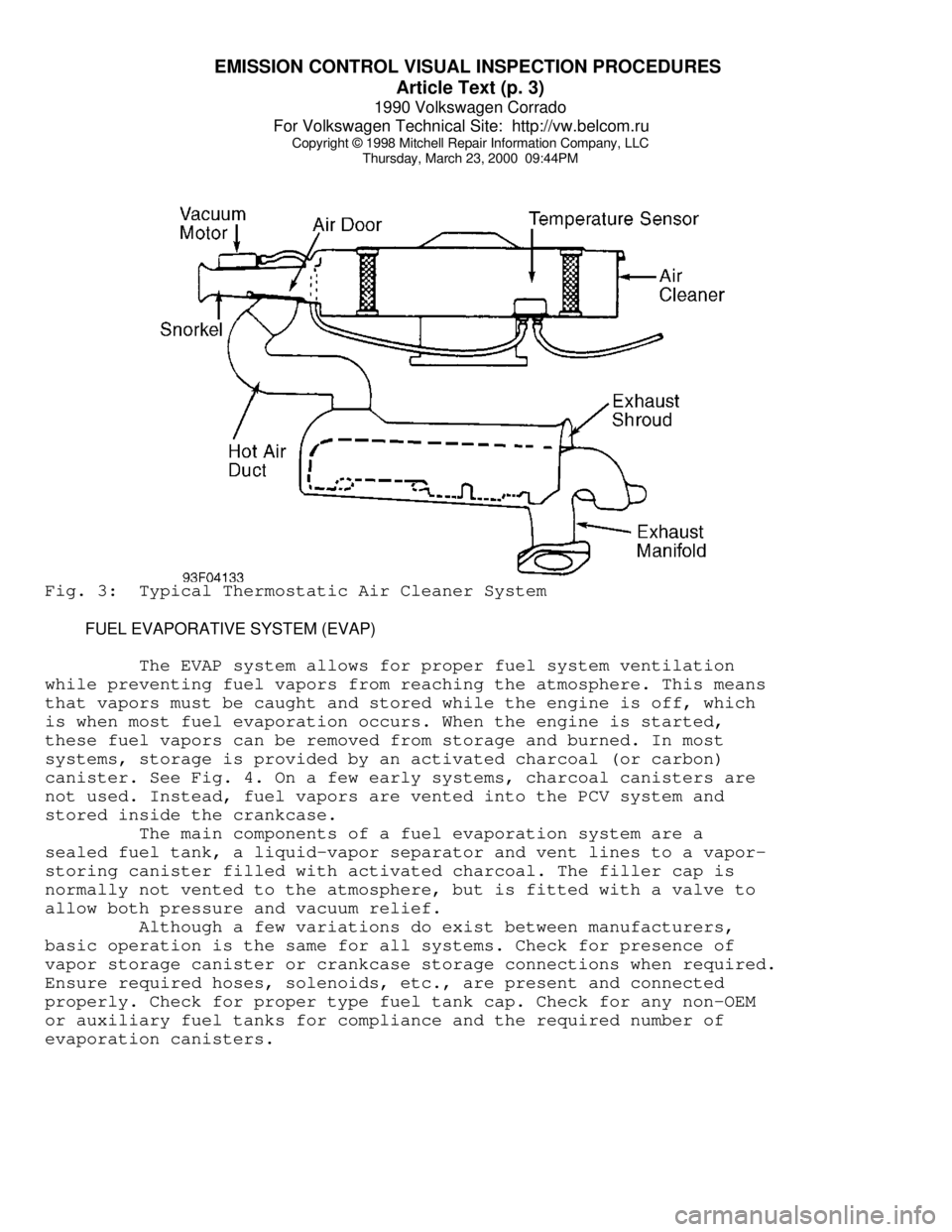
Thursday, March 23, 2000 09:44PMFig. 3: Typical Thermostatic Air Cleaner System
FUEL EVAPORATIVE SYSTEM (EVAP)
The EVAP system allows for proper fuel system ventilation
while preventing fuel vapors from reaching the atmosphere. This means
that vapors must be caught and stored while the engine is off, which
is when most fuel evaporation occurs. When the engine is started,
these fuel vapors can be removed from storage and burned. In most
systems, storage is provided by an activated charcoal (or carbon)
canister. See Fig. 4. On a few early systems, charcoal canisters are
not used. Instead, fuel vapors are vented into the PCV system and
stored inside the crankcase.
The main components of a fuel evaporation system are a
sealed fuel tank, a liquid-vapor separator and vent lines to a vapor-
storing canister filled with activated charcoal. The filler cap is
normally not vented to the atmosphere, but is fitted with a valve to
allow both pressure and vacuum relief.
Although a few variations do exist between manufacturers,
basic operation is the same for all systems. Check for presence of
vapor storage canister or crankcase storage connections when required.
Ensure required hoses, solenoids, etc., are present and connected
properly. Check for proper type fuel tank cap. Check for any non-OEM
or auxiliary fuel tanks for compliance and the required number of
evaporation canisters.
Page 500 of 906
EMISSION CONTROL VISUAL INSPECTION PROCEDURES
Article Text (p. 6)
1990 Volkswagen Corrado
For Volkswagen Technical Site: http://vw.belcom.ru
Copyright © 1998 Mitchell Repair Information Company, LLC
Thursday, March 23, 2000 09:44PM
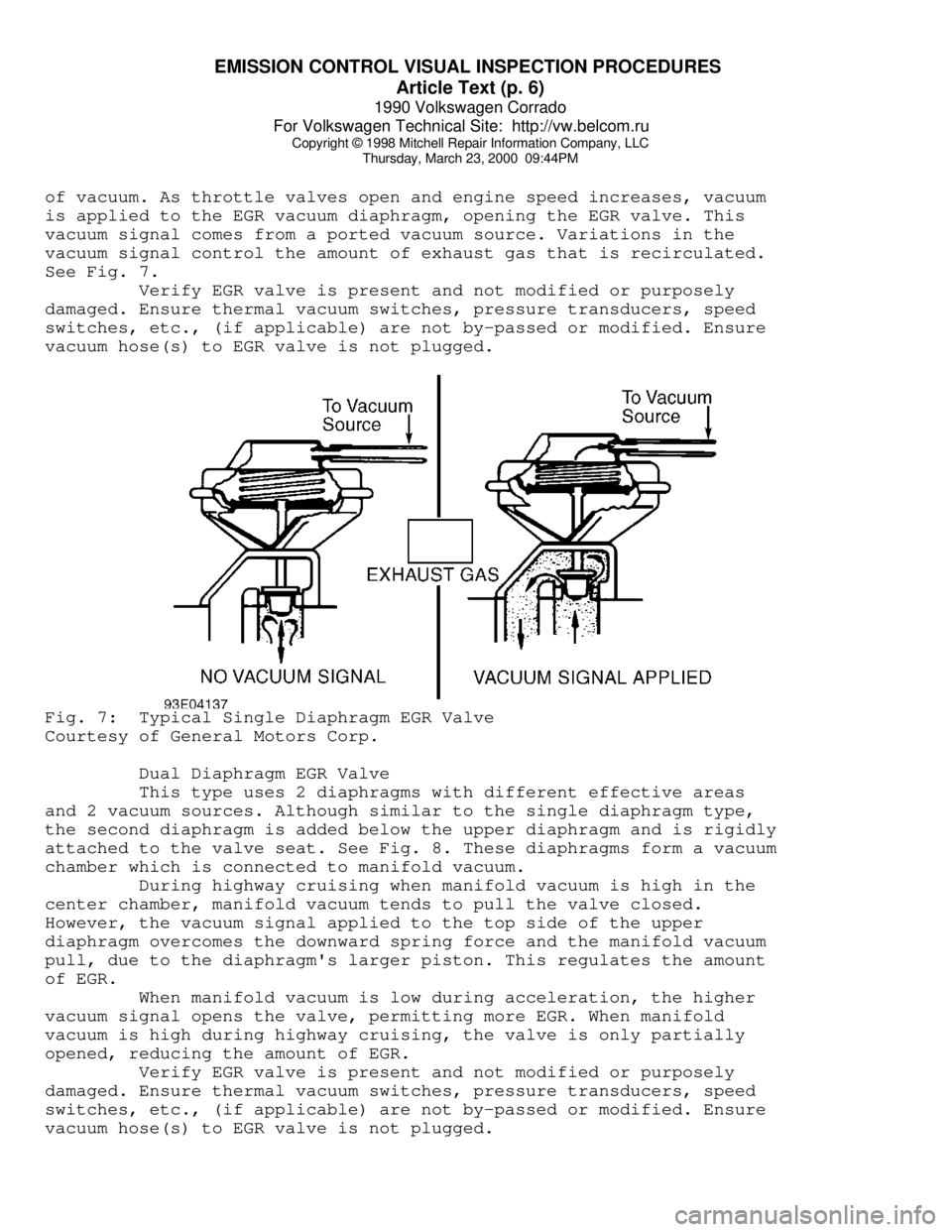
of vacuum. As throttle valves open and engine speed increases, vacuum
is applied to the EGR vacuum diaphragm, opening the EGR valve. This
vacuum signal comes from a ported vacuum source. Variations in the
vacuum signal control the amount of exhaust gas that is recirculated.
See Fig. 7.
Verify EGR valve is present and not modified or purposely
damaged. Ensure thermal vacuum switches, pressure transducers, speed
switches, etc., (if applicable) are not by-passed or modified. Ensure
vacuum hose(s) to EGR valve is not plugged.Fig. 7: Typical Single Diaphragm EGR Valve
Courtesy of General Motors Corp.
Dual Diaphragm EGR Valve
This type uses 2 diaphragms with different effective areas
and 2 vacuum sources. Although similar to the single diaphragm type,
the second diaphragm is added below the upper diaphragm and is rigidly
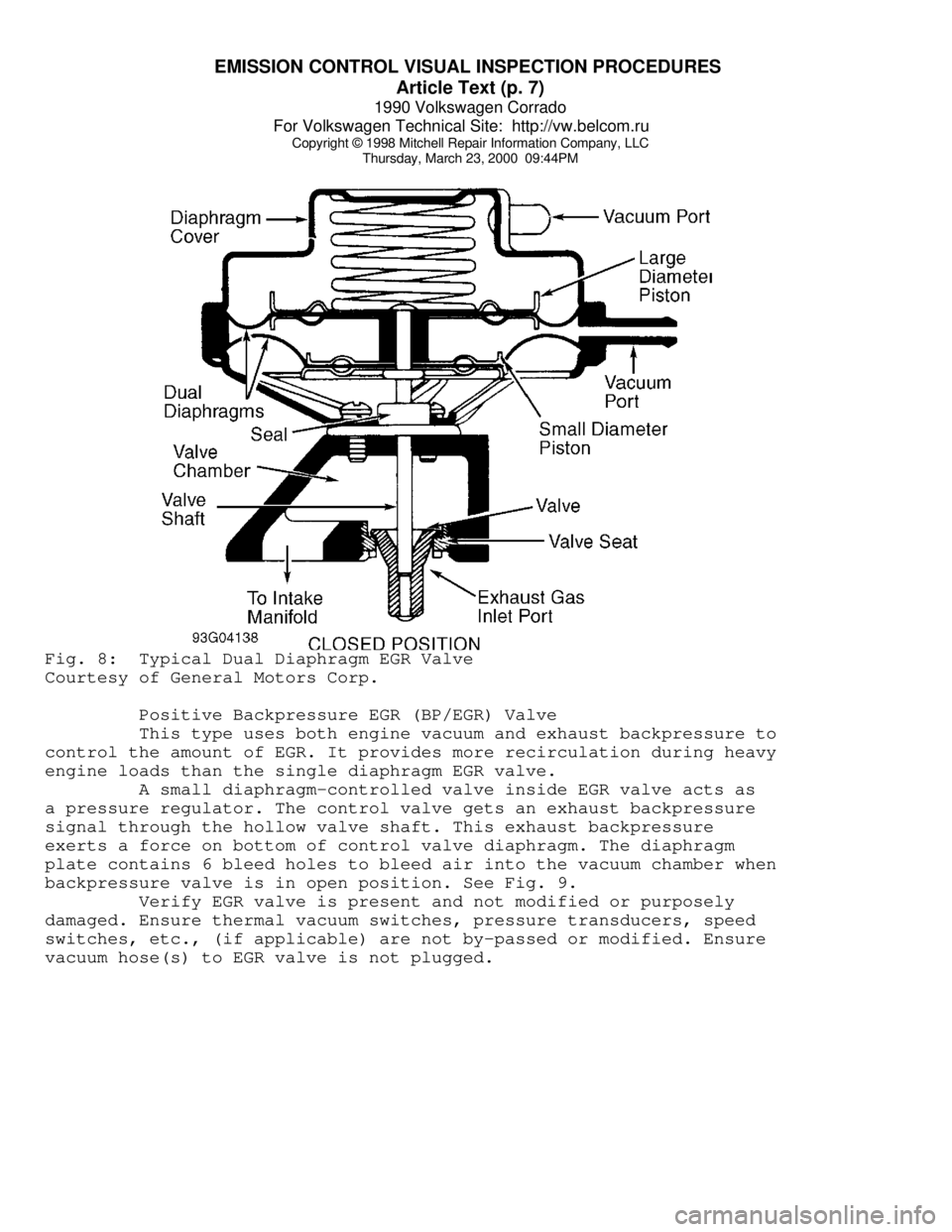
attached to the valve seat. See Fig. 8. These diaphragms form a vacuum
chamber which is connected to manifold vacuum.
During highway cruising when manifold vacuum is high in the
center chamber, manifold vacuum tends to pull the valve closed.
However, the vacuum signal applied to the top side of the upper
diaphragm overcomes the downward spring force and the manifold vacuum
pull, due to the diaphragm's larger piston. This regulates the amount
of EGR.
When manifold vacuum is low during acceleration, the higher
vacuum signal opens the valve, permitting more EGR. When manifold
vacuum is high during highway cruising, the valve is only partially
opened, reducing the amount of EGR.
Verify EGR valve is present and not modified or purposely
damaged. Ensure thermal vacuum switches, pressure transducers, speed
switches, etc., (if applicable) are not by-passed or modified. Ensure
vacuum hose(s) to EGR valve is not plugged.
Page 501 of 906
EMISSION CONTROL VISUAL INSPECTION PROCEDURES
Article Text (p. 7)
1990 Volkswagen Corrado
For Volkswagen Technical Site: http://vw.belcom.ru
Copyright © 1998 Mitchell Repair Information Company, LLC
Thursday, March 23, 2000 09:44PMFig. 8: Typical Dual Diaphragm EGR Valve
Courtesy of General Motors Corp.
Positive Backpressure EGR (BP/EGR) Valve
This type uses both engine vacuum and exhaust backpressure to
control the amount of EGR. It provides more recirculation during heavy
engine loads than the single diaphragm EGR valve.
A small diaphragm-controlled valve inside EGR valve acts as
a pressure regulator. The control valve gets an exhaust backpressure
signal through the hollow valve shaft. This exhaust backpressure
exerts a force on bottom of control valve diaphragm. The diaphragm
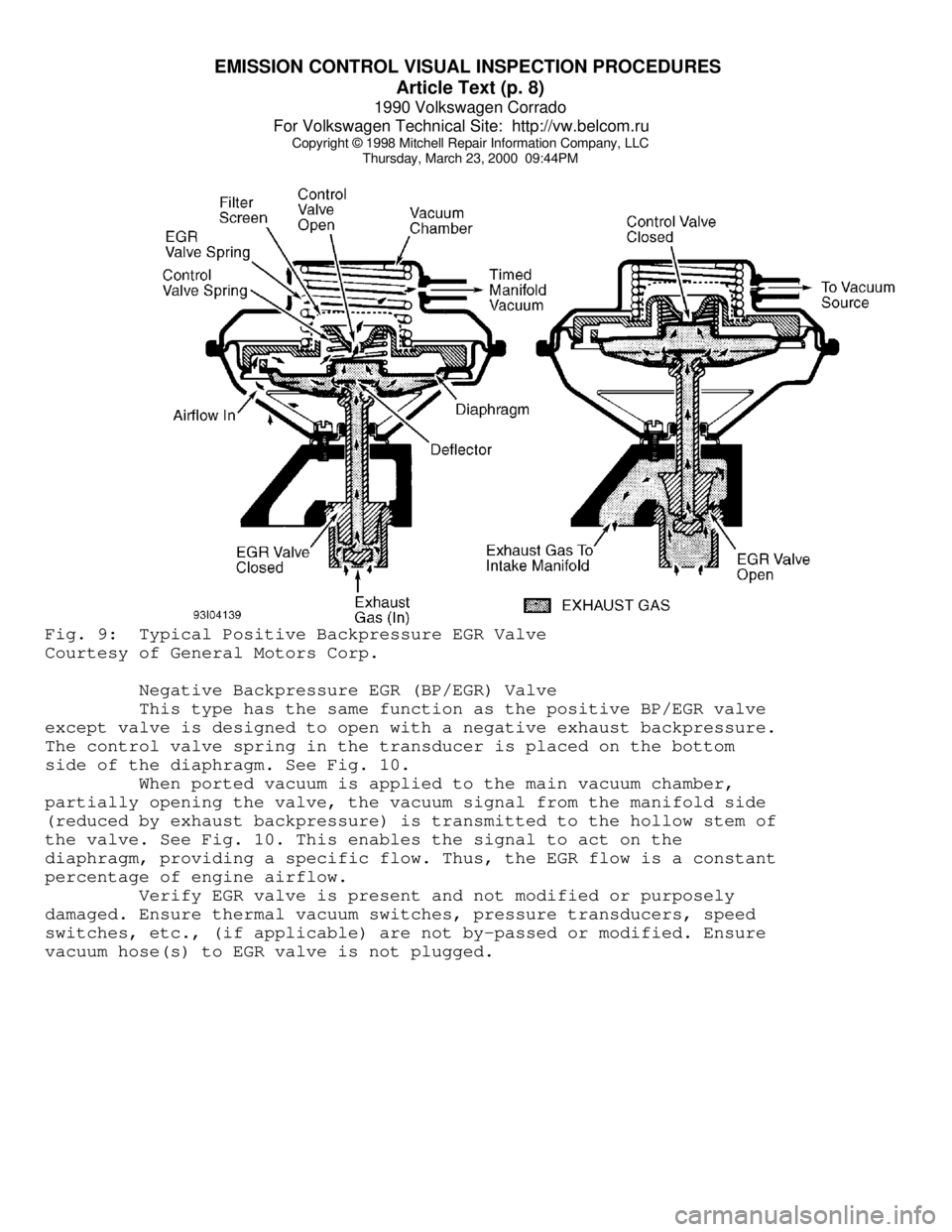
plate contains 6 bleed holes to bleed air into the vacuum chamber when
backpressure valve is in open position. See Fig. 9.
Verify EGR valve is present and not modified or purposely
damaged. Ensure thermal vacuum switches, pressure transducers, speed
switches, etc., (if applicable) are not by-passed or modified. Ensure
vacuum hose(s) to EGR valve is not plugged.
Page 502 of 906
EMISSION CONTROL VISUAL INSPECTION PROCEDURES
Article Text (p. 8)
1990 Volkswagen Corrado
For Volkswagen Technical Site: http://vw.belcom.ru
Copyright © 1998 Mitchell Repair Information Company, LLC
Thursday, March 23, 2000 09:44PMFig. 9: Typical Positive Backpressure EGR Valve
Courtesy of General Motors Corp.
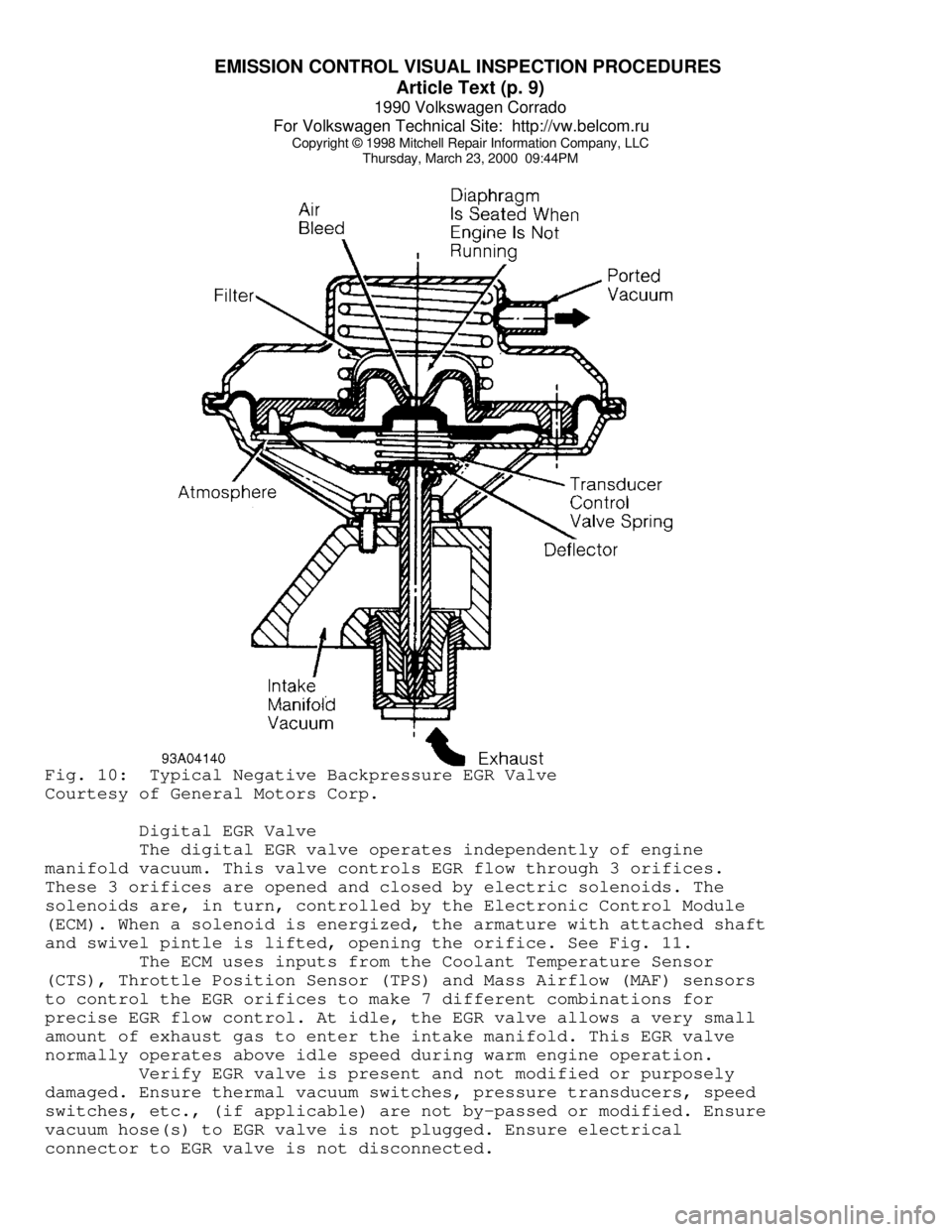
Negative Backpressure EGR (BP/EGR) Valve
This type has the same function as the positive BP/EGR valve
except valve is designed to open with a negative exhaust backpressure.
The control valve spring in the transducer is placed on the bottom
side of the diaphragm. See Fig. 10.
When ported vacuum is applied to the main vacuum chamber,
partially opening the valve, the vacuum signal from the manifold side
(reduced by exhaust backpressure) is transmitted to the hollow stem of
the valve. See Fig. 10. This enables the signal to act on the
diaphragm, providing a specific flow. Thus, the EGR flow is a constant
percentage of engine airflow.
Verify EGR valve is present and not modified or purposely
damaged. Ensure thermal vacuum switches, pressure transducers, speed
switches, etc., (if applicable) are not by-passed or modified. Ensure
vacuum hose(s) to EGR valve is not plugged.
Page 503 of 906
EMISSION CONTROL VISUAL INSPECTION PROCEDURES
Article Text (p. 9)
1990 Volkswagen Corrado
For Volkswagen Technical Site: http://vw.belcom.ru
Copyright © 1998 Mitchell Repair Information Company, LLC
Thursday, March 23, 2000 09:44PMFig. 10: Typical Negative Backpressure EGR Valve
Courtesy of General Motors Corp.
Digital EGR Valve
The digital EGR valve operates independently of engine
manifold vacuum. This valve controls EGR flow through 3 orifices.
These 3 orifices are opened and closed by electric solenoids. The
solenoids are, in turn, controlled by the Electronic Control Module
(ECM). When a solenoid is energized, the armature with attached shaft
and swivel pintle is lifted, opening the orifice. See Fig. 11.
The ECM uses inputs from the Coolant Temperature Sensor
(CTS), Throttle Position Sensor (TPS) and Mass Airflow (MAF) sensors
to control the EGR orifices to make 7 different combinations for
precise EGR flow control. At idle, the EGR valve allows a very small
amount of exhaust gas to enter the intake manifold. This EGR valve
normally operates above idle speed during warm engine operation.
Verify EGR valve is present and not modified or purposely
damaged. Ensure thermal vacuum switches, pressure transducers, speed
switches, etc., (if applicable) are not by-passed or modified. Ensure
vacuum hose(s) to EGR valve is not plugged. Ensure electrical
connector to EGR valve is not disconnected.
Page 505 of 906
EMISSION CONTROL VISUAL INSPECTION PROCEDURES
Article Text (p. 11)
1990 Volkswagen Corrado
For Volkswagen Technical Site: http://vw.belcom.ru
Copyright © 1998 Mitchell Repair Information Company, LLC
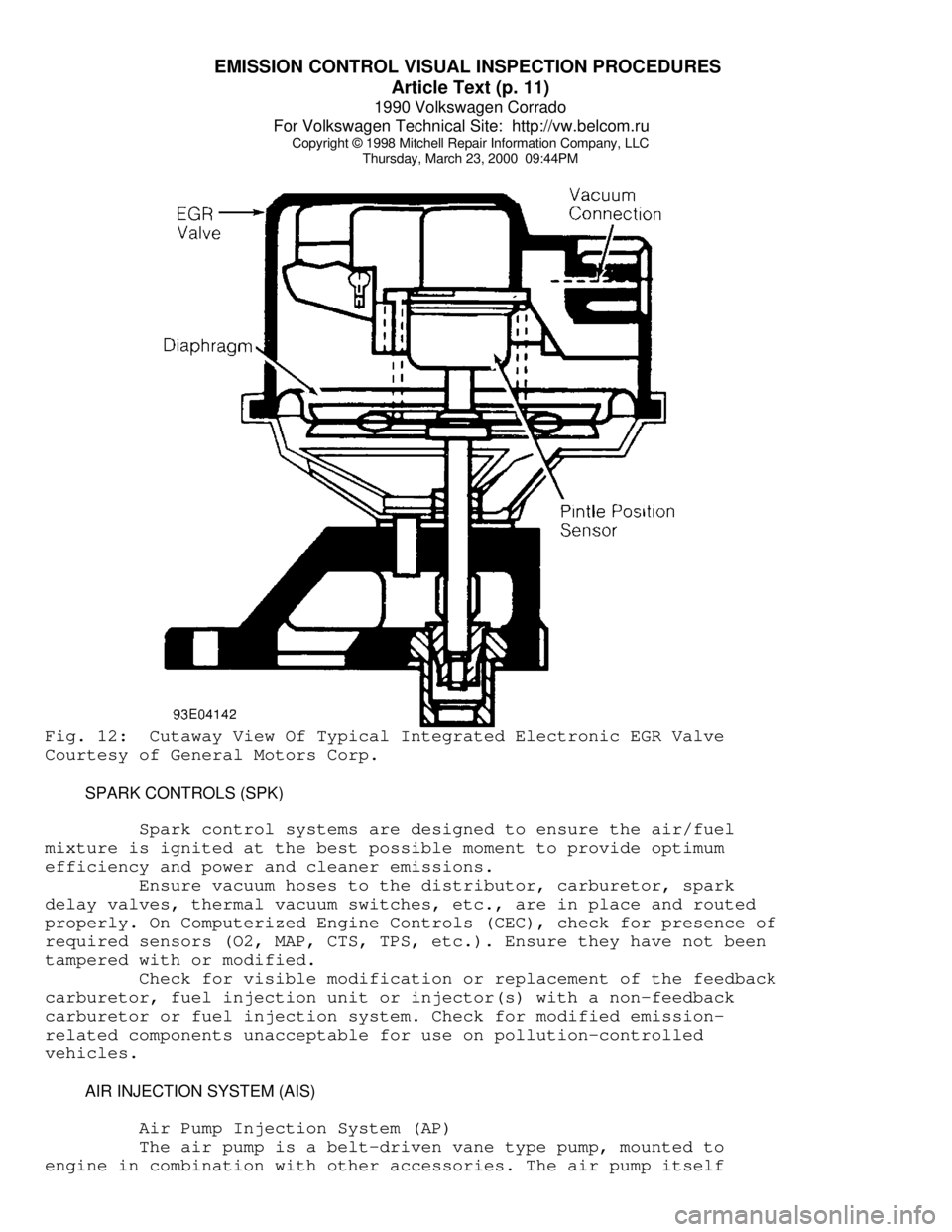
Thursday, March 23, 2000 09:44PMFig. 12: Cutaway View Of Typical Integrated Electronic EGR Valve
Courtesy of General Motors Corp.
SPARK CONTROLS (SPK)
Spark control systems are designed to ensure the air/fuel
mixture is ignited at the best possible moment to provide optimum
efficiency and power and cleaner emissions.
Ensure vacuum hoses to the distributor, carburetor, spark
delay valves, thermal vacuum switches, etc., are in place and routed
properly. On Computerized Engine Controls (CEC), check for presence of
required sensors (O2, MAP, CTS, TPS, etc.). Ensure they have not been
tampered with or modified.
Check for visible modification or replacement of the feedback
carburetor, fuel injection unit or injector(s) with a non-feedback
carburetor or fuel injection system. Check for modified emission-
related components unacceptable for use on pollution-controlled
vehicles.
AIR INJECTION SYSTEM (AIS)
Air Pump Injection System (AP)
The air pump is a belt-driven vane type pump, mounted to
engine in combination with other accessories. The air pump itself
Page 507 of 906

EMISSION CONTROL VISUAL INSPECTION PROCEDURES
Article Text (p. 13)
1990 Volkswagen Corrado
For Volkswagen Technical Site: http://vw.belcom.ru
Copyright © 1998 Mitchell Repair Information Company, LLC
Thursday, March 23, 2000 09:44PM
OXYGEN SENSOR (O2)
The O2 sensor is mounted in the exhaust system where it
monitors oxygen content of exhaust gases. Some vehicles may use 2 O2
sensors. The O2 sensor produces a voltage signal which is proportional
to exhaust gas oxygen concentration (0-3%) compared to outside oxygen
(20-21%). This voltage signal is low (about .1 volt) when a lean
mixture is present and high (1.0 volt) when a rich mixture is present.
As ECM compensates for a lean or rich condition, this
voltage signal constantly fluctuates between high and low, crossing a
reference voltage supplied by the ECM on the O2 signal line. This is
referred to as cross counts. A problem in the O2 sensor circuit should
set a related trouble code.
COMPUTERIZED ENGINE CONTROLS (CEC)
The CEC system monitors and controls a variety of
engine/vehicle functions. The CEC system is primarily an emission
control system designed to maintain a 14.7:1 air/fuel ratio under most
operating conditions. When the ideal air/fuel ratio is maintained, the
catalytic converter can control oxides of nitrogen (NOx), hydrocarbon
(HC) and carbon monoxide (CO) emissions.
The CEC system consists of the following sub-systems:
Electronic Control Module (ECM), input devices (sensors and switches)
and output signals.
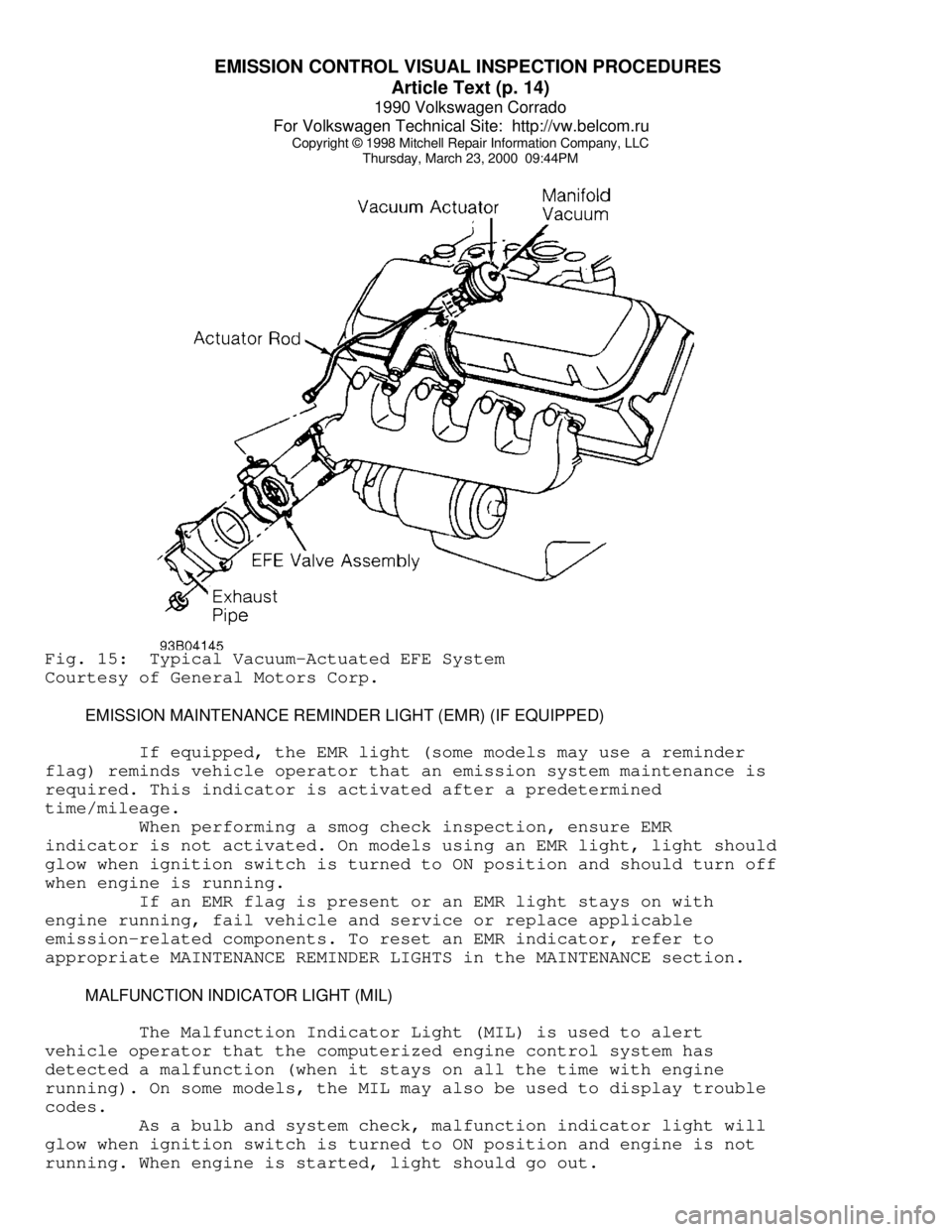
EARLY FUEL EVAPORATION (EFE)
The EFE valve is actuated by either a vacuum actuator or a
bimetal spring (heat-riser type). The EFE valve is closed when engine
is cold. The closed valve restricts exhaust gas flow from the exhaust
manifold. This forces part of the exhaust gas to flow up through a
passage below the carburetor. As the exhaust gas quickly warms the
intake mixture, distribution is improved. This results in better cold
engine driveability, shorter choke periods and lower emissions.
Ensure EFE valve in exhaust manifold is not frozen or rusted
in a fixed position. On vacuum-actuated EFE system, check EFE thermal
vacuum valve and check valve(s). Also check for proper vacuum hose
routing. See Fig. 15.
Page 508 of 906
EMISSION CONTROL VISUAL INSPECTION PROCEDURES
Article Text (p. 14)
1990 Volkswagen Corrado
For Volkswagen Technical Site: http://vw.belcom.ru
Copyright © 1998 Mitchell Repair Information Company, LLC
Thursday, March 23, 2000 09:44PMFig. 15: Typical Vacuum-Actuated EFE System
Courtesy of General Motors Corp.
EMISSION MAINTENANCE REMINDER LIGHT (EMR) (IF EQUIPPED)
If equipped, the EMR light (some models may use a reminder
flag) reminds vehicle operator that an emission system maintenance is
required. This indicator is activated after a predetermined
time/mileage.
When performing a smog check inspection, ensure EMR
indicator is not activated. On models using an EMR light, light should
glow when ignition switch is turned to ON position and should turn off
when engine is running.
If an EMR flag is present or an EMR light stays on with
engine running, fail vehicle and service or replace applicable
emission-related components. To reset an EMR indicator, refer to
appropriate MAINTENANCE REMINDER LIGHTS in the MAINTENANCE section.
MALFUNCTION INDICATOR LIGHT (MIL)
The Malfunction Indicator Light (MIL) is used to alert
vehicle operator that the computerized engine control system has
detected a malfunction (when it stays on all the time with engine
running). On some models, the MIL may also be used to display trouble
codes.
As a bulb and system check, malfunction indicator light will
glow when ignition switch is turned to ON position and engine is not
running. When engine is started, light should go out.
Page 510 of 906

ENGINE OVERHAUL PROCEDURES - GENERAL INFORMATION
Article Text
1990 Volkswagen Corrado
For Volkswagen Technical Site: http://vw.belcom.ru
Copyright © 1998 Mitchell Repair Information Company, LLC
Thursday, March 23, 2000 09:44PM
ARTICLE BEGINNING
Engine Overhaul Procedures - General Information
ALL PISTON ENGINES
* PLEASE READ THIS FIRST *
Examples used in this article are general in nature and do
not necessarily relate to a specific engine or system. Illustrations
and procedures have been chosen to guide mechanic through engine
overhaul process. Descriptions of processes of cleaning, inspection,
assembly and machine shop practice are included.
Always refer to appropriate engine overhaul article in the
ENGINES section for complete overhaul procedures and specifications
for the vehicle being repaired.
ENGINE IDENTIFICATION
The engine may be identified from its Vehicle Identification
Number (VIN) stamped on a metal tab. Metal tab may be located in
different locations depending on manufacturer. Engine identification
number or serial number is located on cylinder block. Location varies
with manufacturer.
INSPECTION PROCEDURES
* PLEASE READ THIS FIRST *
NOTE: Always refer to appropriate engine overhaul article in the
ENGINES section for complete overhaul procedures and
specifications for the vehicle being repaired.
GENERAL
Engine components must be inspected to meet manufacturer's
specifications and tolerances during overhaul. Proper dimensions and
tolerances must be met to obtain proper performance and maximum engine
life.
Micrometers, depth gauges and dial indicator are used for
checking tolerances during engine overhaul. Magnaflux, Magnaglo, dye-
check, ultrasonic and x-ray inspection procedures are used for parts
inspection.
MAGNETIC PARTICLE INSPECTION
Magnaflux & Magnaglo
Magnaflux is an inspection technique used to locate material
flaws and stress cracks. The part in question is subjected to a strong
magnetic field. The entire part, or a localized area, can be
magnetized. The part is coated with either a wet or dry material that
contains fine magnetic particles.
Page 511 of 906

ENGINE OVERHAUL PROCEDURES - GENERAL INFORMATION
Article Text (p. 2)
1990 Volkswagen Corrado
For Volkswagen Technical Site: http://vw.belcom.ru
Copyright © 1998 Mitchell Repair Information Company, LLC
Thursday, March 23, 2000 09:44PM
Cracks which are outlined by the particles cause an
interruption in the magnetic field. The dry powder method of Magnaflux
can be used in normal light. A crack will appear as an obvious bright
line.
Fluorescent liquid is used in conjunction with a blacklight
in a second Magnaflux system called Magnaglo. This type of inspection
demands a darkened room. The crack will appear as a glowing line in
this process. Both systems require complete demagnetizing upon
completion of the inspection. Magnetic particle inspection applies to
ferrous materials only.
PENETRANT INSPECTION
Zyglo
The Zyglo process coats the material with a fluorescent dye
penetrant. The part is often warmed to expand cracks that will be
penetrated by the dye. When the coated part is subjected to inspection
with a blacklight, a crack will glow brightly. Developing solution
is often used to enhance results. Parts made of any material, such as
aluminum cylinder heads or plastics, may be tested using this process.
Dye Check
Penetrating dye is sprayed on the previously cleaned
component. Dye is left on component for 5-45 minutes, depending upon
material density. Component is then wiped clean and sprayed with a
developing solution. Surface cracks will show up as a bright line.
ULTRASONIC INSPECTION
If an expensive part is suspected of internal cracking,
Ultrasonic testing is used. Sound waves are used for component
inspection.
X-RAY INSPECTION
This form of inspection is used on highly stressed
components. X-ray inspection maybe used to detect internal and
external flaws in any material.
PRESSURE TESTING
Cylinder heads can be tested for cracks using a pressure
tester. Pressure testing is performed by plugging all but one of the
holes in the head and injecting air or water into the open passage.
Leaks are indicated by the appearance of wet or damp areas when using
water. When air is used, it is necessary to spray the head surface
with a soap solution. Bubbles will indicate a leak. Cylinder head may
also be submerged in water heated to specified temperature to check
for cracks created during heat expansion.
CLEANING PROCEDURES