check engine VOLKSWAGEN CORRADO 1990 Repair Manual
[x] Cancel search | Manufacturer: VOLKSWAGEN, Model Year: 1990, Model line: CORRADO, Model: VOLKSWAGEN CORRADO 1990Pages: 906, PDF Size: 6.56 MB
Page 740 of 906

STEERING COLUMN SWITCHES
Article Text
1990 Volkswagen Corrado
For Volkswagen Technical Site: http://vw.belcom.ru
Copyright © 1998 Mitchell Repair Information Company, LLC
Thursday, March 23, 2000 09:51PM
ARTICLE BEGINNING
1989-92 SAFETY EQUIPMENT
Steering Column Switches
Cabriolet, Corrado, Fox,
Golf, GTI, Jetta, Passat
WARNING: To avoid injury from accidental air bag deployment, read and
carefully follow all WARNINGS and SERVICE PRECAUTIONS.
NOTE: For information on air bag DIAGNOSIS & TESTING or DISPOSAL
PROCEDURES, see the AIR BAGS article.
SERVICE PRECAUTIONS
Observe these precautions when working with air bag systems:
* DO NOT use computer memory saver tool. Using computer
memory tool will keep air bag system active and may
cause accidental deployment of air bag unit.
* Disable air bag system before servicing any air bag
system or steering column component. See DISABLING &
ACTIVATING AIR BAG SYSTEM.
* Because of critical operating requirements of system,
DO NOT attempt to service any air bag system component.
* Air bag parts should not be left unattended. They
should be installed in vehicle immediately after
obtaining them.
* Air bag components which have been dropped more than 18
inches should not be used.
* Chemical cleaners, oil and grease should not contact
vinyl covering on air bag unit.
* DO NOT place stickers or covers on steering wheel.
* Always disable air bag system before performing
electric welding on vehicle.
* Air bag system can only be tested using Diagnostic
Tester (VAG 1551) and Multimeter (US 1119). Never use
test light on air bag system.
* DO NOT expose air bag unit to temperatures greater than
194øF (90øC).
SYSTEM OPERATION CHECK
Two lights pertaining to air bag system are located directly
above air bag symbol in instrument cluster. See Fig. 1.
Control light is used to indicate readiness of system. This
light, which glows when ignition switch is turned to ON position or
engine is started, will stay on approximately 5-8 seconds while
diagnosis unit in air bag control unit performs an electronic test
cycle of system.
Page 748 of 906

STEERING SYSTEM - POWER
Article Text
1990 Volkswagen Corrado
For Volkswagen Technical Site: http://vw.belcom.ru
Copyright © 1998 Mitchell Repair Information Company, LLC
Thursday, March 23, 2000 09:51PM
ARTICLE BEGINNING
1990-92 STEERING
Volkswagen - Power Rack & Pinion
1990-92 Passat
1991-92 Cabriolet, Corrado, Golf, GTI, Jetta, Vanagon
DESCRIPTION & OPERATION
System consists of a vane pump, rack and pinion steering
gear, and an oil reservoir. Vane pump draws fluid from reservoir and
supplies it to flow control valve. Control valve directs fluid to
appropriate side of rack piston.
LUBRICATION
CAPACITY
Fluid capacity is approximately 1 qt. (.95L).
FLUID TYPE
On all models, the recommended fluid type is V.W. Hydraulic
Oil (G 002 000).
FLUID LEVEL CHECK
Remove reservoir cover. Start engine and let idle. Fluid
level should be between MIN and MAX marks on reservoir.
HYDRAULIC SYSTEM BLEEDING
1) Start engine and let idle. Ensure fluid is at proper
level. Turn steering wheel from lock to lock several times quickly.
2) Continue until fluid level remains at reservoir mark.
Ensure no bubbles appear in reservoir when steering wheel is turned.
Shut off engine. Ensure oil level does not rise more than 3/8" (10
mm).
Page 750 of 906
STEERING SYSTEM - POWER
Article Text (p. 3)
1990 Volkswagen Corrado
For Volkswagen Technical Site: http://vw.belcom.ru
Copyright © 1998 Mitchell Repair Information Company, LLC
Thursday, March 23, 2000 09:51PM
3) If pump pressure is not within specification, replace
pump.
STEERING WHEEL TURNING FORCE
Except Vanagon
Remove steering gear. See POWER RACK & PINION under REMOVAL &
INSTALLATION. Loosen lock nut. Turn adjuster bolt until pinion shaft
can be turned by hand without binding. Hold adjuster bolt in position
while tightening lock nut.
Vanagon
If steering effort is too high, check steering shaft,
steering linkage, "U" joints, and ball joints for binding. If all are
okay, replace steering gear.
REMOVAL & INSTALLATION
POWER STEERING PUMP
Removal
Remove alternator and pump belts. Disconnect hydraulic lines
from pump. Cap lines to prevent contamination. Remove bracket bolts.
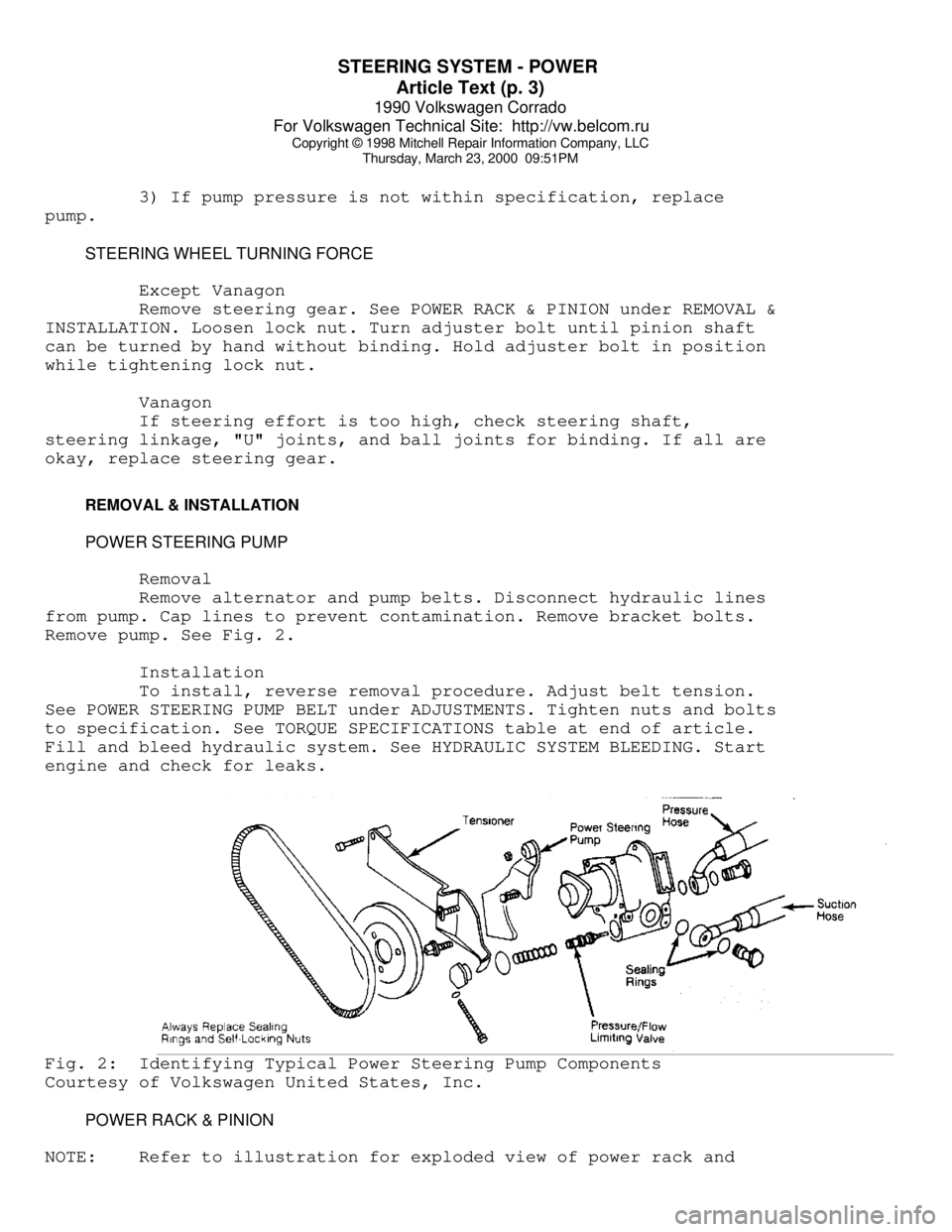
Remove pump. See Fig. 2.
Installation
To install, reverse removal procedure. Adjust belt tension.
See POWER STEERING PUMP BELT under ADJUSTMENTS. Tighten nuts and bolts
to specification. See TORQUE SPECIFICATIONS table at end of article.
Fill and bleed hydraulic system. See HYDRAULIC SYSTEM BLEEDING. Start
engine and check for leaks.Fig. 2: Identifying Typical Power Steering Pump Components
Courtesy of Volkswagen United States, Inc.
POWER RACK & PINION
NOTE: Refer to illustration for exploded view of power rack and
Page 751 of 906

STEERING SYSTEM - POWER
Article Text (p. 4)
1990 Volkswagen Corrado
For Volkswagen Technical Site: http://vw.belcom.ru
Copyright © 1998 Mitchell Repair Information Company, LLC
Thursday, March 23, 2000 09:51PM
pinion components. See Fig. 1.
Removal (Cabriolet)
1) Remove pressure line from pump. Drain fluid from pump and
line. Disconnect tie rod ends from steering knuckles. Remove
transmission mount and bracket. Remove exhaust manifold.
2) Remove hydraulic lines from steering gear. Plug openings.
Remove shift linkage from steering gear (if equipped). Remove ground
wire. Disconnect pinion shaft at "U" joint. Remove retaining bolts and
steering gear.
Removal (Corrado)
1) Disconnect return line from pump. Drain fluid from pump
and line. Disconnect tie rod ends from steering knuckles.
2) Remove lock bolt at "U" joint. Remove steering gear
retaining bolts. Disconnect hydraulic lines at steering gear. Plug
openings.
3) Support engine and transmission. Remove subframe bolts.
Remove steering gear.
Removal (Golf, GTI & Jetta)
1) Disconnect return line from pump. Drain fluid from pump
and line. Disconnect tie rod ends from steering knuckles.
2) Remove shift linkage from steering gear (if equipped).
Disconnect pinion shaft at "U" joint. Disconnect hydraulic lines from
steering gear. Plug openings. Remove retaining bolts.
3) Support engine and transmission with Engine Support (10-
222A). Remove left transmission mount bolts. Loosen right transmission
mount bolts. Remove steering gear.
Removal (Passat)
1) Disconnect return line from pump. Drain fluid from pump
and line. Disconnect tie rod ends from steering knuckles.
2) Support engine and transmission with Engine Support (10-
222A and 10-222A/1). Remove steering gear boot. Remove transmission
mount bolts. Lower engine/transmission sufficiently to separate
steering shaft halves.
3) Disconnect hydraulic lines from steering gear. Plug
openings. Remove retaining nuts and steering gear.
Removal (Vanagon)
1) Removal and installation information is not available from
manufacturer.
Installation (All Models)
Reverse removal procedure to install. Tighten nuts and bolts
to specification. See TORQUE SPECIFICATIONS table at end of article.
Fill and bleed hydraulic system. See HYDRAULIC SYSTEM BLEEDING. Check
wheel alignment. See appropriate WHEEL ALIGNMENT SPECIFICATIONS &
PROCEDURES article in the WHEEL ALIGNMENT section:
* WHEEL ALIGNMENT SPECIFICATIONS & PROCEDURES - (1990 - All
Page 755 of 906
SUSPENSION - FRONT
Article Text (p. 3)
1990 Volkswagen Corrado
For Volkswagen Technical Site: http://vw.belcom.ru
Copyright © 1998 Mitchell Repair Information Company, LLC
Thursday, March 23, 2000 09:51PM
REMOVAL & INSTALLATION
HUB & KNUCKLE ASSEMBLY
Use exploded view illustration when removing or installing
hub and knuckle assembly. See Fig. 1 or 2.
LOWER CONTROL ARM & BALL JOINT
Removal
1) Raise and support vehicle. Remove bolt retaining ball
joint at wheel bearing housing. Force ball joint from of housing.
Leave control arm hanging in mounts at subframe.
2) If control arm is not to be removed and ball joint is
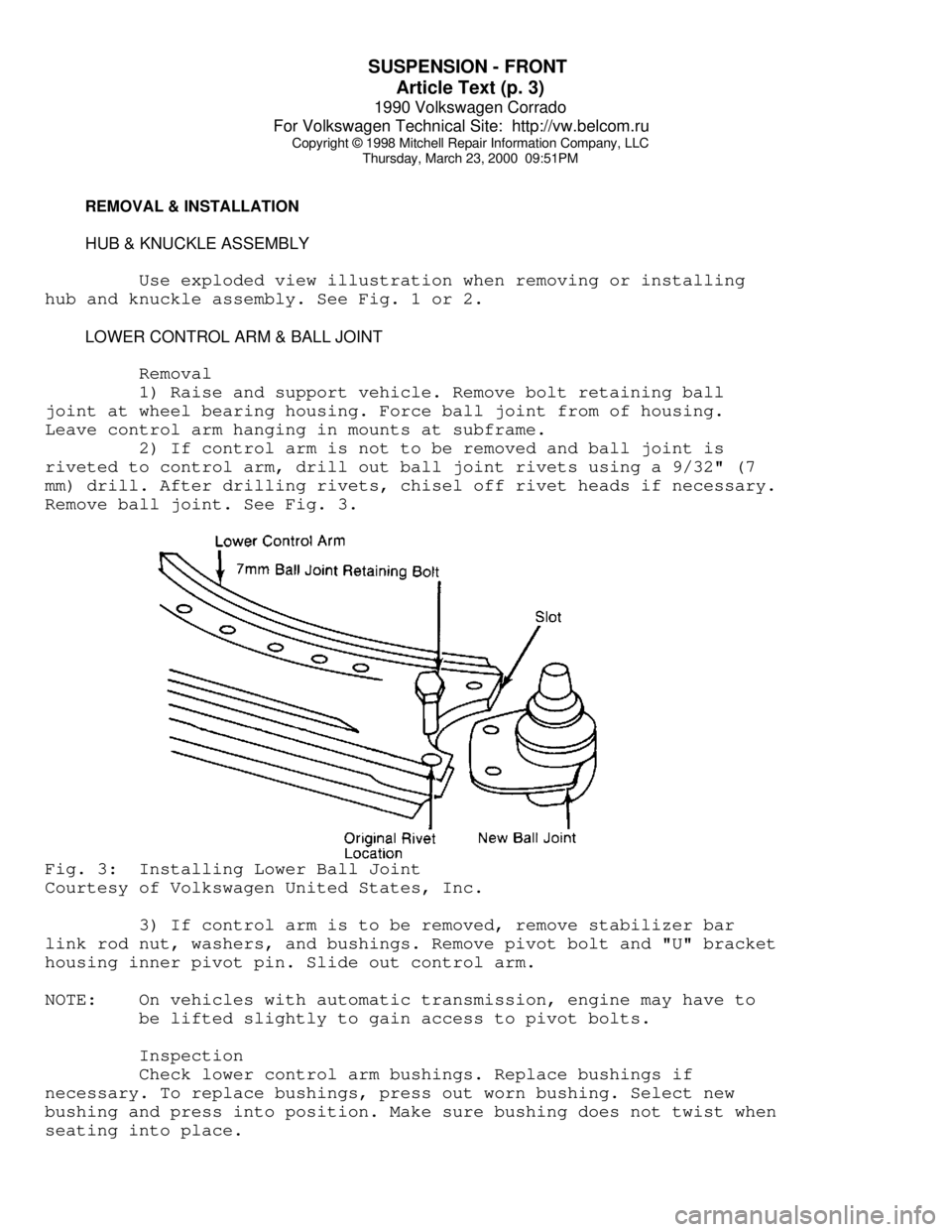
riveted to control arm, drill out ball joint rivets using a 9/32" (7
mm) drill. After drilling rivets, chisel off rivet heads if necessary.
Remove ball joint. See Fig. 3.Fig. 3: Installing Lower Ball Joint
Courtesy of Volkswagen United States, Inc.
3) If control arm is to be removed, remove stabilizer bar
link rod nut, washers, and bushings. Remove pivot bolt and "U" bracket
housing inner pivot pin. Slide out control arm.
NOTE: On vehicles with automatic transmission, engine may have to
be lifted slightly to gain access to pivot bolts.
Inspection
Check lower control arm bushings. Replace bushings if
necessary. To replace bushings, press out worn bushing. Select new
bushing and press into position. Make sure bushing does not twist when
seating into place.
Page 756 of 906

SUSPENSION - FRONT
Article Text (p. 4)
1990 Volkswagen Corrado
For Volkswagen Technical Site: http://vw.belcom.ru
Copyright © 1998 Mitchell Repair Information Company, LLC
Thursday, March 23, 2000 09:51PM
Installation
Slide new ball joint into slot in control arm. Install and
tighten ball joint retaining bolts. Install lower control arm to
subframe. Install ball joint into wheel bearing housing. To complete
installation, reverse removal procedure. Tighten control arm bolts
with vehicle on ground. Tighten all bolts and nuts to specification.
See TORQUE SPECIFICATIONS TABLE at end of article. Check wheel
alignment. See SPECIFICATIONS & PROCEDURES article in the WHEEL
ALIGNMENT Section.
STRUT ASSEMBLY
Removal
1) Raise and support vehicle. Remove wheel assembly. Remove
and support caliper assembly out of work area. Remove bolts which
retain strut to wheel bearing housing. Note top bolt is used to adjust
front wheel camber.
2) Support front suspension arm and related components. Pry
suspension strut from wheel bearing housing. Working inside engine
compartment, remove upper strut retaining nuts. Remove strut.
Installation
To install, reverse removal procedure. Tighten bolts and nuts
to specification. See TORQUE SPECIFICATIONS TABLE at end of article.
Check wheel alignment. See SPECIFICATIONS & PROCEDURES article in the
WHEEL ALIGNMENT Section.
FRONT SUSPENSION ASSEMBLY
Removal
1) Raise vehicle and support at center with safety stands.
Disconnect brake line and plug openings. Leave flex line in place.
Remove stabilizer link rod nut, bushings and washers.
2) Remove tie rod nut. Separate tie rod from wheel bearing
housing. Remove bolts retaining inner portion of constant velocity
joint to transaxle drive flange.
3) Remove lower control arm front pivot bolt. Remove bolts
retaining "U" shaped bracket holding control arm rear pivot.
NOTE: On vehicles with automatic transmission, engine may have to
be lifted slightly to gain access to pivot bolts.
4) Support suspension assembly being removed. Remove upper
strut retaining nuts. Remove suspension assembly from vehicle.
Installation
To install, reverse removal procedure. Make sure convex side
of thrust washer faces pivot bolt head. Tighten bolts and nuts to
specification. Check wheel alignment.See SPECIFICATIONS & PROCEDURES
article in the WHEEL ALIGNMENT Section.
WHEEL BEARING
Page 766 of 906

TRANSMISSION SERVICING - A/T
Article Text
1990 Volkswagen Corrado
For Volkswagen Technical Site: http://vw.belcom.ru
Copyright © 1998 Mitchell Repair Information Company, LLC
Thursday, March 23, 2000 09:51PM
ARTICLE BEGINNING
1990-91 TRANSMISSION SERVICING
Automatic Transmission
Cabriolet, Corrado, Golf, GTI, Jetta, Passat
IDENTIFICATION
VOLKSWAGEN AUTOMATIC TRANSMISSION APPLICATIONS TABLEÄÄÄÄÄÄÄÄÄÄÄÄÄÄÄÄÄÄÄÄÄÄÄÄÄÄÄÄÄÄÄÄÄÄÄÄÄÄÄÄÄÄÄÄÄÄÄÄÄÄÄÄÄÄÄModel Transmission
Cabriolet, Golf,
GTI & Jetta ................ Model 010 Transmission
Corrado & Passat ............. Model 096 Transmission
ÄÄÄÄÄÄÄÄÄÄÄÄÄÄÄÄÄÄÄÄÄÄÄÄÄÄÄÄÄÄÄÄÄÄÄÄÄÄÄÄÄÄÄÄÄÄÄÄÄÄÄÄÄÄÄ LUBRICATION SERVICE INTERVALS
Check fluid level at each oil change. Change fluid every 30,
000 miles under severe driving conditions. Replace ATF filter on
Corrado and Passat every 30,000 miles (if equipped).
CHECKING LUBRICANT FLUID LEVEL
TRANSMISSION
Park vehicle on level surface, with transmission at normal
operating temperature. Set selector lever to Park or Neutral. Apply
parking brake. Allow engine to idle. Remove dipstick, wipe clean, and
reinsert. Remove dipstick. Fluid level should be between marks on
dipstick.
NOTE: Normal transmission fluid color on late production vehicles
is Red/Brown.
FINAL DRIVE (EXCEPT CORRADO & PASSAT)
Place vehicle on level surface. Fluid level should be up to
edge of fill hole on side of case.
FINAL DRIVE (CORRADO & PASSAT)
Place vehicle on level surface. Remove speedometer drive
shaft. Wipe shaft clean. Reinsert and again remove shaft. Fluid level
should be between MIN and MAX marks on shaft.
RECOMMENDED LUBRICANT FLUID
Page 781 of 906

TROUBLE SHOOTING - BASIC PROCEDURES
Article Text (p. 5)
1990 Volkswagen Corrado
For Volkswagen Technical Site: http://vw.belcom.ru
Copyright © 1998 Mitchell Repair Information Company, LLC
Thursday, March 23, 2000 09:52PM
Binding brake pedal See DISC, DRUM BRAKES
or BRAKE SYSTEMÄÄÄÄÄÄÄÄÄÄÄÄÄÄÄÄÄÄÄÄÄÄÄÄÄÄÄÄÄÄÄÄÄÄÄÄÄÄÄÄÄÄÄÄÄÄÄÄÄÄÄÄÄÄÄÄÄÄÄÄÄÄÄÄÄÄÄÄÄÄPulsation or
Roughness Uneven pad wear caused by See DISC BRAKES or
caliper BRAKE SYSTEM
Uneven rotor wear See DISC BRAKES or
BRAKE SYSTEM
Drums out-of-round Reface or replace drums
ÄÄÄÄÄÄÄÄÄÄÄÄÄÄÄÄÄÄÄÄÄÄÄÄÄÄÄÄÄÄÄÄÄÄÄÄÄÄÄÄÄÄÄÄÄÄÄÄÄÄÄÄÄÄÄÄÄÄÄÄÄÄÄÄÄÄÄÄÄÄ CARBURETOR TROUBLE SHOOTING:
READ THIS FIRST:
WARNING: This is GENERAL information. This article is not intended
to be specific to any unique situation or individual vehicle
configuration. The purpose of this Trouble Shooting
information is to provide a list of common causes to
problem symptoms. For model-specific Trouble Shooting,
refer to SUBJECT, DIAGNOSTIC, or TESTING articles available
in the section(s) you are accessing.
COLD START SYMPTOMS
BASIC COLD START SYMPTOMS TROUBLE SHOOTING CHART
ÄÄÄÄÄÄÄÄÄÄÄÄÄÄÄÄÄÄÄÄÄÄÄÄÄÄÄÄÄÄÄÄÄÄÄÄÄÄÄÄÄÄÄÄÄÄÄÄÄÄÄÄÄÄÄÄÄÄÄÄÄÄÄÄÄÄÄÄÄÄCONDITION POSSIBLE CAUSE CORRECTION
ÄÄÄÄÄÄÄÄÄÄÄÄÄÄÄÄÄÄÄÄÄÄÄÄÄÄÄÄÄÄÄÄÄÄÄÄÄÄÄÄÄÄÄÄÄÄÄÄÄÄÄÄÄÄÄÄÄÄÄÄÄÄÄÄÄÄÄÄÄÄEngine Won't Choke not closing Check choke
Start operation, see
FUEL SYSTEMS
Choke linkage bent Check linkage, see
FUEL SYSTEM
ÄÄÄÄÄÄÄÄÄÄÄÄÄÄÄÄÄÄÄÄÄÄÄÄÄÄÄÄÄÄÄÄÄÄÄÄÄÄÄÄÄÄÄÄÄÄÄÄÄÄÄÄÄÄÄÄÄÄÄÄÄÄÄÄÄÄÄÄÄÄEngine Starts, Choke vacuum kick setting Check setting and
Then Dies too wide adjust see, FUEL
SYSTEMS
Fast idle RPM too low Reset RPM to specif-
ication, see TUNE-UP
Fast idle cam index Reset fast idle cam
incorrect index, see FUEL
SYSTEMS
Vacuum leak Inspect vacuum
system for leaks
Page 782 of 906

TROUBLE SHOOTING - BASIC PROCEDURES
Article Text (p. 6)
1990 Volkswagen Corrado
For Volkswagen Technical Site: http://vw.belcom.ru
Copyright © 1998 Mitchell Repair Information Company, LLC
Thursday, March 23, 2000 09:52PM
Low fuel pump outlet Repair or replace
pump, see FUEL
SYSTEMS
Low carburetor fuel level Check float setting
see FUEL SYSTEMÄÄÄÄÄÄÄÄÄÄÄÄÄÄÄÄÄÄÄÄÄÄÄÄÄÄÄÄÄÄÄÄÄÄÄÄÄÄÄÄÄÄÄÄÄÄÄÄÄÄÄÄÄÄÄÄÄÄÄÄÄÄÄÄÄÄÄÄÄÄEngine Quits Choke vacuum kick setting Reset vacuum kick
Under Load incorrect setting,see FUEL
SYSTEMS
Fast idle cam index Reset fast idle cam
incorrect index, see FUEL
SYSTEM
Incorrect hot fast idle Reset fast idle RPM,
speed RPM see TUNE-UP
ÄÄÄÄÄÄÄÄÄÄÄÄÄÄÄÄÄÄÄÄÄÄÄÄÄÄÄÄÄÄÄÄÄÄÄÄÄÄÄÄÄÄÄÄÄÄÄÄÄÄÄÄÄÄÄÄÄÄÄÄÄÄÄÄÄÄÄÄÄÄEngine Starts, Choke vacuum kick set too Reset vacuum kick,
Runs Up,Then narrow see FUEL SYSTEMS
Idles, Slowly
With Black Smoke Fast idle cam index Reset fast idle cam
incorrect index, see FUEL
SYSTEMS
Hot fast idle RPM too low Reset fast idle RPM,
see TUNE-UP
ÄÄÄÄÄÄÄÄÄÄÄÄÄÄÄÄÄÄÄÄÄÄÄÄÄÄÄÄÄÄÄÄÄÄÄÄÄÄÄÄÄÄÄÄÄÄÄÄÄÄÄÄÄÄÄÄÄÄÄÄÄÄÄÄÄÄÄÄÄÄ HOT STARTING SYMPTOMS
BASIC HOT START SYMPTOMS TROUBLE SHOOTING CHART
ÄÄÄÄÄÄÄÄÄÄÄÄÄÄÄÄÄÄÄÄÄÄÄÄÄÄÄÄÄÄÄÄÄÄÄÄÄÄÄÄÄÄÄÄÄÄÄÄÄÄÄÄÄÄÄÄÄÄÄÄÄÄÄÄÄÄÄÄÄÄCONDITION POSSIBLE CAUSE CORRECTION
ÄÄÄÄÄÄÄÄÄÄÄÄÄÄÄÄÄÄÄÄÄÄÄÄÄÄÄÄÄÄÄÄÄÄÄÄÄÄÄÄÄÄÄÄÄÄÄÄÄÄÄÄÄÄÄÄÄÄÄÄÄÄÄÄÄÄÄÄÄÄEngine Won't Engine flooded Allow fuel to
Start evaporate
ÄÄÄÄÄÄÄÄÄÄÄÄÄÄÄÄÄÄÄÄÄÄÄÄÄÄÄÄÄÄÄÄÄÄÄÄÄÄÄÄÄÄÄÄÄÄÄÄÄÄÄÄÄÄÄÄÄÄÄÄÄÄÄÄÄÄÄÄÄÄ COLD ENGINE DRIVEABILITY SYMPTOMS
BASIC COLD ENGINE DRIVEABILITY SYMPTOMS TROUBLE SHOOTING CHART
ÄÄÄÄÄÄÄÄÄÄÄÄÄÄÄÄÄÄÄÄÄÄÄÄÄÄÄÄÄÄÄÄÄÄÄÄÄÄÄÄÄÄÄÄÄÄÄÄÄÄÄÄÄÄÄÄÄÄÄÄÄÄÄÄÄÄÄÄÄÄCONDITION POSSIBLE CAUSE CORRECTION
ÄÄÄÄÄÄÄÄÄÄÄÄÄÄÄÄÄÄÄÄÄÄÄÄÄÄÄÄÄÄÄÄÄÄÄÄÄÄÄÄÄÄÄÄÄÄÄÄÄÄÄÄÄÄÄÄÄÄÄÄÄÄÄÄÄÄÄÄÄÄEngine Stalls in Choke vacuum kick setting Reset choke vacuum
Gear incorrect kick, see FUEL
SYSTEMS
Fast idle RPM incorrect Reset fast idle RPM,
see TUNE-UP
Page 785 of 906

TROUBLE SHOOTING - BASIC PROCEDURES
Article Text (p. 9)
1990 Volkswagen Corrado
For Volkswagen Technical Site: http://vw.belcom.ru
Copyright © 1998 Mitchell Repair Information Company, LLC
Thursday, March 23, 2000 09:52PM
malfunction necessaryÄÄÄÄÄÄÄÄÄÄÄÄÄÄÄÄÄÄÄÄÄÄÄÄÄÄÄÄÄÄÄÄÄÄÄÄÄÄÄÄÄÄÄÄÄÄÄÄÄÄÄÄÄÄÄÄÄÄÄÄÄÄÄÄÄÄÄÄÄÄAlternator Light Loose or worn alternator Check alternator drive
Stays On With drive belt tension and
Engine Running condition, See Belt
Adjustment in TUNE-UP
article in the
TUNE-UP section
Loose alternator wiring Check all charging
connections system connections
Short in alternator light See Indicator Warning
wiring Lights in STANDARD
INSTRUMENTS in the
ACCESSORIES &
EQUIPMENT section
Defective alternator stator See Bench Tests in
or diodes ALTERNATOR article
Defective regulator See Regulator Check in
ALTERNATOR article
ÄÄÄÄÄÄÄÄÄÄÄÄÄÄÄÄÄÄÄÄÄÄÄÄÄÄÄÄÄÄÄÄÄÄÄÄÄÄÄÄÄÄÄÄÄÄÄÄÄÄÄÄÄÄÄÄÄÄÄÄÄÄÄÄÄÄÄÄÄÄAlternator Blown fuse See WIRING DIAGRAMS
Light Stays Off
With Ignition
Switch ON
Defective alternator See Testing in
ALTERNATOR article
Defective indicator light See Indicator Warning
bulb or socket Lights in STANDARD
INSTRUMENTS in the
ACCESSORIES &
EQUIPMENT section
ÄÄÄÄÄÄÄÄÄÄÄÄÄÄÄÄÄÄÄÄÄÄÄÄÄÄÄÄÄÄÄÄÄÄÄÄÄÄÄÄÄÄÄÄÄÄÄÄÄÄÄÄÄÄÄÄÄÄÄÄÄÄÄÄÄÄÄÄÄÄAlternator Short in alternator wiring See On-Vehicle Tests
Light Stays OFF in ALTERNATOR article
With Ignition
Switch ON
Defective rectifier bridge See Bench Tests in
ALTERNATOR article
ÄÄÄÄÄÄÄÄÄÄÄÄÄÄÄÄÄÄÄÄÄÄÄÄÄÄÄÄÄÄÄÄÄÄÄÄÄÄÄÄÄÄÄÄÄÄÄÄÄÄÄÄÄÄÄÄÄÄÄÄÄÄÄÄÄÄÄÄÄÄLights or Fuses Defective alternator wiring See On-Vehicle Tests
Burn Out in ALTERNATOR article
Frequently
Defective regulator See Regulator Check in
ALTERNATOR article