ESP VOLKSWAGEN CORRADO 1990 User Guide
[x] Cancel search | Manufacturer: VOLKSWAGEN, Model Year: 1990, Model line: CORRADO, Model: VOLKSWAGEN CORRADO 1990Pages: 906, PDF Size: 6.56 MB
Page 372 of 906

AA - USING THIS SECTION (GENERAL HELP INFORMATION)
Article Text
1990 Volkswagen Corrado
For Volkswagen Technical Site: http://vw.belcom.ru
Copyright © 1998 Mitchell Repair Information Company, LLC
Thursday, March 23, 2000 09:41PM
ARTICLE BEGINNING
ENGINE PERFORMANCE
How To Use This Section
INTRODUCTION
NOTE: Because there are so many possible combinations of
articles for the different manufacturers and models,
the new hyper-text capabilities built into this product
DO NOT apply to this article.
It is the purpose of this repair information system to help
professional automotive technicians maintain top vehicle performance
and correct driveability problems related to today's high tech
vehicles.
Because of the limited amount of space allowable for the this
product, our titles have been condensed to fit into the menus. An
alphabetical designation has been added to the front of each title to
allow the titles to be displayed in a way that reflects their
respective order of use. References to the titles in some of the
diagnostic flow charts sometimes will not correlate with the titles in
the this product menu. If not, refer to the MENU CROSS-REFERENCE table
below.
MENU CROSS-REFERENCE TABLEÄÄÄÄÄÄÄÄÄÄÄÄÄÄÄÄÄÄÄÄÄÄÄÄÄÄÄÄÄÄÄÄÄÄÄÄÄÄÄÄÄÄÄÄÄÄÄÄÄÄÄÄÄÄÄÄÄÄÄÄÄÄÄÄÄÄÄÄÄÄTitle Associate Print (Book) Title:
A - ENGINE/VIN I D .................................... Introduction
B - EMISSION APPLICATION ..................... Emission Applications
C - TUNE-UP SPECS .............. Service & Adjustment Specifications
C - SPECIFICATIONS ............. Service & Adjustment Specifications
D - ADJUSTMENTS ............................. On-Vehicle Adjustments
E - THEORY/OPERATION ............................ Theory & Operation
F - BASIC TESTING ...................... Basic Diagnostic Procedures
G - TESTS W/ CODES ................................ Self-Diagnostics
H - TESTS W/O CODES .................... Trouble Shooting - No Codes
I - SYS/COMP TESTS ..................... Systems & Component Testing
J - PIN VOLTAGE CHARTS .......................... Pin Voltage Charts
K - SENSOR RANGE CHARTS .............. Sensor Operating Range Charts
L - WIRING DIAGRAMS ................................ Wiring Diagrams
M - VACUUM DIAGRAMS ................................ Vacuum Diagrams
N - REMOVE/INSTALL/OHAUL .......... Removal, Overhaul & Installation
ÄÄÄÄÄÄÄÄÄÄÄÄÄÄÄÄÄÄÄÄÄÄÄÄÄÄÄÄÄÄÄÄÄÄÄÄÄÄÄÄÄÄÄÄÄÄÄÄÄÄÄÄÄÄÄÄÄÄÄÄÄÄÄÄÄÄÄÄÄÄ Because of this we recommend that you read the rest of these
INTRODUCTION paragraphs to better understand why the information is
presented in this new format.
The A - ENGINE/VIN I D article will help you identify the
vehicle and its systems. It will also explain the VIN code and in many
cases, show its location.
Page 411 of 906
ANTI-LOCK BRAKE SYSTEM
Article Text (p. 3)
1990 Volkswagen Corrado
For Volkswagen Technical Site: http://vw.belcom.ru
Copyright © 1998 Mitchell Repair Information Company, LLC
Thursday, March 23, 2000 09:42PM
of vehicle. Depress brake pedal and turn ignition on. Open bleeder
screw and allow fluid to exit until no air is present in fluid. Close
bleeder screw. Turn ignition off and release brake pedal. Perform same
procedure for left rear brake. Ensure fluid level does not go below
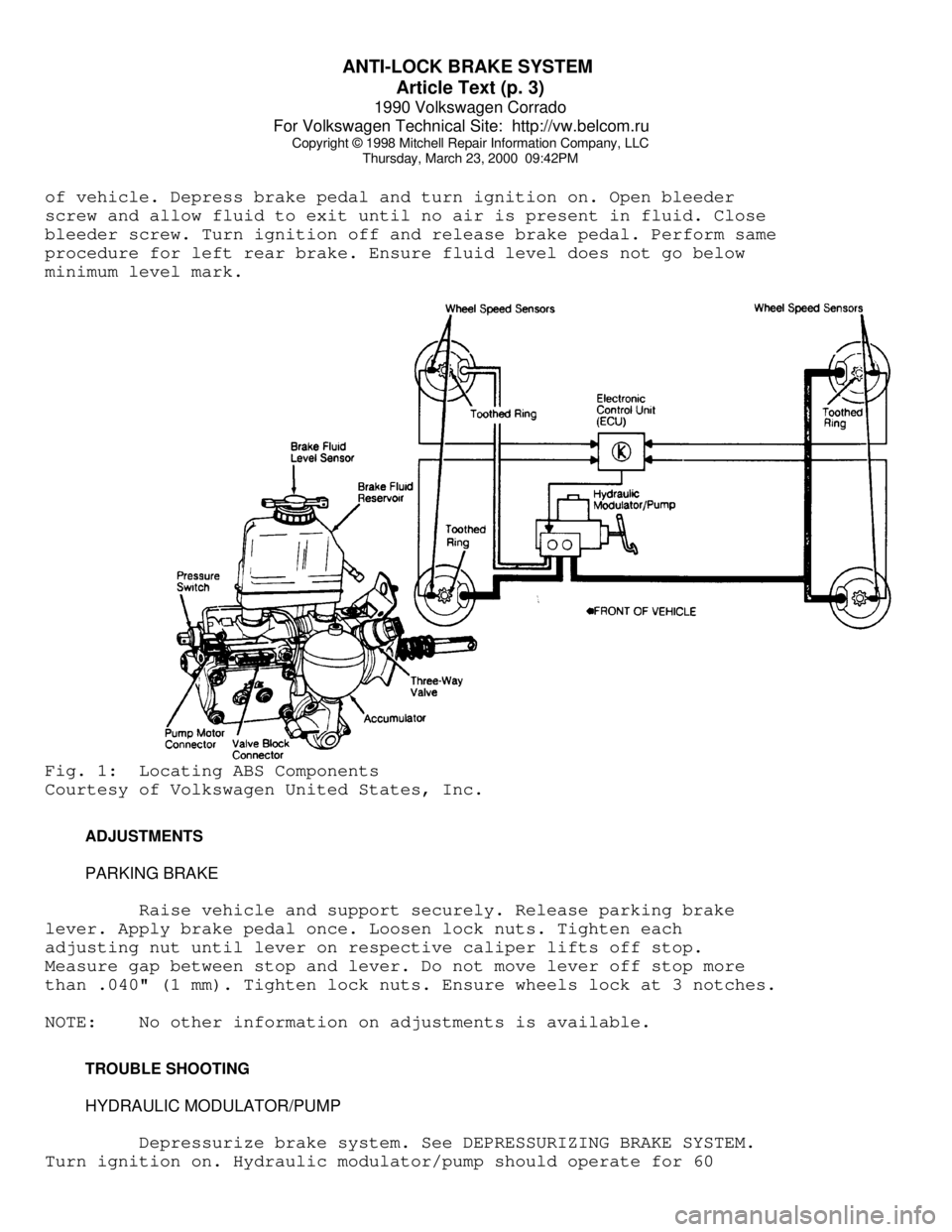
minimum level mark.Fig. 1: Locating ABS Components
Courtesy of Volkswagen United States, Inc.
ADJUSTMENTS
PARKING BRAKE
Raise vehicle and support securely. Release parking brake
lever. Apply brake pedal once. Loosen lock nuts. Tighten each
adjusting nut until lever on respective caliper lifts off stop.
Measure gap between stop and lever. Do not move lever off stop more
than .040" (1 mm). Tighten lock nuts. Ensure wheels lock at 3 notches.
NOTE: No other information on adjustments is available.
TROUBLE SHOOTING
HYDRAULIC MODULATOR/PUMP
Depressurize brake system. See DEPRESSURIZING BRAKE SYSTEM.
Turn ignition on. Hydraulic modulator/pump should operate for 60
Page 437 of 906

COMPUTER RELEARN PROCEDURES
Article Text (p. 2)
1990 Volkswagen Corrado
For Volkswagen Technical Site: http://vw.belcom.ru
Copyright © 1998 Mitchell Repair Information Company, LLC
Thursday, March 23, 2000 09:43PM
"D" and allow engine to idle for one minute.
* Accelerate at normal throttle position (20-50%) until vehicle
shifts into top gear.
* Cruise at light to medium throttle.
* Decelerate to a stop, allowing vehicle to downshift, and use
brakes normally.
* Process may be repeated as necessary.
Manual Transmission
* Place transmission in Neutral position.
* Ensure emergency brake has been set and all accessories
are turned off.
* Start engine and bring to normal operating temperature.
* Allow vehicle to idle in Neutral for one minute.
* Initial relearn is complete: process will be completed during
normal driving.
Some manufacturers identify a specific relearn procedure
which will help establish suitable driveability during relearn stage.
These procedures are especially important if vehicle is equipped with
and electronically controlled automatic transmission or transaxle.
Always complete procedure before returning vehicle to customer.
END OF ARTICLE
Page 513 of 906

ENGINE OVERHAUL PROCEDURES - GENERAL INFORMATION
Article Text (p. 4)
1990 Volkswagen Corrado
For Volkswagen Technical Site: http://vw.belcom.ru
Copyright © 1998 Mitchell Repair Information Company, LLC
Thursday, March 23, 2000 09:44PM
specifications for the vehicle being repaired.
SHEET METAL PARTS
Examples of sheet metal parts are the rocker covers, front
and side covers, oil pan and bellhousing dust cover. Glass bead
blasting or hot tank may be used for cleaning.
Ensure all mating surfaces are flat. Deformed surfaces should
be straightened. Check all sheet metal parts for cracks and dents.
INTAKE & EXHAUST MANIFOLDS
Using solvent cleaning or bead blasting, clean manifolds for
inspection. If the intake manifold has an exhaust crossover, all
carbon deposits must be removed. Inspect manifolds for cracks, burned
or eroded areas, corrosion and damage to fasteners.
Exhaust heat and products of combustion cause threads of
fasteners to corrode. Replace studs and bolts as necessary. On "V"
type intake manifolds, the sheet metal oil shield must be removed for
proper cleaning and inspection. Ensure that all manifold parting
surfaces are flat and free of burrs.
CYLINDER HEAD REPLACEMENT
* PLEASE READ THIS FIRST *
NOTE: Always refer to appropriate engine overhaul article in the
ENGINES section for complete overhaul procedures and
specifications for the vehicle being repaired.
REMOVAL
Remove intake and exhaust manifolds and valve cover. Cylinder
head and camshaft carrier bolts (if equipped), should be removed only
when the engine is cold. On many aluminum cylinder heads, removal
while hot will cause cylinder head warpage. Mark rocker arm or
overhead cam components for location.
Remove rocker arm components or overhead cam components.
Components must be installed in original location. Individual design
rocker arms may utilize shafts, ball-type pedestal mounts or no rocker
arms. For all design types, wire components together and identify
according to the corresponding valve. Remove cylinder head bolts.
Note length and location. Some applications require cylinder head
bolts be removed in proper sequence to prevent cylinder head damage.
See Fig. 1. Remove cylinder head.
Page 527 of 906
ENGINE OVERHAUL PROCEDURES - GENERAL INFORMATION
Article Text (p. 18)
1990 Volkswagen Corrado
For Volkswagen Technical Site: http://vw.belcom.ru
Copyright © 1998 Mitchell Repair Information Company, LLC
Thursday, March 23, 2000 09:44PM
of piston skirt area. Subtract piston diameter from cylinder bore
diameter. The difference is piston-to-cylinder clearance. Clearance
must be within specification. Mark piston for proper cylinder
location.
ASSEMBLING PISTON & CONNECTING ROD
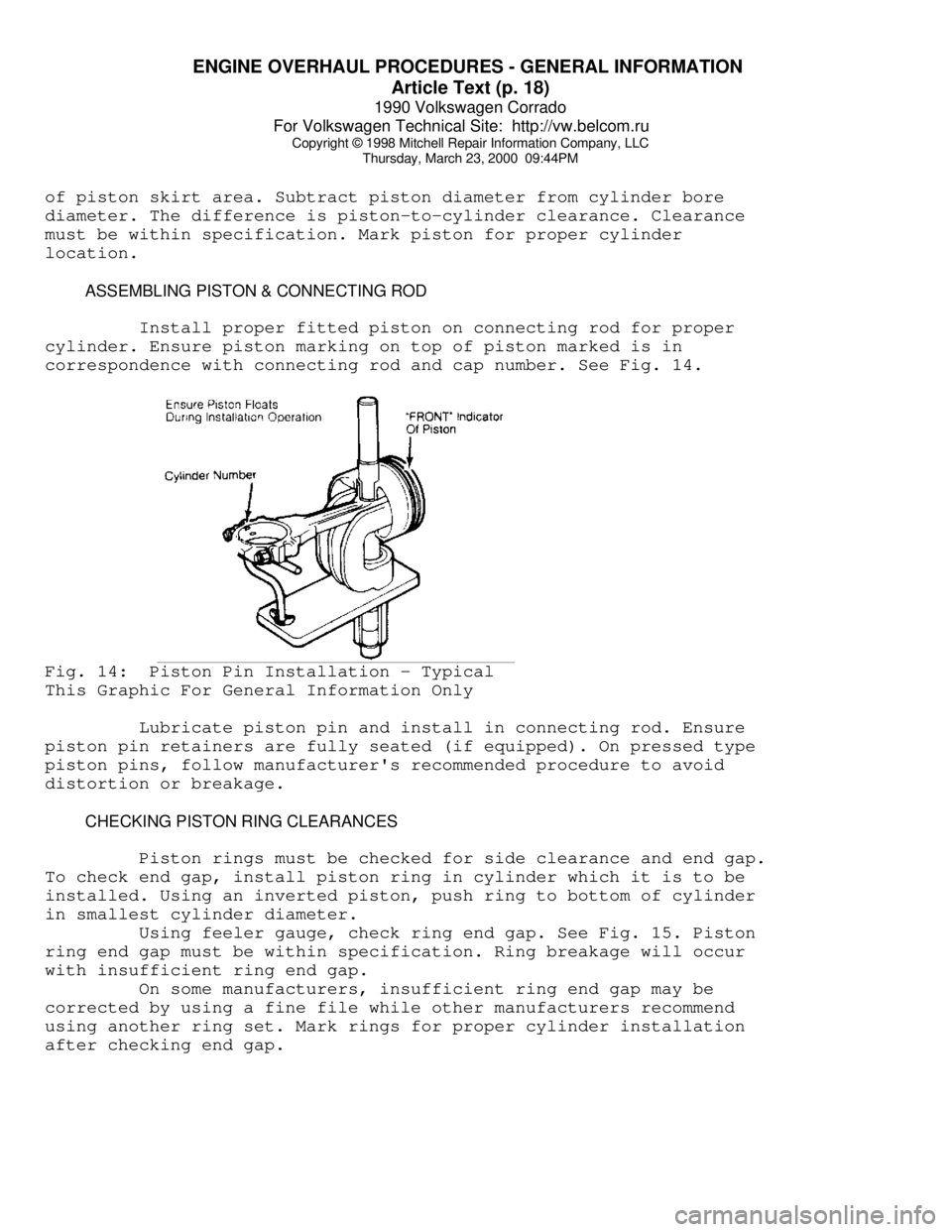
Install proper fitted piston on connecting rod for proper
cylinder. Ensure piston marking on top of piston marked is in
correspondence with connecting rod and cap number. See Fig. 14.Fig. 14: Piston Pin Installation - Typical
This Graphic For General Information Only
Lubricate piston pin and install in connecting rod. Ensure
piston pin retainers are fully seated (if equipped). On pressed type
piston pins, follow manufacturer's recommended procedure to avoid
distortion or breakage.
CHECKING PISTON RING CLEARANCES
Piston rings must be checked for side clearance and end gap.
To check end gap, install piston ring in cylinder which it is to be
installed. Using an inverted piston, push ring to bottom of cylinder
in smallest cylinder diameter.
Using feeler gauge, check ring end gap. See Fig. 15. Piston
ring end gap must be within specification. Ring breakage will occur
with insufficient ring end gap.
On some manufacturers, insufficient ring end gap may be
corrected by using a fine file while other manufacturers recommend
using another ring set. Mark rings for proper cylinder installation
after checking end gap.
Page 531 of 906
ENGINE OVERHAUL PROCEDURES - GENERAL INFORMATION
Article Text (p. 22)
1990 Volkswagen Corrado
For Volkswagen Technical Site: http://vw.belcom.ru
Copyright © 1998 Mitchell Repair Information Company, LLC
Thursday, March 23, 2000 09:44PM
rotated.
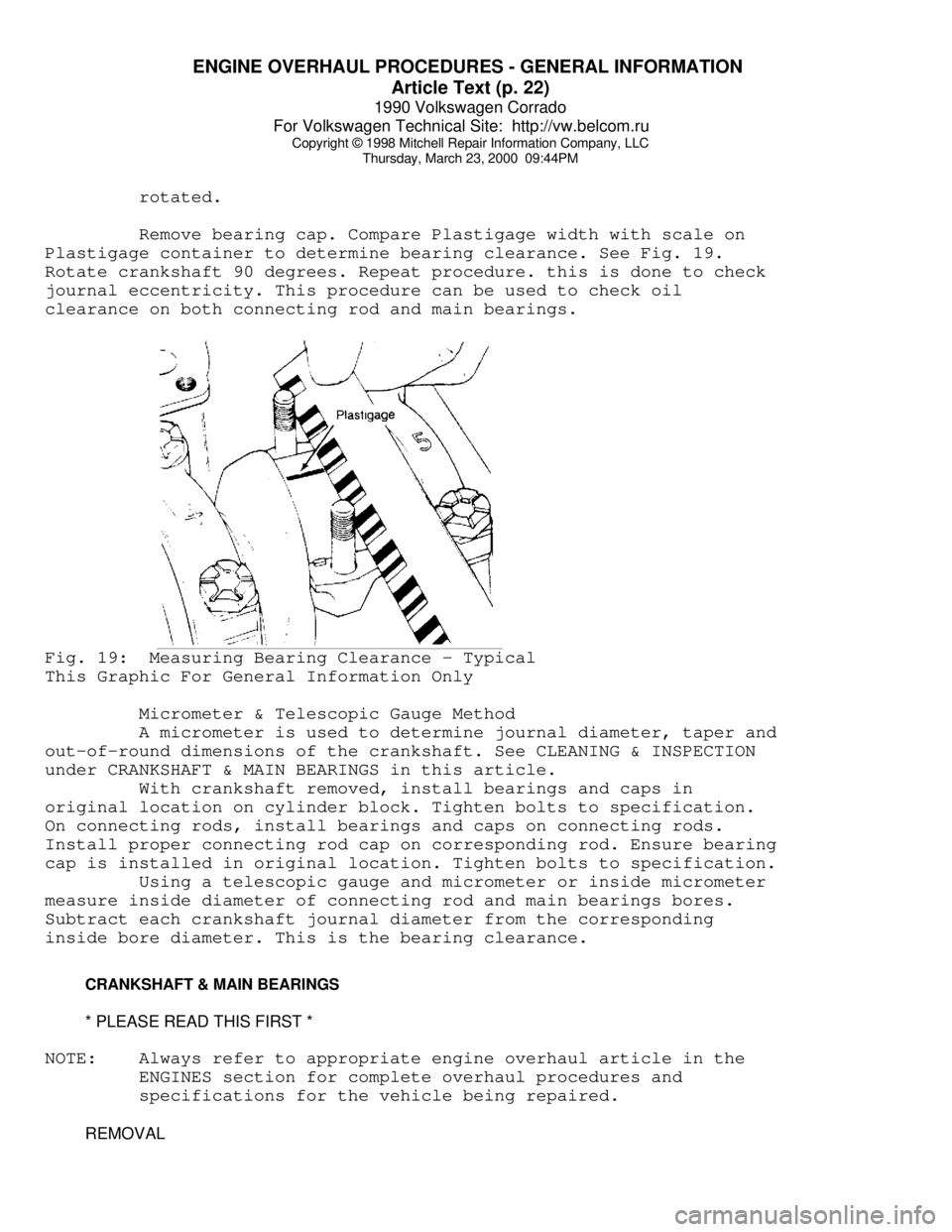
Remove bearing cap. Compare Plastigage width with scale on
Plastigage container to determine bearing clearance. See Fig. 19.
Rotate crankshaft 90 degrees. Repeat procedure. this is done to check
journal eccentricity. This procedure can be used to check oil
clearance on both connecting rod and main bearings.Fig. 19: Measuring Bearing Clearance - Typical
This Graphic For General Information Only
Micrometer & Telescopic Gauge Method
A micrometer is used to determine journal diameter, taper and
out-of-round dimensions of the crankshaft. See CLEANING & INSPECTION
under CRANKSHAFT & MAIN BEARINGS in this article.
With crankshaft removed, install bearings and caps in
original location on cylinder block. Tighten bolts to specification.
On connecting rods, install bearings and caps on connecting rods.
Install proper connecting rod cap on corresponding rod. Ensure bearing
cap is installed in original location. Tighten bolts to specification.
Using a telescopic gauge and micrometer or inside micrometer
measure inside diameter of connecting rod and main bearings bores.
Subtract each crankshaft journal diameter from the corresponding
inside bore diameter. This is the bearing clearance.
CRANKSHAFT & MAIN BEARINGS
* PLEASE READ THIS FIRST *
NOTE: Always refer to appropriate engine overhaul article in the
ENGINES section for complete overhaul procedures and
specifications for the vehicle being repaired.
REMOVAL
Page 555 of 906
F - BASIC TESTING
Article Text (p. 10)
1990 Volkswagen Corrado
For Volkswagen Technical Site: http://vw.belcom.ru
Copyright © 1998 Mitchell Repair Information Company, LLC
Thursday, March 23, 2000 09:44PM
distributor cap.ÄÄÄÄÄÄÄÄÄÄÄÄÄÄÄÄÄÄÄÄÄÄÄÄÄÄÄÄÄÄÄÄÄÄÄÄÄÄÄÄÄÄÄÄÄÄÄÄÄÄÄÄÄÄÄÄÄÄÄÄ HALL EFFECT SENDER & COIL POWER STAGE
The Hall Effect sender and coil power stage should be tested
if there is no spark at the spark plugs when tested. These tests also
check the CIS-Motronic ECU response to the Hall Effect sender signal.
Ensure SPARK and IGNITION COIL tests are performed first.
VOLTAGE SUPPLY & GROUND TO POWER STAGE
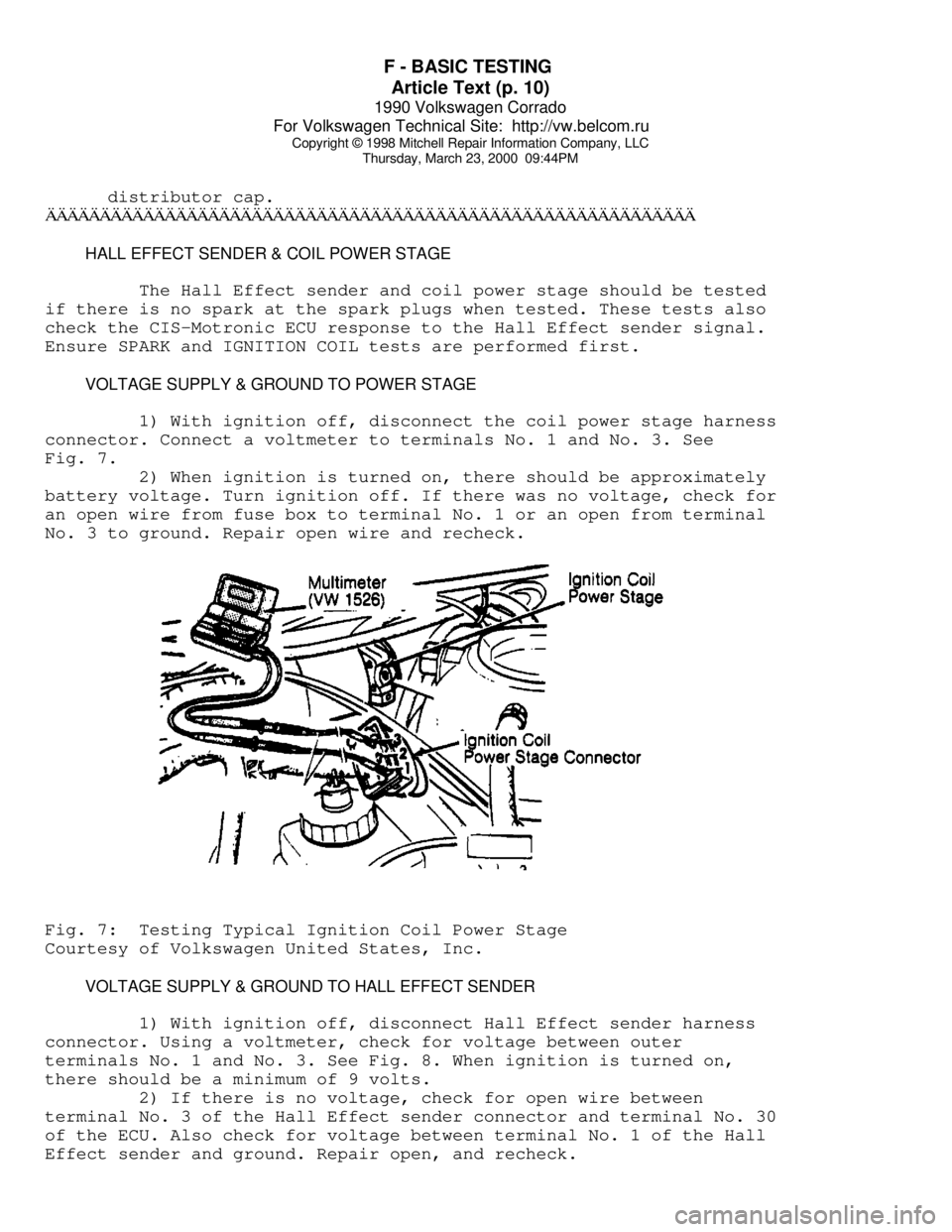
1) With ignition off, disconnect the coil power stage harness
connector. Connect a voltmeter to terminals No. 1 and No. 3. See
Fig. 7.
2) When ignition is turned on, there should be approximately
battery voltage. Turn ignition off. If there was no voltage, check for
an open wire from fuse box to terminal No. 1 or an open from terminal
No. 3 to ground. Repair open wire and recheck.Fig. 7: Testing Typical Ignition Coil Power Stage
Courtesy of Volkswagen United States, Inc.
VOLTAGE SUPPLY & GROUND TO HALL EFFECT SENDER
1) With ignition off, disconnect Hall Effect sender harness
connector. Using a voltmeter, check for voltage between outer
terminals No. 1 and No. 3. See Fig. 8. When ignition is turned on,
there should be a minimum of 9 volts.
2) If there is no voltage, check for open wire between
terminal No. 3 of the Hall Effect sender connector and terminal No. 30
of the ECU. Also check for voltage between terminal No. 1 of the Hall
Effect sender and ground. Repair open, and recheck.
Page 556 of 906
F - BASIC TESTING
Article Text (p. 11)
1990 Volkswagen Corrado
For Volkswagen Technical Site: http://vw.belcom.ru
Copyright © 1998 Mitchell Repair Information Company, LLC
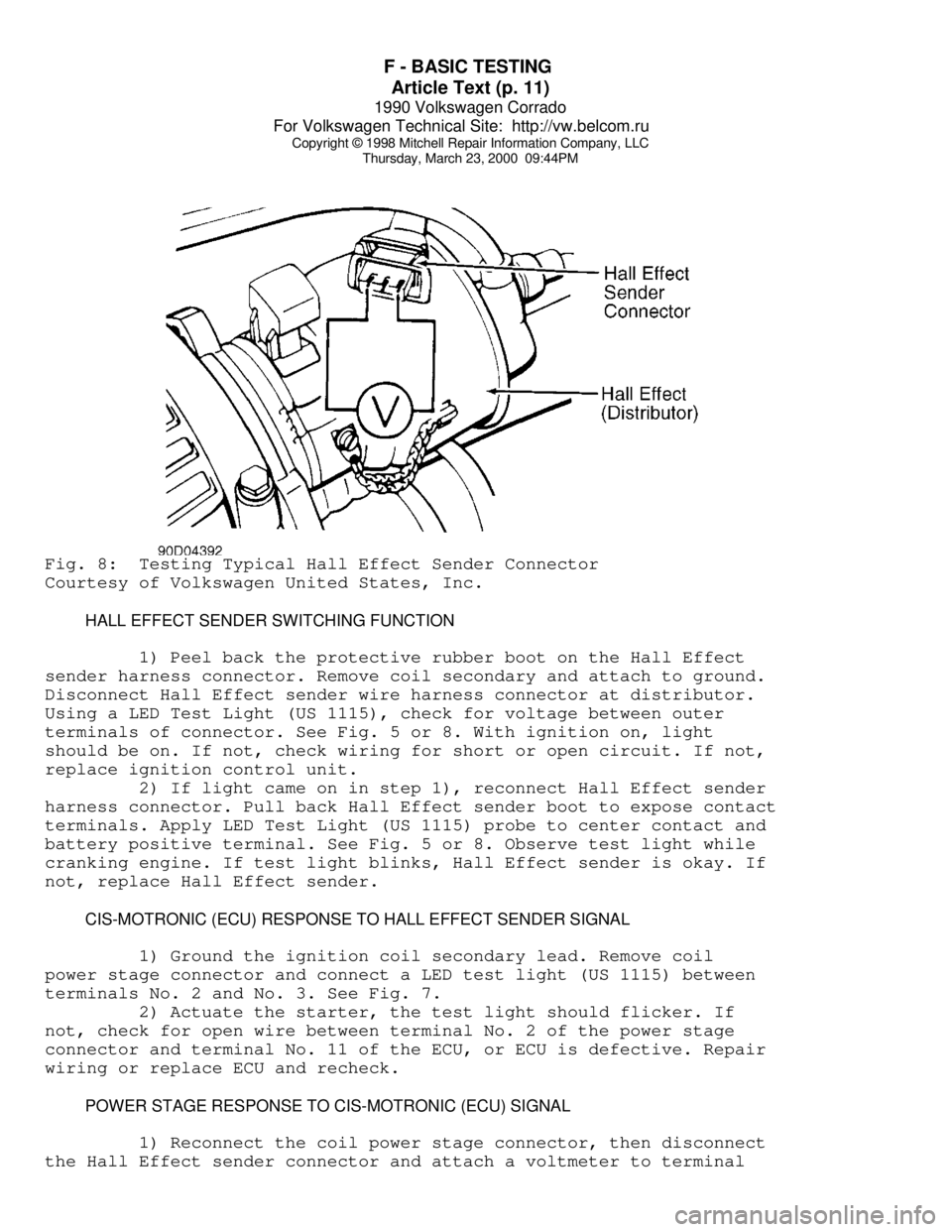
Thursday, March 23, 2000 09:44PMFig. 8: Testing Typical Hall Effect Sender Connector
Courtesy of Volkswagen United States, Inc.
HALL EFFECT SENDER SWITCHING FUNCTION
1) Peel back the protective rubber boot on the Hall Effect
sender harness connector. Remove coil secondary and attach to ground.
Disconnect Hall Effect sender wire harness connector at distributor.
Using a LED Test Light (US 1115), check for voltage between outer
terminals of connector. See Fig. 5 or 8. With ignition on, light
should be on. If not, check wiring for short or open circuit. If not,
replace ignition control unit.
2) If light came on in step 1), reconnect Hall Effect sender
harness connector. Pull back Hall Effect sender boot to expose contact
terminals. Apply LED Test Light (US 1115) probe to center contact and
battery positive terminal. See Fig. 5 or 8. Observe test light while
cranking engine. If test light blinks, Hall Effect sender is okay. If
not, replace Hall Effect sender.
CIS-MOTRONIC (ECU) RESPONSE TO HALL EFFECT SENDER SIGNAL
1) Ground the ignition coil secondary lead. Remove coil
power stage connector and connect a LED test light (US 1115) between
terminals No. 2 and No. 3. See Fig. 7.
2) Actuate the starter, the test light should flicker. If
not, check for open wire between terminal No. 2 of the power stage
connector and terminal No. 11 of the ECU, or ECU is defective. Repair
wiring or replace ECU and recheck.
POWER STAGE RESPONSE TO CIS-MOTRONIC (ECU) SIGNAL
1) Reconnect the coil power stage connector, then disconnect
the Hall Effect sender connector and attach a voltmeter to terminal
Page 591 of 906
I - SYSTEM/COMPONENT TESTS
Article Text (p. 4)
1990 Volkswagen Corrado
For Volkswagen Technical Site: http://vw.belcom.ru
Copyright © 1998 Mitchell Repair Information Company, LLC
Thursday, March 23, 2000 09:46PM
and remove intake boot from top of airflow sensor. Check sensor plate
by lifting plate through travel cycle with magnet or pliers.
2) Continuous resistance should be felt. Move plate back to
rest position. There should be no resistance. If resistance is felt,
replace airflow sensor. If sensor plate lever is difficult to move
upward but moves freely downward, check sensor plate for correct
centering.
3) Sensor plate should be evenly centered in the housing with
plate edge at the narrowest section of the venturi while at rest
position. If sensor plate adjustment is correct, check control plunger
for sticking. If control plunger is sticking, replace fuel distributor
assembly.
AIRFLOW SENSOR (VANAGON)
1) Turn ignition off. Remove Electronic Control Unit (ECU)
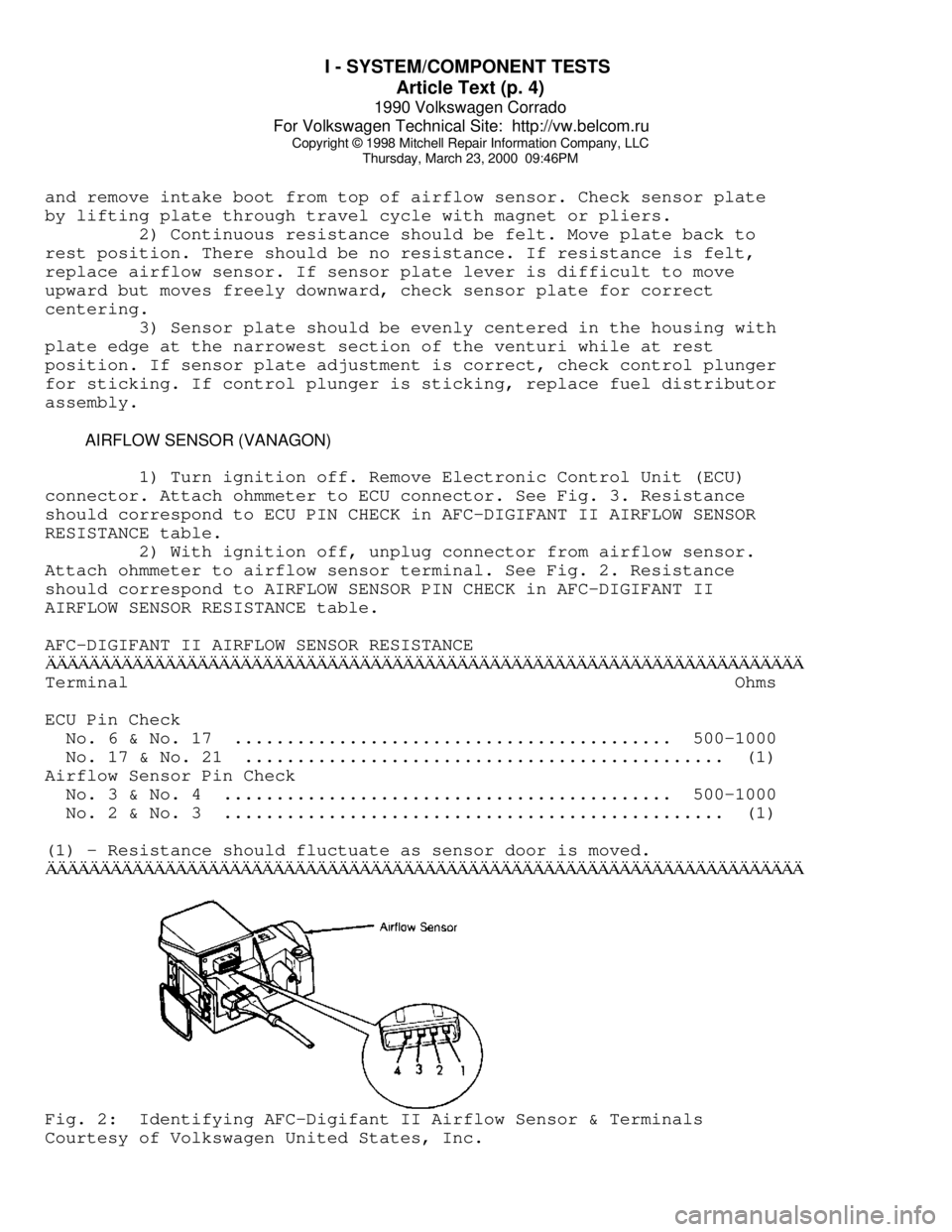
connector. Attach ohmmeter to ECU connector. See Fig. 3. Resistance
should correspond to ECU PIN CHECK in AFC-DIGIFANT II AIRFLOW SENSOR
RESISTANCE table.
2) With ignition off, unplug connector from airflow sensor.
Attach ohmmeter to airflow sensor terminal. See Fig. 2. Resistance
should correspond to AIRFLOW SENSOR PIN CHECK in AFC-DIGIFANT II
AIRFLOW SENSOR RESISTANCE table.
AFC-DIGIFANT II AIRFLOW SENSOR RESISTANCEÄÄÄÄÄÄÄÄÄÄÄÄÄÄÄÄÄÄÄÄÄÄÄÄÄÄÄÄÄÄÄÄÄÄÄÄÄÄÄÄÄÄÄÄÄÄÄÄÄÄÄÄÄÄÄÄÄÄÄÄÄÄÄÄÄÄÄÄÄÄTerminal Ohms
ECU Pin Check
No. 6 & No. 17 .......................................... 500-1000
No. 17 & No. 21 .............................................. (1)
Airflow Sensor Pin Check
No. 3 & No. 4 ........................................... 500-1000
No. 2 & No. 3 ................................................ (1)
(1) - Resistance should fluctuate as sensor door is moved.
ÄÄÄÄÄÄÄÄÄÄÄÄÄÄÄÄÄÄÄÄÄÄÄÄÄÄÄÄÄÄÄÄÄÄÄÄÄÄÄÄÄÄÄÄÄÄÄÄÄÄÄÄÄÄÄÄÄÄÄÄÄÄÄÄÄÄÄÄÄÄFig. 2: Identifying AFC-Digifant II Airflow Sensor & Terminals
Courtesy of Volkswagen United States, Inc.
Page 647 of 906

MAINTENANCE INFORMATION
Article Text (p. 12)
1990 Volkswagen Corrado
For Volkswagen Technical Site: http://vw.belcom.ru
Copyright © 1998 Mitchell Repair Information Company, LLC
Thursday, March 23, 2000 09:48PM
of 650 amps.
CAUTIONS & WARNINGS
CAUTION: Contact with live components of ignition system while
engine is running could lead to a fatal electric shock.
CAUTION: Brake pedal requires extreme pressure to stop vehicle when
engine is not running.
WARRANTY INFORMATION
CAUTION: Always refer to customer's copy of warranty information for
specific model application and/or coverage limitations.
BASIC NEW CAR WARRANTY
Manufacturer warrants to the original retail customer, and
any subsequent purchaser, that every vehicle imported and sold as a
new vehicle to a retail customer will be free of defects in material
and workmanship for 2 years or 24,000 miles, whichever comes first,
after date of delivery to the first retail customer, or after vehicle
was first placed in service.
LIMITED WARRANTY
Warrants cars to be free of defects in materials or
workmanship for a period of 2 years or 24,000 miles, whichever comes
first.
LIMITED POWER TRAIN WARRANTY
Covers engine, transmission and drivetrain for a period of 5
years or 50,000 miles, whichever occurs first.
ANTI-CORROSION
Covers holes caused by corrosion in body sheet metal for 6
years, without respect to mileage, so long as inspection and
maintenance services are performed.
EMISSION CONTROL SYSTEM
Manufacturer warrants to the initial purchaser and each
subsequent purchaser that this vehicle is designed, built, and
equipped so as to conform at the time of sale with all U.S. and
California Air Resources Board emission regulations applicable at the
time of manufacture, and that this vehicle is free from defects in
materials and workmanship which cause it to fail to conform with
applicable regulations within the first 5 years or 50,000 miles,
whichever occurs first.