stop start VOLKSWAGEN CORRADO 1990 Repair Manual
[x] Cancel search | Manufacturer: VOLKSWAGEN, Model Year: 1990, Model line: CORRADO, Model: VOLKSWAGEN CORRADO 1990Pages: 906, PDF Size: 6.56 MB
Page 403 of 906

ALTERNATOR & REGULATOR - BOSCH
Article Text (p. 2)
1990 Volkswagen Corrado
For Volkswagen Technical Site: http://vw.belcom.ru
Copyright © 1998 Mitchell Repair Information Company, LLC
Thursday, March 23, 2000 09:42PM
(most vehicles) are clean and tight. Ensure alternator, engine and
body are properly grounded. Ensure alternator drive belt is tight and
in good condition.
2) Connect ammeter following manufacturer's instructions.
Connect voltmeter leads to battery terminals. Adjust carbon pile on
tester until voltmeter reads 13.5 volts. Alternator output should be
28-35 amps.
3) Repeat process at 1000 RPM. Alternator output should be
75-85 amps. Repeat test at 2000 RPM. Alternator output should be 89
amps. If alternator output is low, remove alternator for testing and
repairs.
4) Start engine and run at 3000 RPM. Adjust carbon pile on
tester to obtain maximum alternator output. Do not allow voltage to go
below 12.6 volts.
5) Alternator output should equal alternator rated output,
minus 16-20 amps. If reading is 16-20 amps below alternator rating,
replace regulator and retest. If output is still low, repair or
replace alternator.
REGULATOR CONTROL VOLTAGE TEST
1) Connect ammeter following manufacturer's instructions.
Connect voltmeter leads to battery terminals. Start engine and run at
3000 RPM.
2) Run engine until voltage stops rising. Voltage should be
13.5-14.5 volts. If reading is incorrect, remove regulator and ensure
brushes are longer than 7/32" (6 mm). Replace if necessary.
3) If brushes are okay and regulator fails to keep voltage
within specified limits, replace regulator and retest. If voltage is
still incorrect, repair or replace alternator.
BENCH TESTING
DIODE ASSEMBLY
1) Place ohmmeter on x 100 scale. Connect ohmmeter leads
across "B+" terminal and 3 stator terminals one at a time. Reverse
leads. Ohmmeter should indicate continuity in one direction only.
2) Connect ohmmeter leads across negative plate and 3 stator
terminals one at a time. See Fig. 1. Reverse leads. Ohmmeter should
indicate continuity in one direction only.
3) Connect ohmmeter leads across "D+" terminal and 3 stator
terminals one at a time. Reverse leads. Ohmmeter should indicate
continuity in one direction only. Replace diode assembly if defective.
Page 412 of 906
ANTI-LOCK BRAKE SYSTEM
Article Text (p. 4)
1990 Volkswagen Corrado
For Volkswagen Technical Site: http://vw.belcom.ru
Copyright © 1998 Mitchell Repair Information Company, LLC
Thursday, March 23, 2000 09:42PM
seconds maximum and then stop. Depress brake pedal a few times; pump
should operate again for a few seconds. If pump motor does not
operate, check electrical system. If pump motor operates for more than
60 seconds, internal or external hydraulic leak may be indicated.
Check for external leaks. If external leak is not found, further
testing may be needed to check for internal leaks.
ANTI-LOCK WARNING LIGHT
Start engine. ANTI-LOCK warning light should come on, then
turn off after a few seconds. If light does not come on when engine is
started, check electrical system. If light comes on and stays on,
fault has been detected by the ECU and testing will be needed. See
SYSTEM TESTING under DIAGNOSIS & TESTING.
DIAGNOSIS & TESTING
SYSTEM TESTING
NOTE: Check battery condition, brake fluid level, electrical
connections and wiring for damage. If fluid level is
incorrect or battery and/or electrical connections are
faulty, correct problem before preceding. Perform each step,
in sequence, to test entire system, except for ECU. If
faulty ECU is suspected, replace with a known good one, and
retest system. Unplug ECU connector for all test steps.
Power Voltage-To-ECU Test
Turn ignition off. Unplug ECU connector. Turn ignition on.
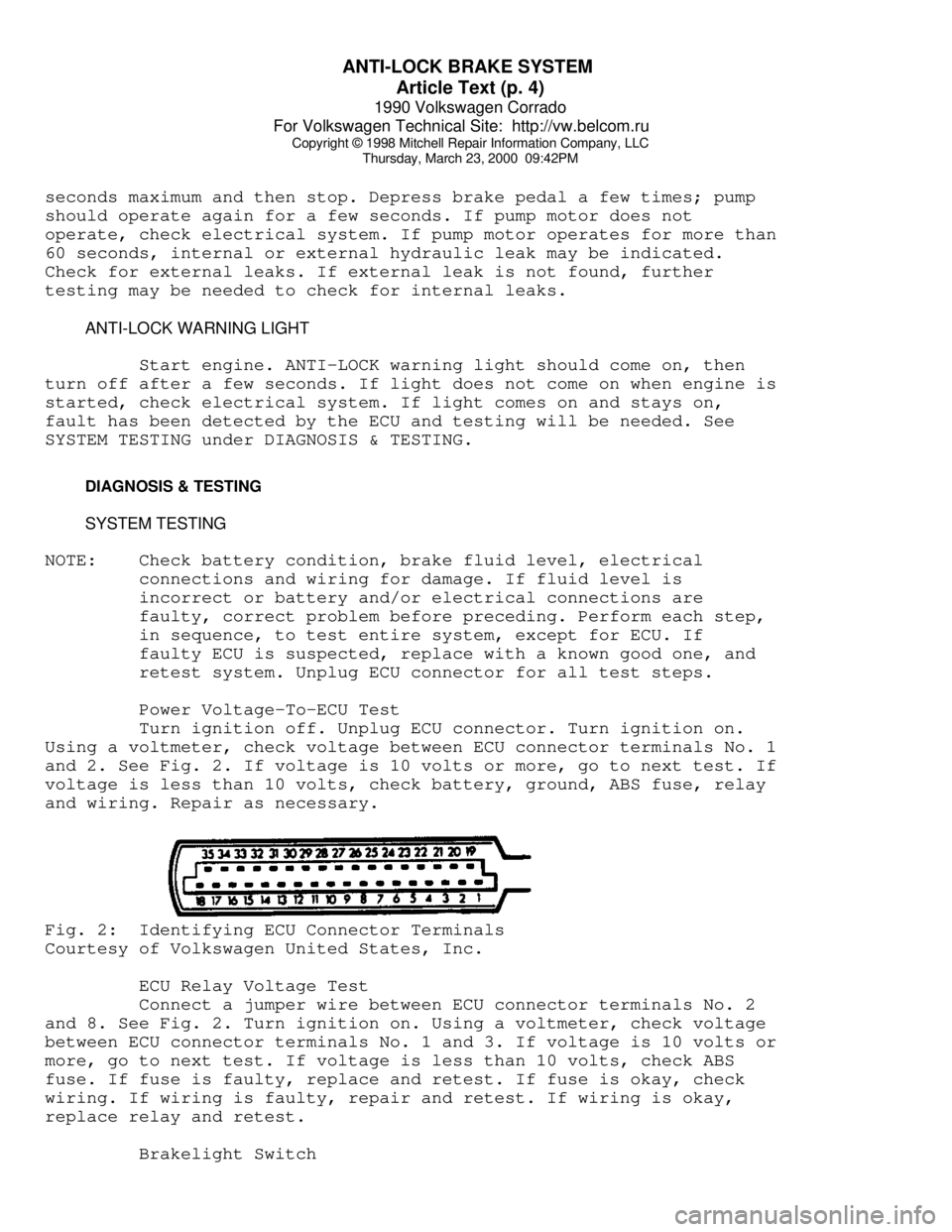
Using a voltmeter, check voltage between ECU connector terminals No. 1
and 2. See Fig. 2. If voltage is 10 volts or more, go to next test. If
voltage is less than 10 volts, check battery, ground, ABS fuse, relay
and wiring. Repair as necessary.Fig. 2: Identifying ECU Connector Terminals
Courtesy of Volkswagen United States, Inc.
ECU Relay Voltage Test
Connect a jumper wire between ECU connector terminals No. 2
and 8. See Fig. 2. Turn ignition on. Using a voltmeter, check voltage
between ECU connector terminals No. 1 and 3. If voltage is 10 volts or
more, go to next test. If voltage is less than 10 volts, check ABS
fuse. If fuse is faulty, replace and retest. If fuse is okay, check
wiring. If wiring is faulty, repair and retest. If wiring is okay,
replace relay and retest.
Brakelight Switch
Page 437 of 906

COMPUTER RELEARN PROCEDURES
Article Text (p. 2)
1990 Volkswagen Corrado
For Volkswagen Technical Site: http://vw.belcom.ru
Copyright © 1998 Mitchell Repair Information Company, LLC
Thursday, March 23, 2000 09:43PM
"D" and allow engine to idle for one minute.
* Accelerate at normal throttle position (20-50%) until vehicle
shifts into top gear.
* Cruise at light to medium throttle.
* Decelerate to a stop, allowing vehicle to downshift, and use
brakes normally.
* Process may be repeated as necessary.
Manual Transmission
* Place transmission in Neutral position.
* Ensure emergency brake has been set and all accessories
are turned off.
* Start engine and bring to normal operating temperature.
* Allow vehicle to idle in Neutral for one minute.
* Initial relearn is complete: process will be completed during
normal driving.
Some manufacturers identify a specific relearn procedure
which will help establish suitable driveability during relearn stage.
These procedures are especially important if vehicle is equipped with
and electronically controlled automatic transmission or transaxle.
Always complete procedure before returning vehicle to customer.
END OF ARTICLE
Page 439 of 906

D - ADJUSTMENTS
Article Text (p. 2)
1990 Volkswagen Corrado
For Volkswagen Technical Site: http://vw.belcom.ru
Copyright © 1998 Mitchell Repair Information Company, LLC
Thursday, March 23, 2000 09:43PM
connected, timing mark on flywheel should appear at pointer in hole.
NOTE: Before checking engine timing, raise engine speed above 2100
RPM at least 4 times. This must be done each time ignition
is turned off and restarted to clear ECU memory and by-pass
hot-start, fast-idle function.
3) If an adjustment is needed, turn ignition off and loosen
distributor hold-down bolt (2.0L has 2 hold-down bolts) just enough to
move distributor by hand. Start engine and allow to idle. Turn
distributor until timing mark is aligned with pointer in bellhousing.
4) Stop engine and tighten hold down bolt to 18 ft. lbs. (24
N.m). On 2.0L tighten hold-down bolts to 87 INCH lbs. (10 N.m). Check
and readjust if necessary and install plastic plug in inspection hole.
VANAGON
1) Engine oil temperature must be 176ø F (80ø C). Connect
timing light and tachometer. Start engine and allow to idle. Check
ignition timing at 800-1000 RPM.
NOTE: Before checking engine timing, raise engine speed above 2100
RPM at least 4 times. This must be done each time ignition
is turned off and restarted to clear ECU memory and by-pass
hot-start, fast-idle function.
2) If an adjustment is needed, turn ignition off and loosen
distributor hold-down bolt just enough to move distributor by hand.
Remove connectors from idle stabilizer by squeezing connectors then
pulling apart. Plug idle stabilizer connectors together.
3) Start and allow engine to idle. Turn distributor until
notch on V-belt pulley matches separation in case. Set timing and RPM.
Reconnect electrical connectors to idle stabilizer. Tighten
distributor clamp bolt.
IGNITION TIMING TABLE
IGNITION TIMING (Degrees BTDC @ RPM)
ÄÄÄÄÄÄÄÄÄÄÄÄÄÄÄÄÄÄÄÄÄÄÄÄÄÄÄÄÄÄÄÄÄÄÄÄÄÄÄÄÄÄÄÄÄÄÄÄÄÄÄÄÄÄÄÄÄÄÄÄÄÄÄÄÄÄÄÄÄÄApplication Checking Adjusting
1.8L ..................... 4-8 @ 870-930 ........... 5-7 @ 870-930
2.0L ..................... 4-8 @ 770-830 ........... 5-7 @ 770-830
2.1L ..................... 4-8 @ 800-900 ........... 5-7 @ 800-900
ÄÄÄÄÄÄÄÄÄÄÄÄÄÄÄÄÄÄÄÄÄÄÄÄÄÄÄÄÄÄÄÄÄÄÄÄÄÄÄÄÄÄÄÄÄÄÄÄÄÄÄÄÄÄÄÄÄÄÄÄÄÄÄÄÄÄÄÄÄÄ COLD (FAST) IDLE
Fast idle RPM is not adjustable.
IDLE SPEED & MIXTURE
Page 444 of 906

D - ADJUSTMENTS
Article Text (p. 7)
1990 Volkswagen Corrado
For Volkswagen Technical Site: http://vw.belcom.ru
Copyright © 1998 Mitchell Repair Information Company, LLC
Thursday, March 23, 2000 09:43PM
together. Turn idle speed screw until idle speed is correct. To adjust
timing, see CHECKING & ADJUSTING under IGNITION TIMING in this
article.
3) Ensure all vehicle electrical equipment is off. Place
exhaust gas analyzer in exhaust pipe. See IDLE SPEED & CO LEVEL table.
If adjustment is needed, go to next step.
4) If adjustment is needed in step 2). Remove intake air
sensor from engine. Center punch plug in CO adjusting hole. Using a
3/32" drill bit, drill hole 5/32" (4 mm) deep in center of plug.
Remove any metal shavings. Screw in a sheet metal screw and remove
plug using pliers to pry plug out.
5) Disconnect oxygen sensor connector on left side of engine
compartment (Green wire). Start engine. Set idle speed and CO reading
by alternately turning mixture and idle speed adjustment screws.
Reconnect oxygen sensor and idle stabilizer connectors. Let engine
idle for 2 minutes.
6) Check CO value. If incorrect, repeat adjusting procedure.
If correct turn ignition off. Drive in new adjusting hole plug flush
with air intake sensor. Remove all test equipment and reconnect all
hoses and wiring.
NOTE: Do not push down on adjustment screw and do not accelerate
engine with wrench in plate. Remove wrench after each
adjustment and accelerate engine briefly before measuring
current reading. Always adjust from a high to a low reading.
IDLE SPEED & CO LEVELÄÄÄÄÄÄÄÄÄÄÄÄÄÄÄÄÄÄÄÄÄÄÄÄÄÄÄÄÄÄÄÄÄÄÄÄÄÄÄÄÄÄÄÄÄÄÄÄÄÄÄÄÄÄÄÄÄÄÄÄÄÄÄÄÄÄÄÄÄÄApplication Idle RPM CO Level
Cabriolet .................. 850-1000 ................... 0.3-1.2%
Fox ........................ 800-1000 ................... 0.3-1.2%
Golf ....................... 800-1000 ................... 0.3-1.2%
Golf GT ..................... 800-900 ................... 0.3-1.2%
GTI ........................ 800-1000 ................... 0.3-1.2%
Jetta ...................... 800-1000 ................... 0.3-1.2%
Vanagon ..................... 830-930 ................... 0.3-1.2%
ÄÄÄÄÄÄÄÄÄÄÄÄÄÄÄÄÄÄÄÄÄÄÄÄÄÄÄÄÄÄÄÄÄÄÄÄÄÄÄÄÄÄÄÄÄÄÄÄÄÄÄÄÄÄÄÄÄÄÄÄÄÄÄÄÄÄÄÄÄÄ THROTTLE STOP SCREW
NOTE: Stop screw is set by manufacturer and should not be moved.
If basic factory setting has been changed, turn throttle stop
screw counterclockwise until there is a gap between stop and screw.
Turn screw in until it just touches stop. Turn screw 1/2 turn (180
degrees) further. Check and adjust idle speed and CO.
IDLE & FULL THROTTLE SWITCH ADJUSTMENTS
IDLE SWITCH ADJUSTMENT DIGIFANT II (EXCEPT VANAGON)
Page 545 of 906

ENGINE OVERHAUL PROCEDURES - GENERAL INFORMATION
Article Text (p. 36)
1990 Volkswagen Corrado
For Volkswagen Technical Site: http://vw.belcom.ru
Copyright © 1998 Mitchell Repair Information Company, LLC
Thursday, March 23, 2000 09:44PM
to ensure correct amount of oil has filled crankcase. Check oil level
while pre-oiling.
If pressure oiler is not available, disconnect ignition
system. Remove oil pressure sending unit and replace with oil pressure
test gauge. Using starter motor, rotate engine starter until gauge
shows normal oil pressure for several seconds. DO NOT crank engine
for more than 30 seconds to avoid starter motor damage.
Ensure oil pressure has reached the most distant point from
the oil pump. Reinstall oil pressure sending unit. Reconnect ignition
system.
INITIAL START-UP
Start the engine and operate engine at low speed while
checking for coolant, fuel and oil leaks. Stop engine. Recheck coolant
and oil level. Adjust if necessary.
CAMSHAFT
Break-in procedure is required when a new or reground
camshaft has been installed. Operate and maintain engine speed between
1500-2500 RPM for approximately 30 minutes. Procedure may vary due to
manufacturers recommendations.
PISTON RINGS
Piston rings require a break-in procedure to ensure seating
of rings to cylinder walls. Serious damage may occur to rings if
correct procedures are not followed.
Extremely high piston ring temperatures are produced obtained
during break-in process. If rings are exposed to excessively high RPM
or high cylinder pressures, ring damage can occur. Follow piston ring
manufacturer's recommended break-in procedure.
FINAL ADJUSTMENTS
Check or adjust ignition timing and dwell (if applicable).
Adjust valves (if necessary). Adjust carburetion or injection idle
speed and mixture. Retighten cylinder heads (if required). If
cylinder head or block is aluminum, retighten bolts when engine is
cold. Follow the engine manufacturer's recommended break-in procedure
and maintenance schedule for new engines.
NOTE: Some manufacturer's require that head bolts be retightened
after specified amount of operation. This must be done to
prevent head gasket failure.
END OF ARTICLE
Page 548 of 906

F - BASIC TESTING
Article Text (p. 3)
1990 Volkswagen Corrado
For Volkswagen Technical Site: http://vw.belcom.ru
Copyright © 1998 Mitchell Repair Information Company, LLC
Thursday, March 23, 2000 09:44PM
CABRIOLET, GOLF GL/GTI, JETTA WITH AFC-DIGIFANT II
1) Install Fuel Pressure Gauge at service port on fuel
plenum. Fuel pressure gauge must be able to read 0-50 psi. Start
engine and allow it to idle. System fuel pressure should be
approximately 36 psi (2.5 kg/cmý).
2) Disconnect vacuum hose from top of the fuel pressure
regulator. Fuel pressure should increase to approximately 44 psi (3.0
kg/cm
ý). Turn engine off. After 10 minutes, residual pressure should
be 29 psi (2.0 kg/cm
ý). If system pressure is too high, the fuel
pressure regulator should be replaced.
3) If residual pressure is too low, run the engine until
system pressure is built up, pinch off Blue fuel return line. If
pressure holds, replace the fuel regulator.
CORRADO WITH AFC-DIGIFANT II
1) Install Fuel Pressure Gauge (VW 1318) and Adaptor (VW
3118-1 and 11) between the fuel distributor test port and pressure
switch. Bleed excess air from system cycling control valve with gauge
upside down.
2) Open fuel pressure gauge control lever, start engine and
allow to idle. Fuel pressure should be approximately 36.3 psi (2.5
kg/cm
ý). Pull hose off intake manifold fuel pressure should increase
to approximately 43.5 psi (3.0 kg/cm
ý).
3) Switch ignition off. After 10 minutes residual pressure
should be 29 psi (2.0 kg/cm
ý). If residual pressure is too low, run
the engine until system pressure is built up, pinch off Blue fuel
return line. If pressure holds, replace the fuel regulator.
If fuel pressure is low, check the following:
* Fuel lines for leaks.
* Fuel injectors leaking.
* Fuel pump check valve leaking.
* Pressure gauge stop-cock leaking.
FOX & JETTA GLI WITH CIS-E & CIS-MOTRONIC
1) Connect pressure gauge (VW 1318) between fuel distributor
port and the end of the fuel line to cold start valve. Ensure control
lever is in the closed position. See Fig. 1. Bleed excess air from
system by cycling control valve with gauge upside down.
2) Open fuel pressure gauge control lever. Start engine allow
to run. System fuel pressure should 75-82 psi (5.2-5.6 kg/cm
ý). On
Jetta GLi system pressure should be 89-95 psi (6.1-6.6 kg/cm
ý). If
system fuel pressure is low, perform fuel volume check. If fuel volume
is okay, replace fuel pressure regulator.
3) If fuel pressure is above specification, remove return
hose from pressure regulator and repeat test. If system pressure is
okay, check for restricted fuel return line. If pressure is incorrect,
replace fuel pressure regulator.
Page 597 of 906
I - SYSTEM/COMPONENT TESTS
Article Text (p. 10)
1990 Volkswagen Corrado
For Volkswagen Technical Site: http://vw.belcom.ru
Copyright © 1998 Mitchell Repair Information Company, LLC
Thursday, March 23, 2000 09:46PM
FUEL CONTROL
COLD START VALVE (ALL MODELS EXCEPT VANAGON)
1) Engine temperature must be below 85øF (30øC). Disconnect
cold start valve attaching screws and remove valve with harness
connector and fuel line attached.
2) Remove ignition coil secondary wire and jumper to ground.
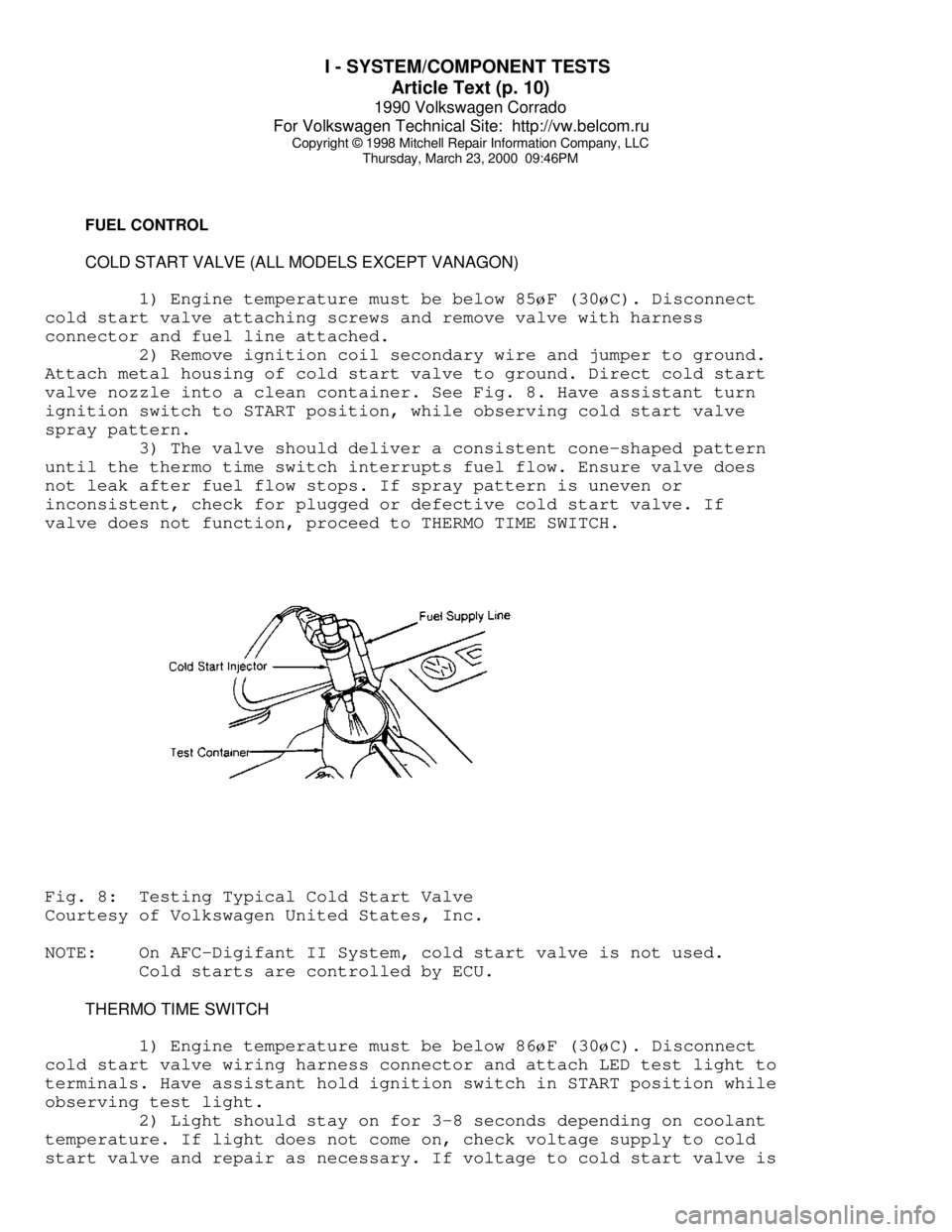
Attach metal housing of cold start valve to ground. Direct cold start
valve nozzle into a clean container. See Fig. 8. Have assistant turn
ignition switch to START position, while observing cold start valve
spray pattern.
3) The valve should deliver a consistent cone-shaped pattern
until the thermo time switch interrupts fuel flow. Ensure valve does
not leak after fuel flow stops. If spray pattern is uneven or
inconsistent, check for plugged or defective cold start valve. If
valve does not function, proceed to THERMO TIME SWITCH.Fig. 8: Testing Typical Cold Start Valve
Courtesy of Volkswagen United States, Inc.
NOTE: On AFC-Digifant II System, cold start valve is not used.
Cold starts are controlled by ECU.
THERMO TIME SWITCH
1) Engine temperature must be below 86
øF (30øC). Disconnect
cold start valve wiring harness connector and attach LED test light to
terminals. Have assistant hold ignition switch in START position while
observing test light.
2) Light should stay on for 3-8 seconds depending on coolant
temperature. If light does not come on, check voltage supply to cold
start valve and repair as necessary. If voltage to cold start valve is
Page 601 of 906

I - SYSTEM/COMPONENT TESTS
Article Text (p. 14)
1990 Volkswagen Corrado
For Volkswagen Technical Site: http://vw.belcom.ru
Copyright © 1998 Mitchell Repair Information Company, LLC
Thursday, March 23, 2000 09:46PM
terminals. Disconnect Hall Effect sender wire harness connector from
distributor. Turn ignition on.
2) While observing DVOM reading, attach center terminal of
connector to ground for 3 seconds. Voltage reading should briefly
increase to 4.5 volts. If voltage reading did not increase, check
wiring for short or open circuit. If wiring is okay, replace ignition
control unit.
EMISSION SYSTEMS & SUB-SYSTEMS
EXHAUST GAS RECIRCULATION (EGR)
1) With engine idling, apply about 12 in. Hg to EGR valve
with a hand-held vacuum pump. Engine should run rough or stall. If
idle does not change, remove EGR valve and inspect for restricted port
passage. Clean as required.
2) If port is clean, apply about 12 in. Hg to EGR valve with
vacuum pump. If valve does not move, replace EGR valve. If valve
moves, go to next step.
3) Install EGR valve and new gasket. Connect vacuum gauge to
EGR vacuum line with a "T" fitting. Start engine and increase engine
speed to about 3000 RPM. Vacuum gauge should indicate vacuum. If okay,
test is complete. If not okay, vacuum source is plugged. Repair as
necessary and repeat test.
FUEL EVAPORATION
EVAP CANISTER BY-PASS VALVE (ALL MODELS EXCEPT VANAGON)
1) Remove both vent hoses and vacuum hose from canister by-
pass valve. Apply very low air pressure to vent hoses individually.
There should be no airflow. If air passes through, replace by-pass
valve.
2) Attach vacuum pump to vacuum hose and apply 5-10 in. Hg.
Apply low air pressure to vent hoses individually. Valve should be
open and air should flow. If air does not flow, replace by-pass valve.
EVAP CANISTER BY-PASS VALVE (VANAGON)
1) Start and warm engine to normal operating temperature.
Disconnect White nylon hose from rubber boot at rear of intake
manifold. Attach vacuum pump and apply 5-10 in. Hg. If vacuum holds,
control valve is okay.
2) If vacuum does not hold, disconnect Purple vacuum hose
from throttle body. Attach vacuum gauge. If less than one in. Hg is
present, replace control valve. If more than one in. Hg is present,
adjust throttle valve stop screw and repeat test.
Page 676 of 906
N - REMOVE/INSTALL/OVERHAUL
Article Text (p. 3)
1990 Volkswagen Corrado
For Volkswagen Technical Site: http://vw.belcom.ru
Copyright © 1998 Mitchell Repair Information Company, LLC
Thursday, March 23, 2000 09:49PM
Centering Sensor Plate & Lever
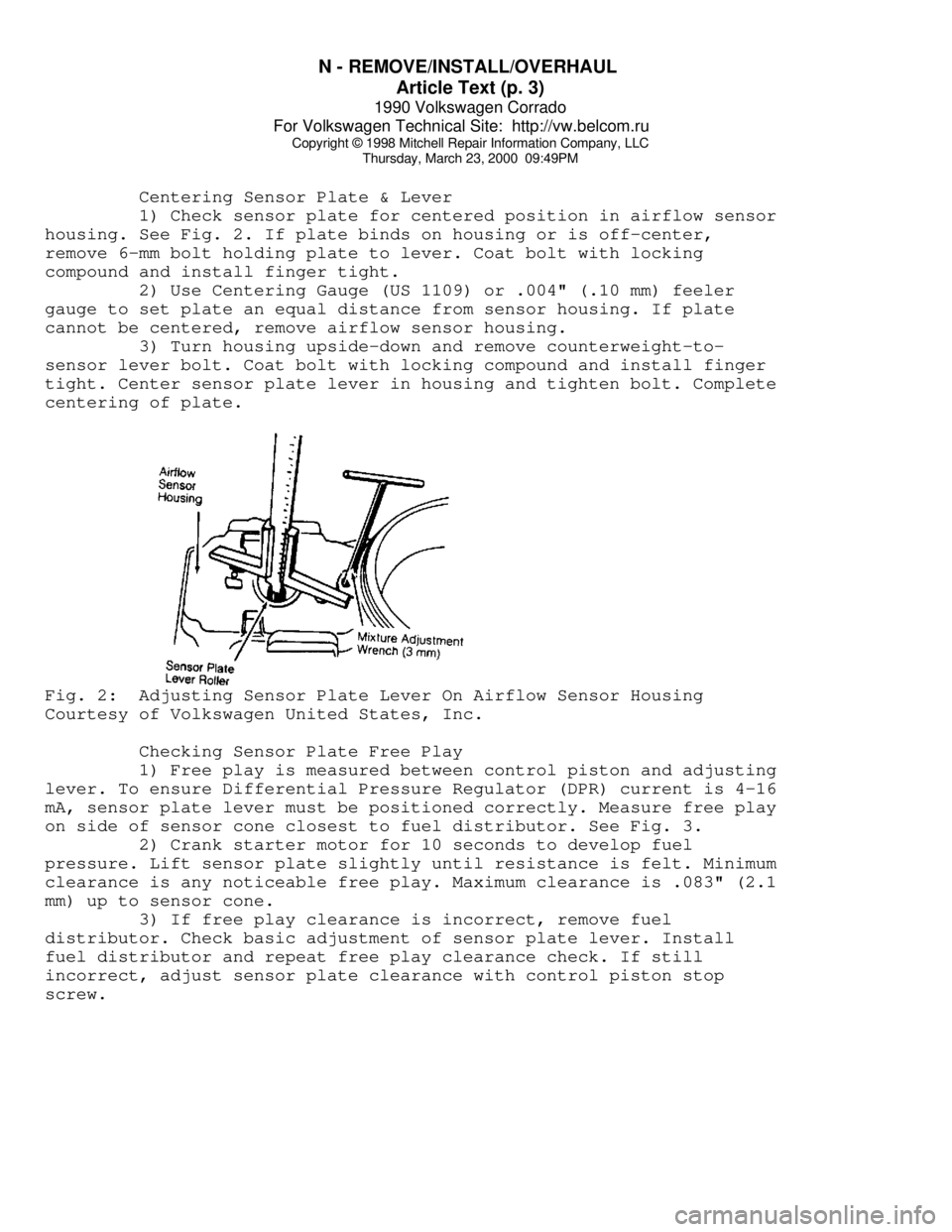
1) Check sensor plate for centered position in airflow sensor
housing. See Fig. 2. If plate binds on housing or is off-center,
remove 6-mm bolt holding plate to lever. Coat bolt with locking
compound and install finger tight.
2) Use Centering Gauge (US 1109) or .004" (.10 mm) feeler
gauge to set plate an equal distance from sensor housing. If plate
cannot be centered, remove airflow sensor housing.
3) Turn housing upside-down and remove counterweight-to-
sensor lever bolt. Coat bolt with locking compound and install finger
tight. Center sensor plate lever in housing and tighten bolt. Complete
centering of plate.Fig. 2: Adjusting Sensor Plate Lever On Airflow Sensor Housing
Courtesy of Volkswagen United States, Inc.
Checking Sensor Plate Free Play
1) Free play is measured between control piston and adjusting
lever. To ensure Differential Pressure Regulator (DPR) current is 4-16
mA, sensor plate lever must be positioned correctly. Measure free play
on side of sensor cone closest to fuel distributor. See Fig. 3.
2) Crank starter motor for 10 seconds to develop fuel
pressure. Lift sensor plate slightly until resistance is felt. Minimum
clearance is any noticeable free play. Maximum clearance is .083" (2.1
mm) up to sensor cone.
3) If free play clearance is incorrect, remove fuel
distributor. Check basic adjustment of sensor plate lever. Install
fuel distributor and repeat free play clearance check. If still
incorrect, adjust sensor plate clearance with control piston stop
screw.