warning VOLKSWAGEN E GOLF 2015 5G / 7.G Owners Manual
[x] Cancel search | Manufacturer: VOLKSWAGEN, Model Year: 2015, Model line: E GOLF, Model: VOLKSWAGEN E GOLF 2015 5G / 7.GPages: 394, PDF Size: 5.6 MB
Page 237 of 394
Setting the electronic parking brake
You can engage the electronic parking brake any time the vehicle is not moving - even if the ignition is switched off. Always engage the parking brake when you leave or park the vehicle.
x Pull and hold the button ⇒ fig. 129.
x The parking brake is engaged when the indicator light G (arrow) in the button and in the instru-
ment cluster ⇒ Warning and indicator lights lights up.
Releasing the electronic parking brake
x Switch the ignition on.
x Press the button ⇒ fig. 129. At the same time, press the brake pedal firmly or press the accelerator pedal lightly if the electric motor is drive ready.
x The parking brake is released when the indicator light G (arrow) in the button and in the instru-
ment cluster ⇒ Warning and indicator lights goes out.
Releasing the electronic parking brake automatically when you start driving
The electronic parking brake releases automatically when you start driving if the driver's door is closed and the driver's safety belt is buckled.
Emergency braking function
Only use the emergency braking function in an emergency, when you cannot stop the vehicle using
the brake pedal ⇒ !
x Pull and hold the button ⇒ fig. 129 to brake the vehicle hard. An audio warning signal will sound at the same time.
x To stop the braking maneuver, release the button or press the accelerator pedal.
WARNING
Improper use of the electronic parking brake can cause accidents and severe injuries.
x Never use the parking brake to slow down the vehicle when it is moving, except in an emergency. Braking distance is much longer, since only the rear wheels are braked. Alwa ys use the foot brake.
x Never press the accelerator pedal when a selector lever position or gear is engaged and the electric motor is drive ready. The vehicle could begin moving, even if the electronic park-ing brake is set.
NOTICE
Even though the transmission is in Park (P), the vehicle may move a couple of inches (a few centimeters) forwards or backwards if you take your foot off the brake pedal after stopping the vehicle without first firmly setting the parking brake.
If the 12-volt vehicle battery is dead, the electronic parking brake cannot be released.
You may hear noises when setting or releasing the electronic parking brake.
If the electronic parking brake is not used for a while, an automatic system check will occasional-ly run when the vehicle is parked. This system check makes audible noises.
Page 239 of 394

mance by applying more pressure to the brake pedal. But, during the break-in period, the stopping distance for hard braking and emergency braking will be longer until the brakes are fully broken in. Avoid hard braking and situations that might require hard braking (such as following other vehicles too closely) – especially during the break-in period.
Brake pad wear depends mostly on operating conditions and the way the vehicle is driven. If you do a lot of city and short-distance driving and/or have a sporty driving style, you should have the brake pads checked by an authorized Volkswagen dealer or authorized Volkswagen Service Facility more often than the regular service intervals.
Wet brakes (for example, after driving through water or washing the vehicle or after heavy rainfall) will not brake as well. Stopping distances will be longer when brake discs are wet or, in winter, even icy. Wet or icy brakes must be dried as soon as possible by carefully applying the brakes a couple of times while traveling at a relatively high speed. Make sure nobody is behind you and that you do not endan-
ger yourself or others ⇒ .
Brakes coated with road salt also react slower and need longer stopping distances. If there is salt on the roads and you are not braking regularly, brake carefully and gently from time to time to remove any
salt coating from the brake discs and pads ⇒ .
Brake disc corrosion (rust) and dirt buildup on the brake pads are more likely to occur if the vehicle is not driven much or is driven only for short distances with little braking. If the brakes have not been used and there is some rust on the discs, clean the brake discs and pads once in a while by carefully braking a couple of times while driving at relatively high speed to help clean the brake discs and pads.
Make sure nobody is behind you and that you do not endanger yourself or others ⇒ .
Brake system malfunction
If you brake and find that the vehicle doesn't brake nearly as well as it used to (sudden increase in stopping distance), a brake circuit may have failed. The brake warning light H or "2!+% will light up and a message may appear in the instrument cluster display. If you believe the vehicle is safe to drive, immediately take it to the nearest authorized Volkswagen dealer or authorized Volkswagen Service Facility for repair. Drive slowly and very carefully, allow for the longer stopping distance, and be ready to push longer and harder on the brake pedal to slow the vehicle down.
Electro-mechanical brake booster
The electro-mechanical brake booster works only when the electric motor is activated. It increases the force on the brakes above and beyond the pressure put on the brake pedal by the driver.
If the electro-mechanical brake booster is not working, you will have to push the brake pedal harder to
make up for the lack of booster assistance and the resulting longer stopping distance ⇒ .
WARNING
New brake pads do not provide maximum braking performance.
x New brake pads do not have the best stopping power for the first 185 miles (300 km) and must be “broken in.” You can compensate for the slightly reduced braking force by putting more pressure on the brake pedal.
x Drive with extra care while the new brake pads are being broken in. This reduces the risk of collisions and serious personal injuries due to a loss of control over the vehicle.
x Never follow other vehicles too closely or put yourself into other situations that might require sudden, hard braking, especially when the brake pads have not been broken in.
Page 240 of 394
WARNING
Overheated brakes will reduce the vehicle's stopping power and increase stopping distances considerably.
x When driving downhill, the brakes have to work especially hard and heat up quickly.
x Before driving downhill, especially on hills that are long or steep, always reduce speed and use the recuperation mode. This will let the vehicle use electric motor braking and re-duce the load on the brakes. Otherwise, the brake system could overheat and possibly fail. Only use the brakes when you need them to slow the vehicle down more or to stop.
x A damaged front bumper or a non-standard spoiler can reduce airflow to the brakes and make them overheat.
WARNING
Wet brakes or brakes coated with ice or road salt react slower and need longer stopping dis-tances.
x Carefully apply the brakes to test them.
x Always dry brakes and clean off ice and salt coatings with a few cautious brake applica-tions when visibility, weather, road and traffic conditions permit.
WARNING
Driving when the electro-mechanical brake booster is not working increases stopping dis-tances and can cause accidents and serious personal injuries.
x Never let the vehicle coast when the electric motor is switched off.
x If the electro-mechanical brake booster is not working, a lot more pedal force is needed to slow down and stop.
NOTICE
x Never “ride” the brakes by keeping your foot on the brake pedal when you do not want to brake. Constant pressure on the brake pedal can make the brakes overheat. Riding the brakes will substantially reduce braking performance, increase stopping distance, and can cause complete brake system failure.
x Before driving downhill, especially on hills that are long or steep, always reduce speed and use the recuperation mode. This will let the vehicle use electric motor braking and reduce the load on the brakes. Otherwise, the brake system could overheat and possibly fail. Only use the brakes when you need them to slow the vehicle down more or to stop.
When the front brakes are serviced, you should have the rear brake pads inspected at the same time. The wear of all brake pads should be visually checked regularly. The best way to check for brake pad wear is to have your authorized Volkswagen dealer or authorized Volkswagen Service Facility visually inspect the pads through the openings in the wheel rims or from underneath the vehicle. If necessary, the wheels can be taken off for a more thorough inspection.
Braking assistance systems
Page 242 of 394

x ABS stops working if you release or let up on the brake.
When ABS is doing its job, you will notice a slight vibration through the brake pedal and hear a noise. ABS cannot shorten the stopping distance under all conditions. The stopping distance may even be longer, for instance, when driving on gravel or on newly fallen snow covering an icy or slip-pery surface.
Brake Assist (BAS)
The Brake Assist System can help to reduce stopping distances. If you press the brake pedal very quickly, BAS detects an emergency situation. It then very quickly builds up full brake system pressure, maximizing braking power and reducing the stopping distance. This way, ABS can be activated more quickly and efficiently.
Do not reduce pressure on the brake pedal! BAS switches off automatically as soon as you release or let up on the brake.
Anti-Slip Regulation (ASR)
ASR reduces electric motor power directed to spinning wheels and adjusts power to the road condi-tions. Even under poor road conditions, ASR can make it easier to get moving, accelerate, and climb hills.
ASR can be switched on or off manually ⇒ Switching Anti-Slip Regulation (ASR) on and off.
Electronic Differential Lock (EDL and XDL)
EDL is applied during regular straight-line acceleration. EDL gently brakes a drive wheel that has lost traction (spinning) and redirects the drive force to other drive wheels. In extreme cases, EDL automat-ically switches off to keep the brake from overheating. As soon as the brake has cooled down, EDL automatically switches on again.
XDL is an extension of the Electronic Differential Lock system. XDL does not react to drive wheel slippage when driving straight ahead. Instead, XDL detects slippage of the inside front wheel during fast cornering. XDL applies enough brake pressure to this wheel in order to stop the slippage. This improves traction, which helps the vehicle stay on track.
WARNING
Driving fast on icy, slippery, or wet roads can lead to a loss of control and result in serious personal injury for you and your passengers.
x Always adjust your speed and driving style to road, traffic, weather, and visibility condi-tions. Never let the additional safety that ESC, ABS, BAS, ASR, and EDL can provide tempt you into taking extra risks.
x Braking assistance systems cannot overcome the laws of physics and always prevent loss of vehicle control. Slippery and wet roads are still dangerous even with ESC and the other systems!
x Driving too fast on wet roads can cause the wheels to lose contact with the road and “hy-droplane.” A vehicle that has lost road contact cannot be braked, steered, or controlled.
x These systems cannot reduce the risk of accident, for example if you drive too fast for conditions or if you do not keep your distance from the vehicle in front of you.
x Although these systems are very effective and can help you control the vehicle in many difficult situations, always remember that your vehicle handling control is limited by tire trac-tion.
x When accelerating on a slippery surface, for example on ice and snow, depress the accel-erator carefully. Even with these systems, the wheels may start to spin, leading to a loss of vehicle control.
Page 243 of 394

WARNING
The effectiveness of ESC can be significantly reduced if other components and systems that affect vehicle dynamics, including but not limited to brakes, tires, and other systems men-tioned above, are not properly maintained or functioning.
x Always remember that vehicle alterations or modifications can affect the functioning of the ABS, BAS, ASR, EDL, and ESC systems.
x Changing the vehicle suspension or using an unapproved tire/wheel combination can change the way the ABS, BAS, ASR, EDL, and ESC systems work and reduce their effective-ness.
x The effectiveness of ESC is also determined by the tires fitted ⇒ Tires and wheels.
All 4 wheels must be equipped with identical tires in order for ESC and ASR to work properly. Differences in the tread circumference of the tires can cause the system to reduce the electric motor power when it is not expected.
If ABS is not working, ESC, ASR, and EDL will also not work.
You may hear noises when these systems are active.
Switching Anti-Slip Regulation (ASR) on and off
Page 245 of 394

The brake fluid level drops slightly when the vehicle is being used as the brake pads wear and the brakes are automatically adjusted.
Changing brake fluid
Brake fluid must be changed according to the service schedule in your ⇒ Booklet Warranty and
Maintenance. Have the brake fluid checked by an authorized Volkswagen dealer or an authorized Volkswagen Service Facility. Refill only with new brake fluid that meets the standards listed above.
WARNING
Brake failure and reduced brake performance can be caused by not having enough brake fluid in the reservoir or by old or incorrect brake fluid.
x Check the brake system and brake fluid level regularly.
x Always change the brake fluid according to the service schedule in your
⇒ Booklet Warranty and Maintenance.
x Hard braking with old brake fluid may cause vapor lock. Vapor lock reduces braking per-formance, increases stopping distances and can even cause total brake failure.
x Always make sure that only the correct brake fluid is used. Only use brake fluid that ex-pressly conforms to VW Standard 501 14 or, if it is not available, only use a high-quality brake fluid that conforms to U.S. Standard FMVSS 116 DOT 4 requirements.
x Using another brake fluid, or one that is not of high quality, can impair the function of the brake system and reduce its effectiveness. If the container does not say that the brake fluid complies with VW Standard 501 14, or U.S. Standard FMVSS 116 DOT 4, do not use it.
x The brake fluid must be new.
WARNING
Brake fluid is poisonous.
x To reduce the risk of poisoning, never use food, beverage or other non-original containers to store brake fluid. Someone might be misled by the original label on the container, or by the shape of the container, and drink the brake fluid. This could occur even if you relabel the container as “brake fluid.”
x Only store brake fluid in the closed, original container and keep it out of the reach of chil-dren.
NOTICE
Brake fluid will damage vehicle paint, plastic parts, and tires. Wipe any brake fluid off vehicle paint and other vehicle parts immediately.
Brake fluid can pollute the environment. Brake fluid that has leaked out must be collected and disposed of properly, following all applicable environmental regulations.
Page 247 of 394

DANGER
High-voltage systems in the electric motor compartment and in other places on the vehicle can cause electrical shocks or even electrocution, severe burns, other serious injuries, and even death!
x Always assume that the high-voltage battery is fully charged and that all high-voltage components are live.
x Touching damaged orange high-voltage cables, the high-voltage battery or other parts of the high-voltage electrical system can cause fatal electric shock.
x The high-voltage system may also be active even when the ignition is switched off!
x Electrolyte fluid in the high-voltage battery will cause severe chemical burns. If electrolyte fluid contacts skin, thoroughly flush affected area with clean water for at least 15 minutes and then wash affected area with soap and water; medical attention is recommended.
x Never attempt to carry out any work on the high-voltage network, the high-voltage cables or the high-voltage battery.
x Never open, maintain or repair components or parts of the high-voltage network, and nev-er disconnect them from the network.
x Never damage, change or remove the orange high-voltage cables or disconnect them from the high-voltage network.
x Never open, modify or remove the cover of the high-voltage battery.
x Any work on the high-voltage system, or on systems which could be indirectly affected by it, must only be carried out by properly trained and qualified experts.
x Work in the vicinity of high-voltage components and high-voltage cables with machinery, sharp-edged tools or heat sources, for example, welding, soldering, hot air or thermal adhe-sives, may only be performed after the high-voltage components have been disconnected. Only properly qualified and trained specialist staff may work on the high voltage compo-nents.
x The Volkswagen standards and guidelines must be adhered to when carrying out any work on the high-voltage network or the high-voltage battery.
x During such work, keep the vehicle key safe and far enough away from the vehicle to pre-vent any risk of the ignition being accidentally switched on and the electrical system activat-ed (particularly in vehicles with Keyless Access).
x Any gasses emitted by or escaping from the high-voltage battery may be toxic or flamma-ble.
x Damage to the vehicle or to the high-voltage battery could lead to a leak of toxic gases, either immediately or at a later time. These emitted gases could also potentially cause a fire. If damage has been incurred, it is vital to then open the vehicle windows to allow any emitted gases to disperse. Do not inhale these gases.
x Never touch or inhale any liquids or gasses leaking from the high-voltage battery, espe-cially if the battery has been damaged.
x Remember to inform any attending emergency services that the vehicle is equipped with a high-voltage battery.
Warning and indicator lights
Page 250 of 394
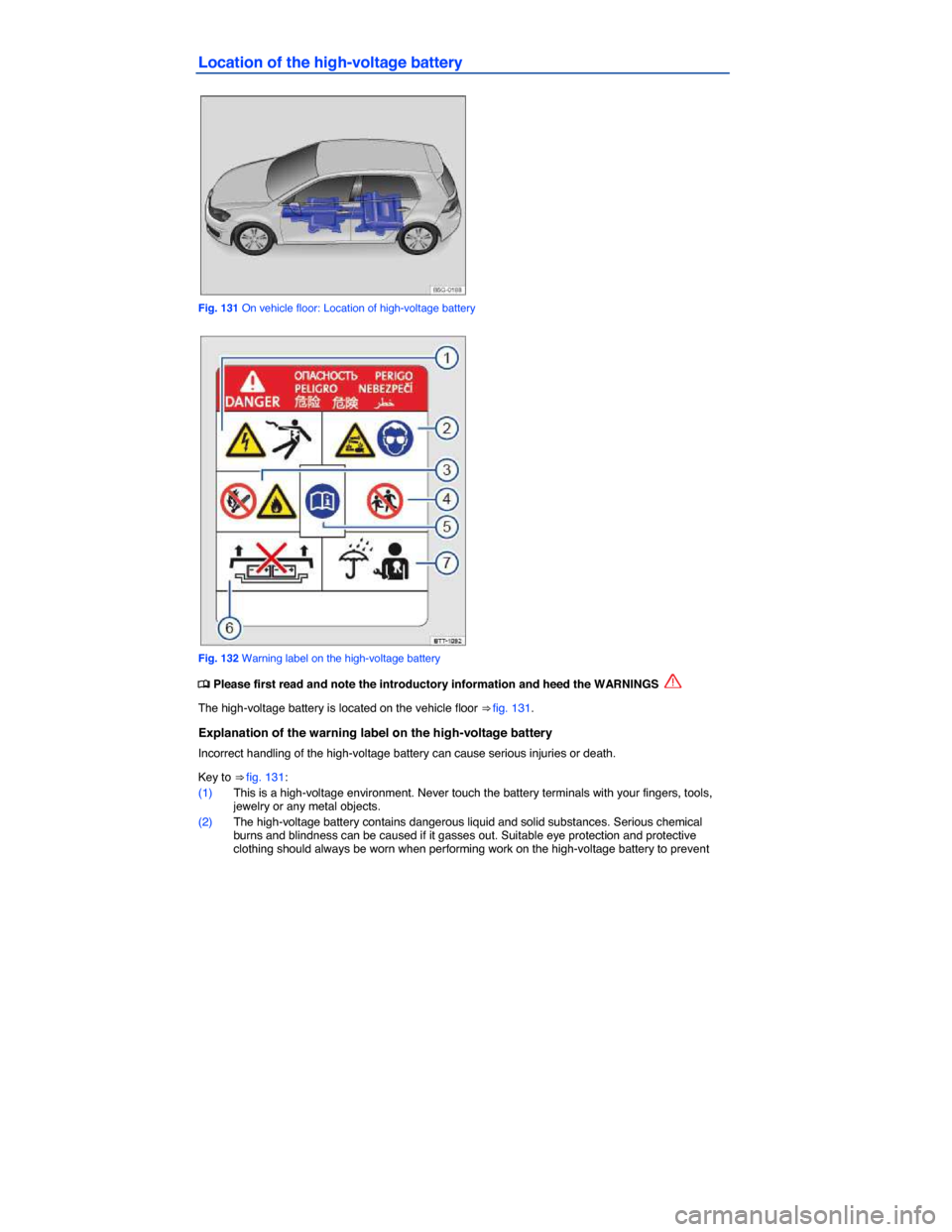
Location of the high-voltage battery
Fig. 131 On vehicle floor: Location of high-voltage battery
Fig. 132 Warning label on the high-voltage battery
Page 251 of 394
the battery fluid coming in contact with skin and eyes. If skin or eyes come into contact with bat-tery fluid, rinse the affected areas with clean flowing water for at least 15 minutes and see a doctor immediately.
(3) The high-voltage battery can burn. The high-voltage battery should never be exposed to fire, sparks or naked flames. Always handle the high-voltage battery with care to prevent damage and fluid leaks.
(4) Always keep children away from the high-voltage battery.
(5) You will find further information and warnings in the Owner's Manual and in the workshop manual.
(6) Never remove the cover from the high-voltage battery nor disassemble the high-voltage battery.
(7) Have maintenance work on the high-voltage battery performed only by properly qualified and
trained specialist staff ⇒ . Never make try to modify the high-voltage battery. The opened high-voltage battery should not come into contact with water or other liquids. Liquids can cause short-circuits, electric shocks and burns.
WARNING
Working on the high-voltage battery can cause severe chemical burns, explosions or life-endangering electric shocks.
x Any necessary work should only be carried out by an authorized Volkswagen dealer or an authorized Volkswagen Service Facility .
WARNING
Damage to the high-voltage battery can cause liquids and gases to leak. Harmful substances can then leak and cause injuries. The emitted gases could also potentially cause a fire.
x Do not touch any fluid that leaks out from the high-voltage battery as it can cause chemi-cal burns.
x Call the fire department in the event of a fire. Inform the fire department that the vehicle has an electric drive and high-voltage components.
x Leave the hazard area.
x If you think that the high-voltage battery has been damaged, have the high-voltage battery checked by properly qualified and trained specialist staff.
Charge level display
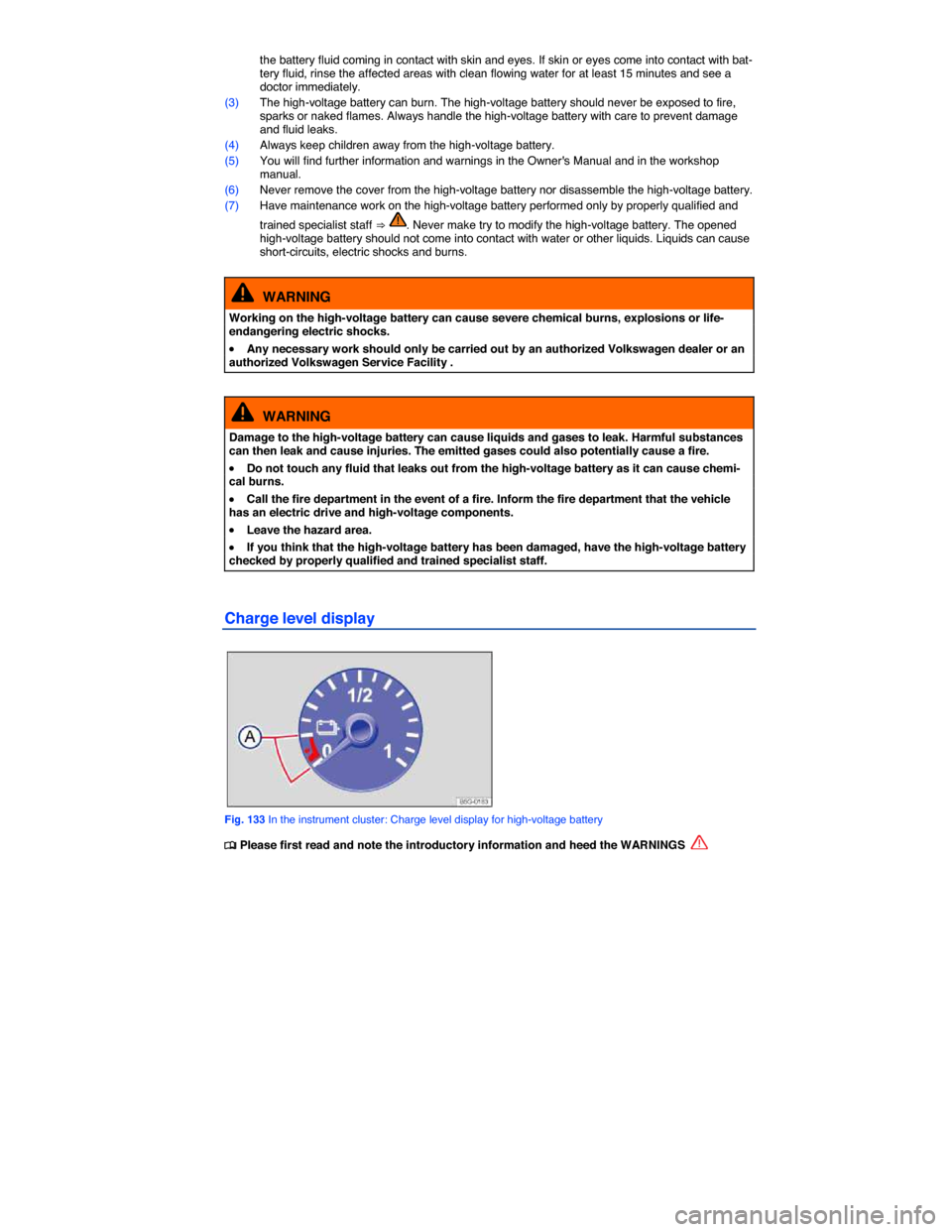
Fig. 133 In the instrument cluster: Charge level display for high-voltage battery
Page 252 of 394
The current charge level of the high-voltage battery is displayed in the instrument cluster ⇒ fig. 133.
The current range is also shown on the instrument cluster display ⇒ fig. 9.
When the high-voltage battery is fully charged, the needle in the charge level display points to 1.
the charge level of the high-voltage battery has reached the “reserve range” (A) or the vehicle is driving in the reserve range, various indicator lights will light up in the instrument cluster and text
messages will appear in the instrument cluster display ⇒ fig. 9. Charge the high-voltage battery as soon as possible.
WARNING
Driving when the high-voltage battery charge level is too low can lead to stalling in traffic, collisions and serious personal injury.
x Always make sure that the high-voltage battery has enough charge to get where you are going and that the high-voltage battery can be charged when you get there.
Range of the high-voltage battery