steering VOLKSWAGEN E GOLF 2015 5G / 7.G Owner's Manual
[x] Cancel search | Manufacturer: VOLKSWAGEN, Model Year: 2015, Model line: E GOLF, Model: VOLKSWAGEN E GOLF 2015 5G / 7.GPages: 394, PDF Size: 5.6 MB
Page 241 of 394

The ESC, ABS, BAS, ASR, and EDL braking assistance systems work only when the electric motor is activated. These systems can significantly improve active driving safety.
Electronic Stability Control (ESC)
ESC helps to improve road holding and vehicle dynamics to help reduce the probability of skidding and loss of vehicle control. It works only when the electric motor is activated. ESC detects certain difficult driving situations, including when the vehicle is beginning to spin (yaw) out of control. ESC then helps you to get the vehicle back under control by selectively braking the wheels and/or reducing electric motor power and by providing steering assistance to help hold the vehicle on the driver's intended course.
ESC has limitations. It is important to remember that ESC cannot overcome the laws of physics. It will not always be able to help out under all conditions you may come up against. For example, ESC may not always be able to help you master situations where there is a sudden change in the coefficient of friction of the road surface. When there is a section of dry road that is suddenly covered with water, slush or snow, ESC cannot perform the same way it would on a dry surface. If the vehicle “hydro-planes” (rides on a cushion of water instead of the road surface), ESC will not be able to help you steer the vehicle because contact with the pavement has been interrupted and the vehicle cannot be braked or steered. During fast cornering, particularly on winding roads, ESC cannot always deal as effectively with difficult driving situations as it can at lower speeds. When towing a trailer, ESC is not able to help you regain control as it would if you were not towing a trailer.
Always adjust your speed and driving style to visibility, road, traffic, and weather conditions. ESC cannot override the vehicle's physical limits, increase the available traction, or keep a vehicle on the road if road departure is a result of driver inattention. Instead, ESC improves the possibility of keeping the vehicle under control and on the road during extreme maneuvers by using the driver's steering inputs to help keep the vehicle going in the intended direction. If you are traveling at a speed that causes you to run off the road before ESC can provide any assistance, you may not experience the benefits of ESC.
ESC includes and/or works together with the ABS, BAS, ASR, EDL, and XDL systems (see below). ESC is switched on all the time. In certain situations when you need less traction or additional traction cannot be achieved, you can switch off ASR in the Infotainment system by pressing the #!2 button
followed by the
Page 340 of 394

WARNING
Leaving the optional safety belt extender attached to the safety belt buckle on the front pas-senger seat when the safety belt is not being used will prevent the Advanced Airbag System from working properly and can increase the risk of serious personal injury in a collision.
x Leaving the extender attached to the safety belt buckle when the front seat is occupied and the safety belt is not being used will signal to the airbag control unit that the front pas-senger seat is occupied and that the safety belt is being used. The electronic control unit for the airbag system will then receive incorrect information that will
– cause the safety belt pretensioner to deploy unnecessarily in collisions and
– cause the front passenger airbag to deploy later in collisions in which the front airbag would otherwise be triggered earlier to help protect an unrestrained front seat passenger.
x Always remove the safety belt extender when it is not needed and stow it safely.
x Never use the safety belt extender to secure a child restraint.
WARNING
Items stored between the safety belt buckle and the center console can cause safety belt buckle to send the wrong information to the airbag control unit and prevent the Advanced Airbag System from working properly.
x Always make sure that nothing can interfere with the safety belt buckles and that they are not obstructed.
WARNING
Improper care and servicing, and improper modification and repair work, can increase the risk of personal injury and death by preventing an airbag from deploying when needed or deploying an airbag unexpectedly:
x Never repair, adjust, or change any parts of the airbag system.
x All work on the airbag system, steering wheel, instrument panel, front seats or electrical system (including the installation of audio equipment, mobile telephones and CB radios, etc.) should be performed by authorized Volkswagen dealers or authorized Volkswagen Service Facilities. They have the necessary manuals, training, and special equipment.
x The airbag system can be activated only once. After an airbag has inflated, it must be replaced.
x Use only original equipment airbags approved by Volkswagen. Have them installed by a trained technician who has the necessary tools and diagnostic equipment to properly replace any airbag in your vehicle and assure system effectiveness in a crash.
x Never permit salvaged or recycled airbags to be installed in your vehicle.
Undeployed airbag modules and safety belt pretensioners are classified as Perchlorate Materi-al. Special handling may apply – see http://www.dtsc.ca.gov/hazardouswaste/perchlorate. Obey all applicable legal requirements regarding handling and disposal of the vehicle or parts of its restraint system, including airbag modules and safety belts with pretensioners. Authorized Volkswagen dealers and authorized Volkswagen Service Facilities are familiar with the requirements, and we recommend that you have them perform this service for you.
Page 379 of 394
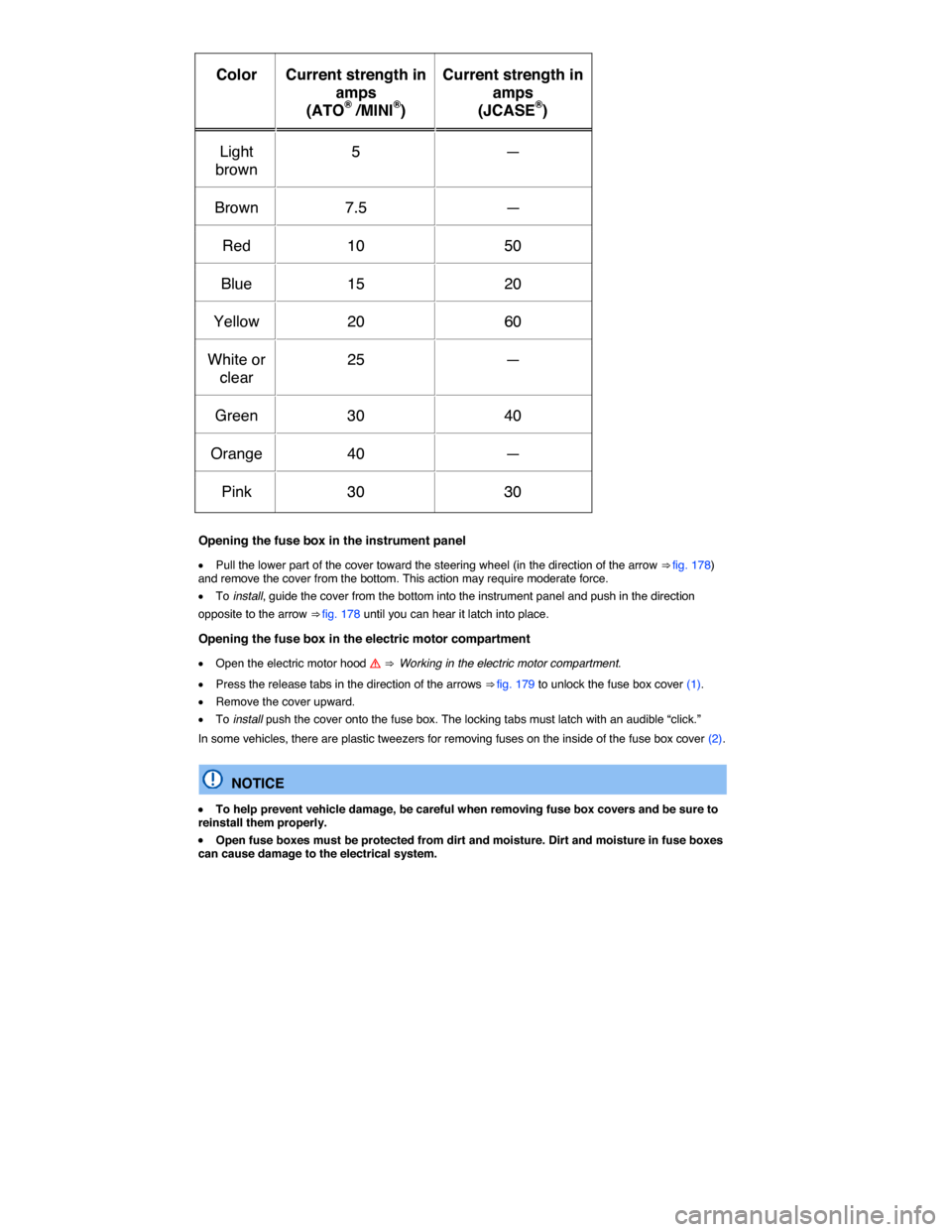
Color Current strength in
amps
(ATO® /MINI®)
Current strength in
amps
(JCASE®)
Light
brown
5 —
Brown 7.5 —
Red 10 50
Blue 15 20
Yellow 20 60
White or
clear
25 —
Green 30 40
Orange 40 —
Pink 30 30
Opening the fuse box in the instrument panel
x Pull the lower part of the cover toward the steering wheel (in the direction of the arrow ⇒ fig. 178) and remove the cover from the bottom. This action may require moderate force.
x To install, guide the cover from the bottom into the instrument panel and push in the direction
opposite to the arrow ⇒ fig. 178 until you can hear it latch into place.
Opening the fuse box in the electric motor compartment
x Open the electric motor hood
Page 388 of 394

WARNING
Towing a vehicle changes the way it handles and brakes. To help reduce the risk of an acci-dent and serious personal injury, note the following:
x The driver of the vehicle that is being towed:
– Since the brake booster also does not work when the electric motor is stopped, you will need to press harder on the brake pedal to slow down or stop. Always be alert so as not to rear-end the towing vehicle.
– Will have to use considerably more force to turn the steering wheel because the power steering is not working.
x The driver of the vehicle that is doing the towing:
– Must accelerate gradually and gently and avoid jerking movements.
– Must not brake hard or steer sharply.
– Must brake earlier and more gently than in normal driving.
NOTICE
x Be careful not to damage the paint when installing and removing the towing eye and the cover for the threaded hole behind the bumper.
Text messages
Page 391 of 394
WARNING
If the vehicle is towed even though the text message Towing damages electrical sys-tem. See owner's man.! appears in the instrument cluster, vibrations can occur in the electric drive and the front wheels can lock, especially on ice or wet roads. Locking front wheels can impair the steering functions and cause accidents and serious injuries.
x If the message Towing damages electrical system. See owner's man.! appears in the instrument cluster, only tow the vehicle in emergency situations at walking speed and for a maximum of 330 ft. (100 m).
NOTICE
If the vehicle is towed even though the text message Towing damages electrical system. See owner's man.! appears in the instrument cluster and walking speed is exceeded or it is towed further than 330 ft. (100 m), serious damage can be done to the to the electric drive.
A vehicle can be towed only if the electronic parking brake is switched off and the electronic steering column lock is released. In case of a power loss or malfunctions of the electrical system, the electric motor may have to be jump-started in order to release the electronic steering column lock and the electronic parking brake.
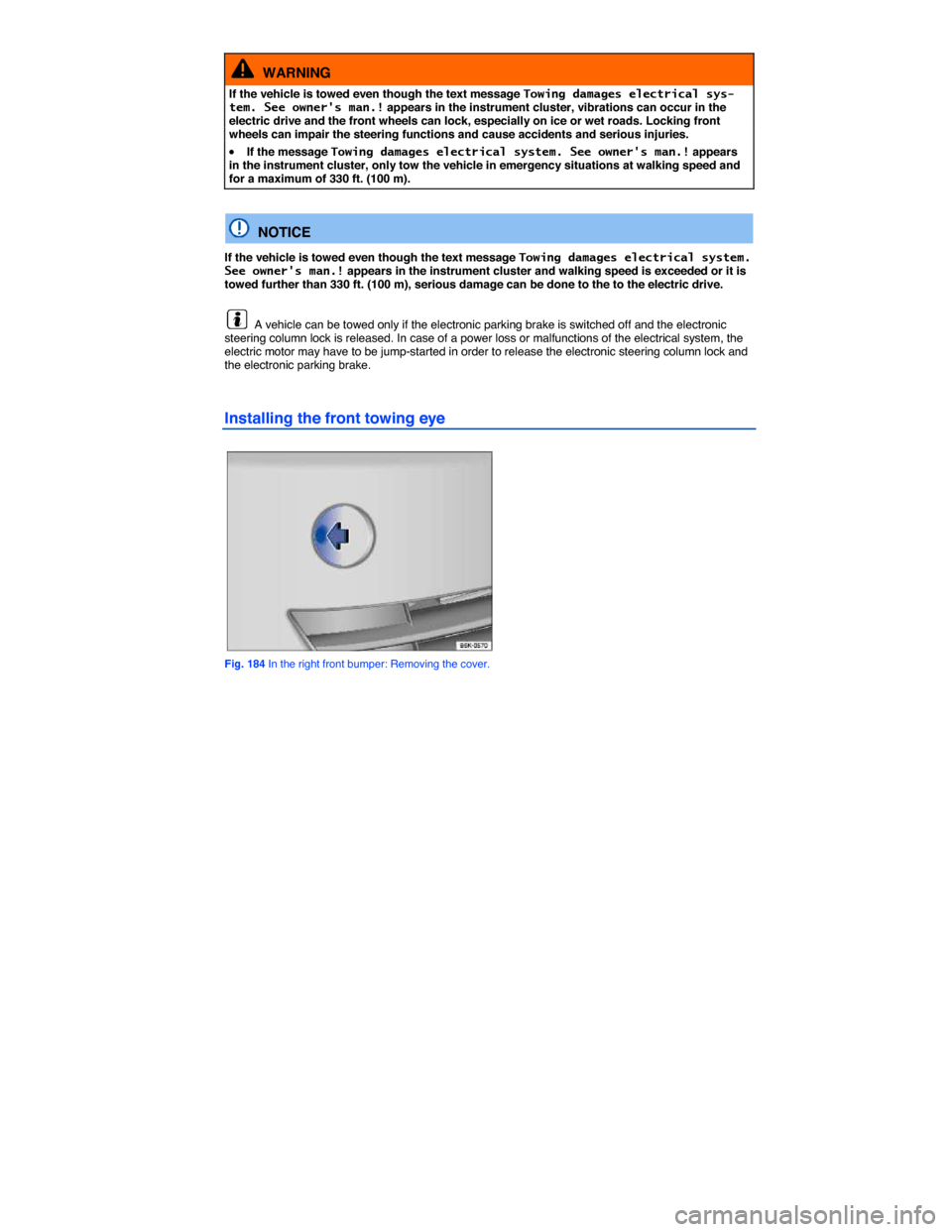
Installing the front towing eye
Fig. 184 In the right front bumper: Removing the cover.