Air VOLKSWAGEN E GOLF 2015 5G / 7.G Service Manual
[x] Cancel search | Manufacturer: VOLKSWAGEN, Model Year: 2015, Model line: E GOLF, Model: VOLKSWAGEN E GOLF 2015 5G / 7.GPages: 394, PDF Size: 5.6 MB
Page 245 of 394

The brake fluid level drops slightly when the vehicle is being used as the brake pads wear and the brakes are automatically adjusted.
Changing brake fluid
Brake fluid must be changed according to the service schedule in your ⇒ Booklet Warranty and
Maintenance. Have the brake fluid checked by an authorized Volkswagen dealer or an authorized Volkswagen Service Facility. Refill only with new brake fluid that meets the standards listed above.
WARNING
Brake failure and reduced brake performance can be caused by not having enough brake fluid in the reservoir or by old or incorrect brake fluid.
x Check the brake system and brake fluid level regularly.
x Always change the brake fluid according to the service schedule in your
⇒ Booklet Warranty and Maintenance.
x Hard braking with old brake fluid may cause vapor lock. Vapor lock reduces braking per-formance, increases stopping distances and can even cause total brake failure.
x Always make sure that only the correct brake fluid is used. Only use brake fluid that ex-pressly conforms to VW Standard 501 14 or, if it is not available, only use a high-quality brake fluid that conforms to U.S. Standard FMVSS 116 DOT 4 requirements.
x Using another brake fluid, or one that is not of high quality, can impair the function of the brake system and reduce its effectiveness. If the container does not say that the brake fluid complies with VW Standard 501 14, or U.S. Standard FMVSS 116 DOT 4, do not use it.
x The brake fluid must be new.
WARNING
Brake fluid is poisonous.
x To reduce the risk of poisoning, never use food, beverage or other non-original containers to store brake fluid. Someone might be misled by the original label on the container, or by the shape of the container, and drink the brake fluid. This could occur even if you relabel the container as “brake fluid.”
x Only store brake fluid in the closed, original container and keep it out of the reach of chil-dren.
NOTICE
Brake fluid will damage vehicle paint, plastic parts, and tires. Wipe any brake fluid off vehicle paint and other vehicle parts immediately.
Brake fluid can pollute the environment. Brake fluid that has leaked out must be collected and disposed of properly, following all applicable environmental regulations.
Page 247 of 394

DANGER
High-voltage systems in the electric motor compartment and in other places on the vehicle can cause electrical shocks or even electrocution, severe burns, other serious injuries, and even death!
x Always assume that the high-voltage battery is fully charged and that all high-voltage components are live.
x Touching damaged orange high-voltage cables, the high-voltage battery or other parts of the high-voltage electrical system can cause fatal electric shock.
x The high-voltage system may also be active even when the ignition is switched off!
x Electrolyte fluid in the high-voltage battery will cause severe chemical burns. If electrolyte fluid contacts skin, thoroughly flush affected area with clean water for at least 15 minutes and then wash affected area with soap and water; medical attention is recommended.
x Never attempt to carry out any work on the high-voltage network, the high-voltage cables or the high-voltage battery.
x Never open, maintain or repair components or parts of the high-voltage network, and nev-er disconnect them from the network.
x Never damage, change or remove the orange high-voltage cables or disconnect them from the high-voltage network.
x Never open, modify or remove the cover of the high-voltage battery.
x Any work on the high-voltage system, or on systems which could be indirectly affected by it, must only be carried out by properly trained and qualified experts.
x Work in the vicinity of high-voltage components and high-voltage cables with machinery, sharp-edged tools or heat sources, for example, welding, soldering, hot air or thermal adhe-sives, may only be performed after the high-voltage components have been disconnected. Only properly qualified and trained specialist staff may work on the high voltage compo-nents.
x The Volkswagen standards and guidelines must be adhered to when carrying out any work on the high-voltage network or the high-voltage battery.
x During such work, keep the vehicle key safe and far enough away from the vehicle to pre-vent any risk of the ignition being accidentally switched on and the electrical system activat-ed (particularly in vehicles with Keyless Access).
x Any gasses emitted by or escaping from the high-voltage battery may be toxic or flamma-ble.
x Damage to the vehicle or to the high-voltage battery could lead to a leak of toxic gases, either immediately or at a later time. These emitted gases could also potentially cause a fire. If damage has been incurred, it is vital to then open the vehicle windows to allow any emitted gases to disperse. Do not inhale these gases.
x Never touch or inhale any liquids or gasses leaking from the high-voltage battery, espe-cially if the battery has been damaged.
x Remember to inform any attending emergency services that the vehicle is equipped with a high-voltage battery.
Warning and indicator lights
Page 264 of 394

Temperature monitoring
During the charging process the charging cable can become slightly warmer. This is normal and no cause for concern
If the control unit or the charging cable becomes too hot, the charging current will automatically be reduced If the control unit or the charging cable continues to get hot even at the lowest charging current, the protection unit will be switched off, and will remain switched off until it has cooled down sufficiently.
If no other sources of heat, such as direct sunlight, can be identified as relevant, have the outlet checked by properly qualified and trained experts.
Charging cable for charging at charging stations (if equipped)
Keep the charging cable for charging at a charging station safely in its bag in the luggage compart-ment. Follow the operating manual for the charging station. Before using the charging cable, read the procedure for charging with alternating current
WARNING
Charging the high-voltage battery improperly, using improper or damaged outlets and charg-ing cables, improper handling of the high-voltage battery or failure to follow safe charging procedures can cause short circuits, electric shock, explosions, fire, burns, injuries and death.
x Always connect the charging cable to a properly functioning 110 Volt Ground Fault Circuit (GFI) wall outlet. The outlet must be properly protected from water, moisture and other fluids.
x Always check the fuse protection of the GFI outlet before connecting the charging cable.
x Never connect the charging cable to a conventional power outlet, regardless of whether the outlet is protected or not.
x Never use the charging cable with an extension cord of any kind.
x Never let plugs or connectors come into contact with water, moisture, or any other fluids.
x Never use any charging cable if it is damaged and never use the charging cable with a damaged GFI outlet.
x Never attempt to alter or repair cables or other electrical components.
x Never let anybody stay in the vehicle while the high-voltage battery is charging.
x Never do any kind of work on the outside or inside of the vehicle while the high-voltage battery is charging.
x Always disconnect the charging cable completely from the vehicle before starting the motor.
WARNING
If you are not familiar with the outlet or the electrical installation or it has not been checked by qualified experts, never use it for charging. Even very low charging currents can cause serious damage and in particular fires if the socket or electrical installation is in bad condi-tion. If necessary, get expert assistance from a qualified electrical installation specialist.
WARNING
If a 110 Volt outlet is being used for charging, never charge 2 or more vehicles on outlets of the same fuse at the same time. Use a different fuse circuit for charging another vehicle. Al-ways comply with the maximum load for the fuse circuit used. If necessary, get expert assis-tance.
Page 276 of 394

x If the brake or clutch pedal is depressed.
x If regulation related to driving dynamics is taking place, for example, though ESC.
x If an airbag deploys.
x Automatic transmission: If the selector lever is shifted from D/S to another position.
Page 285 of 394
detected. This is especially true for low or high objects. The system will no longer sound warn-ings about these objects. Ignoring signals from the Park Distance Control system could result in serious damage to the vehicle.
x The sensors in the bumpers can be damaged or become misaligned in low speed impacts and parking maneuvers. Damaged or misaligned sensors cannot accurately detect or report objects that might be within range of the PDC system.
x To help make sure that the system works properly, always keep the sensors in the bumpers clean and free of snow and ice; do not cover the sensors with stickers or other objects.
x When cleaning the sensors with power washers or steam cleaners, only spray the sensors directly for a very short time, and always keep the washer nozzle at least 4 inches (10 cm) from the sensors.
x Noise from rough roads, cobblestones, other vehicles and the surrounding area, for exam-ple, can prevent the Park Distance Control system from accurately detecting and reporting people and objects that may be within range of the sensors.
x Aftermarket components such as bicycle racks can impair the function of the Park Distance Control system.
Volkswagen recommends practicing with the Park Distance Control system in a location or parking space with no traffic in order to become familiar with the system and how it works.
Operation
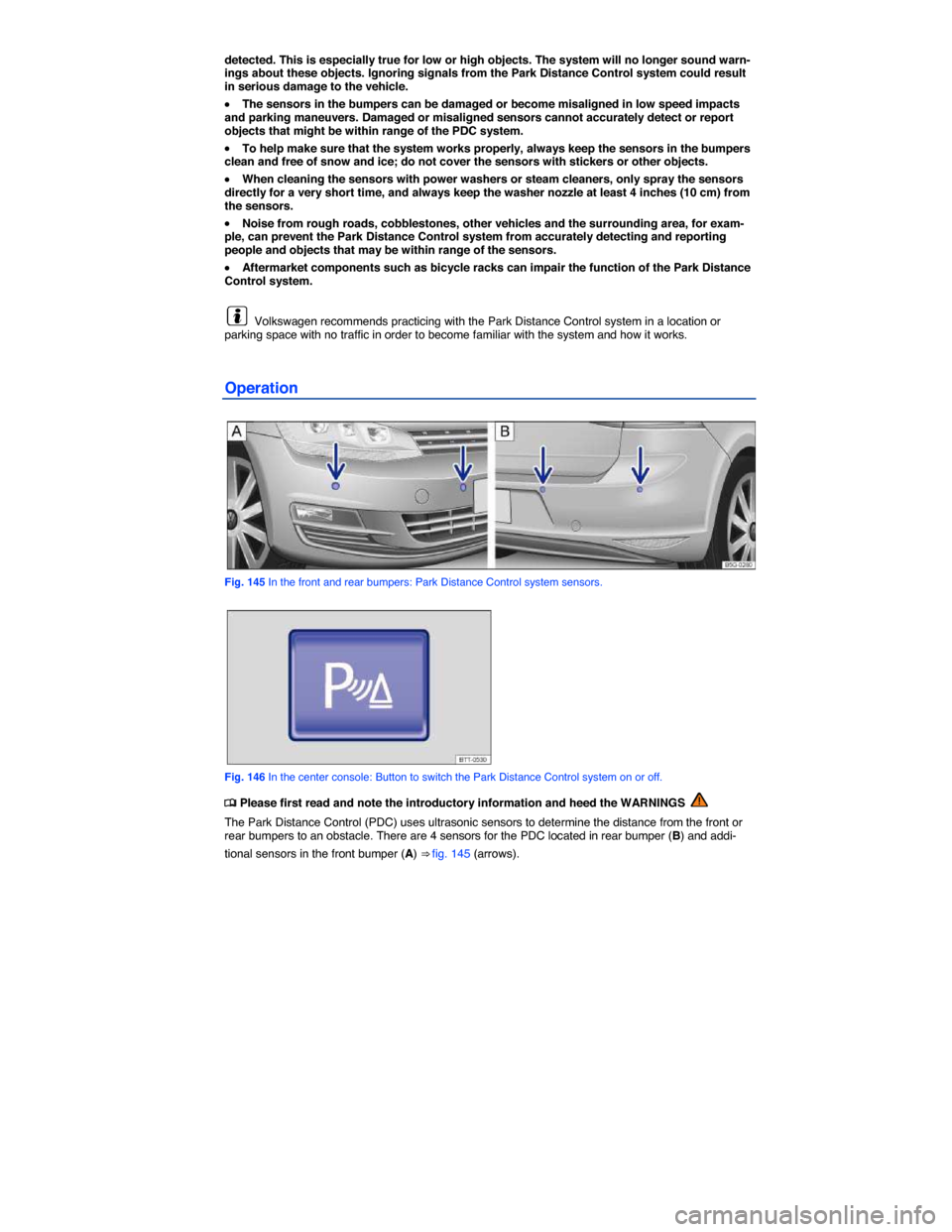
Fig. 145 In the front and rear bumpers: Park Distance Control system sensors.
Fig. 146 In the center console: Button to switch the Park Distance Control system on or off.
Page 293 of 394

Heating and air conditioning
Page 294 of 394
WARNING
Poor visibility increases the risk of collisions and other accidents that cause serious person-al injuries.
x Always make sure all windows are clear of ice, snow and condensation for good visibility to the front, sides, and rear.
x Always make sure you know how to properly use the climate control system as well as the rear window defroster that you will need for good visibility.
x Never use air recirculation for long periods of time. When the air conditioner is off and recirculation mode is on, condensation can quickly form on the windows and greatly reduce visibility.
x Always switch off recirculation mode when it is not needed.
WARNING
Stale air causes driver fatigue and reduces driver alertness, which can cause accidents, colli-sions and serious personal injury.
x Never switch off the fan for a long period of time and never use air recirculation for a long period of time because no fresh air will enter the passenger compartment.
NOTICE
x If you think the air conditioner is not working properly or may be damaged, switch it off to help prevent more damage. Have the air conditioner checked by an authorized Volkswagen dealer or an authorized Volkswagen Service Facility.
x Air conditioner repair requires specialized knowledge and special tools. Volkswagen rec-ommends that you see an authorized Volkswagen dealer or an authorized Volkswagen Service Facility.
x Do not smoke when air recirculation is switched on. Smoke drawn into the ventilation sys-tem can leave residue on the evaporator and on the dust and pollen active carbon filter, result-ing in permanent odors whenever the air conditioner is switched on.
If the air conditioner is switched off, the fresh outside air will not be dehumidified. To help keep the windows from fogging over, Volkswagen recommends leaving the air conditioner (compressor) switched on. Press the !
Page 295 of 394
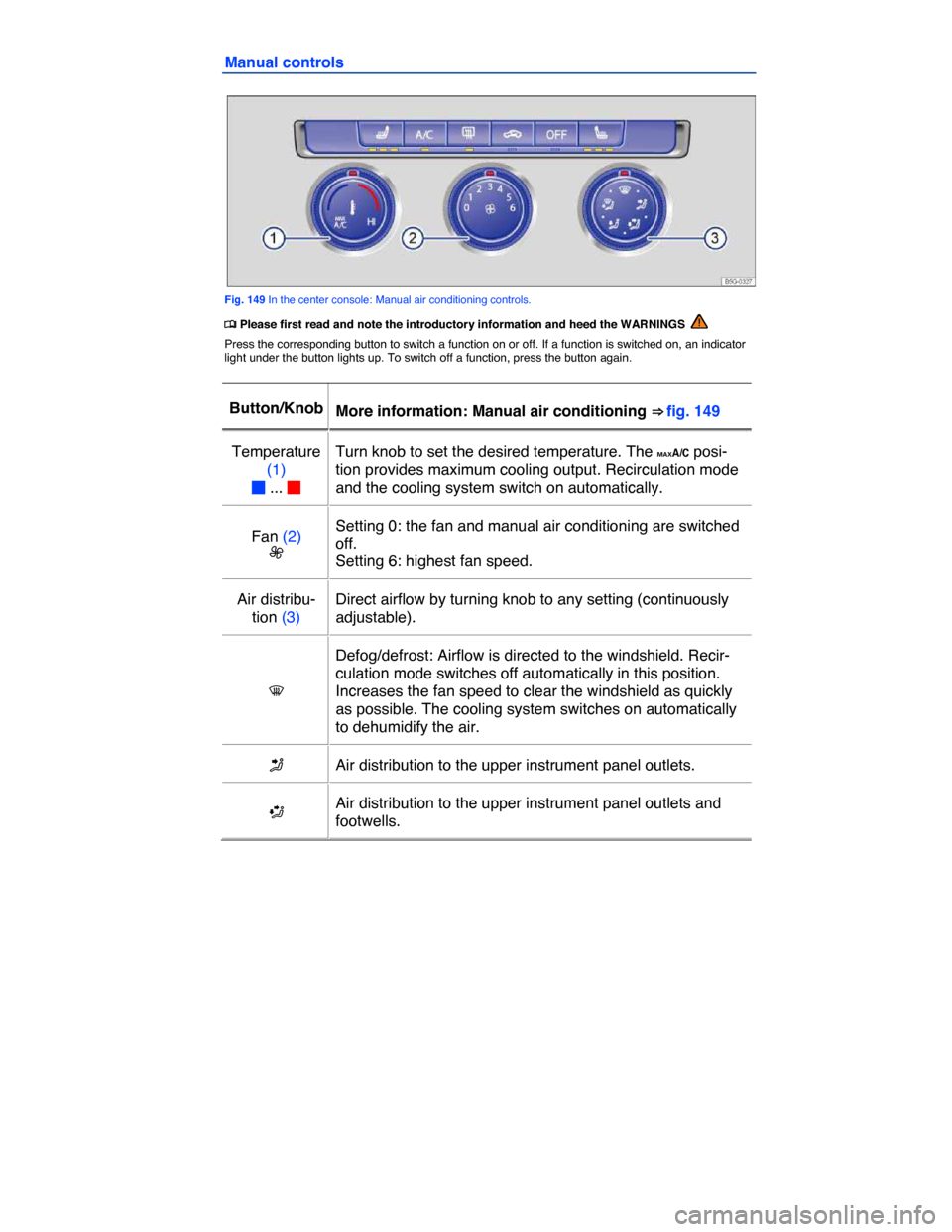
Manual controls
Fig. 149 In the center console: Manual air conditioning controls.
Page 296 of 394
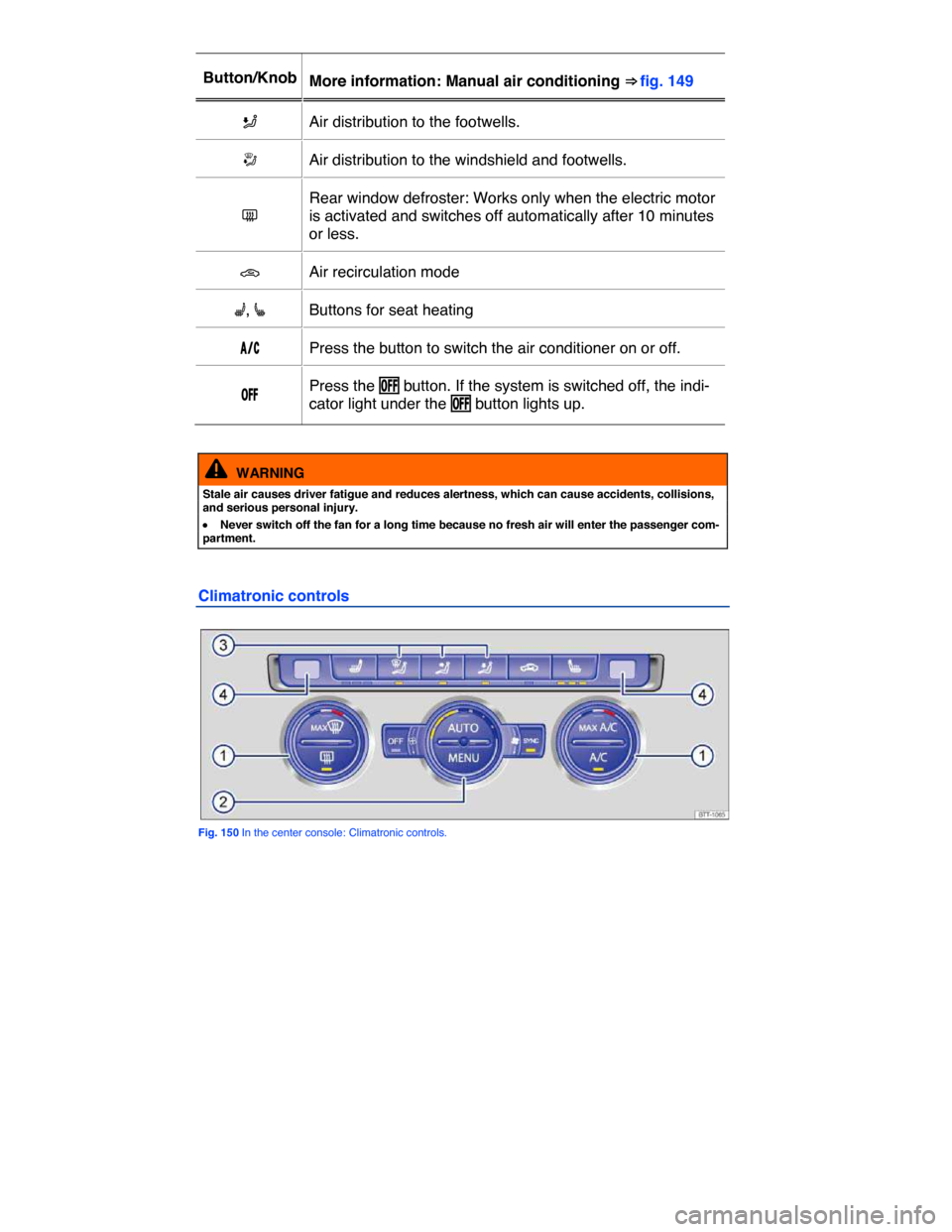
Button/Knob More information: Manual air conditioning ⇒ fig. 149
L Air distribution to the footwells.
u Air distribution to the windshield and footwells.
=
Rear window defroster: Works only when the electric motor
is activated and switches off automatically after 10 minutes
or less.
3 Air recirculation mode
A, [ Buttons for seat heating
!
Page 299 of 394

Opening the Air conditioning menu
x Press the -%.5 ⇒ fig. 150 button.
The current air conditioning settings are displayed in the upper section of the screen, for example, the temperatures that are currently set for the driver and passenger sides. Set temperatures up to +72 °F (+22 °C) are shown with blue arrows, while temperatures above +72 °F (+22 °C) are shown with red arrows.
Tap the corresponding function key to switch a function on or off, or to select a submenu.
Function
key
Effect
/&& Switch off the Climatronic.
/. Switch on the Climatronic.
Setup