battery VOLKSWAGEN EOS 2010 User Guide
[x] Cancel search | Manufacturer: VOLKSWAGEN, Model Year: 2010, Model line: EOS, Model: VOLKSWAGEN EOS 2010Pages: 381, PDF Size: 3.89 MB
Page 172 of 381

Passenger car tire
A tire intended for use on passenger cars, multipurpose passenger vehicles, and trucks, that have a gross vehicle weight rating (GVWR) of 10,000 pounds or less.
Ply
A layer of rubber-coated parallel cords.
Ply separation
A parting of rubber compound between adjacent plies.
Pneumatic tire
A mechanical device made of rubber, chemicals, fabric, and steel or other materials, that, when mounted on an automotive wheel, provides the traction and contains the gas or fluid that sustains the load.
Production options weight
The combined weight of installed regular production options weighing over 5 lbs (2.3 kg) more then the standard items they replace, and not previously considered as curb weight or accessory weight. These include, for example, heavy-duty brakes, ride levelers, heavy-duty battery, and special trim.
Radial ply tires
A pneumatic tire in which the ply cords that extend to the beads are laid at substantially 90 degrees to the centerline of the tread.
Recommended inflation pressure
The tire pressure recommended by the vehicle manufacturer for a tire of a specified size that has not been driven for more than a couple of miles (kilometers) at low speeds in the 3 hour period before the tire pressure is measured or adjusted.
Reinforced tire
A tire designed to operate at higher loads and at higher inflation pressures than the corresponding standard tire.
Rim
The outer edge of a wheel upon which the tire beads are seated.
Rim diameter
The nominal diameter of the wheel's tire bead seating surface. If you change your wheel size, to wheels of a different diameter, you will have to purchase new tires to match the new wheels.
Rim size
Designation means rim diameter and width.
Rim type designation
The industry or manufacturer's designation for a rim by style or code.
Rim width
The nominal distance between wheel rim flanges.
Section width
The linear distance between the exteriors of the sidewalls of an inflated tire, excluding elevations due to labeling decoration, or protective bands.
Sidewall
The portion of a tire between the bead and the tread.
Page 183 of 381
your vehicle to ensure that the replacement or alternate tires and wheels allow the TPMS to continue to function properly.
Spare wheel or compact spare wheel
The spare wheel or compact spare wheel has no tire pressure sensor. When the spare or compact spare wheel is mounted on the vehicle, the Tire Pressure Monitoring System (TPMS) indicator light will flash in the instrument cluster display. The TPMS continues to monitor the other 3 wheels.
Tire storage
If the tires do not move for an extended period of time, the sensors will not transmit tire pressures to the system. This saves sensor battery life. The sensors are reactivated by driving the vehicle again.
WARNING
Incorrect tire pressure can cause sudden tire failure, loss of vehicle control and serious personal injury.
x Always check and correct air pressure in all 4 tires, particularly after changing, exchanging, or repairing tires.
x After that, always make sure that all 4 tires are inflated to the correct tire pressure for the tires installed on the vehicle.
x See the tire pressure label ⇒ fig. 104, Tire inflation pressure and the Owner's Literature for recommended cold tire inflation pressure and other important information.
x When replacing tires or wheel rims on vehicles equipped with TPMS, always read and heed all of the information and WARNINGS, Tires and wheels.
NOTICE
x The wheel electronics are attached to special aluminum valves on the wheels. These valves are screwed on rigidly. Never bend the valves “into position” when checking and adjusting tire pressure.
x Missing tire air valve caps could result in damage to the valves, as well as to the sensors on the Tire Pressure Monitoring System. Therefore, make sure your valve caps conform to the specifications of those originally installed on the vehicle and that they are always tightly and properly screwed on to the valves. Do not use metallic valve caps
x Do not use “comfort valve caps.” They do not seal properly and can damage the sensors.
x When changing or rotating the tires, be careful not to damage the valves or sensors.
x The aluminum valves that are installed should be replaced after about 6 years of use due to aging of the rubber seals. The valves can be replaced when a tire is changed. Do not reuse aluminum valves after they are removed. They must be replaced. The tire pressure sensors can be reused.
Page 199 of 381
Leaving the key in the ignition for a long time when the engine is not running will drain the vehicle battery.
Leaving the selector lever for a long period of time in any position other than Park (P) when the ignition is switched off can drain the vehicle battery.
On automatic transmission vehicles, the vehicle key can be removed from the ignition switch only when the transmission is in Park (P). You may have to press the release button on the transmission selector lever to put the lever into Park (P).
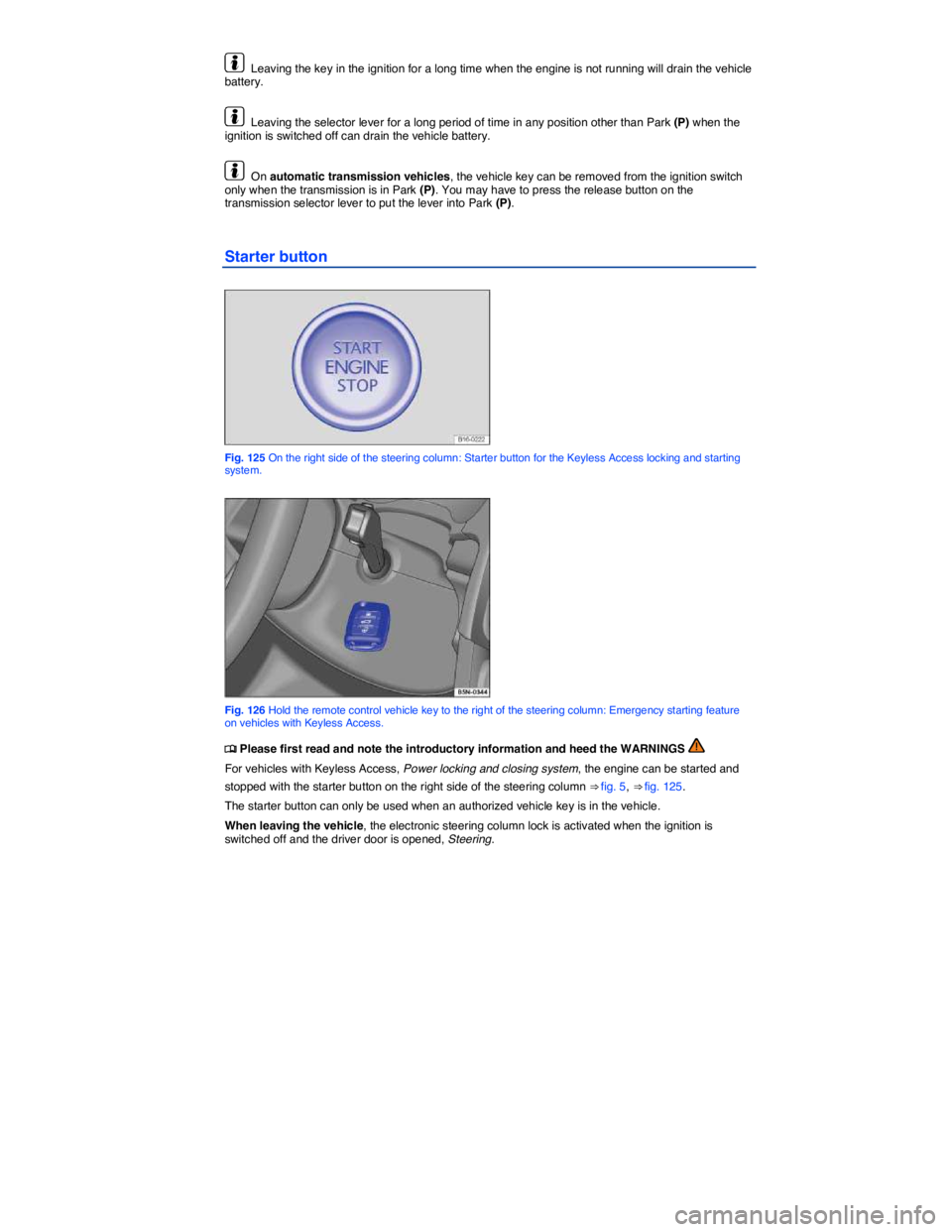
Starter button
Fig. 125 On the right side of the steering column: Starter button for the Keyless Access locking and starting system.
Fig. 126 Hold the remote control vehicle key to the right of the steering column: Emergency starting feature on vehicles with Keyless Access.
Page 200 of 381
Switching the ignition on and off
x Briefly press the starter button once without operating the brake pedal ⇒ .
Emergency start feature
If an authorized remote control vehicle key is in the passenger compartment but the instrument cluster displays Key not in Range when you push the starter button, the remote control vehicle key battery is weak or dead. You can still start the engine using the Emergency start feature.
x Make sure the selector lever is in the Park (P) position.
x Hold the remote control vehicle key to the right of the steering column trim immediately after
pressing the starter button ⇒ fig. 126.
x The ignition automatically switches on and the engine starts.
Emergency shut-off
If the engine does not switch off by briefly pressing the starter button, emergency shut-off is necessary:
x Press the starter button twice within 3 seconds or press and hold the button longer than 1 second
⇒ in Stopping the engine
x The engine switches off automatically.
Engine restart feature
If no authorized remote control vehicle key is identified in the passenger compartment after the engine has been switched off, the engine can be restarted within about 5 seconds. A related message is shown in the instrument cluster display.
After the 5 seconds have passed, the engine can no longer be started without an authorized vehicle key in the passenger compartment.
WARNING
Unintended vehicle movement can cause serious personal injury.
x Do not depress the brake pedal when switching on the ignition, as the engine could otherwise start immediately.
WARNING
Improper use of vehicle keys can result in serious personal injury.
x Always take the key with you when you leave the vehicle. Children or unauthorized persons may use it to lock the vehicle, start the engine, and operate vehicle systems such as the power windows, leading to serious personal injury.
x Never leave children, disabled persons, or anyone who cannot help themselves in the vehicle. The doors can be locked using the remote control vehicle key. This could result in people being trapped in the vehicle in an emergency. For example, depending on the time of year, people trapped in the vehicle can be exposed to very high or very low temperatures.
x Heat buildup in the passenger and luggage compartment of a parked vehicle can result in temperatures in the vehicle that are much higher than the outside temperatures, particularly in summer. Temperatures can quickly reach levels that can cause unconsciousness and death, particularly to small children.
If the ignition is switched on or the engine is running and the driver door is opened, a chime sounds. The chime is also a reminder to switch off the engine and turn off the ignition before leaving and locking the vehicle from the outside.
Page 209 of 381
WARNING
Unintended vehicle movement can cause serious personal injury.
x Never get out of the driver's seat while the engine is running, especially when the transmission is in a drive gear. If you must leave your vehicle while the engine is running, always set the parking brake and shift the transmission into Park (P).
x Never leave the vehicle in Neutral (N). It will roll down hills, whether the engine is running or not.
x When the engine is running and a drive gear - Drive (D), Sport Drive (S), or Reverse (R) - has been selected, press and hold the brake pedal to keep the vehicle from moving. The vehicle may “creep” and move forward or backward even if the engine is idling slowly.
x Never shift into Reverse (R) or Park (P) when the vehicle is moving.
NOTICE
Even though the transmission is in Park (P), the vehicle may move a couple of inches (a few centimeters) forwards or backwards if you take your foot off the brake pedal after stopping the vehicle without first setting the parking brake.
If the selector lever is moved into Neutral (N) by mistake when the vehicle is moving, take your foot off the accelerator pedal. Wait until the engine speed has dropped to idle speed before moving the selector lever into a drive gear.
Leaving the selector lever for a long period of time in any position other than Park (P) when the ignition is switched off can drain the vehicle battery.
Shifting with Tiptronic®
Fig. 130 Selector lever in Tiptronic position.
Page 214 of 381
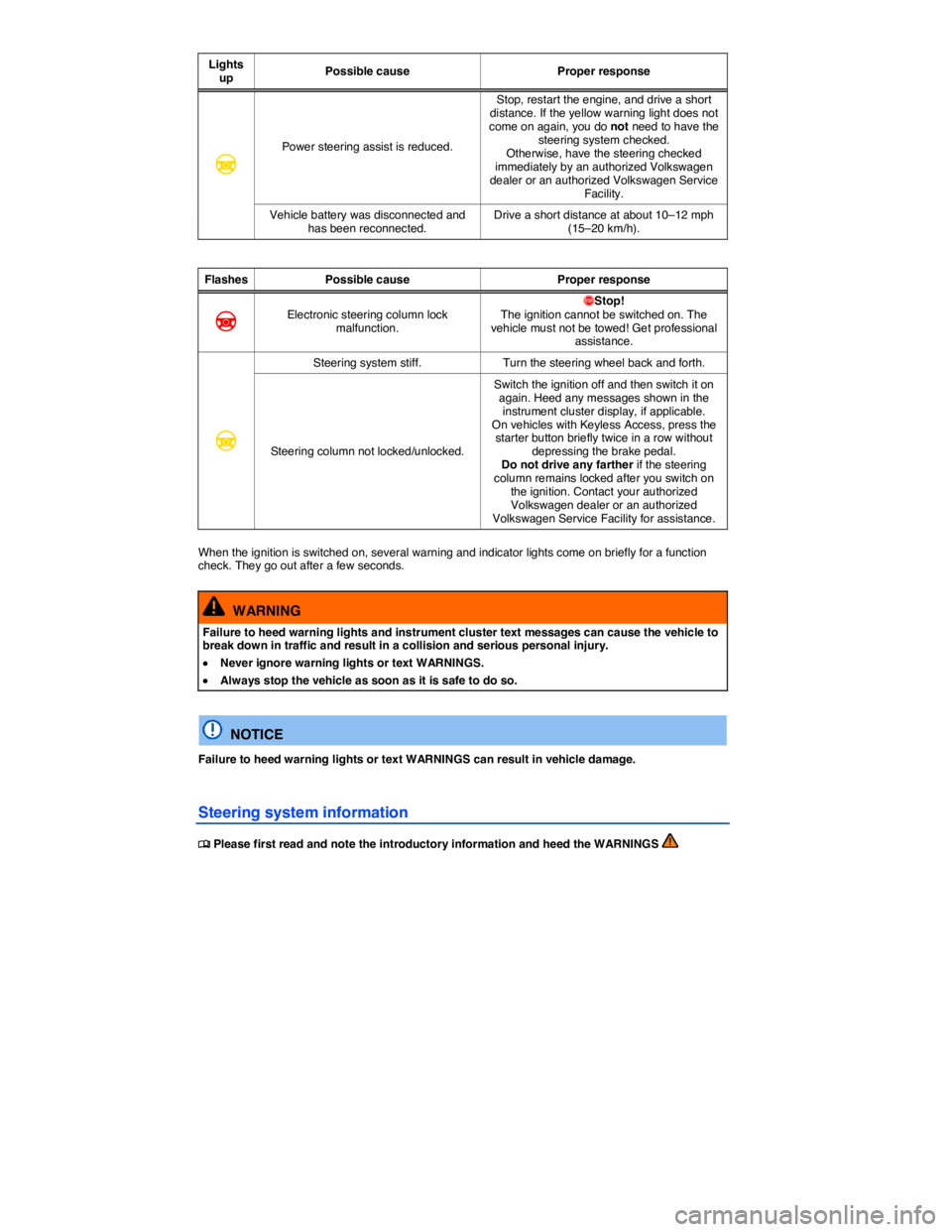
Lights up Possible cause Proper response
D
Power steering assist is reduced.
Stop, restart the engine, and drive a short distance. If the yellow warning light does not come on again, you do not need to have the steering system checked. Otherwise, have the steering checked immediately by an authorized Volkswagen dealer or an authorized Volkswagen Service Facility.
Vehicle battery was disconnected and has been reconnected. Drive a short distance at about 10–12 mph (15–20 km/h).
Flashes Possible cause Proper response
D Electronic steering column lock malfunction.
Page 250 of 381
Emergency starting and starting the engine with a very weak vehicle battery or after the vehicle battery has been replaced may change or delete system settings (including time, date, personal convenience settings, and programming). Check the settings and correct as necessary once the vehicle battery has built up a sufficient charge.
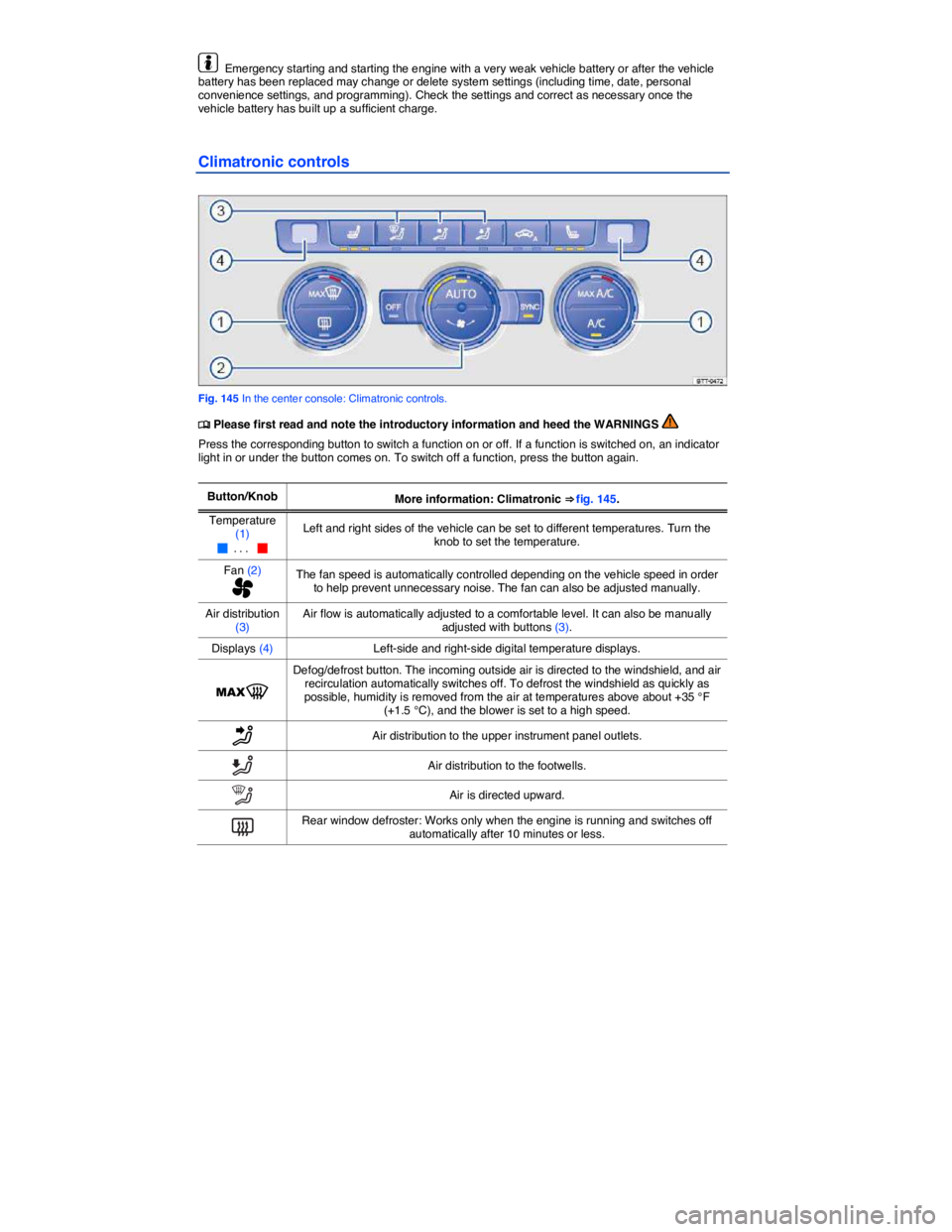
Climatronic controls
Fig. 145 In the center console: Climatronic controls.
Page 266 of 381

WARNING
High voltage systems in the engine compartment can cause electrical shocks or even electrocution, severe burns, other serious injuries, and even death!
x Never short-circuit the electrical system. Be especially careful when using jumper cables. The vehicle's battery could explode!
x To reduce the risk of electrical shock and personal injury while the engine is running or being started:
– Never touch ignition cables. Never touch other components of the high voltage electronic ignition system.
– Never touch the wiring of the HID – High Intensity Discharge (Xenon) headlights.
x Read and heed the important information and warnings on cleaning the engine compartment Cleaning the engine compartment.
WARNING
Moving parts in the engine compartment can cause serious personal injury on contact.
x Never reach into the area around or touch the radiator fan. Contact with the blades can cause serious personal injury. Always remember that the radiator fan is temperature-controlled and can come on suddenly even when the engine has been switched off for a while and the key has been removed from the ignition.
x If you have to perform a check or repair when the engine is running, there are more risks from the rotating parts, such as the drive belts, alternator, radiator fan, etc., and from the high-voltage ignition system. Always use extreme care.
– Always make sure that jewelry, loose clothing and long hair do not get caught in rotating engine parts. Before starting any work remove your jewelry, take off your necktie, tie back and cover your hair, and do not wear clothing that can hang down and get caught in moving engine parts.
– Always use extreme caution if the accelerator pedal has to be depressed to perform a check. The vehicle will start to move even if the parking brake is on.
x Never leave any objects in the engine compartment, for example cleaning rags and tools. Objects left behind can cause malfunctions, engine damage, and even fires.
WARNING
Operating fluids and some materials in the engine compartment can catch fire easily, causing burns and other serious personal injuries!
x Never smoke near the engine compartment.
x Never work next to open flames or sparks.
x Never pour or spill operating fluids or other flammable liquids on the engine. These fluids can ignite on hot engine parts and cause injuries.
x If work on the fuel system or the electrical system is necessary:
– Always disconnect the 12 Volt vehicle battery. Make sure the vehicle is unlocked when you disconnect the battery, or the alarm will go off. Never touch the electrical wiring of the ignition system.
– Never work near heaters, water heaters, or other open flames.
x Always have a functional, approved fire extinguisher nearby.
Page 284 of 381

Vehicle battery
Page 285 of 381
WARNING
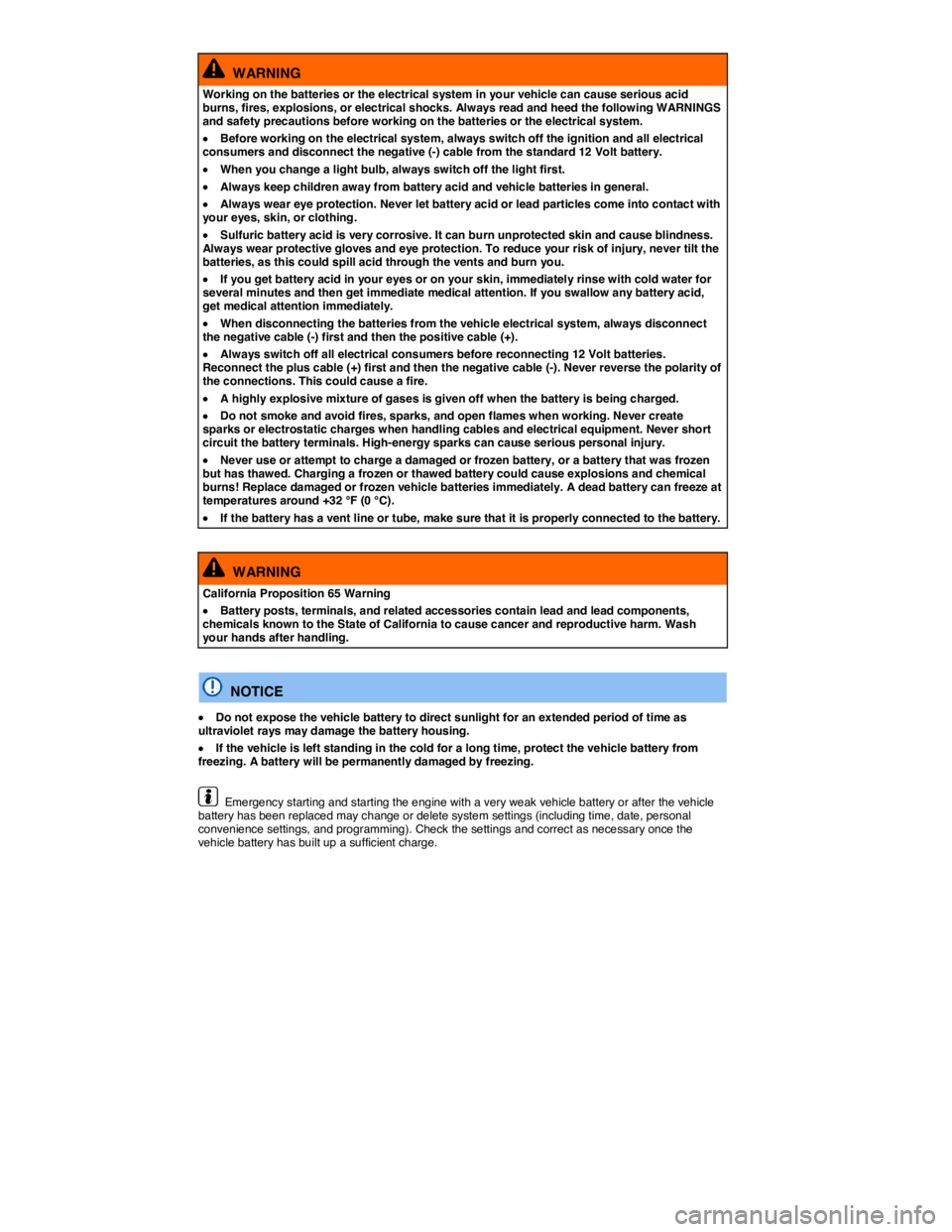
Working on the batteries or the electrical system in your vehicle can cause serious acid burns, fires, explosions, or electrical shocks. Always read and heed the following WARNINGS and safety precautions before working on the batteries or the electrical system.
x Before working on the electrical system, always switch off the ignition and all electrical consumers and disconnect the negative (-) cable from the standard 12 Volt battery.
x When you change a light bulb, always switch off the light first.
x Always keep children away from battery acid and vehicle batteries in general.
x Always wear eye protection. Never let battery acid or lead particles come into contact with your eyes, skin, or clothing.
x Sulfuric battery acid is very corrosive. It can burn unprotected skin and cause blindness. Always wear protective gloves and eye protection. To reduce your risk of injury, never tilt the batteries, as this could spill acid through the vents and burn you.
x If you get battery acid in your eyes or on your skin, immediately rinse with cold water for several minutes and then get immediate medical attention. If you swallow any battery acid, get medical attention immediately.
x When disconnecting the batteries from the vehicle electrical system, always disconnect the negative cable (-) first and then the positive cable (+).
x Always switch off all electrical consumers before reconnecting 12 Volt batteries. Reconnect the plus cable (+) first and then the negative cable (-). Never reverse the polarity of the connections. This could cause a fire.
x A highly explosive mixture of gases is given off when the battery is being charged.
x Do not smoke and avoid fires, sparks, and open flames when working. Never create sparks or electrostatic charges when handling cables and electrical equipment. Never short circuit the battery terminals. High-energy sparks can cause serious personal injury.
x Never use or attempt to charge a damaged or frozen battery, or a battery that was frozen but has thawed. Charging a frozen or thawed battery could cause explosions and chemical burns! Replace damaged or frozen vehicle batteries immediately. A dead battery can freeze at temperatures around +32 °F (0 °C).
x If the battery has a vent line or tube, make sure that it is properly connected to the battery.
WARNING
California Proposition 65 Warning
x Battery posts, terminals, and related accessories contain lead and lead components, chemicals known to the State of California to cause cancer and reproductive harm. Wash your hands after handling.
NOTICE
x Do not expose the vehicle battery to direct sunlight for an extended period of time as ultraviolet rays may damage the battery housing.
x If the vehicle is left standing in the cold for a long time, protect the vehicle battery from freezing. A battery will be permanently damaged by freezing.
Emergency starting and starting the engine with a very weak vehicle battery or after the vehicle battery has been replaced may change or delete system settings (including time, date, personal convenience settings, and programming). Check the settings and correct as necessary once the vehicle battery has built up a sufficient charge.