brake VOLKSWAGEN EOS 2015 1.G User Guide
[x] Cancel search | Manufacturer: VOLKSWAGEN, Model Year: 2015, Model line: EOS, Model: VOLKSWAGEN EOS 2015 1.GPages: 393, PDF Size: 5.57 MB
Page 168 of 393

WARNING
Tires must have the required clearance. Tires that do not have enough clearance can rub against parts of the vehicle body, suspension, and brake system, causing brake system failure, tread delamination, and sudden blowouts.
x Always make sure that new tires are not larger than the tires approved for your vehicle and that the new tires do not rub against parts of the vehicle.
NOTICE
x When switching to different tires, make certain the valves and sensors are not damaged.
x Never drive without valve stem caps. The valves and sensors could be damaged.
x If a sensor for the Tire Pressure Monitoring System must be replaced, the corresponding valve must be replaced at the same time.
Always dispose of old tires in accordance with legal requirements.
TPMS wheel sensors are classified as Perchlorate Material – special handling may apply. Obey all legal requirements regarding handling and disposal of these components – see http://www.dtsc.ca.gov/hazardouswaste/perchlorate. Obey all applicable legal requirements regarding handling and disposal of the vehicle or parts of its restraint system, including airbag modules and safety belts with pretensioners. Authorized Volkswagen dealers and authorized Volkswagen Service Facilities are familiar with the requirements, and we recommend that you have them perform this service for you.
If the replacement wheel is different from the tires that you have mounted on your vehicle — for example, winter tires, wider, low-profile tires or a compact spare — only use the replacement wheel for a short time and drive cautiously.
x Replace it with a tire matching the others on your vehicle as soon as possible.
Although tire size specifications can be the same, the actual dimensions may differ from those nominal values for different tire makes, or the tire contours may be significantly different.
.
Page 183 of 393

Normal occupant weight
Means 150 lbs (68 kilograms) times the number of occupants seated in the vehicle up to the total seating capacity of your vehicle.
Occupant distribution
The placement of passengers in a vehicle.
Outer diameter
The diameter of a new, properly inflated tire.
Overall width
Total width measured at the exterior sidewalls of an inflated tire, including the additional width of labeling, decorations, or protective bands or ribs.
Passenger car tire
A tire intended for use on passenger cars, multipurpose passenger vehicles, and trucks, that have a gross vehicle weight rating (GVWR) of 10,000 pounds or less.
Ply
A layer of rubber-coated parallel cords.
Ply separation
A parting of rubber compound between adjacent plies.
Pneumatic tire
A mechanical device made of rubber, chemicals, fabric, and steel or other materials, that, when mounted on an automotive wheel, provides the traction and contains the gas or fluid that sustains the load.
Production options weight
The combined weight of installed regular production options weighing over 5 lbs (2.3 kg) more than the standard items they replace, and not previously considered as curb weight or accessory weight. These include, for example, heavy-duty brakes, ride levelers, roof rack, heavy-duty battery, and special trim.
Radial ply tires
A pneumatic tire in which the ply cords that extend to the beads are laid at substantially 90 degrees to the centerline of the tread.
Recommended inflation pressure
The tire pressure recommended by the vehicle manufacturer for a tire of a specified size that has not been driven for more than a couple of miles (kilometers) at low speeds in the 3 hour period before the tire pressure is measured or adjusted.
Reinforced tire
A tire designed to operate at higher loads and at higher inflation pressures than the corresponding standard tire.
Rim
The outer edge of a wheel upon which the tire beads are seated.
Rim diameter
The nominal diameter of the wheel's tire bead seating surface. If you change your wheel size, to wheels of a different diameter, you will have to purchase new tires to match the new wheels.
Page 186 of 393

the loaded trailer) is also limited. More passengers, or passengers who are heavier than the assumed 150 lbs (68 kg), mean that less weight can be carried as luggage or other cargo. The tire pressure label on your Volkswagen also lists the maximum combined weight of all of the occupants and luggage or other cargo that the vehicle can carry.
WARNING
Overloading a vehicle can cause loss of vehicle control, a crash or other accident, serious personal injury, and even death.
x Carrying more weight than your vehicle was designed to carry will prevent the vehicle from handling properly and increase the risk of the loss of vehicle control.
x The brakes on a vehicle that has been overloaded may not be able to stop the vehicle in a safe distance.
x Tires on a vehicle that has been overloaded can fail suddenly, including a blowout and sudden deflation, causing loss of control and a crash.
x Always make sure that the total load being transported – including the weight of a trailer hitch and the tongue weight of a loaded trailer – does not make the vehicle heavier than the vehicle's Gross Vehicle Weight Rating.
Determining the correct load limit
Page 212 of 393

WARNING
Unintended vehicle movement can cause serious personal injury.
x Do not depress the brake pedal when switching on the ignition, as the engine could otherwise start immediately.
WARNING
Improper use of vehicle keys can result in serious personal injury.
x Always take the key with you when you leave the vehicle. Children or unauthorized persons may use it to lock the vehicle, start the engine, and operate vehicle systems such as the power windows, leading to serious personal injury.
x Never leave children, disabled persons, or anyone who cannot help themselves in the vehicle. The doors can be locked using the remote control vehicle key. This could result in people being trapped in the vehicle in an emergency. For example, depending on the time of year, people trapped in the vehicle can be exposed to very high or very low temperatures.
x Heat buildup in the passenger and luggage compartment of a parked vehicle can result in temperatures in the vehicle that are much higher than the outside temperatures, particularly in summer. Temperatures can quickly reach levels that can cause unconsciousness and death, particularly to small children.
If the ignition is switched on or the engine is running and the driver door is opened, a chime sounds. The chime is also a reminder to switch off the engine and turn off the ignition before leaving and locking the vehicle from the outside.
Starting the engine
Page 213 of 393
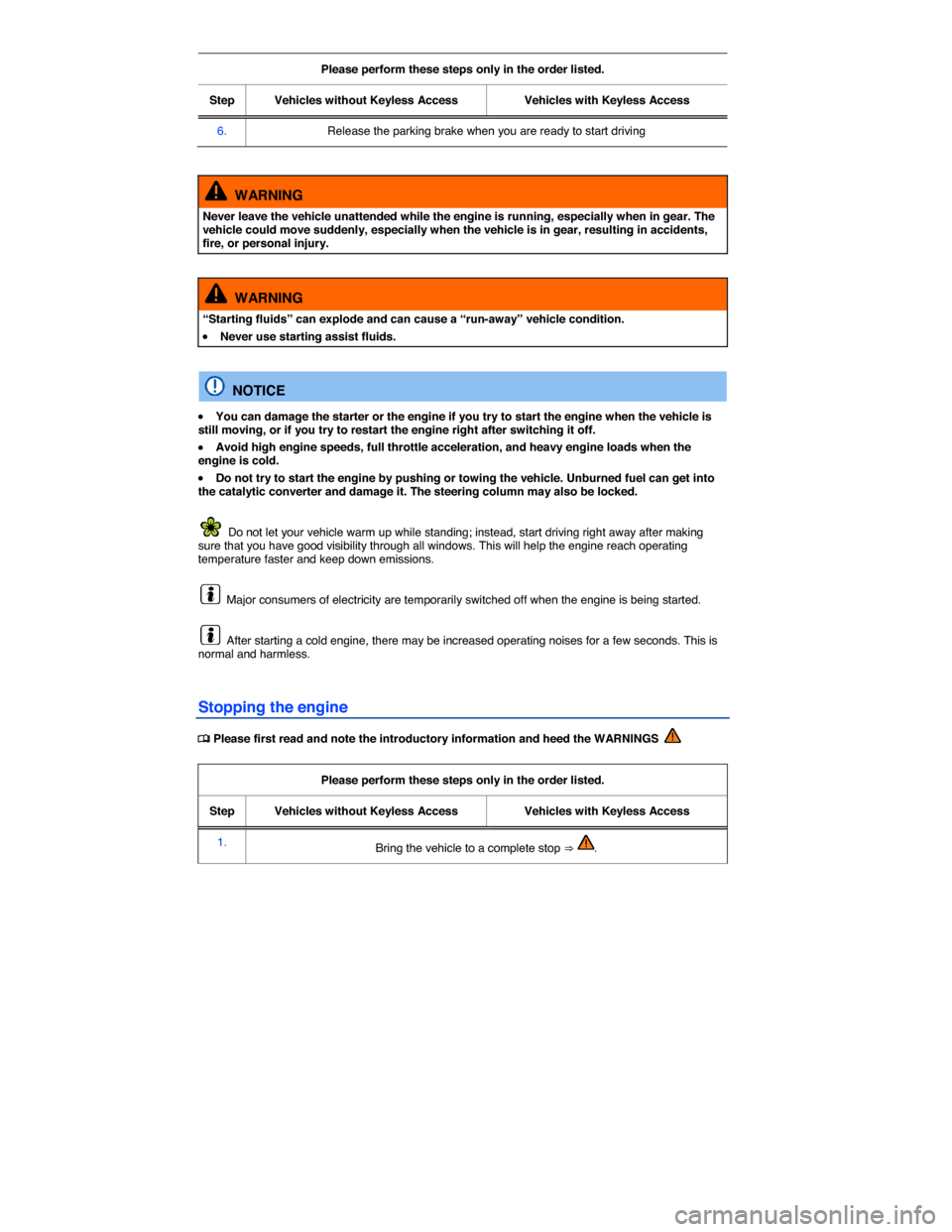
Please perform these steps only in the order listed.
Step Vehicles without Keyless Access Vehicles with Keyless Access
6. Release the parking brake when you are ready to start driving
WARNING
Never leave the vehicle unattended while the engine is running, especially when in gear. The vehicle could move suddenly, especially when the vehicle is in gear, resulting in accidents, fire, or personal injury.
WARNING
“Starting fluids” can explode and can cause a “run-away” vehicle condition.
x Never use starting assist fluids.
NOTICE
x You can damage the starter or the engine if you try to start the engine when the vehicle is still moving, or if you try to restart the engine right after switching it off.
x Avoid high engine speeds, full throttle acceleration, and heavy engine loads when the engine is cold.
x Do not try to start the engine by pushing or towing the vehicle. Unburned fuel can get into the catalytic converter and damage it. The steering column may also be locked.
Do not let your vehicle warm up while standing; instead, start driving right away after making sure that you have good visibility through all windows. This will help the engine reach operating temperature faster and keep down emissions.
Major consumers of electricity are temporarily switched off when the engine is being started.
After starting a cold engine, there may be increased operating noises for a few seconds. This is normal and harmless.
Stopping the engine
Page 214 of 393

Please perform these steps only in the order listed.
Step Vehicles without Keyless Access Vehicles with Keyless Access
2. Depress and hold down the brake pedal until step 4 is completed.
3. Shift the transmission into Park (P).
4. Apply the parking brake to help prevent the vehicle from moving
5. Turn the vehicle key to position ⇒ fig. 125 (0) in the ignition switch. Briefly press the starter button ⇒ fig. 126. If the engine will not switch off, carry out the emergency shut-off procedure
6. Removing the vehicle key from the ignition switches off electrical equipment and activates the steering column lock.
Opening the doors switches off electrical equipment and activates the steering column lock.
WARNING
Never stop the engine before the vehicle has come to a complete stop. You can lose control of the vehicle, crash, and be seriously injured.
x The airbags and safety belt pretensioners will not work when the ignition is switched off.
x The brake booster does not work when the engine is not running. More brake pedal pressure will be needed to stop the vehicle.
x The power steering system does not work when the engine is not running, and you will need more force to steer the vehicle.
x When the key is removed from the ignition switch, the steering will lock and you will not be able to steer the vehicle.
NOTICE
If the vehicle has been driven hard for a long time, the engine could overheat when it is stopped. To reduce the risk of engine damage, let the engine idle in Neutral for about 2 minutes before you switch off the ignition.
If the ignition is switched on or the engine is running and the driver door is opened, a chime sounds. The chime is also a reminder to switch off the engine and turn off the ignition before leaving and locking the vehicle from the outside.
The vehicle key can only be removed from the ignition when the transmission is in Park (P).
After the engine has been switched off, the radiator fan in the engine compartment may keep running for several minutes, or may start running after the vehicle has been parked for a while, even if the ignition is switched off and the vehicle key has been removed. The radiator fan shuts off automatically when the engine has cooled down enough.
Page 217 of 393

NOTICE
x Never “ride” the brakes by keeping your foot on the brake pedal when you do not want to brake. This will make the brakes wear faster.
x Before driving downhill, especially on hills that are long or steep, always reduce speed and shift into lower gear (manual or automatic transmission). This will let the vehicle use engine braking and reduce the load on the brakes. Otherwise, the brake system could overheat and even fail. Only use the brakes when you need them to slow the vehicle down more or to stop.
Warning and indicator lights
Page 218 of 393
NOTICE
Failure to heed warning lights or text WARNINGS can result in vehicle damage.
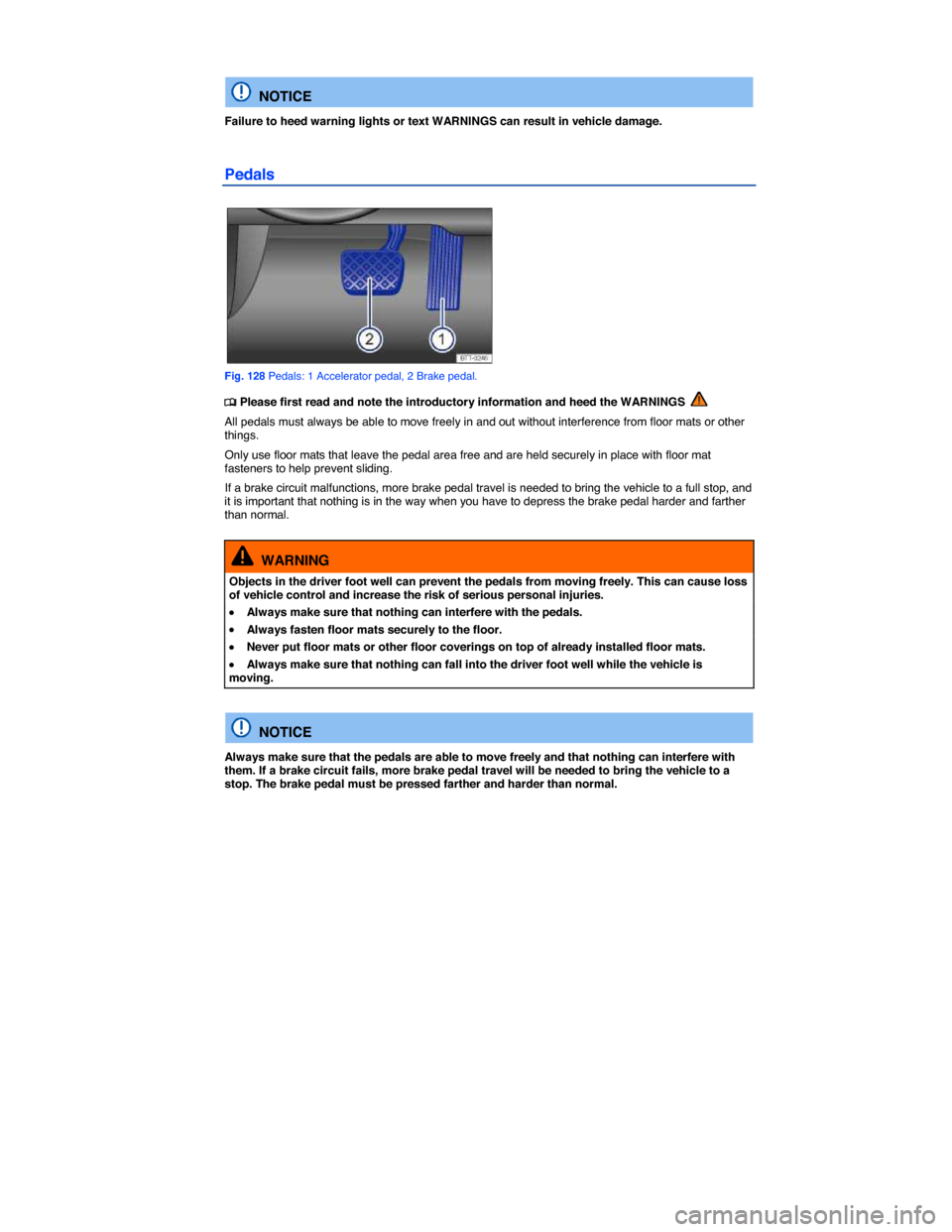
Pedals
Fig. 128 Pedals: 1 Accelerator pedal, 2 Brake pedal.
Page 220 of 393

Selector lever position
Designation Meaning ⇒
2 Reverse The reverse gear is engaged. Shift into Reverse only when the vehicle is not moving.
. Neutral Transmission is in Neutral position. No power is transmitted to the wheels and no engine braking is available.
$ Drive (standard driving position) All forward gears shift up and down automatically. The transmission shifts as needed depending on engine load, individual driving style, and vehicle speed.
3 Sport Drive (Sport driving position) All forward gears automatically upshift later and downshift earlier than in the D (Drive) position, to take full advantage of the engine's power reserves. The transmission shifts as needed depending on engine load, individual driving style, and vehicle speed.
Automatic Shift Lock (ASL)
The Automatic Shift Lock (ASL) in Park (P) and Neutral (N) prevents drive positions from being engaged inadvertently, which would cause the vehicle to move.
To release the ASL, depress and hold the brake pedal with the ignition switched on. Press the release button on the selector lever at the same time.
The ASL is not engaged if the selector lever is moved quickly through Neutral (N) (e.g., when shifting from Reverse (R) to Drive (D)). This makes it possible to “rock” the vehicle backwards and forwards if it is stuck in snow or mud. The ASL engages automatically if the brake pedal is not depressed and the lever is in Neutral (N) for more than about 1 second and the vehicle is traveling no faster than about 3 mph (5 km/h).
In rare cases, the ASL may not engage on vehicles with DSG® Direct Shift Gearbox. If this happens, power to the drive wheels will be interrupted to prevent the vehicle from moving unexpectedly. The green indicator light K will blink and a text message will be displayed. To engage the Automatic Shift Lock (ASL):
x Depress and then release the brake pedal. Try to engage the ASL again.
WARNING
Moving the selector lever to the wrong position can cause loss of vehicle control, a collision, and serious personal injury.
x Never accelerate when moving the selector lever.
x When the engine is running and a drive position is engaged, the vehicle will start to move as soon as the brake pedal is released.
x Never shift into Reverse or Park when the vehicle is moving.
Page 221 of 393
WARNING
Unintended vehicle movement can cause serious personal injury.
x Never get out of the driver's seat while the engine is running, especially when the transmission is in a drive gear. If you must leave your vehicle while the engine is running, always set the parking brake and shift the transmission into Park (P).
x Never leave the vehicle in Neutral (N). It will roll down hills, whether the engine is running or not.
x When the engine is running and a drive gear - Drive (D), Sport Drive (S), or Reverse (R) - has been selected, press and hold the brake pedal to keep the vehicle from moving. The vehicle may “creep” and move forward or backward even if the engine is idling slowly.
x Never shift into Reverse (R) or Park (P) when the vehicle is moving.
NOTICE
Even though the transmission is in Park (P), the vehicle may move a couple of inches (a few centimeters) forwards or backwards if you take your foot off the brake pedal after stopping the vehicle without first setting the parking brake.
If the selector lever is moved into Neutral (N) by mistake when the vehicle is moving, take your foot off the accelerator pedal. Wait until the engine speed has dropped to idle speed before moving the selector lever into a drive gear.
Leaving the selector lever for a long period of time in any position other than Park (P) when the ignition is switched off can drain the vehicle battery.
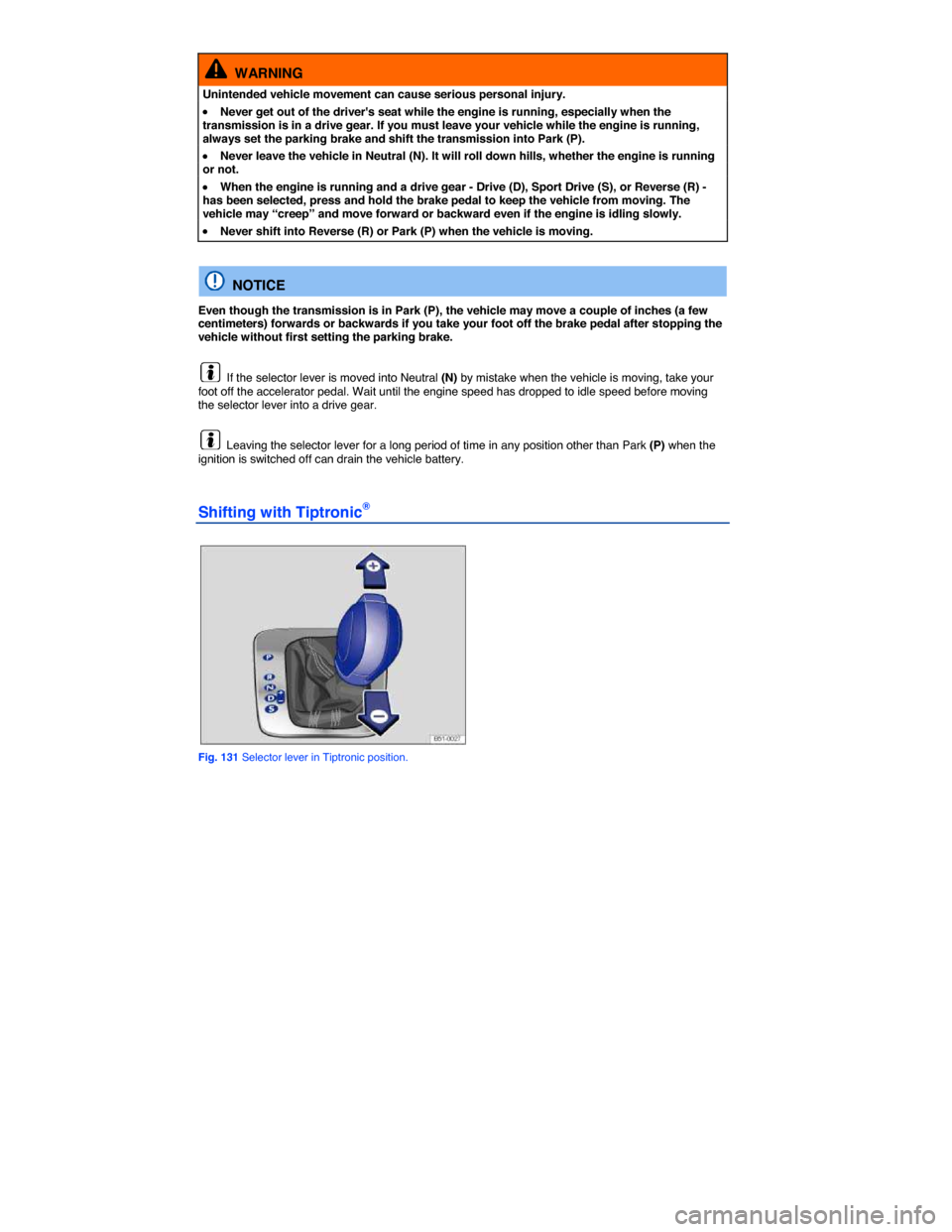
Shifting with Tiptronic®
Fig. 131 Selector lever in Tiptronic position.