service indicator VOLKSWAGEN EOS 2015 1.G User Guide
[x] Cancel search | Manufacturer: VOLKSWAGEN, Model Year: 2015, Model line: EOS, Model: VOLKSWAGEN EOS 2015 1.GPages: 393, PDF Size: 5.57 MB
Page 171 of 393
Engine Tire dimensions Tire pressure
bar psi kPa
235/40 R 18 xl 2.6 37 255
Compact spare wheel T125/70 R 16 4.2 61 415
xl = reinforced sidewall.
The Tire Pressure Monitoring System is configured at the factory with the correct tire inflation pressure applicable for the vehicle model, engine and factory-installed tires. The tire inflation
pressure is listed on the tire inflation pressure label on the driver door jamb ⇒ Tire inflation pressure. The tire inflation pressures for the road tires are listed on this label. The inflation pressure for the compact spare is as specified on the tire pressure label or on a separate label for the compact spare, if there is one. In the event of a discrepancy between the above figures and the tire pressures listed on the tire inflation pressure label, the pressures listed on the label are the ones you should use. The listed pressure applies to all road tires. If different tires are installed that do not have the same cold tire inflation pressure as the tires originally installed on your vehicle, the Tire Pressure Monitoring System cannot properly monitor tire inflation pressures unless the TPMS is reset to the new tire pressures. Authorized Volkswagen dealers and authorized Volkswagen Service Facilities have the necessary special tools and can reset the TPMS for the new tires on your vehicle.
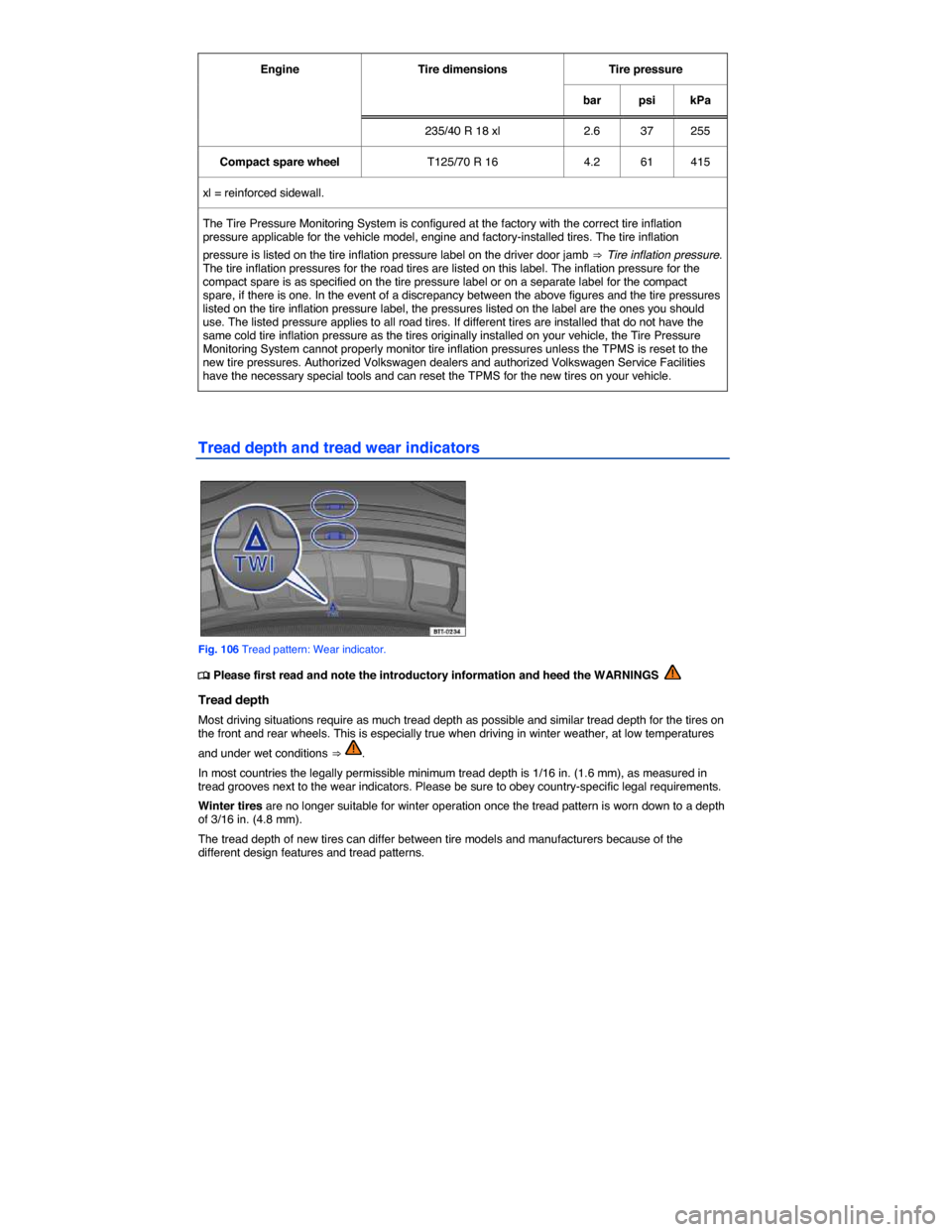
Tread depth and tread wear indicators
Fig. 106 Tread pattern: Wear indicator.
Page 177 of 393

Tire labeling (example) Meaning
XL Indicates “reinforced” tire (heavy-duty)
M+S or M/S Indicates Mud and Snow capability (also M/S) ⇒ Winter tires.
RADIAL TUBELESS Tubeless radial tire.
E4 ... Labeling according to international regulations (E) including number of the approving country. The multi-digit approval number is listed next.
DOT BT RA TY5 1709
Tire identification number (TIN)3 – In some cases the manufacturing date is only on one side of the tire:
DOT The tire complies with the requirements of the United States Department of Transportation, responsible for issuing safety standards.
BT Identification letter of the manufacturing site.
RA Manufacturer information regarding tire dimensions.
TY5 Tire characteristics provided by the manufacturer.
1709 Manufacturing date: 17th week in 2009.
TWI Marks the position of the treadwear indicator
Made in Germany Country of manufacture.
MAX LOAD 615 KG (1356 LBS) United States maximum load rating per wheel.
MAX INFLATION 350 KPA (51 PSI) United States maximum permissible inflation pressure.
ROTATION Rotation direction (unidirectional tires)
SIDEWALL 1 PLY RAYON Tire ply composition and materials used: 1 layer of rayon.
TREAD 4 PLIES 1 RAYON + 2 STEEL + 1 NYLON
Tire tread composition and materials used: In this example there are 4 layers under the tread: 1 layer of rayon, 2 layers of steel belt and 1 layer of nylon.
Consumer information regarding comparison to specified base tires (standardized test
procedure) ⇒ :
TREADWEAR 220 Relative service life expectancy of the tire referenced to a U.S.-specific standard test.
3 TIN represents the serial number of the tire.
Page 190 of 393

Dispose of the wheel electronics and the old batteries in an environmentally responsible manner. Batteries of the type used in the wheel electronics may contain Perchlorate Material. Special handling may apply. See www.dtsc.ca.gov/hadardouswaste/perchlorate. Obey all applicable legal requirements regarding proper disposal.
Do not rely only on the Tire Pressure Monitoring System. Check your tires regularly to make sure they are properly inflated and have no signs of damage, such as punctures, cuts, cracks, and blisters. Remove any objects that become embedded in the tire tread but have not penetrated into the body of tire itself.
The Tire Pressure Monitoring System checks for the factory-recommended inflation pressure, as
shown on the label inside the driver door ⇒ Tire inflation pressure.
x For replacement tires that require a different inflation pressure, the TPMS must be adjusted to the new pressure specification by an authorized Volkswagen dealer or an authorized Volkswagen Service Facility. Only one value can be entered for each tire; see the tire inflation pressure label on the driver
door pillar ⇒ Tire inflation pressure.
x To help prevent damage to the sensor and valve, do not put excessive force on the valve when checking the tire pressure. Do not try to bend the valve.
x If sensors have to be replaced, have the valves changed at the same time.
x The tire valve gaskets must be replaced whenever a tire is mounted on the rim. Your authorized Volkswagen dealer or authorized Volkswagen Service Facility has a valve seal and gasket kit for this purpose. Always make sure that a valve seal and gasket kit is also used whenever a sensor is replaced.
x If you have to adjust the tire pressure on a “warm” tire, fill the tire with 2.0 - 4.35 psi (20 - 30 kPa) more than the pressure specified on the tire pressure label.
x When the TPMS determines that the air pressure in at least one tire is too low, carefully check the pressure in all 4 tires with an accurate tire pressure gauge. Low tire pressure usually cannot be determined by looking at the tire. This is especially true of low-profile tires.
A Declaration of Compliance with the United States FCC and Industry Canada regulations is
found in the Consumer Information section of this Manual ⇒ page 336, Declaration of Compliance, Telecommunications and Electronic Systems.
There may be differences between the pressure readings from a tire pressure gauge and the pressures registered by the Tire Pressure Monitoring System. The electronic TPMS is more accurate.
If you have work done on your wheels or tires, inform the workshop that the vehicle is equipped with a Tire Pressure Monitoring System that has sensors in the wheels.
Indicator light (telltale)
Page 224 of 393

Emergency shift program
If all selector lever position indicators in the instrument cluster display are highlighted against a bright background, there is a system malfunction. The automatic transmission and the DSG automatic transmission will then operate in the emergency shift program. The emergency shift program lets you drive the vehicle, but at a reduced speed and without being able to use all of the forward gears.
In some cases, vehicles with a DSG® Direct Shift Gearbox automatic transmission may not be able to shift into reverse. It is then impossible to drive the vehicle backwards.
In any event, have the automatic transmission checked by an authorized Volkswagen dealer or authorized Volkswagen Service Facility.
Overheating of Direct Shift Gearbox (DSG®) automatic transmission
The DSG® automatic transmission may overheat, for example, due to frequent starts, extended “creeping,” or stop-and-go traffic. Overheating is indicated by the warning light
Page 232 of 393

Flashes Possible cause Proper response
K The release button in the selector lever is not engaged. Engage the Automatic Shift Lock (ASL)
When the ignition is switched on, several warning and indicator lights come on briefly for a function check. They go out after a few seconds.
WARNING
Failure to heed warning lights and instrument cluster text messages can cause the vehicle to break down in traffic and result in a collision and serious personal injury.
x Never ignore warning lights or text WARNINGS.
x Always stop the vehicle as soon as it is safe to do so.
WARNING
Driving with bad brakes can cause a collision and serious personal injury.
x If the brake warning light "2!+% or H does not go out, or lights up when driving, either the brake fluid level in the reservoir is too low or there is a fault in the brake system. Stop the
vehicle as soon as you can do so safely and get expert assistance ⇒ page 240, Brake fluid.
x If the brake warning light "2!+% or H comes on at the same time as the ABS warning light !"3 or J, the ABS may not be working properly. This could cause the rear wheels to lock up relatively quickly during braking. Rear wheel brake lock-up can cause loss of vehicle control.
x If you believe the vehicle is safe to drive, drive slowly and very carefully to the nearest authorized Volkswagen dealer, authorized Volkswagen Service Facility, or other qualified workshop and have the brake system inspected. Avoid sudden hard braking and steering.
x If the ABS indicator light !"3 or J does not go out, or if it lights up while driving, the ABS system is not working properly. The vehicle can then be stopped only with the standard brakes (without ABS). You will not have the protection ABS provides. Contact your authorized Volkswagen dealer or an authorized Volkswagen Service Facility as soon as possible.
x If the symbol "2!+% 7%!2 or I lights up in the instrument cluster display, whether alone or together with a text message, immediately contact an authorized Volkswagen dealer or authorized Volkswagen Service Facility to have the brake pads checked and, if necessary, replaced.
NOTICE
Failure to heed warning lights or text WARNINGS can result in vehicle damage.
Page 249 of 393
Display
Different cruise control versions are available. The stored speed is shown in the instrument cluster display on some equipment versions.
Status ⇒ fig. 138
(A) Cruise control temporarily deactivated. Stored speed in small numbers.
(B) System malfunction. See an authorized Volkswagen dealer or an authorized Volkswagen Service Facility.
(C) Cruise control activated. No speed stored in memory.
(D) Cruise control is active. Stored speed in large numbers.
Indicator lights
Lights up Possible cause
% Cruise control is regulating the vehicle speed. #25)3%
When the ignition is switched on, several warning and indicator lights come on briefly for a function check. They go out after a few seconds.
WARNING
Failure to heed warning lights and instrument cluster text messages can cause the vehicle to break down in traffic and result in a collision and serious personal injury.
x Never ignore warning lights or text WARNINGS.
x Always stop the vehicle as soon as it is safe to do so.
NOTICE
Failure to heed warning lights or text WARNINGS can result in vehicle damage.
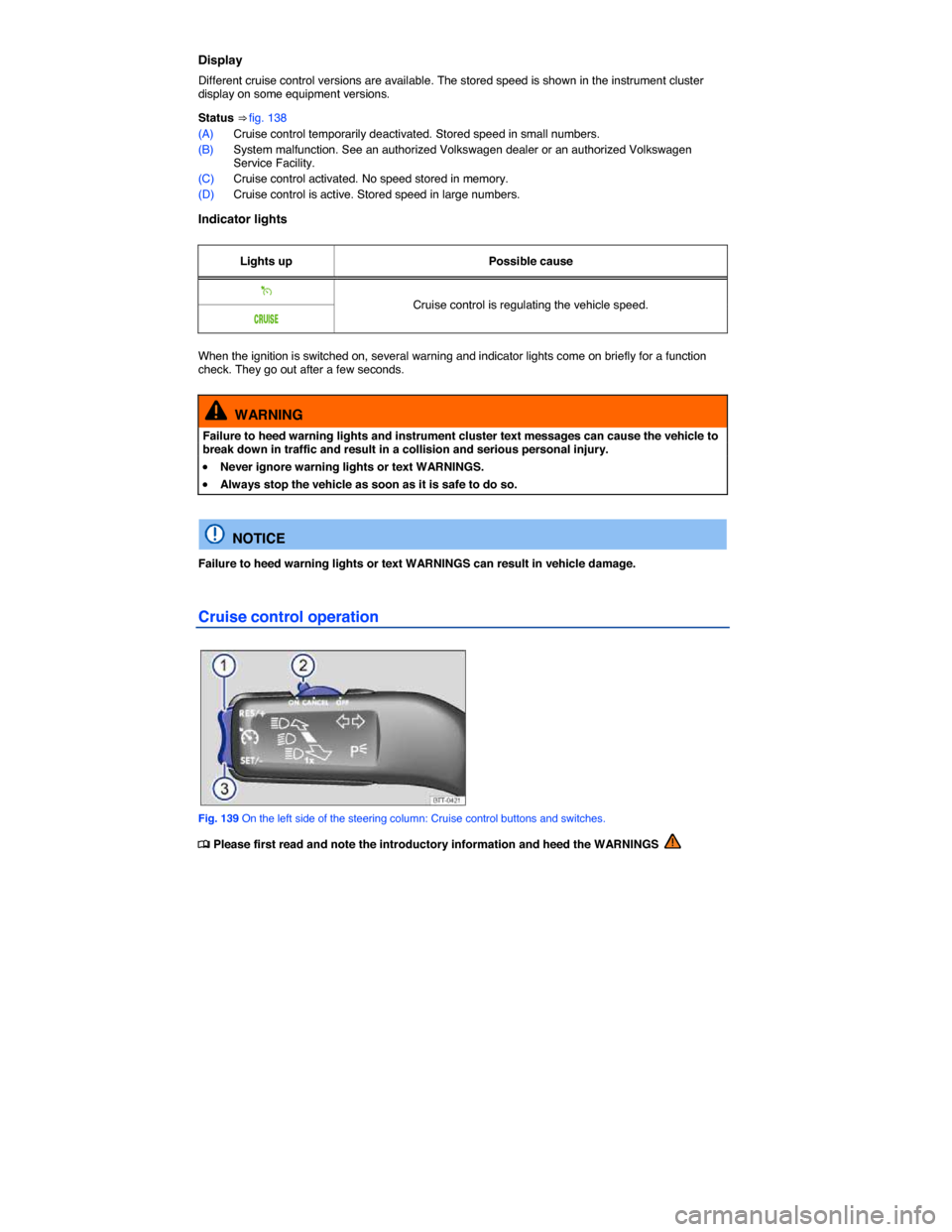
Cruise control operation
Fig. 139 On the left side of the steering column: Cruise control buttons and switches.
Page 338 of 393

Lights up Possible cause Proper response
B Engine control/monitoring system malfunction (engine Malfunction Indicator Light - MIL)
Ease off the accelerator. Carefully drive to the nearest authorized Volkswagen dealer or authorized Volkswagen Service Facility. Have engine checked.
Flashes Possible cause Proper response
B Misfire, which can damage the catalytic converter.
Ease off the accelerator. Carefully drive to the nearest authorized Volkswagen dealer or authorized Volkswagen Service Facility. Have engine checked.
When the ignition is switched on, several warning and indicator lights come on briefly for a function check. They go out after a few seconds.
NOTICE
Failure to heed warning lights or text WARNINGS can result in vehicle damage.
As long as the indicator lights B or %0# are on, expect engine malfunctions, increased fuel consumption, and loss of engine efficiency.
Catalytic converter
Page 353 of 393

The indicator light may be flashing in the instrument cluster. In addition, there may be a text message in the instrument cluster display that gives instructions as to what to do.
Possible situations for emergency closing
Provided the preliminary requirements have been met, the CSC roof can be closed using the emergency procedure if you have one or more of the following problems:
x The windows in the doors will not go down.
x The soft-close feature of the luggage compartment lid is not working.
x Sensors that determine the position of the CSC roof when it is opening and closing are not working.
Emergency CSC roof closing
x Check whether there is enough room behind the vehicle for the luggage compartment lid to swing out backwards.
x Open the driver and passenger door and leave the doors open.
x Press your thumb on the top part of the Volkswagen emblem on the luggage compartment lid, and flip lower part of the emblem outward. This unlocks the rear lid. But do not lift the luggage compartment lid.
x Switch the ignition off and back on again.
x Start the engine.
x Pull and hold the center console lever ⇒ fig. 172 for at least 30 seconds.
x Release the lever.
x Pull and hold the lever again ⇒ fig. 172 and immediately pull back and hold the driver door switch
⇒ fig. 173 (1) until the CSC roof has completely closed and locked.
It takes a few seconds for the closing process to start after you pull both controls. A tone sounds and the indicator light in the instrument cluster display lights up during the emergency closing process. There may also be a message in the instrument cluster display.
The closing process is immediately interrupted if you let go of the lever or the switch or if one of the
cancel conditions changes (⇒ Cancel conditions for emergency closing). The process can be restarted by again pulling the center console lever and the switch in the driver door.
x After emergency roof closing is complete, continue to hold the lever and switch to close all windows.
x OR: After emergency closing, pull switch (1).
x OR: Insert the key in the lock of the driver's door, turn in the closing direction, and hold until all windows are closed.
x Have the vehicle checked immediately by an authorized Volkswagen dealer or an authorized Volkswagen Service Facility.
Cancel conditions for emergency closing
Emergency closing the CSC roof is canceled if any of the following situations occurs:
x The lever in the center console or the switch in the driver door is released.
x The ignition is switched off.
x Any door is shut.
x The vehicle battery voltage is less than 9 Volts.
x The luggage compartment lid is closed before the roof frames are locked into the mountings on the windshield.
x The vehicle moves at a speed greater than about 0.6 mph (1 km/h).
x The outside temperature is below +5° F (- 15° C).
Page 378 of 393

WARNING
Improper replacement of burned out headlights and other light bulbs can cause serious personal injury.
x Stop! Always read and heed the WARNINGS before doing any work in the engine
compartment ⇒ Working in the engine compartment. The engine compartment of any motor vehicle is a potentially dangerous area, and work in this area can lead to serious personal injury.
x HID – High Intensity Discharge (Xenon) headlights get power from a high voltage source that can cause severe personal injury and even death if handled improperly.
x H7 bulbs and HID – High Intensity Discharge (Xenon) headlights are under high pressure and can explode if handled improperly.
x Always let a burned out light bulb cool down before replacing it.
x Never replace a light bulb unless you are familiar with all of the necessary procedures. In particular, never remove a headlight unless you know exactly how to carry out the job and have the correct tools and light bulbs.
x If you are uncertain about what to do, have the work performed by an authorized Volkswagen dealer, an authorized Volkswagen Service Facility, or another qualified workshop. Serious personal injury may result from improperly performed work.
x We strongly recommend that you always have HID – High Intensity Discharge (Xenon) headlights and H7 bulbs replaced by a qualified technician.
x Do not touch the glass of light bulbs with your bare hands. Fingerprints left on the bulb evaporate due to the heat when the bulb is switched on and cause the reflector to “cloud.”
x There are sharp edges on and around the headlight housing in the engine compartment and the rear light housing. Wear hand protection if you replace bulbs.
NOTICE
After replacing a headlight bulb or other light bulb, always make sure that the rubber covers or plastic caps have been properly and securely reinstalled to help prevent water from getting into the electrical connections and the headlight housing and damaging the electrical system.
LEDs cannot be replaced. Contact your authorized Volkswagen dealer or authorized Volkswagen Service Facility for assistance.
Indicator light