warning VOLKSWAGEN EOS 2015 1.G Manual PDF
[x] Cancel search | Manufacturer: VOLKSWAGEN, Model Year: 2015, Model line: EOS, Model: VOLKSWAGEN EOS 2015 1.GPages: 393, PDF Size: 5.57 MB
Page 181 of 393

Remove center hubcaps and decorative rim rings before installing snow chains ⇒ . However, for safety reasons, caps must be installed on the wheel bolts. These are available from authorized Volkswagen dealers and authorized Volkswagen Service Facilities.
Compact spare wheel
For technical reasons, snow chains cannot be used on the compact spare
If you must use snow chains and have a compact spare wheel mounted, move the compact spare wheel to the rear axle if a front tire has to be replaced. The tire taken off the rear axle can then be used to replace the flat front tire. Be sure to install the unidirectional tires so that they will run in the proper direction. Volkswagen recommends installing the snow chains before mounting the wheel to the vehicle.
WARNING
Using the wrong snow chains or installing snow chains improperly can cause accidents and severe personal injuries.
x Always use the proper snow chains.
x Follow the installation instructions provided by the snow chain manufacturer.
x Never exceed the permissible speed limit when driving with snow chains.
NOTICE
x Remove snow chains when roads are free of snow. Otherwise, the chains can damage the tires, impair vehicle handling and can be quickly worn down.
x Snow chains can scratch or damage wheel rims if they have direct contact with the rims. Volkswagen recommends using coated snow chains.
Glossary of tire and loading terminology
Page 184 of 393

Rim size
Designation means rim diameter and width.
Rim type designation
The industry or manufacturer's designation for a rim by style or code.
Rim width
The nominal distance between wheel rim flanges.
Section width
The linear distance between the exteriors of the sidewalls of an inflated tire, excluding elevations due to labeling decoration, or protective bands.
Sidewall
The portion of a tire between the bead and the tread.
Sidewall separation
The parting of the rubber compound from the cord material in the sidewall.
Speed rating (letter code)
A standardized letter code indicating the maximum speed at which a tire is designed to be driven for extended periods of time. The ratings range from 93 mph or 150 km/h (“P”) to 186 mph or (300 km/h) “Y”.
The speed rating letter code, where applicable, is molded on the tire sidewall. You may not find this information on all tires because it is not required by law.
Tire Pressure Monitoring System
A system that detects when at least one of a vehicle's tires is underinflated and illuminates a low tire-pressure warning light.
Tread
The portion of a tire that normally touches the road.
Tread rib
A tread section running circumferentially around a tire.
Tread separation
Tire failure caused by the tread pulling away from the tire carcass.
Tread wear indicators (TWI)
Raised areas within the main tread grooves that show, visually, when tires are worn and near the end of their useful life.
Uniform Tire Quality Grading (UTQG)
A tire information system developed by the U.S. National Highway Traffic Safety Administration (NHTSA) that is designed to help buyers compare tires. UTQG is not a safety rating, nor is it a guarantee that a tire will last for a certain number of miles or perform a certain way. It gives tire buyers more information to compare with factors such as price, brand loyalty and dealer recommendations. Under UTQG, tires are graded by the tire manufacturers in 3 areas: tread wear, traction and temperature resistance. UTQG information is molded into the tire sidewalls.
U.S. DOT Tire Identification Number (TIN)
A tire's serial number. It begins with the letters “DOT” (“Department of Transportation”) and indicates that the tire meets all federal standards. The next 2 numbers or letters indicate the plant where the tire was manufactured. The last 4 numbers represent the week and year of manufacture.
Page 186 of 393

the loaded trailer) is also limited. More passengers, or passengers who are heavier than the assumed 150 lbs (68 kg), mean that less weight can be carried as luggage or other cargo. The tire pressure label on your Volkswagen also lists the maximum combined weight of all of the occupants and luggage or other cargo that the vehicle can carry.
WARNING
Overloading a vehicle can cause loss of vehicle control, a crash or other accident, serious personal injury, and even death.
x Carrying more weight than your vehicle was designed to carry will prevent the vehicle from handling properly and increase the risk of the loss of vehicle control.
x The brakes on a vehicle that has been overloaded may not be able to stop the vehicle in a safe distance.
x Tires on a vehicle that has been overloaded can fail suddenly, including a blowout and sudden deflation, causing loss of control and a crash.
x Always make sure that the total load being transported – including the weight of a trailer hitch and the tongue weight of a loaded trailer – does not make the vehicle heavier than the vehicle's Gross Vehicle Weight Rating.
Determining the correct load limit
Page 189 of 393

WARNING
Incorrect tire pressures and/or underinflated tires can cause sudden tire failure, loss of control, collision, serious personal injury or even death.
x When the warning symbol appears in the instrument cluster, stop and inspect the tires.
x Incorrect tire pressure and/or underinflated tires can cause increased tire wear and can affect the handling of the vehicle and stopping ability.
x Incorrect tire pressures and/or underinflated tires can also lead to sudden tire failure, including a blowout and sudden deflation, causing loss of vehicle control.
x The driver is responsible for the correct tire pressures for all tires on the vehicle. The
recommended tire pressure values are listed on a sticker inside the driver door ⇒ Tire inflation pressure.
x The TPMS can only work correctly when all tires on the vehicle are filled to the correct cold tire inflation pressure specified for the tires installed on the vehicle.
x Using incorrect tire pressure values can cause accidents or other damage. Always inflate the tires to the correct specified cold tire pressure values for the tires installed on the vehicle.
x Always maintain correct cold tire inflation pressure so that TPMS can do its job.
x Always inflate tires to the recommended and correct tire pressure before driving off.
x Driving with underinflated tires causes them to flex (bend) more, letting them get too hot, resulting in tread separation, sudden tire failure and loss of control.
x Excessive speed and/overloading can cause heat build-up, sudden tire failure, and loss of control.
x If the tire pressure is too low or too high, the tires will wear prematurely and the vehicle will not handle well.
x If the tire is not “flat” and you do not have to change a wheel immediately, drive carefully and at reduced speed to the nearest service station to check the tire pressure and add air as required.
x When replacing tires or wheel rims on vehicles equipped with TPMS always read and heed
the information and all WARNINGS regarding Tires and wheels ⇒ Tires and wheels.
NOTICE
x The wheel electronics are attached to special aluminum valves on the wheels. These valves are screwed on rigidly. Never bend the valves “into position” when checking and adjusting tire pressure.
x Missing valve stem caps can cause damage to the valves as well as to the TPMS sensors. To help prevent damage, always use valve stem caps like those originally installed at the factory. The caps must be screwed on tightly. Do not use metal valve stem caps.
x Do not use “comfort valve caps.” They do not seal properly and can damage the sensors.
x When replacing or rotating tires, make certain the valves and sensors are not damaged.
x The aluminum valves that are installed should be replaced after about 6 years of use because of aging in the rubber seals. The valves can be replaced when a tire is changed. Do not reuse aluminum valves after they are removed. They must be replaced. The tire pressure sensor can be reused.
x When replacing the valve cores, use only nickel-plated replacement cores.
x The batteries in the wheel electronics last up to 10 years. It is not possible to replace the batteries. The entire device must be replaced.
Underinflated tires increase fuel consumption and tire wear.
Page 192 of 393

WARNING
Incorrect tire pressures and/or underinflated tires can cause sudden tire failure, loss of control, collision, serious personal injury, or even death.
x When the warning symbol
Page 194 of 393

your vehicle to ensure that the replacement or alternate tires and wheels allow the TPMS to continue to function properly.
Spare wheel or compact spare wheel
The spare wheel or compact spare wheel has no tire pressure sensor. When the spare or compact spare wheel is mounted on the vehicle, the Tire Pressure Monitoring System (TPMS) indicator light will flash in the instrument cluster display. The TPMS continues to monitor the other 3 wheels.
Tire storage
If the tires do not move for an extended period of time, the sensors will not transmit tire pressures to the system. This saves sensor battery life. The sensors are reactivated by driving the vehicle again.
WARNING
Incorrect tire pressure can cause sudden tire failure, loss of vehicle control and serious personal injury.
x Always check and correct air pressure in all 4 tires, particularly after changing, exchanging, or repairing tires.
x After that, always make sure that all 4 tires are inflated to the correct tire pressure for the tires installed on the vehicle.
x See the tire pressure label ⇒ fig. 105 ⇒ Tire inflation pressure and the Owner's Literature for recommended cold tire inflation pressure and other important information.
x When replacing tires or wheel rims on vehicles equipped with TPMS, always read and
heed all of the information and WARNINGS ⇒ Tires and wheels.
NOTICE
x The wheel electronics are attached to special aluminum valves on the wheels. These valves are screwed on rigidly. Never bend the valves “into position” when checking and adjusting tire pressure.
x Missing tire air valve caps could result in damage to the valves, as well as to the sensors on the Tire Pressure Monitoring System. Therefore, make sure your valve caps conform to the specifications of those originally installed on the vehicle and that they are always tightly and properly screwed on to the valves. Do not use metallic valve caps
x Do not use “comfort valve caps.” They do not seal properly and can damage the sensors.
x When changing or rotating the tires, be careful not to damage the valves or sensors.
x The aluminum valves that are installed should be replaced after about 6 years of use due to aging of the rubber seals. The valves can be replaced when a tire is changed. Do not reuse aluminum valves after they are removed. They must be replaced. The tire pressure sensors can be reused.
Page 196 of 393

WARNING
Objects in the driver foot well can prevent the pedals from moving freely. This can cause loss of vehicle control and increase the risk of serious personal injuries.
x Always make sure that nothing can interfere with the pedals.
x Always fasten floor mats securely to the floor.
x Never put floor mats or other floor coverings on top of already installed floor mats.
x Always make sure that nothing can fall into the driver foot well while the vehicle is moving.
WARNING
Some kinds of cigarette lighters can be lit unintentionally, or crushed causing a fire that can result in serious burns and vehicle damage.
x Always make sure that there are no lighters in the seat tracks or near other moving parts before adjusting the seats.
x Before closing a storage compartment, always make sure that no cigarette lighter can be activated, crushed, or otherwise damaged.
x Never leave a cigarette lighter in a storage compartment, on the instrument panel, or in other places in the vehicle. Heat buildup in the passenger and luggage compartment of a parked vehicle can result in temperatures in the vehicle that are much higher than the outside temperatures, particularly in summer. High temperatures could cause the cigarette lighter to catch fire.
NOTICE
x The defroster heating wires in the rear window can be damaged by hard or sharp things on the shelf below the rear window.
x Do not keep any food, medicine, or other items sensitive to heat or cold in the vehicle. They can be damaged or made unusable by heat or cold.
x Things that are made of transparent materials (such as eyeglasses, magnifying glasses, or transparent suction cups on the windows) can magnify sunlight and damage the vehicle.
Page 208 of 393

WARNING
To reduce the risk of serious personal injury when starting and running the vehicle's engine:
x Never start the engine or let it run in a confined or enclosed area. Engine exhaust contains carbon monoxide, a poisonous, colorless, and odorless gas. Carbon monoxide can cause unconsciousness and death.
x Never start the engine or let it run if oil, fuel, or other flammable substances are under, around, or have leaked from the vehicle, for example, due to vehicle damage.
x Never leave the vehicle unattended with the engine running, especially when it is in gear. The vehicle could move suddenly or some other unexpected event could occur, resulting in property damage, fire, or personal injury.
x Never use starting assist fluids. Starting fluids can explode and can cause a “run-away” vehicle condition.
WARNING
The vehicle exhaust system and the catalytic converter get very hot. They can cause fires and serious personal injury.
x Never park the vehicle where the hot exhaust system or catalytic converter could ignite flammable materials, such as brush, leaves, dry grass, spilled fuel, etc.
x Never apply additional undercoating or rust proofing on or near the exhaust manifold, exhaust pipes, catalytic converter, or heat shields.
Indicator lights
Page 209 of 393
WARNING
Failure to heed warning lights and instrument cluster text messages can cause the vehicle to break down in traffic and result in a collision and serious personal injury.
x Never ignore warning lights or text WARNINGS.
x Always stop the vehicle as soon as it is safe to do so.
x Whenever stalled or stopped for repair, move the vehicle a safe distance off the road, turn on the emergency flashers, stop the engine, and use other warning devices to warn approaching traffic.
NOTICE
Failure to heed warning lights or text WARNINGS can result in vehicle damage.
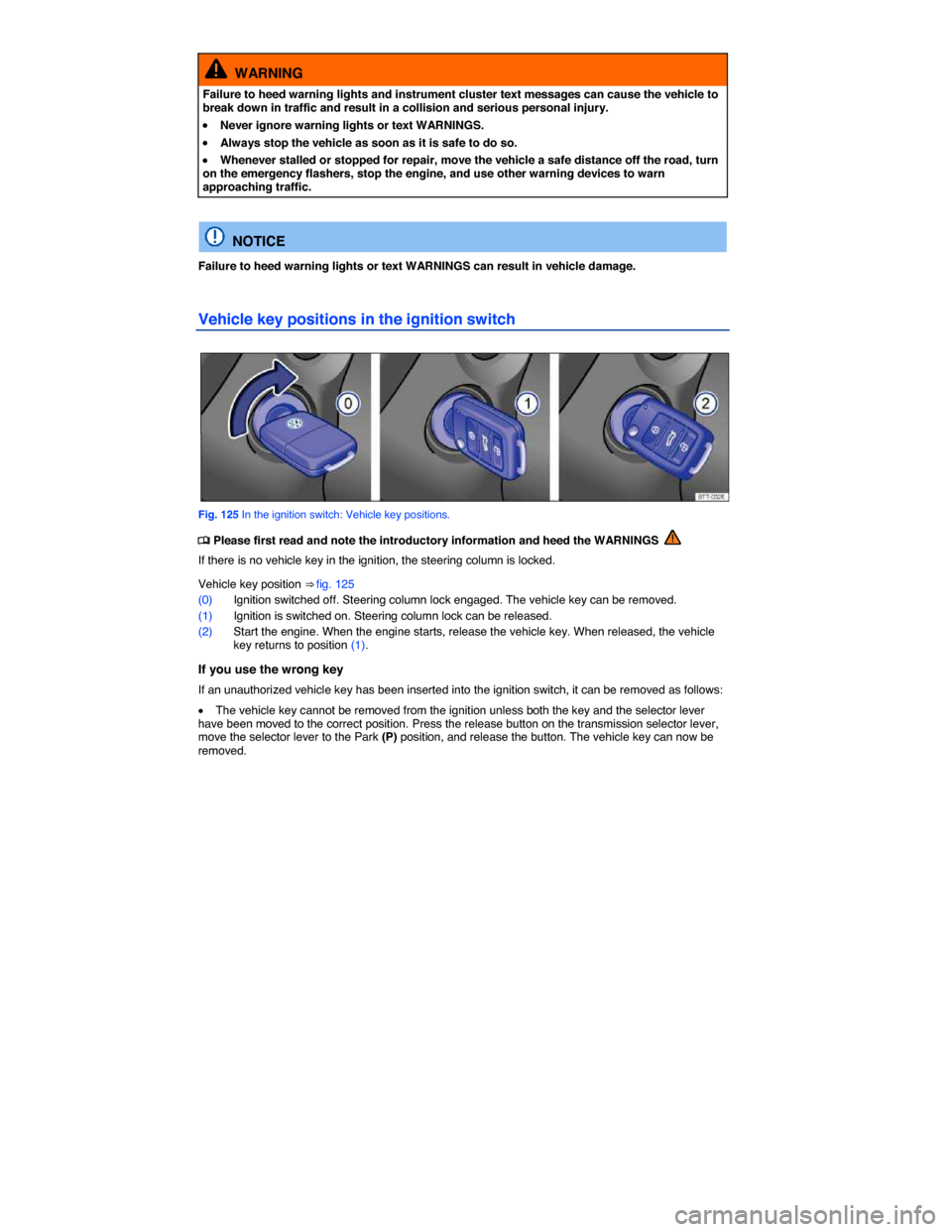
Vehicle key positions in the ignition switch
Fig. 125 In the ignition switch: Vehicle key positions.
Page 210 of 393

WARNING
Improper use of vehicle keys can result in serious personal injury.
x Always take the key with you when you leave the vehicle. The engine can be started and vehicle systems such as the power windows can be operated, leading to serious personal injury.
x Never leave children, disabled persons, or anyone who cannot help themselves in the vehicle. The doors can be locked with the remote control vehicle key. This could result in people being trapped in the vehicle in an emergency. For example, depending on the time of year, people trapped in the vehicle can be exposed to very high or very low temperatures.
x Heat buildup in the passenger and luggage compartment of a parked vehicle can result in temperatures in the vehicle that are much higher than the outside temperatures, particularly in summer. Temperatures can quickly reach levels that can cause unconsciousness and death, particularly to small children.
x Never remove the key from the ignition switch while the vehicle is moving or rolling to a stop. The steering wheel will lock and you will not be able to steer or control the vehicle.
Leaving the key in the ignition for a long time when the engine is not running will drain the vehicle battery.
Leaving the selector lever for a long period of time in any position other than Park (P) when the ignition is switched off can drain the vehicle battery.
On automatic transmission vehicles, the vehicle key can be removed from the ignition switch only when the transmission is in Park (P). You may have to press the release button on the transmission selector lever to put the lever into Park (P).
Starter button
Fig. 126 On the right side of the steering column: Starter button for the Keyless Access locking and starting system.