belt VOLKSWAGEN GOLF 1993 1H / 3.G Owners Manual
[x] Cancel search | Manufacturer: VOLKSWAGEN, Model Year: 1993, Model line: GOLF, Model: VOLKSWAGEN GOLF 1993 1H / 3.GPages: 156, PDF Size: 6.36 MB
Page 2 of 156
Downloaded from www.Manualslib.com manuals search engine l
,
l
You have chosen the European bestseller, the Golf
... and the environment
Built for the future
You I ave chosen a car Whlcli is ladlcal in ev ry respeCt. Even concerning the environ
ment Your new Golf has been developed to damage the e nvironme nt as little as possIL le Nor o nly today, but tomorrow and In he
'utu r .
Clean solutions from clean ideas
W e beheve that more can be done fo r the
envtronment today If we forgo some th ings.
S o
In manufacturing your new Golf , we have . wherever possib le, forgone environmentall y harmful materials, for e :amp le CFCs In p lastic parts, cadmium and asbes
t os .
For [he paintwork. we are fO I going chemica l
solvents to an ever rncreaslng degree, and sing more and more aler-based paints
Clean performance
Naturally, all engines fitted III the Golf are low pollutants .
They are particularly qUiet
and low In uel
consumption That is of course dependent on your driv ing style . Tips and advice on the
s ubject can be found in thiS manual Exactly
Ihere can b e found in the alpha betrcallnde x
under the heading" EnVIronm ent" .
Reduced emissions
Vaporrzation -from plastics in th e ve hicle in
teriol or from the fuel tank -Will hardly occlIr In you r new Golf.
For examp le, we have llserl new materlals
for the Instrument panel, and the walls of the fuel tank have be en treated to red uce emiSSions a" much as pOSSible
A sign of the times
Y our new Golf has been constructed In such
a wa y that It can be disp osed of env ironmen
t ally
The plast iC parts have
a speCial marking to Simplify Identlfeat lon and reprocessing of materials at a later date.
Some of these plastiC parts are made entire
l y from
recy cled mate rial.
These really a re signs of tile times.
... and more safety
Safe all round
Your nevy Golf has exemp lary safet y.
It offers an extraordinar y high deg ree of aci e and pass i e safet
Active -from the running
gear to the ergo
nomics of the interior . Passive -from the
fron enlj structure nd the passenge r cell , the steenng, the steerlllg wheel, the seats ,
through 10 he seat belt sYStem With bel tra e an oressure limiters for driver ilnd fro· seat passenger.
.411 15 S he result of our safety philosophy.
For us sa ety means protection .
~ '" e ar Iples
Safe and Sound
All mo,
By,
ev e
wh
str i
Sa
E VE fe e
T he
a nc
f
ro' eVE
I t (
T h , Slt
m" d ar
in c
Cu
T h
o p·
b e p re
i m
Page 3 of 156
Downloaded from www.Manualslib.com manuals search engine ~II in all passive safety, strictly tested in "1ore than 30 different crash tests.
9y our own sta ndards, standards which are
ev en higher than those laid down by law a~d ....,hich in many pOints go further than tne
str ict US standa rds.
Safe and comfortable
'::ven the seats in your new Golf ensure ef
' e cti ve protection for the oc cupants.
T hey have a robust base, a firm seat .ramp
a n d
are de signed so that you do not slip out from under the seat belt (submar in ing) in the
e v ent of a collision .
It contracts
The new Golf is equipped w ith a safety
s teering column , whose increased defor
m at io n distance considerably reduces the :!anger of it penetrating the interior and thus
I n cre ase s passive safety
Cushions
The new V olkswagen Airbag System is the
J pti mal supplement to the fastened seat [Jelt. ng gered by an electronic sensor, It orotects the breast and head form possible
p act WIt parts of the vehicle interior.
· .. and the service
One of the largest and most efficient service
o rganisat ions in the world IS wait ing to look
after your Golf : in Europe alone there IS a
network of more than 9000 Volkswagen
dealers,
who work effiCiently and acco rding
to works guidelines.
The Volkswagen dealers will also ensure
that everything
is OK on your Golf. BeSides
the
• 1-year unlimited mileage warranty
against defects
in manufacture
a whole package of further guarantees
and
services is offered in most countries, like for
e xample:
• 3-year warranty against defects
in paint
work .
• 6-year warrant y against rusting through
on the bodywork -the warranty is valid with
out annual protection treatment but does
not cover rusting that results from external
damage .
• The mobil ity guarantee.
If you should IJ'lve a breakdown at
any time,
Volkswagen dealers w ill help you at short
n otice. Either by a qUick repair, a hire car or
e ven an overnight stay at a hotel for you and
your passengers
• The re liable Volkswagen
emergency ser
vice .
Help around-the-clo ck
-;-only a phone call is
required The numbers are In the list of ad
dresses in tI-, e veh icle wallet.
•
The Volkswagen Service telephone
If you have any questions, suggestions
or criticisms, please call our service advisor
free-of-charge on 130 /3102 or In eastern
German y on 0371/5600426 This service IS at present only available in Germany.
• 1-year warrant y
on workshop repairs.
• 1-year warranty
on all Genuine parts and on Volkswagen accessories approved by us.
•
The quick, low-priced Express Service
for smaller jobs.
• A reasonabl y priced replacement car for
the period that yours
is being serviced or re
paired -ask your dealer.
• The Volkswagen Accessory Service.
Tested , factor y-approved accessories and
professiona l installation -please read the
notes
on page 115.
V o lkswagen dealers will gladly supply de
tails on the above-mentioned servic
es and
possible deviations in individual countries.
See also the notes in the Service Schedule .
We wish you safe, reliable and en joyable
motoring
Volkswagen
Page 5 of 156
Downloaded from www.Manualslib.com manuals search engine CONTROLS AND EQUIPMENT
Dashboard and Controls ..... 4
. ey s, Cen tral locking . . .... 6, 7
::"tl-thef t warning system .... 8
Joors .......................... .... 9
oot lid .... ........... . . . . . 10
::Iectric windows .. . .. 10
• ~Irrors . . ..... . ... 12
Seal belts 13
"" rbag System . . . . . 18
Safe ty for children .. ... 21
ead restraints . . . . . .. 24
= ro nt seats . . . . . . . . . . . .. 25
Rear seat . . . 27
L u ggage compartment ... . ... . ...... 28
M esh partition (Estate) ...... 29
L u ggage compartment cover /
F olding/sliding cover
... 30
Pedals, Hand brake .. 31
Manual gearbox .... ... .... 31
Automati c gearbox . . . .. .......... 32
H eig ht-adjustable steering wheel ..... 35
I gnition lock. . . . . .. 35
Starting/stopp ing engine 36, 38
\lIstrumellts .. .... 39
Warning lamps ....... 46
Switches . . . . . . . . . . . . . . 50
Turn signal and dip lever ............. 53
Cruise control system ........... 54
Wi ndscreen wipe r and washer system 55
Heating an d ventilation .. . ...... 56
Air cond itioner ......' 59
Sliding/ti ltin g roof. . . . . . . . . . . . ... 65
Sun visors / Interior lights 66,67
Cigarette lighter, Ash tray ..... 68
Shelves and boxes . . . . . . . . . . . ... 69
Roof rack / Roof ra ilings ... 70
DRIVING TIPS
The firs t 1500 km -and after wards .... 71
Driving economically and ecologically .. 72
Brakes. . . . . . . . . . . . . . . . 75
Tra iler tow ing . .. ..... . .... ... ...... 77
Driving a four- wheel drive vehicle .. 79
GENERAL MAINTENANCE
Filling the tan k, Fuel. 81, 82
Care of vehicle ........ .. . . 85
Bonnet . . ... 90
Engine compartment .. ...... .... .... 91
Engine oil ..... .......... ........... 92
Automatic transmission fluid (ATF)* ... 96
Power-assisted steering .. 96
Cooling system . . . . . . . . . . .. . 97
B rake fluid ...... 99
Battery . . . . .. 100
Spark plugs. V-belts . . . . . . . . . 102
Washer system
... . .. 103
Windscreen w iper blades . . . 104
Dust a
nd pollen filter * . 104
Wheel s . 105
D riving abroad ..... ............... 110
Accessories, modifications and
renewa l ot parts .............. III
Mobile telephones and tw o-way rad ios 111
DO -lT-YOURSELF
First -aid kit, Warn ing triangle ........ 112
Storage of vehicle tools, spare wheel
a n d ball coupling trailer bracket ...... 113
Vehicle tools, Spare wheel 114
CONTENTS
Changing w heels . 116
F uses . ........ .. .. . . . ... . .... 119
Changing bulbs. . .... .. . 121
Installing radio . . . . .. 127
E mergency starting .. .. 128
Tow starting / to wing . . .. 129
L ift ing vehicle ......... 131
SPECIAL INFORMATION
Body ..... .... . .......... 132
Environmental compatibility ... 133
TECHNICAL DATA
Engine data . .. , .... .... . 134
P er forman ce .. ... ... ... . .. 136
Fuel consump tion .. 137
Wh eels
. . 139
T yre pressures
.. .. ... .. . . .. ... 1 4 1
Weights ... 143
Trailer weights .. 144
Dimensions. ...... .. ... 145
Capacities " ..... 146
Vehicle identification data ... 147
ALPHABETICAL INDEX
Alph abetical index ... 148
3
Page 15 of 156
Downloaded from www.Manualslib.com manuals search engine CONTROLS AND EQUIPMENT
Seat belts
Why have seat belts?
It has been proven that seat belts give good protection in accidents. In most countries therefore the wearing of seat belts is required by law.
Attention • The belts should be put on be
fore every journey -even in town
traffic. This also applies to the
rear seats.
Pregnant women too should al
ways wear a seat belt.
• The routing of the belt is of
major importance to the protec
tive effect of the belt. How the
belt should be worn is described
on the next pages.
How children can be carried safely in the ve
h icle is explained on pag e 21 .
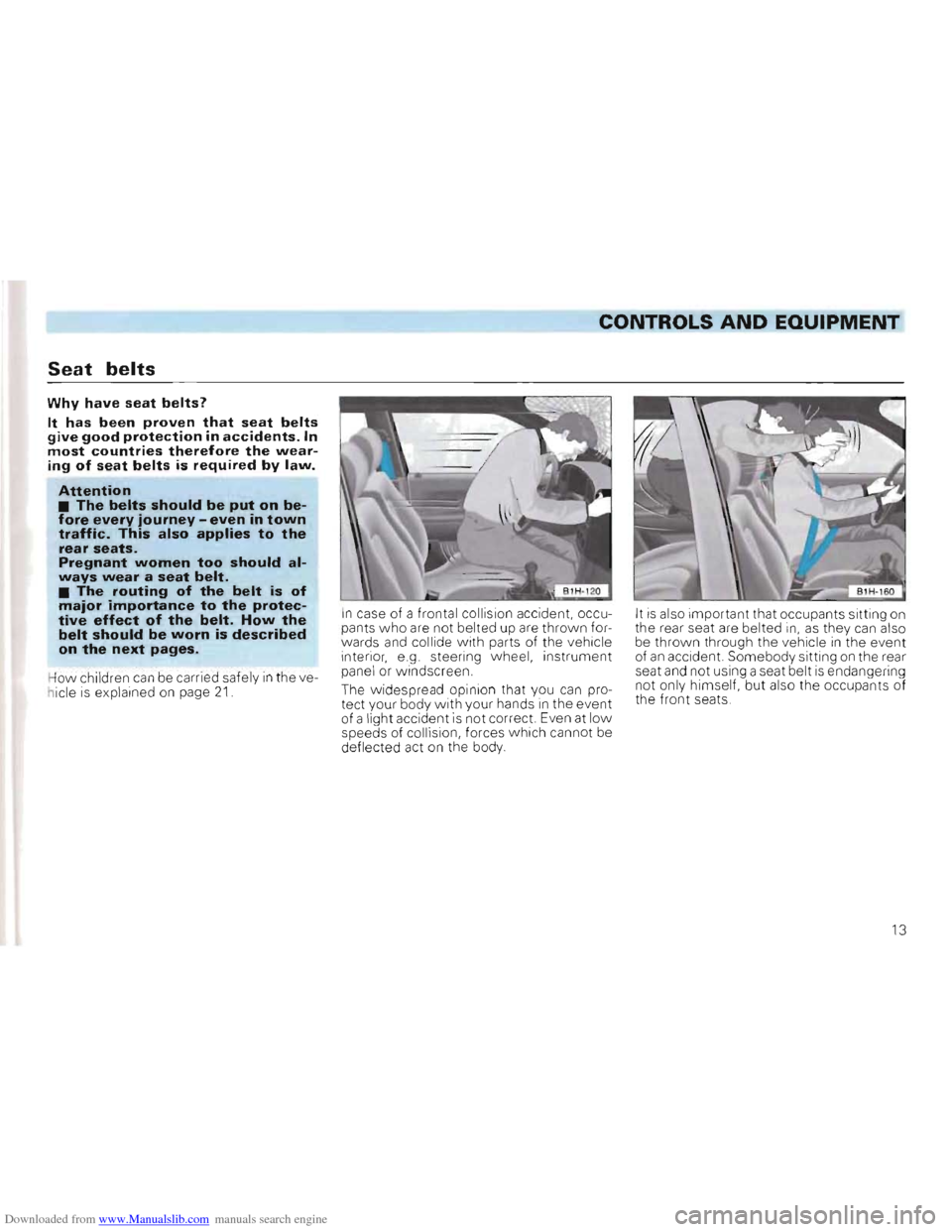
In case of a frontal collision accident, occu
pants w ho are not belted up are thrown for
w ards and collide with parts of the vehicle
interior, e.g steering wheel, instrument panel or w ind screen.
The wide spread opinion that you can pro
tect your body with your hands in the event
of a light accident is not corr ect. Even at low speeds of collision, forces which cannot be
deflected act on the body. It
is also
important that occupants sitting on
the rear se at are belted in, as they can also
be th rown throu gh the vehicle in the event
of an accident. Somebody sitting on the rear
seat and not u sing a seat belt is endangering
not only himself , but also the occupants of the front seats.
13
Page 16 of 156
Downloaded from www.Manualslib.com manuals search engine CONTROLS AND EQUIPMENT
--------------------------------------------------------------------------------~
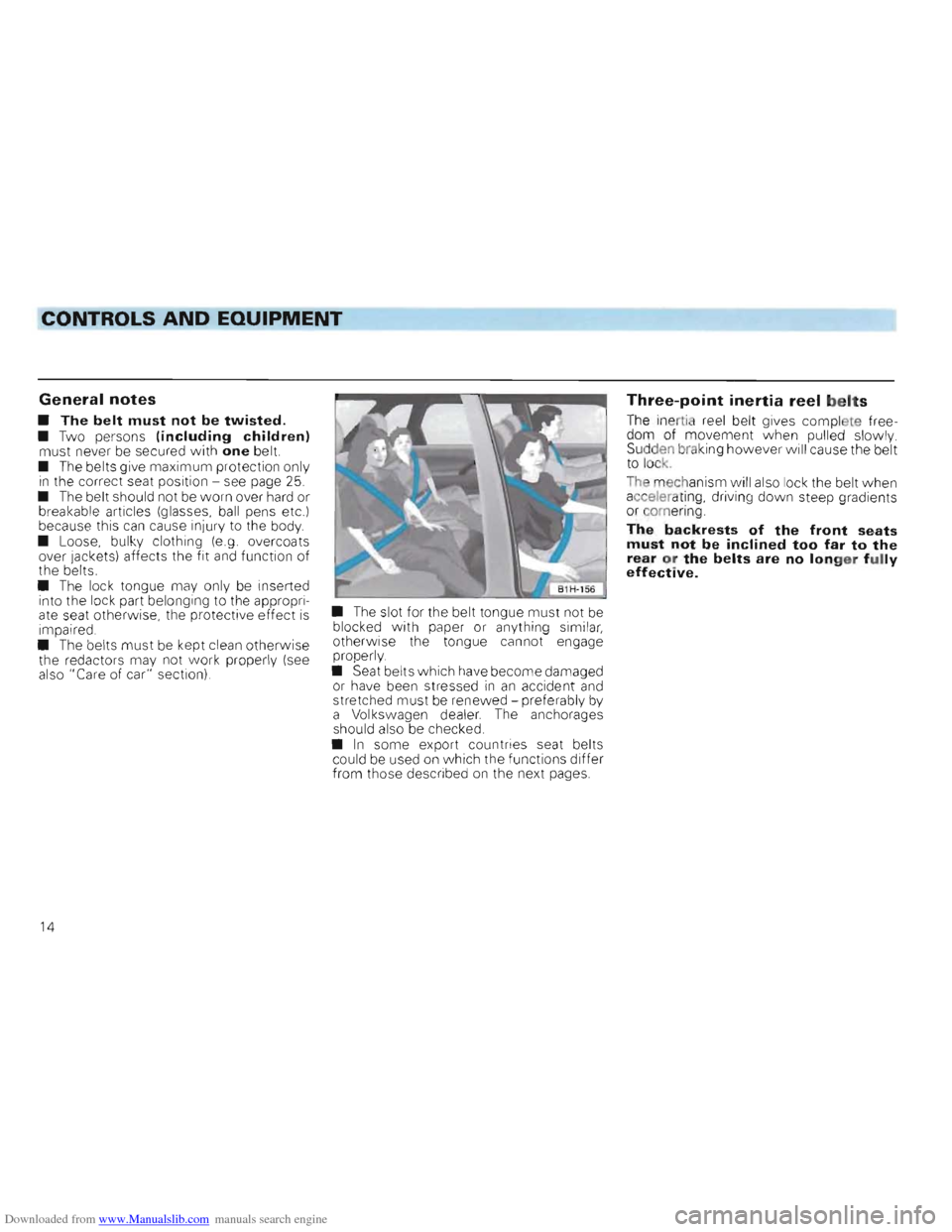
General notes
• The belt must not be twisted.
• Two persons (including children) must never be secured with one belt.
• The be lts give maximum prot ection only in the correct seat position -see page 25.
• The belt shou
ld not be worn over hard or
breakable articles (glasses, bal l pens etc.) because this can cause injury to the body .
• Loose, bulky clothing (e.g. overcoats
over Jackets) affects the
fit and funct ion of
the belts .
• The lock tongue may only be inserted
into the lock part belonging to the approp
riate seat otherwise, the protect ive effect is impaired.
• The belts
must be kep t clea n otherwise
the redactors may not work prope rly (see
a lso" Care of car" section) •
The
slot for the belt tongue must not be
blocked with paper or anything similar, otherwise the tongue cannot engage
proper ly.
• Seat belts which have become damaged
or have been stressed in an accident and
stretched must be renewed -preferab ly by
a
Vol kswagen dealer. The anchorages
should also be checked .
•
In some export countries seat belts
co uld be used on w hich the functio ns differ
from those described on the next pages.
Three-point inertia reel belts
The ine rtia ree l belt gives complete free
do m o f mov ement when pul[ed slowly.
Sud den brak ing
however will cause the belt
to loc k.
Th e mec hanism w
il[ a lso lock the belt w hen acc eler ati ng, driving down steep gradients
o r cornering.
The backrests of the front seats must not be inclined too far to th e rear or the belts are no longer fully effective.
14
Page 17 of 156
Downloaded from www.Manualslib.com manuals search engine L-___________________________________________________~~~_CONTROLS AND EQUIPMENT
Putting 3-point belt on
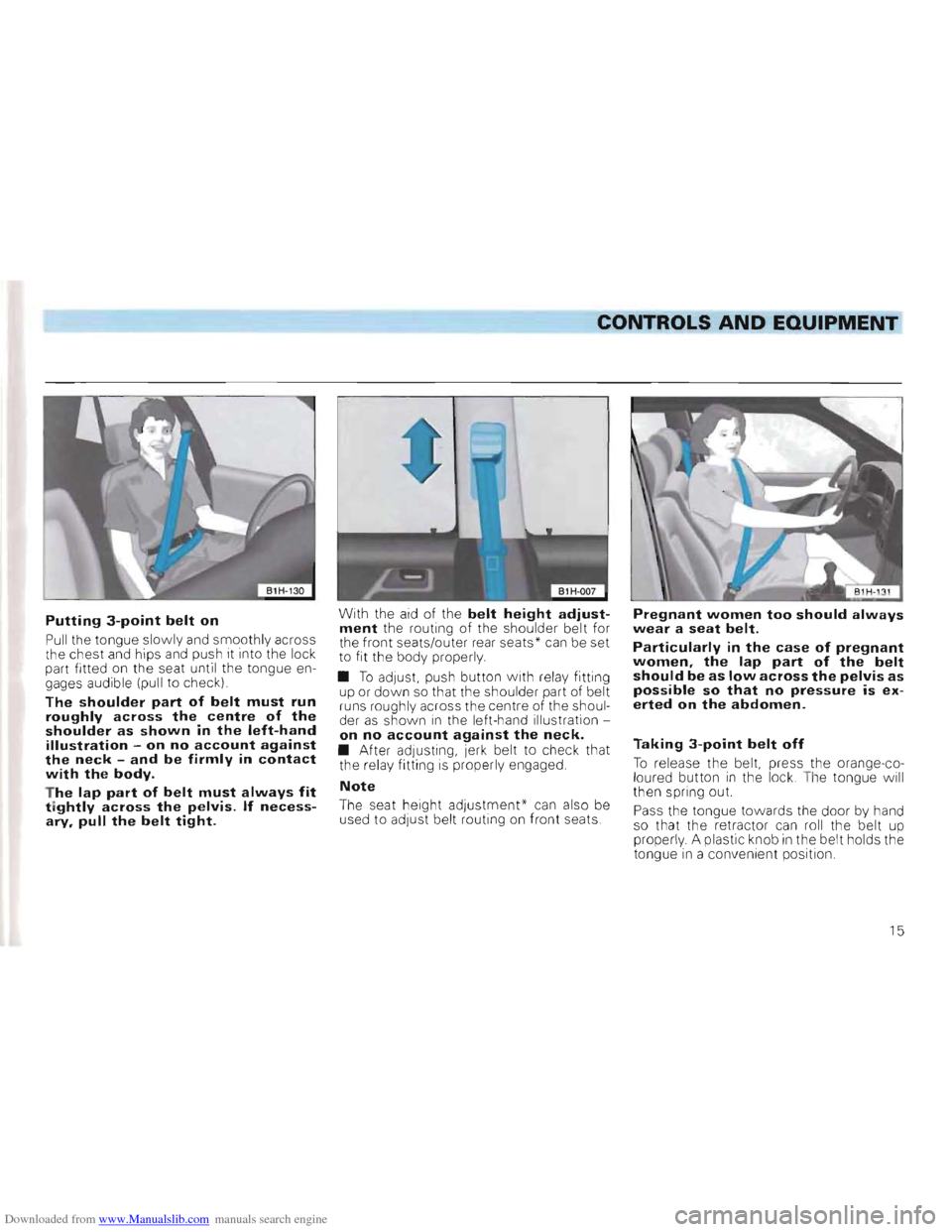
Pull the tongue slowly and smoothly across
t he chest and hips and push it into the lock
part fitted on the
seat unti l the tongue en
gages audible (pull to c heck)
The shoulder part of belt must run roughly across the centre of the shoulder as shown in the left-hand illustration -on no account against the neck -and be firmly in contact with the body.
T he lap part of belt must always fit tightly across the pelvis. If necessary, pull the belt tight.
With the aid of the belt height adjustment the routing of the shou lder belt for
the fron t seats/outer rear seat s * can be set
t o fit the body properly.
• T o
adJUSt. push button with re la y fitting
up or down so that the shoulder part of be lt
runs rough ly across the cen tre of the shoul
der as shown i n the le ft-h and illustration on no account against the neck. • After adjustin g, jerk belt to check that
the relay fitting is properly engaged.
Note
The seat height adjustment' can also be
used to adju st be lt routing on front seats.
Pregnant women too should always
wear a seat belt.
Particularly in the case of pregnant
women, the lap part of the belt
should be as low across the pelvis as
possible so that no pressure is ex
erted on the abdomen.
Taking 3-point belt off
To re lease the belt, press the orange-co
l oured button in the lock . T he to ngue will
th en s pring out.
Pass the tongue
towards the door by hand
so that the retractor can roll the belt up
prope
rly . A plastic knob in the belt holds the
t o ngue in a convenient position .
15
Page 18 of 156
Downloaded from www.Manualslib.com manuals search engine CONTROLS AND EQUIPMENT
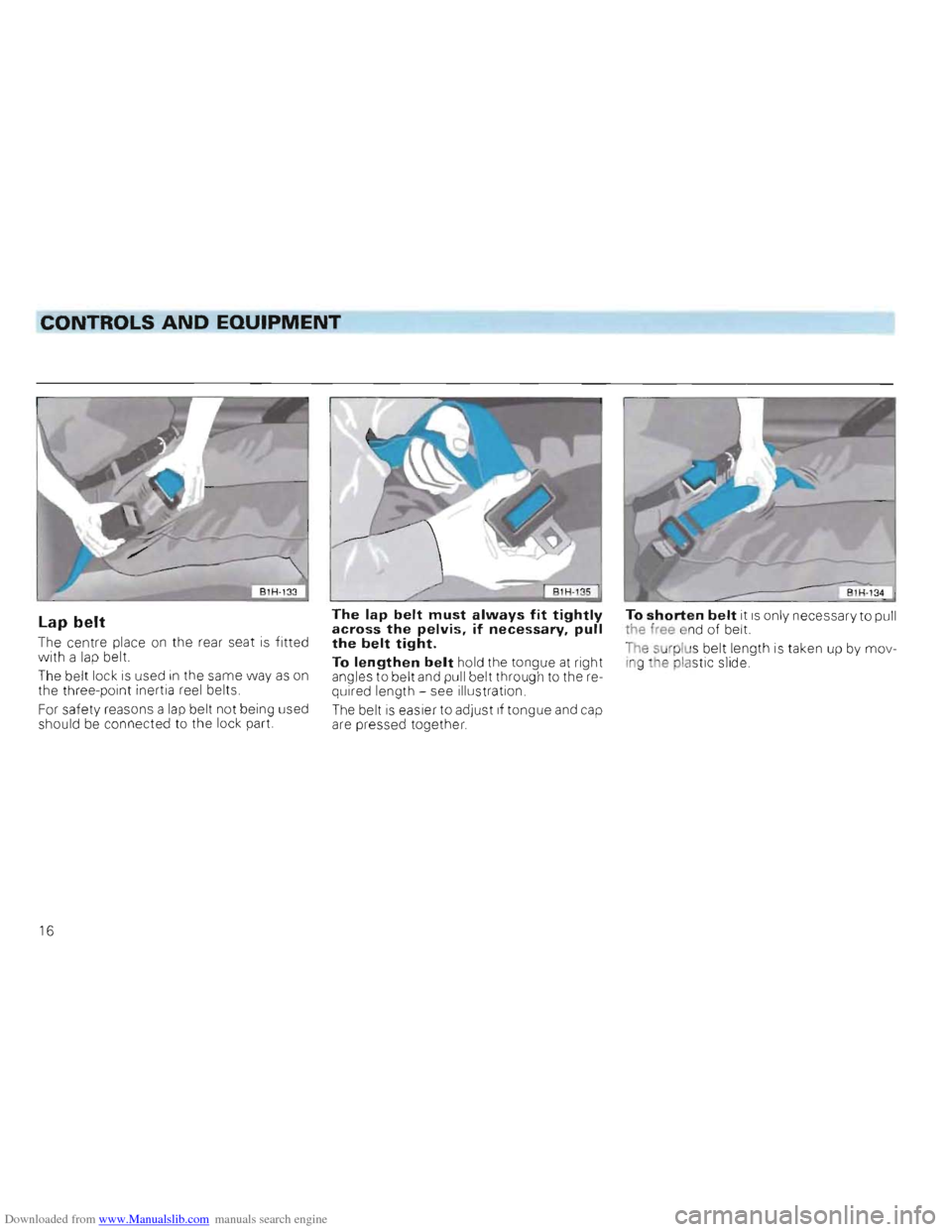
Lap belt
The centre place on the rear seat is fitted
with a lap belt.
Th e belt lock is used in the same way as on
the three-point inertia reel belts.
For safety reasons a
lap belt not being used
shou ld be connected to the lock part.
The lap belt must always fit tightly across the pelvis, if necessary, pull the belt tight.
To lengthen belt hold the tongue at right
angles to belt and pull belt through to the required length -see illustration.
The belt
is easier to adjust if tongue and cap
are pressed together.
To sh orten belt it is only necess ary to pull the free end of belt.
The sur plu s be lt length is taken up by mov
Ing the plastic slid e.
16
Page 19 of 156
Downloaded from www.Manualslib.com manuals search engine CONTROLS AND EQUIPMENT
Belt holder*
Front
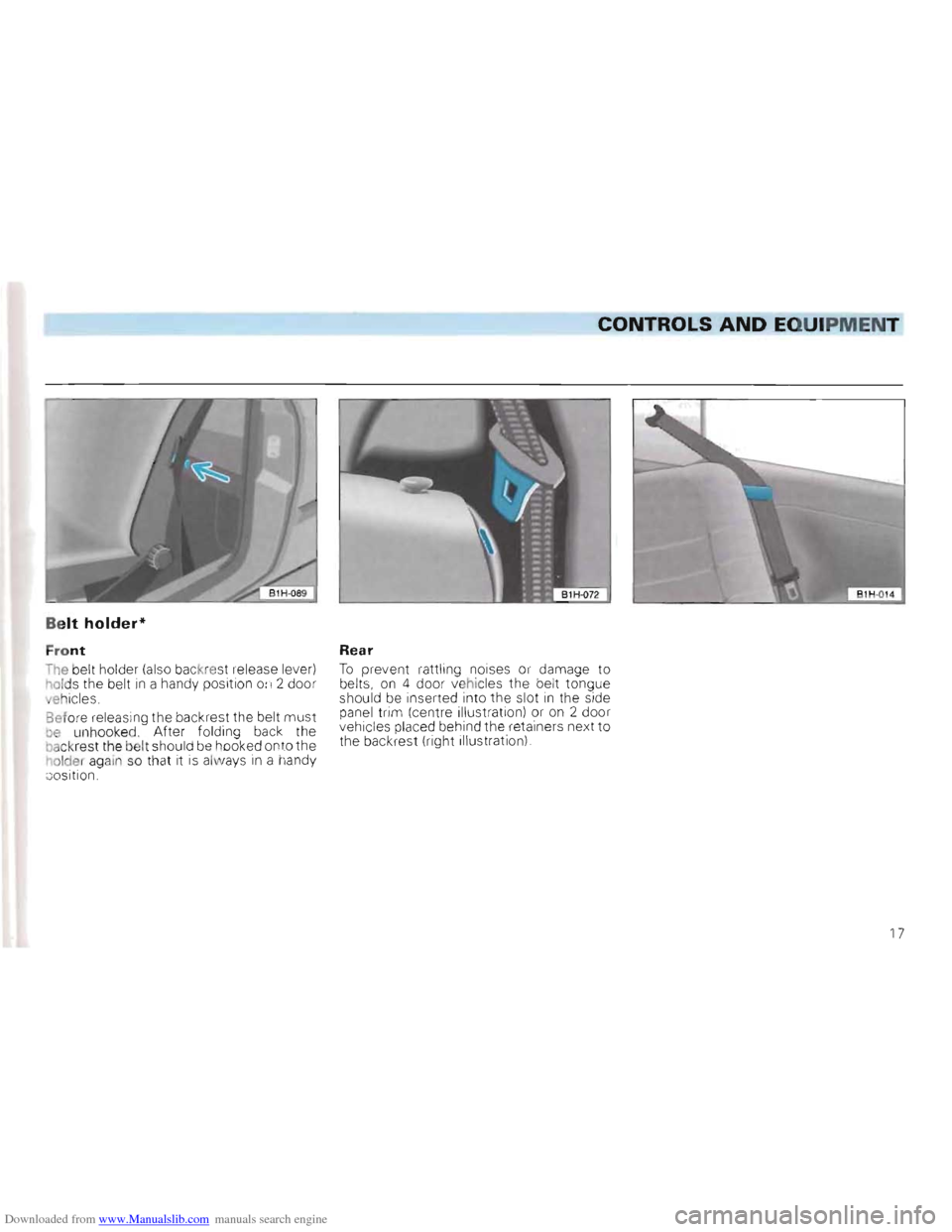
The belt ho lder (also backres t relea se lever)
h olds the belt in a handy position on 2 door
veh icles.
Before relea sing the backrest the belt must
oe unhooked. After folding back the
b ackrest the belt should be hooke d onto the
ho lde r ag ain so that it is always in a handy
p os ition .
Rear
To prevent rattling noises or damage to
belts, on 4 door vehicles the belt tongue
sho uld be inserted into the slo t in the side
panel trim (centre illustration) or on 2 door
ve hicles placed behind the reta ine rs next to
the backrest (right illustration)
17
Page 20 of 156
Downloaded from www.Manualslib.com manuals search engine CONTROLS AND EQUIPMENT
Airbag-System*
Vehicles with Airbag System for the driver and passenger can be recognized by an inscription "AI RBAG" on the steering wheel padded plate and on the right end of the dash panel.
Supplementary to the three point seat belts the Airbag System offers additional protection for the driver's and passenger's head and chest In a serious
frontal collision.
Apart
from its normal protective function the seat belt also has the task of keeping the
driver or passenger in such a position so
that the Airbag can offer maximum protec
tion in the case of a frontal collision.
The Airbag system will not be triggered for:
• Side collisions
• Rear collisions
•
Rol l i ng-over
• Minor frontal collisions
Therefore the seat belts should always be used not only for reasons of statutory regulations, but also for safety reasons!
Essentially the system consists of
• The electronic control and monitoring
unit
• Both airbags (air sack
with gas gener
ator) with gas generator for the:
- Driver (in steering wheel),
- Passenger (in right of dash panel)
• A
warning lamp in the dash panel -see
page 49.
The functional readiness of the Airbag
System is electronically monitored.
Each
time the ignition is switched on the
warning lamp lights for about 3 seconds
(self diagnosis).
The system has a fault, if
• When switching on the ignition the warn ing lam p does not light.
•
After swi tching on the ignition the warn
ing la m p does not extinguish after about 3
second s
• The warning lamp
comes on or flickers
du rin g the Journey.
Attention
When a fault is present the sys
tem should be checked by a
Volkswagen dealer immediately.
Otherwise there is the danger
that the Airbag will not be acti
vated in the case of an accident.
18
Page 23 of 156
Downloaded from www.Manualslib.com manuals search engine CONTROLS AND EQUIPMENT
Safety for children
Children under 12 years of age should normally travel on the rear seat1). Depending upon their age, height and weight, they must be protected with either a child restraint system or the seat belt provided. For reasons of safety, the child restraint system should be fitted in the middle of the bench seat or behind the passenger seat.
Attention Children under 1.50 m (5') tall must not use normal seat belts without the child restraint system. This could cause injury to the stomach and neck.
Ob serv e any statutor y regulation s to th e conrary .
Only officially approved ch ild restraint sys
te ms w hich are suitable for the child should
be used.
T he
ECE-R 21 standard 44 app lies to child re
straint systems. This categorizes restraint
systems Into four classes:
Cla ss 0: 0-10 kg
(approx to 9 months)
C lass 1 9
-18 kg
(approx . 8 m onths to 4 years)
Class
2: 15-25 kg
(approx. 3 to 7 yea rs)
Class 3: 22 -36 kg
(approx 6 to 12 years)
Child
restraint systems tested according to
ECE-R standard 44 are clearly marked w ith
the ECE-R test mark 44 (capital E in a Circle,
with test number below) .
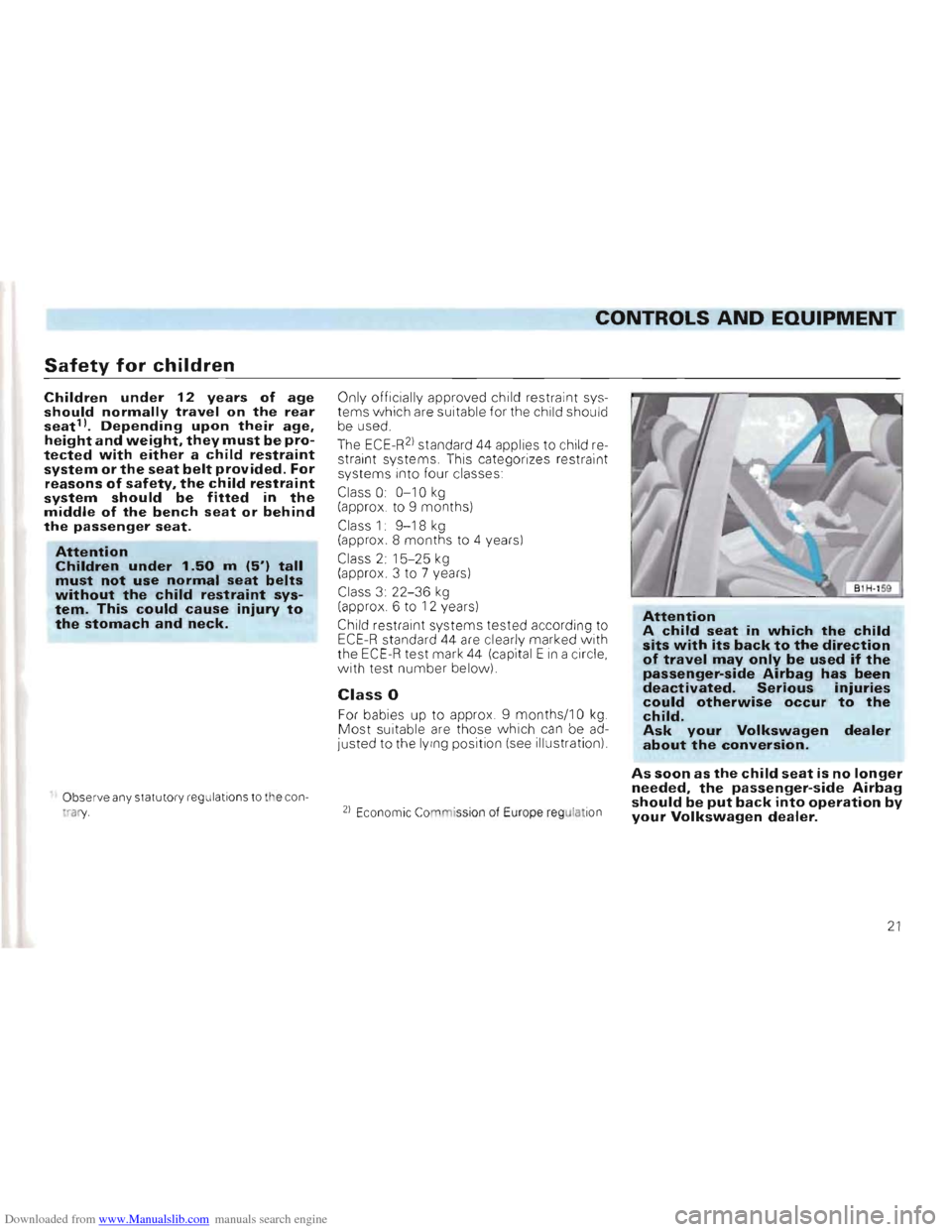
Class 0
For babies up to app rox . 9 months/10 kg Most suitable are those which can be ad
Justed to the lY ing position (see Illustration)
2) Econom ic Co mission of Europe regulat ion
Attention A child seat in which the child sits with its back to the direction of travel may only be used if the passenger-side Airbag has been deactivated. Serious injuries could otherwise occur to the child. Ask your Volkswagen dealer about the conversion.
As soon as the child seat is no longer needed, the passenger-side Airbag should be put back into operation by your Volkswagen dealer.
21